Imagine the moment you realize your child has been moved to Eilat or is being retained there without your consent, leaving you to face a complex foreign legal system from thousands of miles away. This discovery often brings a paralyzing sense of urgency and a deep fear of losing contact. It’s natural to feel overwhelmed by the specific jurisdiction of the Southern District courts and the technical hurdles of the Israeli legal process. Identifying a strategic Hague Convention lawyer Eilat is a critical step in connecting international expectations with local court realities.
This guide offers the clarity needed to navigate these high-stakes cases with a focus on informed decision-making rather than emotional reaction. We’ll examine the ‘Habitual Residence’ test, the strict procedural timelines mandated by Israeli law, and the essential steps to take within the first 48 hours. By understanding the strategic landscape, families can better manage the risks of cross-border disputes and work toward a stable resolution for their children. This information serves as an educational resource to help you move forward with confidence.
Key Takeaways
- Understand why Israeli law mandates a rapid six-week resolution for initial Hague proceedings to ensure a child’s prompt return to their home country.
- Learn how the “Habitual Residence” test determines a child’s true center of life, often overriding parental intent in the eyes of the court.
- Identify the specific jurisdictional challenges of the Southern District, where Eilat cases are typically adjudicated in the Be’er Sheva Family Court.
- Discover how a Hague Convention lawyer Eilat bridges the gap between US legal expectations and the practical realities of the Israeli judicial system.
- Gain a strategic roadmap for the critical first 48 hours to avoid long-term litigation through informed, early decision-making.
What is the Hague Convention and How Does it Apply in Eilat?
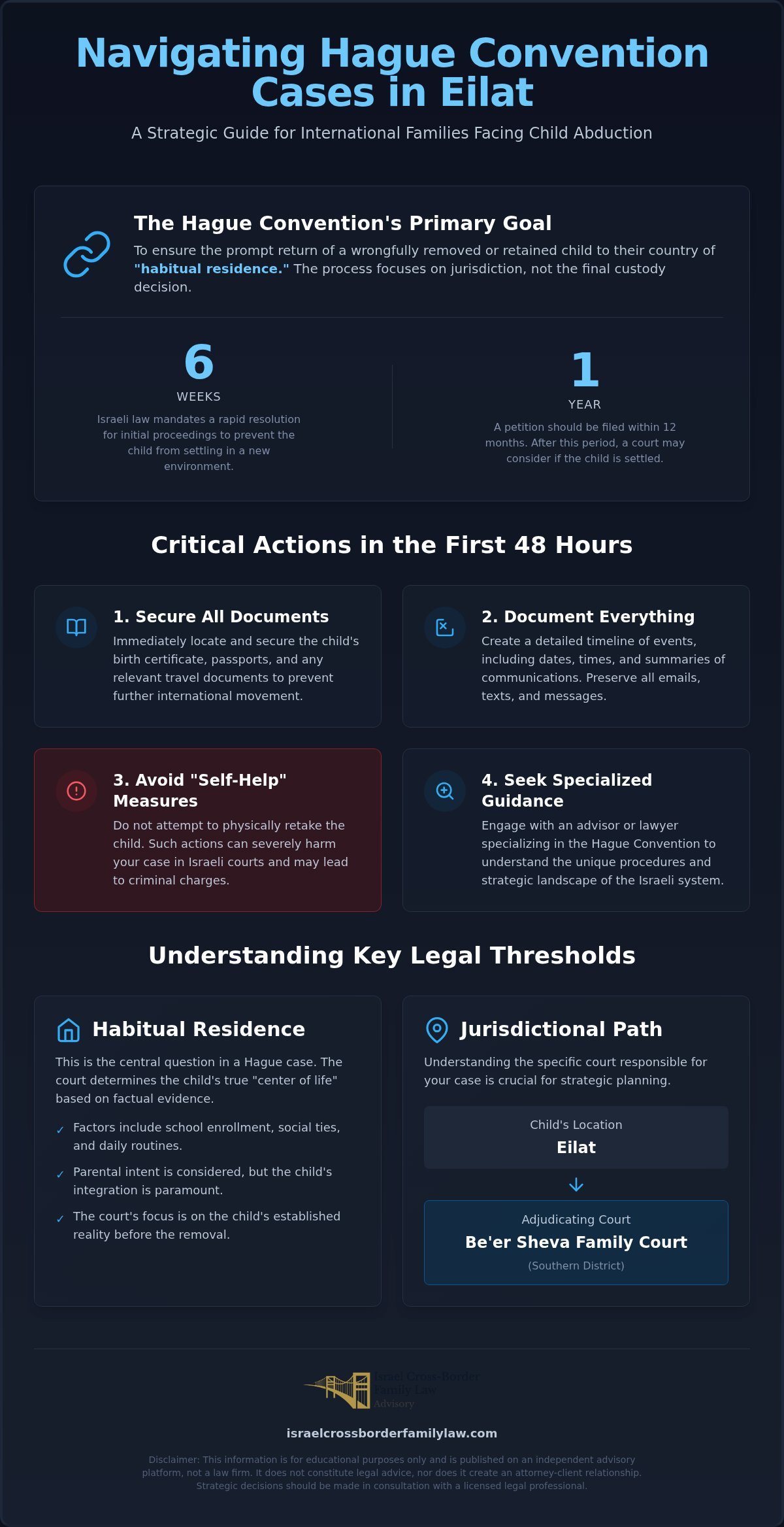
The Hague Convention on the Civil Aspects of International Child Abduction is a multilateral treaty designed to protect children from the harmful effects of abduction and retention across international borders. Its primary goal is to ensure the prompt return of children to their country of "habitual residence." In the context of the Southern District, this means that if a child is brought to Eilat without the consent of a parent with custody rights, the convention provides a legal framework to restore the status quo. Crucially, the Hague Convention functions as a jurisdictional mechanism to determine where a custody case should be heard, rather than serving as a forum for the custody battle itself.
One of the most significant aspects of the Israeli implementation of this treaty is the emphasis on speed. Israeli family courts are mandated to complete proceedings within six weeks from the filing date. This rapid resolution is intended to prevent the taking parent from establishing a new "center of life" for the child in Israel, which could complicate the return process. For those seeking a Hague Convention lawyer Eilat, understanding this condensed timeline is vital for strategic planning and managing expectations.
To better understand how this international treaty functions in practice, watch this helpful video:
The Role of the Israeli Central Authority
The Department of International Affairs within the Ministry of Justice serves as Israel’s Central Authority. They coordinate with foreign governments and can work with the Eilat police to locate children and facilitate the return process. While the police may assist in locating a child, they generally don’t intervene in the civil aspects of the case without a specific court order. Engaging in "self-help" measures, such as attempting to physically retake a child, can severely jeopardize your standing in court and may lead to criminal complications. A strategic Hague Convention lawyer Eilat will focus on navigating these bureaucratic channels efficiently.
Immediate Steps for Parents in Eilat
If you believe your child has been wrongfully taken to or kept in Eilat, timing is your most valuable asset. You should immediately secure all relevant travel documents and birth certificates to prevent further relocation. It’s essential to file a petition within the first year of the alleged abduction; if more than 12 months pass, the court may consider whether the child has become settled in their new environment. For a deeper look at the procedural requirements, see our guide on hague convention child abduction. Early strategic decisions often determine the trajectory of the entire case.
Key Legal Thresholds: Habitual Residence and Grave Risk
Successful resolution of an abduction case hinges on meeting specific legal thresholds defined in the Hague Convention on the Civil Aspects of International Child Abduction. Unlike standard custody disputes, these proceedings don’t examine the "best interests of the child" in a general sense. This distinction is often confusing for parents who expect to argue about which parent provides a better home or school. In Hague cases, the court focuses strictly on whether the removal was "wrongful" based on the child’s habitual residence. A parent might unintentionally fall into the "acquiescence trap" by sending text messages or emails that suggest temporary consent to a move, which the other parent then presents as permanent permission in court. Strategic guidance from a Hague Convention lawyer Eilat can help you identify these communication risks early on.Defining Habitual Residence in Cross-Border Families
Israeli courts define a child’s habitual residence by identifying their "center of life." This isn’t determined by parental intent alone but by the child’s actual integration into a community. When a family has dual US-Israel citizenship, this test becomes complex. The court looks for concrete evidence of social and physical ties, such as:
Enrollment in local Eilat schools or ganim (kindergartens).
Consistent healthcare records with Israeli HMOs (Kupat Cholim).
Participation in extracurricular activities or local social circles.
The presence of extended family and the child’s language proficiency.
Temporary stays for vacations or family visits don’t typically shift habitual residence. However, the longer a child remains in Eilat, the higher the risk that the court will view Israel as their new home. Understanding how to evaluate your case strategy before these ties become permanent is a critical first step.Navigating the Grave Risk Defense
The most common defense against a return order is Article 13(b), which claims that returning the child would expose them to a "grave risk" of physical or psychological harm. Israeli case law interprets this defense narrowly, requiring evidence of a severe threat rather than general discomfort. The court often considers "undertakings," which are protective measures or financial guarantees the petitioning parent must provide to ensure the child’s safety upon return. Eilat’s unique geographical position near international borders sometimes prompts security-related arguments, though these are rarely successful without documented, specific threats to the individual child. A Hague Convention lawyer Eilat assists in analyzing whether these defenses are likely to hold up against the treaty’s mandate for a prompt return.Get clarity before you commit. Request a confidential consultation.
Strategic Considerations for Hague Cases in the Southern District
When a child is located in Eilat, the legal proceedings don’t typically take place within the city itself. Instead, the Be’er Sheva Family Court holds exclusive jurisdiction over Hague Convention cases for the entire Southern District. This geographical reality creates immediate logistical challenges for a parent based in the US or Europe. Managing a case from abroad requires a deep understanding of how the Southern District operates, as the distance between Eilat and the court can impact everything from witness testimony to the speed of process serving. A Hague Convention lawyer Eilat must account for these distances when building a timeline for the return petition.The "Eilat Factor" also introduces unique hurdles regarding enforcement. Eilat’s status as a remote, tax-free zone near the borders of Jordan and Egypt means that if a parent attempts to further relocate the child, the window for intervention is narrow. The procedural framework is governed by Israeli law via the Hague Convention (Return of Abducted Children) Law, which centralizes authority but relies on regional court efficiency for enforcement. These cases often intersect with broader issues of international custody relocation, making a cohesive strategy essential from the first day of the abduction.Litigating in the Southern District Courts
The judiciary in the Southern District often maintains a different cultural pace than the courts in Tel Aviv or Jerusalem. A critical component of these cases is the role of the Pekidat Saad, or court-appointed social worker. In Eilat-based cases, these professionals are tasked with evaluating the child’s current environment and any potential risks. Their reports carry significant weight in the judge’s decision. While the mandated goal for 2026 remains a six-week resolution for the initial ruling, logistical complexities in the south can sometimes stretch this period. Early coordination is necessary to ensure that social worker interviews and home visits proceed without delay.The Importance of Local Presence and Global Strategy
Success in a cross-border case requires an advisor who acts as a bridge between US legal expectations and the practicalities of the Israeli system. This includes the ability to coordinate with local investigators in Eilat if a child’s exact location is being concealed. It’s also vital to guard against "forum shopping," where a taking parent might try to initiate a separate custody case in a local court to bypass the Hague process. A strategic Hague Convention lawyer Eilat will ensure that the Hague petition remains the primary focus, preventing the case from being diverted into a long-term custody battle in an improper jurisdiction.Get clarity before you commit. Request a confidential consultation.
How to Evaluate a Hague Convention Lawyer for Your Eilat Case
Selecting a Hague Convention lawyer Eilat is a strategic decision that requires more than a local referral. Because these cases are governed by international treaties, you need a professional who understands the technical nuances of Article 15 and Article 16 of the Convention. These specific provisions deal with the determination of "wrongful" removal and the court’s obligation to refrain from deciding custody merits until the return issue is resolved. A lawyer who lacks experience with these articles may allow the case to drift into a standard custody battle, which can cause delays that jeopardize a child’s prompt return.For international families, the "Anglo advantage" is a critical component of a successful strategy. This isn’t merely about speaking English; it’s about the ability to interpret foreign legal expectations and translate them into the context of the Israeli family court system. When your advisor can review US or UK court orders in their original language and explain the strategic risks of the Israeli Southern District in plain English, it reduces the risk of costly misunderstandings. This level of communication ensures you remain in control of the decision-making process during a high-stress period.Transparency regarding pricing is also a hallmark of professional expertise. High-stakes cross-border litigation involves complex logistics, and you should have a clear understanding of the financial commitment required before the case begins. A steady guide will provide a structured view of costs, helping you weigh the financial risks against the urgency of the situation.Questions to Ask During a Consultation
How many Hague cases have you specifically litigated in the Be’er Sheva Family Court?
Do you have a process for coordinating with the US State Department’s Office of Children’s Issues or other relevant foreign authorities?
How do you manage the internal workflow to ensure all filings meet the expedited six-week timeline mandated by Israeli law?
Red Flags to Avoid
Be cautious of any professional who offers a "guarantee" of a specific outcome or child return. The Israeli court system is independent, and no advisor can promise a victory. Other red flags include a lack of familiarity with the complexities of dual US-Israel citizenship or any suggestion of "self-help" measures. Attempting to remove a child from Eilat without a court order is illegal and can lead to immediate criminal consequences, effectively destroying your legal standing in the Hague proceedings.Request a strategic case evaluation
Get clarity before you commit. Request a confidential consultation.
Strategic Guidance: The Cross-Border Advisory Approach
The discovery that a child has been wrongfully removed to or retained in Eilat often triggers a state of panic. While this emotional response is understandable, the success of a return petition depends on your ability to move quickly from a state of alarm to a state of strategy. Decisions made in the first 48 hours are the most critical. These initial hours determine whether you secure the necessary evidence of habitual residence or inadvertently fall into the "acquiescence trap" discussed earlier. Engaging with an independent advisory platform allows you to assess your situation with professional detachment before you commit to a specific course of action.Our approach focuses on providing clarity before commitment. By evaluating the multi-jurisdictional complexity of your case, we help you understand how it works when US legal expectations meet the reality of the Israeli family court. This strategic roadmap is designed to bypass legal jargon, offering you a clear view of the procedural hurdles and timelines involved in the Southern District. Identifying the right Hague Convention lawyer Eilat is a major part of this process, but the strategy behind that choice is what ultimately drives the outcome.The Bridge Between Legal Systems
International families often find the Israeli legal system opaque and frustratingly different from what they know in the US or UK. We serve as a bridge, translating complex Israeli procedures into plain English so you can make informed decisions. This involves managing both the financial risks of high-stakes litigation and the emotional strain of a cross-border dispute. Prioritizing informed choice over reactive litigation is the single most effective way to protect your long-term parental rights and the child’s well-being. By understanding the "why" behind every court filing, you maintain control over the direction of your case.Next Steps: Requesting a Confidential Review
Preparing for an initial advisory call is a vital step in regaining your footing. To make the most of this time, you should have specific information ready for review. This typically includes the child’s current and previous passports, any existing custody orders from your home country, and a detailed timeline of the child’s travel history and residence over the last 24 months. Having these documents organized allows for a more accurate assessment of the "center of life" test. If you are ready to move from uncertainty to a structured plan, the next step is to request a confidential review of your circumstances. This initial contact is the foundation for finding a Hague Convention lawyer Eilat who can execute a precise, strategic return petition.Request a confidential case review.](https://t.mtrbio.com/israelcrossborderfamilylaw)
Get clarity before you commit. Request a confidential consultation.
Securing a Strategic Path Forward for Your Family
Navigating an international child abduction case in the Southern District requires a swift transition from crisis management to long-term strategic planning. You’ve seen that the Israeli family court system prioritizes speed, with a mandate to resolve initial proceedings within six weeks. Success in these high-stakes matters depends on a nuanced application of the "habitual residence" test and a clear understanding of the Be’er Sheva court’s jurisdictional landscape. Selecting a Hague Convention lawyer Eilat who bridges the gap between US legal expectations and Israeli reality is the most critical step in maintaining your parental rights.
We offer authoritative guidance for international families facing the stress of multi-jurisdictional complexity. Our specific focus on Southern District cases ensures that your strategy accounts for the logistical and cultural realities of Eilat. By prioritizing informed choice over reactive litigation, you can manage the emotional and financial risks of this process effectively. Your family’s future depends on the decisions you make today.
Request a strategic case review
Get clarity before you commit. Request a confidential consultation.
Frequently Asked Questions
What is the first thing I should do if my child is taken to Eilat without my consent?
You should immediately contact the Israeli Central Authority and secure your child’s travel documents to prevent further relocation from the Southern District. It’s vital to gather evidence of the child’s habitual residence, such as school records or medical files, before the situation escalates. Avoid "self-help" measures like attempting a physical recovery, as these actions can damage your standing in court. A Hague Convention lawyer Eilat can help you map out a strategic response within the first 48 hours.
How long does a Hague Convention case typically take in Israel?
Israeli law mandates that family courts reach a decision within six weeks of the petition being filed. While this expedited timeline is the procedural goal, complex cases in the Southern District may occasionally face delays due to social worker reports or witness scheduling. Appeals to the District Court must be filed within seven days, and that court is required to rule within 30 days. This rapid pace is designed to minimize the child’s disruption during the proceedings.
Can a child’s preference prevent their return under the Hague Convention?
A child’s objection to returning can be a valid defense if the court determines they have reached an age and degree of maturity where their views should be considered. There is no fixed age for this in Israel, though it’s typically applied to children over the age of 10 or 12. The court must ensure the child’s preference is independent and not the result of "parental alienation" or pressure from the taking parent during their stay in Eilat.
Is a Hague Convention lawyer in Eilat different from a standard divorce lawyer?
Yes, a Hague Convention lawyer Eilat focuses on jurisdictional treaty law rather than the "best interests" standards used in standard divorce or custody litigation. While a divorce lawyer handles local asset division and visitation schedules, a Hague specialist manages the multi-jurisdictional complexity of returning a child to their home country. This requires specific knowledge of international treaties and the procedural rules of the Be’er Sheva Family Court, which holds exclusive jurisdiction over Eilat-based abduction cases.
What happens if the parent who took the child claims domestic violence?
If a parent claims domestic violence, the court evaluates the "grave risk" exception under Article 13(b) of the Convention. Israeli judges interpret this defense narrowly, focusing on whether the child would face severe physical or psychological harm upon return. The court may order "undertakings," which are protective measures the petitioning parent must follow in the home country. These measures ensure the child’s safety while the local courts in the home country eventually decide the long-term custody arrangements.
Can I use the Hague Convention if there is no formal custody order in place?
You can still utilize the Hague Convention even if you don’t have a formal court order for custody. The treaty protects "rights of custody" as defined by the laws of the child’s habitual residence. In many jurisdictions, parents have automatic joint custody rights by law. If you were exercising those rights at the time of the removal, the court can recognize the abduction as wrongful, regardless of whether you had a specific piece of paper from a judge at that time.
Who pays the legal fees in an international child abduction case?
Generally, each party is responsible for their own initial legal costs, but the court has the authority to order the taking parent to reimburse the petitioner’s expenses if a return is ordered. This can include travel costs, legal fees, and the expenses incurred in locating the child. It’s important to understand that there are no court filing fees for Hague petitions in Israel, and the court cannot require a bond or guarantee from the parent seeking the return.
Does the Hague Convention apply if the child has dual US-Israel citizenship?
Yes, the Hague Convention applies regardless of the child’s citizenship status. The legal test is based entirely on the child’s "habitual residence" before the removal, not which passport they hold. Even if a child is an Israeli citizen, the court will order their return if their center of life was in the United States. Citizenship doesn’t grant a parent the right to unilaterally relocate a child to Israel without the other parent’s informed consent.
Get clarity before you commit. Request a confidential consultation.

Article by
Gabriel Lior
A Personal Journey That Became a Mission
The advisory was founded by an American father Gabriel Lior, LLB, MBA , global entrepreneur, and cross-border advisor who spent more than a decade navigating the Israeli family court system firsthand and now lives in Singapore with his son.
As a divorced parent in a cross-border family, Gabriel faced nearly every legal challenge a foreign parent can encounter in Israel — including child custody disputes, child support proceedings, property matters in Israel and abroad, false accusations, and complex immigration and relocation proceedings.
Over the years, he learned the hard way how difficult it is for non-Israeli parents to understand the system, identify the right legal strategy, and choose the right legal representation — especially when language, culture, and jurisdictional differences are involved. He also witnessed how foreign parents and new immigrants are often disadvantaged or taken advantage of by service providers and institutions simply because they lack local knowledge or fluency.
From Client to Advisor
To truly understand — and survive — the system, Gabriel pursued formal legal education in Israel, completing two Israeli law degrees, alongside a BA and MBA earned in the United States. This was never about becoming a practicing attorney, but about gaining a deep, structural understanding of how the system works — and where it breaks down for foreign parents.
This rare combination of:
Firsthand client experience
Israeli legal and US business education
International business and negotiation training
Decades of commercial execution
created a unique perspective – one that understands both sides of the table.
After years of litigation, persistence, and at times self-representation, he ultimately succeeded in securing custody of his son and relocating abroad through a rare legal victory in the Israeli Supreme Court — becoming one of the first fathers in Israel to do so under these circumstances.
Disclaimer
Important Disclaimer:
The information provided on this website and in its content is for general informational and educational purposes only and does not constitute legal advice, legal opinion, or legal representation.
Gabriel Lior is not licensed to practice law in Israel (nor is he interested in doing so) and does not provide legal services, despite having completed 2 Law Degrees. The services offered are advisory in nature and are intended to provide general guidance, strategic insight, and information regarding cross-border family law considerations.
No attorney-client relationship is formed by accessing this website, reading its content, or communicating with us.
Any decisions made based on this information are at your own discretion and risk. For legal advice specific to your situation, you should consult a licensed attorney in the relevant jurisdiction.
Where appropriate, we may refer clients to independent, licensed attorneys or professionals. Such referrals do not constitute legal representation and no liability is assumed for services provided by third parties.