This article is published on an independent advisory platform and does not imply an attorney-client relationship. The content is for informational and advisory purposes only. Legal services are provided only by licensed attorneys under a separate engagement.
The most expensive mistake in a cross-border divorce isn’t usually the division of assets itself, but rather the failure to understand which country’s laws will govern the process. If you hold property or retirement funds in both Israel and the US, you’re likely feeling overwhelmed by the conflicting rules and the fear of losing what you’ve built. International Asset Division During Divorce involves a delicate balance of two legal systems that often view marital property through very different lenses.
This article provides a strategic, advisory-led approach to help you navigate these complexities between Israel and the US. You’ll gain clarity on which laws apply to your specific holdings, learn how to ensure a fair division, and understand why the “race to court” can drastically alter your financial outcome. By identifying risks early, you can protect your global interests and move forward with confidence.
Key Takeaways
- Understand why the timing and location of your initial filing can significantly alter the legal framework applied to your global holdings.
- Identify the risks associated with non-disclosure and learn the strategic importance of accurate cross-border property valuation.
- Navigate the complexities of the US-Israel Tax Treaty to avoid unexpected capital gains liabilities when transferring or selling international assets.
- Explore how to strengthen your financial protections by adding an “Israeli addendum” to your existing US prenuptial agreements.
- Gain a strategic, advisory-led perspective on International Asset Division During Divorce to ensure a fair distribution across different legal systems.
This article is published on an independent advisory platform and does not imply an attorney-client relationship. The content is for informational and advisory purposes only. Legal services are provided only by licensed attorneys under a separate engagement.
Understanding International Asset Division in Cross-Border Divorces
International asset division is the procedural framework used to identify, value, and distribute property that is physically or legally situated in different countries. For families with ties to both Israel and the US, this is not a simple accounting exercise. It involves a sophisticated interplay between international matrimonial law and the domestic statutes of two different nations. When you are managing International Asset Division During Divorce, you must view the marital estate as a single global entity rather than a collection of isolated local assets.
The intersection of Israeli civil law, religious law, and US state statutes makes these cases particularly unique. Unlike a standard domestic divorce, a cross-border case requires you to consider how a decision made in one country will be viewed by the courts in the other. This complexity often leads to confusion regarding which assets are “marital” and which remain separate. Seeking clarity before you make any formal commitments is the most effective way to protect your long-term financial interests and ensure a transparent process.
The Spousal Property Relations Law in Israel (IL)
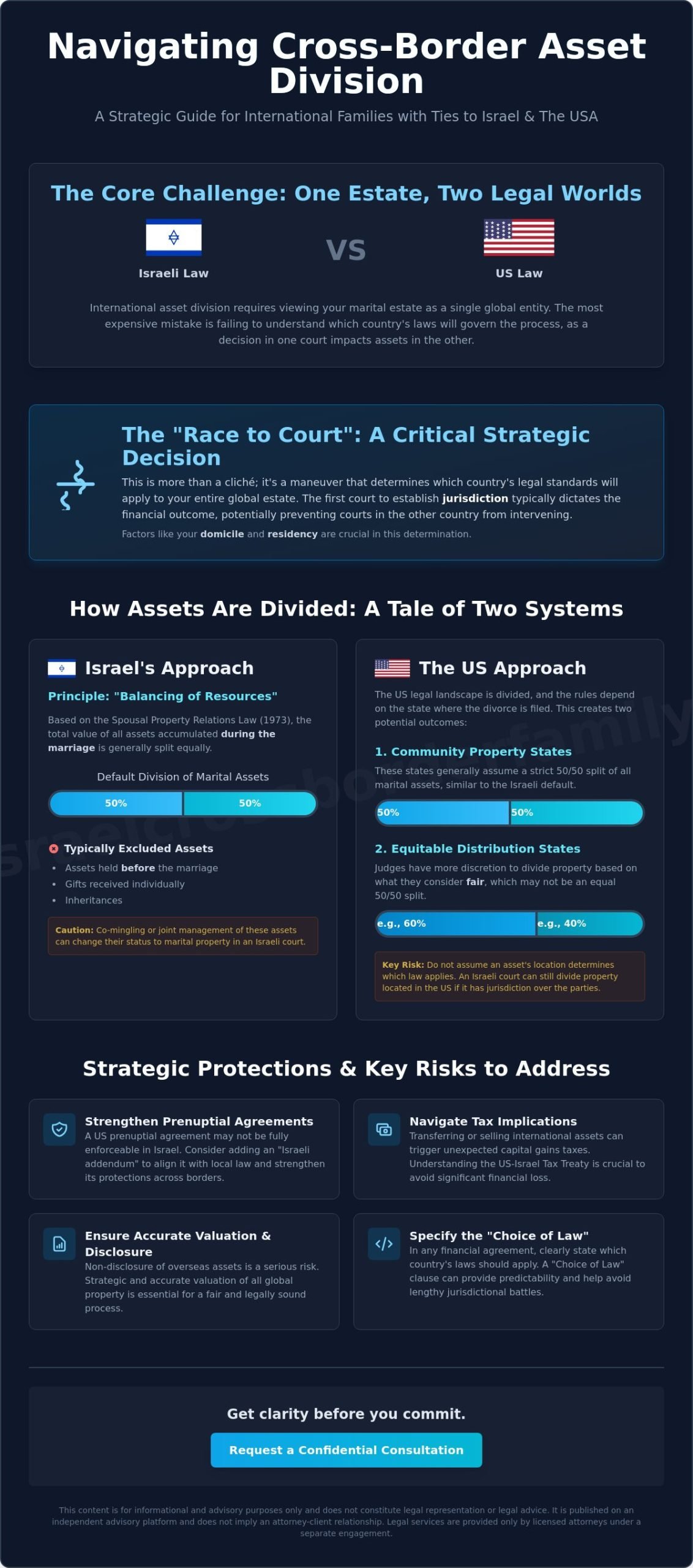
In Israel, the default framework for dividing assets is the Spousal Property Relations Law of 1973. This law operates on the “balancing of resources” principle, which generally dictates that the value of all assets accumulated during the marriage should be split equally between the spouses upon divorce. However, assets held prior to the marriage, or those received as gifts or inheritances, are typically excluded from this balance. It’s important to understand that how you manage or co-mingle these separate assets during the marriage can change their legal status in the eyes of an Israeli court.
US State Law vs. Israeli Law
The US legal landscape is divided between “Community Property” states and “Equitable Distribution” states. In a community property state, the law generally assumes a strict 50/50 split of all marital assets. In contrast, equitable distribution states allow judges more discretion to divide property based on what they consider fair, which may not result in an equal share. A common risk in International Asset Division During Divorce is the assumption that the location of an asset determines the law that applies. In reality, an Israeli court may still attempt to divide property located in the US if it has established jurisdiction over the parties. This highlights the importance of “Choice of Law” clauses in any existing financial agreements.
This article is published on an independent advisory platform and does not imply an attorney-client relationship. The content is for informational and advisory purposes only. Legal services are provided only by licensed attorneys under a separate engagement.
Jurisdiction and the “Race to Court” Between Israel and the US
The “Race to Court” is more than a legal cliché; it’s a strategic maneuver that determines which country’s standards will apply to your life. In International Asset Division During Divorce, the court that first establishes jurisdiction typically dictates the final financial outcome. This is particularly critical when moving between IL and the US, as the first court to be properly “seized” of the case often prevents the other from intervening. If one spouse files in a US state court and the other in Israel, the resulting conflict can lead to years of procedural battles before any assets are actually divided.
Domicile and residency play a major role in this determination. A US court may apply the doctrine of Forum Non Conveniens if it believes an Israeli court is a more appropriate venue for the dispute. This often happens when the majority of family life and assets are located in Israel, despite one spouse having US citizenship. You can request a confidential review to understand how your specific residency status might influence where your case is heard.
Rabbinical Courts vs. Family Courts in Israel
Israel’s dual-court system adds a layer of complexity not found in the US. Both civil Family Courts and religious Rabbinical Courts have concurrent jurisdiction. A spouse can “bundle” property claims with a divorce suit in the Rabbinical Court, effectively bypassing the civil court’s “balancing of resources” mentioned previously. This move can significantly change the outcome for dual citizens and expats, as religious courts may apply different standards to assets like business interests or future earnings. It’s a risk that many unfamiliar with the Israeli system don’t anticipate until it’s too late.
Enjoining Foreign Proceedings
When cases are active in both countries simultaneously, courts may issue anti-suit injunctions to stop a party from continuing litigation elsewhere. These orders are intended to protect the court’s jurisdiction and prevent conflicting judgments. However, enforcing an American injunction in IL is notoriously difficult and requires a deep understanding of international treaties. This jurisdictional clash often leads to a “clash of courts” that drains marital resources without providing a clear resolution. Gaining clarity on these risks before you commit to a specific forum is essential for protecting your global holdings.
This article is published on an independent advisory platform and does not imply an attorney-client relationship. The content is for informational and advisory purposes only. Legal services are provided only by licensed attorneys under a separate engagement.
Valuing and Disclosing Overseas Property and Financial Interests
Transparency is the cornerstone of any fair settlement. In the context of International Asset Division During Divorce, the requirement for full disclosure is absolute in both Israel (IL) and the United States. Attempting to shield or hide assets in one country while litigating in another is a high-risk move that can lead to severe sanctions. Courts may award a larger share of the known estate to the other spouse if they find evidence of bad faith. Forensic accountants play a vital role here. They possess the specialized tools needed to trace funds through international banking systems and identify wealth that might otherwise go unnoticed.
The global asset pool comprises all tangible and intangible holdings owned by either spouse, including real estate, financial accounts, intellectual property, and future interests. Valuing these holdings requires a nuanced understanding of local markets. For instance, an apartment in Tel Aviv’s “Old North” is valued using different metrics than a condominium in Manhattan. You’ll need local appraisers who understand the specific regulatory and tax environments of each city to ensure the numbers on your balance sheet reflect reality. Relying on outdated purchase prices or informal estimates often leads to unfair outcomes during the final distribution.
Cross-Border Retirement and Pension Funds
Retirement accounts are often the largest assets in a marital estate, yet they’re also the most difficult to divide across borders. If you’re living in IL but hold a US-based 401(k) or IRA, you can’t simply use a standard Qualified Domestic Relations Order (QDRO) to split the account. US plan administrators don’t recognize Israeli court orders without specific domestication. Conversely, US courts often struggle to categorize Israeli instruments like Bituach Menahalim or Keren Hishtalmut. These funds have unique tax-free growth structures that don’t always align with US tax categories. This misalignment makes their valuation a point of frequent dispute.
Business Interests and Tech Equity
For tech founders and executives, the complexity of International Asset Division During Divorce reaches its peak when dealing with equity. If you live in Israel but your entity is registered in Delaware, you’re facing a collision of corporate governance and family law. Valuing Restricted Stock Units (RSUs) or unvested stock options requires looking at “active contributions” made during the marriage. If the company’s growth was driven by work performed while living in IL, the Israeli court may claim a share of that value regardless of where the company is headquartered. You must also account for SEC compliance and lock-up periods. These rules can restrict your ability to transfer or sell shares to satisfy a settlement agreement.
This article is published on an independent advisory platform and does not imply an attorney-client relationship. The content is for informational and advisory purposes only. Legal services are provided only by licensed attorneys under a separate engagement.
Tax Implications and Enforcement of Foreign Judgments
A division of property that appears equitable in a courtroom may become financially lopsided once cross-border tax obligations are settled. The US-Israel Tax Treaty provides a framework to prevent double taxation, but it doesn’t automatically shield you from the immediate costs of liquidating assets. For example, selling a property in Tel Aviv to satisfy a US divorce decree can trigger significant capital gains taxes in Israel (IL) that a US judge might not have factored into the final order. Without a strategy that accounts for these liabilities, you might find yourself with significantly less net wealth than anticipated.
Enforcement adds another layer of complexity to International Asset Division During Divorce. It’s a common misconception that a US divorce judgment is automatically valid in Israel. Because the United States is not a party to the 1970 Hague Convention on the Recognition of Divorces and Legal Separations, the recognition of US orders relies on the legal principle of “comity.” This is the voluntary recognition of foreign legal acts by a nation’s courts. To make a foreign order binding, you must go through the process of domesticating the judgment within the target country’s legal system.
Enforcing US Orders in Israel
The Israeli Foreign Judgments Enforcement Law sets strict requirements for recognizing a US decree. Israeli courts will examine whether the US court had proper jurisdiction and if the proceedings met basic standards of due process. There’s also a risk that a court in IL may refuse to enforce specific provisions if they contradict local public policy or religious laws. This is a critical consideration for expats and foreign nationals who may have expected their US settlement to be final. Understanding these barriers before you finalize an agreement can prevent a situation where your assets remain frozen or unreachable.
Tax-Efficient Asset Distribution
Compliance doesn’t end with the final decree. US citizens and residents must remain vigilant about reporting requirements for their Israeli holdings. Under FATCA, single filers living in the US must report foreign financial assets if they exceed $50,000 on the last day of the tax year or $75,000 at any time during the year. For married couples filing jointly in the US, these thresholds rise to $100,000 and $150,000, respectively. Additionally, the FBAR requires reporting for any foreign accounts with an aggregate value exceeding $10,000 at any point in the calendar year. Failing to manage these filings during and after a divorce can lead to severe penalties from the IRS. You should schedule a consultation to discuss your cross-border tax strategy and ensure your settlement is truly sustainable.
This article is published on an independent advisory platform and does not imply an attorney-client relationship. The content is for informational and advisory purposes only. Legal services are provided only by licensed attorneys under a separate engagement.
Strategic Planning: Protecting Assets Before and During Separation
Proactive strategy is the most effective way to manage the risks associated with International Asset Division During Divorce. Many families rely on standard documents that don’t account for the unique interplay between Israeli and US law. Without a strategy that bridges both systems, you may find that decisions made years ago in one country are unenforceable in the other. Proactive financial agreements serve as a roadmap, providing a clear structure for asset distribution and significantly reducing the likelihood of a contested “race to court.”
The first actions you take during a separation often set the trajectory for your long-term financial security. Choosing a cross-border advisory approach over traditional, aggressive litigation allows for a more measured assessment of global risks. This method prioritizes clarity and strategic negotiation, ensuring that both parties understand the tax and jurisdictional consequences of their choices. By focusing on a collaborative resolution, international families can often avoid the high costs of dual-track litigation, which 2026 data indicates can range from $18,000 to $25,000 per person in major metropolitan areas even before international complexities are added.
Prenuptial and Postnuptial Agreements
A common vulnerability for expats is assuming a standard US prenuptial agreement will be automatically recognized in Israel (IL). In Israel, the Spousal Property Relations Law requires that such agreements be validated by a judge or a marriage registrar to be fully enforceable. This often necessitates an “Israeli addendum” to existing US documents. These addendums ensure the agreement meets the specific procedural standards of the Israeli Family Court. Additionally, agreements should explicitly address the possibility of future relocation, as a change in “habitual residence” can shift the legal framework governing your assets.
Seeking Global Clarity
Navigating two divergent legal systems requires a specialized perspective that looks beyond local borders. Our advisory model is designed to help you build this bridge, providing the transparency needed to make informed choices. You can learn more about how it works and view our transparent pricing to see how we support international families through these transitions. Taking the time to seek clarity before you commit to a legal path is the best way to protect your global estate. If you’re ready to explore your options, you can request a confidential case review to discuss your specific situation.
Get clarity before you commit. Request a confidential consultation.
This article is published on an independent advisory platform and does not imply an attorney-client relationship. The content is for informational and advisory purposes only. Legal services are provided only by licensed attorneys under a separate engagement.
Securing Your Global Financial Future
Managing a global estate requires a strategy that respects the distinct legal landscapes of both Israel and the United States. You’ve seen how early decisions regarding jurisdiction can fundamentally shift the financial outcome of your case. Whether you’re valuing complex tech equity or domesticating a foreign order, the intersection of these two systems demands a precise, advisory-led approach. International Asset Division During Divorce is not just about local rules; it’s about understanding how those rules interact across borders to impact your total net wealth after taxes and enforcement costs.
Our practitioners are licensed in both Israel and the US, bringing established expertise to US-Israel cross-border family law. We specialize in multi-jurisdictional asset tracing to ensure your global holdings are accurately identified and protected through every stage of the process. By prioritizing strategic planning over aggressive conflict, you can manage these complexities with confidence and reach a resolution that provides genuine long-term security. Get clarity before you commit. Request a confidential consultation.
This article is published on an independent advisory platform and does not imply an attorney-client relationship. The content is for informational and advisory purposes only. Legal services are provided only by licensed attorneys under a separate engagement.
Frequently Asked Questions
Can an Israeli court divide property I own in the United States?
An Israeli court can indeed include the value of your US-based property in its final judgment if it has proper jurisdiction over you and your spouse. While the court doesn’t physically seize a house in New York, it can adjust the distribution of assets in IL to compensate for the value of the overseas property. This process ensures the total marital estate is balanced according to local civil law.
What happens if my spouse hides assets in a foreign bank account?
Full disclosure of all global holdings is a mandatory requirement in both jurisdictions. If a spouse attempts to hide assets in a foreign account, specialized forensic accountants are often employed to trace these funds through international banking networks. Courts in IL take non-disclosure very seriously and may award the transparent spouse a larger portion of the remaining known assets as a penalty for acting in bad faith.
Is my US prenuptial agreement valid in Israel?
A standard US prenuptial agreement isn’t automatically enforceable in Israel without following specific local procedures. To be valid in IL, the agreement must be approved and validated by a judge or a marriage registrar. Many international families choose to add an “Israeli addendum” to their existing documents. This ensures the agreement satisfies the procedural requirements of the Spousal Property Relations Law and protects your interests.
How does the “Race to Court” affect my financial settlement?
The “Race to Court” determines which nation’s legal framework will govern your International Asset Division During Divorce. Because Israeli and US laws differ on issues like equitable distribution and religious jurisdiction, the first person to file often secures a significant strategic advantage. Filing first in one country can effectively block the other court from making contradictory decisions regarding your global financial interests and future security.
Will I have to pay taxes in both countries when we divide our assets?
The US-Israel Tax Treaty is designed to prevent double taxation, but you may still face significant tax liabilities during the division process. Liquidating an Israeli apartment or a US-based 401(k) can trigger capital gains taxes or early withdrawal penalties. You must also remain compliant with US reporting rules like FBAR and FATCA, which carry heavy fines for non-disclosure of foreign accounts exceeding specific monetary thresholds.
How is the value of a business in Israel determined for a US divorce?
Valuing an Israeli business for a US divorce involves analyzing the “active contributions” made by either spouse during the marriage. Experts look at the growth of the company and determine what portion is considered marital property versus separate property. This is especially complex for tech founders where equity and RSUs are involved. Valuation must account for both market conditions in IL and US corporate governance standards.
Can I enforce a US child support order alongside an asset division in Israel?
You can enforce a US child support order in Israel, but it requires a formal process of domestication through the Israeli court system. The court will review the order to ensure it doesn’t conflict with local public policy or specific religious laws. Once domesticated, the order has the same legal standing as an Israeli judgment. This allows for the combined enforcement of support and property division across borders.
What is the role of a cross-border legal advisor in asset division?
A cross-border legal advisor acts as a strategic bridge between two divergent legal systems. Their role is to identify jurisdictional risks and ensure that any settlement reached is enforceable in both Israel and the US. By focusing on International Asset Division During Divorce from a global perspective, they help you avoid the common pitfalls of dual-track litigation and ensure your long-term financial security is protected from start to finish.

Article by
Gabriel Lior
A Personal Journey That Became a Mission
The advisory was founded by an American father Gabriel Lior, LLB, MBA , global entrepreneur, and cross-border advisor who spent more than a decade navigating the Israeli family court system firsthand and now lives in Singapore with his son.
As a divorced parent in a cross-border family, Gabriel faced nearly every legal challenge a foreign parent can encounter in Israel — including child custody disputes, child support proceedings, property matters in Israel and abroad, false accusations, and complex immigration and relocation proceedings.
Over the years, he learned the hard way how difficult it is for non-Israeli parents to understand the system, identify the right legal strategy, and choose the right legal representation — especially when language, culture, and jurisdictional differences are involved. He also witnessed how foreign parents and new immigrants are often disadvantaged or taken advantage of by service providers and institutions simply because they lack local knowledge or fluency.
From Client to Advisor
To truly understand — and survive — the system, Gabriel pursued formal legal education in Israel, completing two Israeli law degrees, alongside a BA and MBA earned in the United States. This was never about becoming a practicing attorney, but about gaining a deep, structural understanding of how the system works — and where it breaks down for foreign parents.
This rare combination of:
Firsthand client experience
Israeli legal and US business education
International business and negotiation training
Decades of commercial execution
created a unique perspective – one that understands both sides of the table.
After years of litigation, persistence, and at times self-representation, he ultimately succeeded in securing custody of his son and relocating abroad through a rare legal victory in the Israeli Supreme Court — becoming one of the first fathers in Israel to do so under these circumstances.
Disclaimer
Important Disclaimer:
The information provided on this website and in its content is for general informational and educational purposes only and does not constitute legal advice, legal opinion, or legal representation.
Gabriel Lior is not licensed to practice law in Israel (nor is he interested in doing so) and does not provide legal services, despite having completed 2 Law Degrees. The services offered are advisory in nature and are intended to provide general guidance, strategic insight, and information regarding cross-border family law considerations.
No attorney-client relationship is formed by accessing this website, reading its content, or communicating with us.
Any decisions made based on this information are at your own discretion and risk. For legal advice specific to your situation, you should consult a licensed attorney in the relevant jurisdiction.
Where appropriate, we may refer clients to independent, licensed attorneys or professionals. Such referrals do not constitute legal representation and no liability is assumed for services provided by third parties.