The most recognizable name in a legal directory might actually be the wrong choice for your sensitive cross-border family matter. Many expats and international families feel a justified sense of anxiety when they encounter the Israeli legal system, especially with the 2026 expansion of rabbinical court powers and new tax reporting mandates for Olim. You likely recognize that a US court order isn’t automatically valid here; it requires a formal process under the Foreign Judgments Enforcement Law. This article explores the service profile of the Decker Pex levi law firm to help you determine if a large, multi-practice firm or a specialized boutique advisory better serves your specific needs.
You’ll gain a clear understanding of the firm’s strengths and a framework for evaluating counsel based on your jurisdictional risks. We will examine the differences between generalist representation and specialized cross-border strategy so you can move forward with confidence. Please note that this content is published on an independent advisory platform and is not a law firm. It’s intended for informational and strategy purposes only. Legal services are only provided by licensed attorneys under a separate engagement.
Key Takeaways
- Distinguish between multi-practice firms like the Decker Pex levi law firm and specialized boutique advisories to ensure your counsel matches your specific legal needs.
- Learn why administrative immigration services require a different approach than contentious cross-border family litigation involving divorce or child custody.
- Understand the strategic risks of the “race to the court” and how the first decision on jurisdiction can fundamentally alter the outcome of international asset division.
- Gain clarity on the interaction between Israeli Rabbinical Courts and Civil Family Courts to avoid conflicting orders and procedural delays.
- Use a strategic framework to vet potential firms on their actual cross-border experience between the US and Israel before making any formal commitments.
An Overview of Decker Pex Levi Law Offices in Israel
The Decker Pex levi law firm is a prominent multi-practice legal entity in Israel, maintaining a significant physical presence with offices in Jerusalem and Tel Aviv. This firm has built a widespread reputation for handling high-volume administrative matters, particularly in the fields of immigration and citizenship. For expats and international families, understanding the scale of such a firm is the first step in determining if their specific needs align with a large-scale practice or a more focused advisory. The firm’s dual-city presence ensures they are accessible to both the diplomatic community in Jerusalem and the commercial hub of Tel Aviv.
Because the Israeli legal system is uniquely structured, especially regarding family law in Israel, choosing a firm with established roots is often a priority for those unfamiliar with local regulations. The firm serves a diverse international clientele, ranging from individuals seeking Aliyah assistance to those pursuing European passports or navigating US immigration protocols. Their expertise remains highly relevant as regulations continue to shift, such as the March 2026 implementation of the mandatory ETA-IL for visa-exempt travelers from the US, UK, and Australia.
To better understand the firm’s role within the Israeli legal landscape, watch this helpful video:
Core Practice Areas and Rankings
Historical Context and Professional Longevity
Immigration Law vs. Family Law: Identifying Your Specific Needs
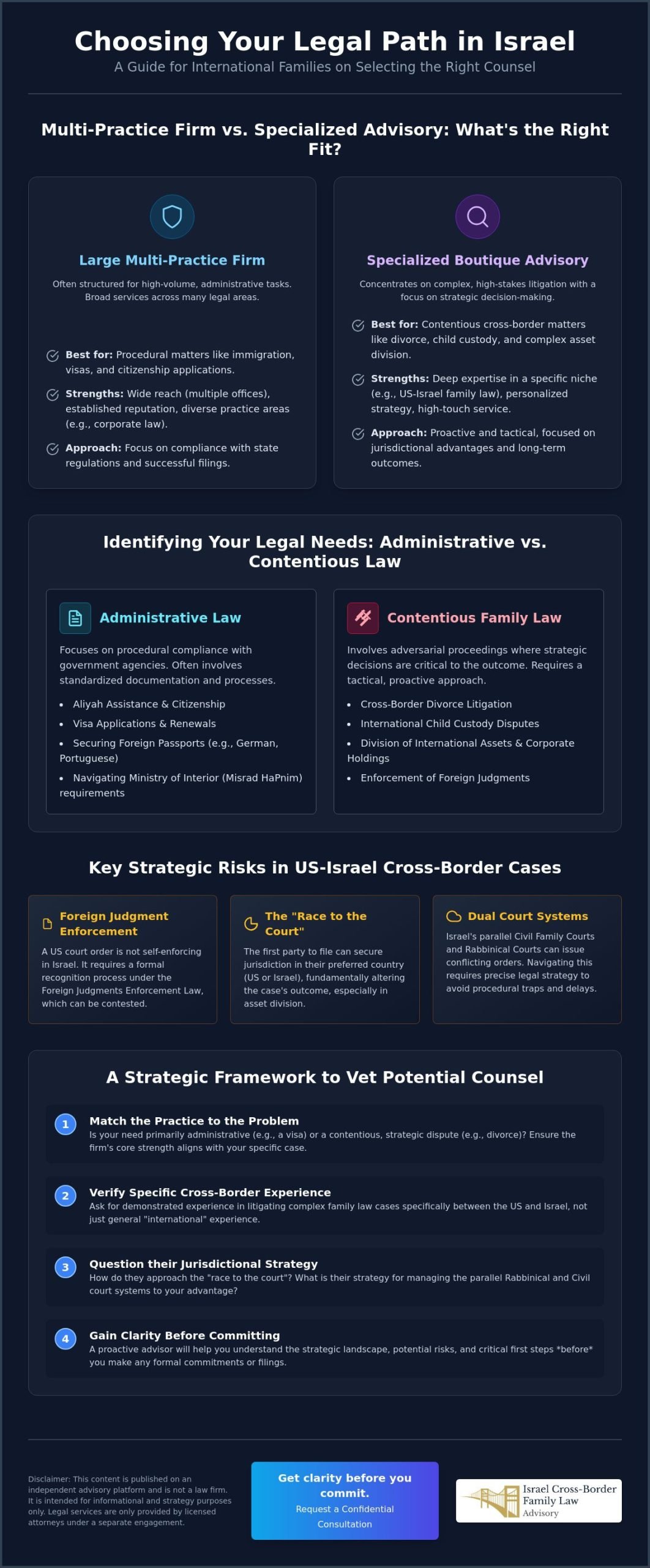
Understanding the distinction between administrative legal services and contentious litigation is vital for anyone managing a life across borders. Large multi-practice entities like the Decker Pex levi law firm are frequently recognized for their proficiency in high-volume immigration and citizenship matters. These services are often procedural, involving the submission of documentation to the Ministry of Interior (Misrad HaPnim) to secure visas, Aliyah rights, or foreign passports. However, family law requires a fundamentally different approach. While immigration law focuses on compliance with state regulations, cross-border family law is strategy-based and involves adversarial proceedings where the outcome depends on tactical decisions made in the earliest stages of a case.
In many cross-border divorces, family assets are inextricably linked to corporate holdings or international business interests. A firm like the Decker Pex levi law firm may offer corporate expertise, but the litigation strategy for dividing those assets in a family court requires a different lens than a standard business transaction. The goal in family law isn’t just a successful filing; it’s protecting long-term personal and financial stability against conflicting legal systems. Identifying the right counsel for expats and foreign nationals who face unique jurisdictional hurdles is a critical first step. It is often helpful to discuss your specific circumstances before initiating any formal legal action.
When to Seek an Immigration Specialist
An immigration specialist is your primary resource when your needs are administrative and follow a set government path. This includes seeking dual citizenship based on ancestral ties, such as German or Austrian applications, or navigating the complexities of the Law of Return. If you’re an employer handling B/1 Foreign Expert visas for US employees, or a family seeking to formalize Aliyah status, an immigration-focused practice provides the necessary volume-handling capabilities. Their role is to act as a bridge between you and the Ministry of Interior, ensuring all paperwork meets the strict 2026 compliance standards for foreign workers and residents.
When a Family Law Advisory is Essential
A specialized family law advisory becomes essential when your case involves personal disputes, child custody, or the division of global assets. In Israel, the first court to seize jurisdiction often dictates the legal framework for the entire case. This “race to court” is even more complex when assets are split between jurisdictions like New York and Tel Aviv. When a case involves children, the Strategic Risks in International Divorce become acute, particularly concerning the Hague Convention on child abduction. These situations require a strategy-based advisory that can manage jurisdictional risks and the differences between Israeli Civil Family Courts and Rabbinical Courts.
Navigating the Complexities of Cross-Border US-Israel Family Matters
Managing a life across two nations creates a unique set of challenges that extend far beyond simple travel logistics. When family matters arise, the legal ties to both nations often collide, creating friction between divergent systems. For those considering the Decker Pex levi law firm, it’s essential to recognize that international family law involves more than just local statutes. It requires a deep understanding of how Israeli law interacts with US state laws and federal requirements. The inherent complexity of these cases is often rooted in the different cultural and legal expectations regarding family life and financial responsibility.
One of the most significant hurdles for English-speaking residents is the dual-track court system. In Israel, family matters can be heard in either the Civil Family Courts or the Rabbinical Courts. This distinction is critical because the two systems may apply different standards to the same case. For a detailed look at how these systems interact with US expectations, the U.S. government guide to US-Israel family law provides an official overview of the framework for child support and enforcement. Understanding these roles is the first step toward securing a stable legal outcome.
US citizens living in Israel must also remain aware of their stateside obligations. Litigating a divorce or asset division in Israel doesn’t automatically resolve IRS reporting requirements or potential orders from US state courts. This is particularly true regarding international custody and relocation, where a lack of careful planning can lead to significant jurisdictional risks. Decisions made early in the process carry immense weight, especially when children or high-value assets are involved.
The Role of Multi-Qualified Practitioners
Practitioners who are licensed to practice in both the US and Israel offer a distinct strategic advantage. They act as a bridge between the American common law tradition and the hybrid Israeli system, which incorporates both secular and religious laws. This dual qualification ensures that the nuances of a US-based prenuptial agreement or a specific state’s property laws aren’t lost in translation. Cross-cultural understanding is often what prevents misunderstandings during high-stakes negotiations, where cultural expectations regarding family and finance may differ significantly.
Corporate and Family Law Intersections
During family law disputes, business assets involved in M&A are often treated as marital property, requiring a sophisticated approach to valuation and division as discussed in this guide on navigating US-Israel M&A. For Israeli founders with US-based families, protecting equity and startup interests is a primary concern during a separation. High-net-worth individuals with multi-jurisdictional holdings require strategic planning to ensure that their assets are shielded from conflicting court orders. Decisions regarding the Decker Pex levi law firm or any other counsel should be grounded in a clear understanding of these complex intersections between business and family life.
Strategic Risks in International Divorce and Asset Division
Engaging in a divorce when your life and assets are split between two countries involves significant strategic risks that a standard domestic case never encounters. The most immediate danger is the potential for conflicting orders from courts in different jurisdictions. If a court in New York orders the sale of a shared property while an Israeli court issues an injunction against its transfer, you face a legal stalemate that can take years and significant capital to resolve. While the Decker Pex levi law firm is a well-known entity for general legal matters in Israel, your strategy must account for these transnational friction points before any papers are filed.
In the Israeli legal system, the “race to the court” is not merely a figure of speech; it’s a procedural reality that often dictates the entire outcome of a case. The first party to file a comprehensive claim in either the Civil Family Court or the Rabbinical Court typically secures that court’s jurisdiction over property, alimony, and custody. If your spouse files in Israel while you are still preparing a case in the United States, you may find yourself litigating under a legal framework you didn’t choose. Understanding how cross-border advisory works can help you anticipate these moves and protect your interests across both systems.
The financial toll of litigating across borders without a unified strategy is often underestimated. You aren’t just paying for two sets of lawyers; you’re paying for the complexity of translating legal concepts between two different systems. Without a central strategy, you risk duplicating efforts or, worse, taking contradictory positions in different courts that damage your credibility. To avoid these pitfalls, it’s essential to request a confidential strategy review before taking any formal steps.
Jurisdictional Challenges for US Citizens
For US citizens, child support enforcement is a primary concern. While a federal Memorandum of Understanding between the US and Israel streamlines the process, it’s not automatic. A US court order must still be recognized through the Foreign Judgments Enforcement Law. Additionally, relocation cases involving children are governed by the Hague Convention on the Civil Aspects of International Child Abduction. These are high-stakes proceedings where a single procedural error can result in a child being ordered back to a country against a parent’s wishes. Finally, remember that a US civil divorce decree isn’t recognized by Israeli religious authorities, which can prevent you from remarrying within Israel without a religious divorce (Get).
The Weight of Early Decisions
Many expats make the mistake of signing “simple” interim agreements in a local office to maintain peace, only to discover they’ve inadvertently waived rights to international pensions or real estate holdings. Early decisions carry immense weight in cross-border cases. Relying on local counsel who lacks specific international jurisdictional experience is a significant risk. They may understand the local statutes but fail to see how a local ruling will impact your tax obligations with the IRS or your standing in a US state court. Clarity is your most valuable asset during this transition. This article is published on an independent advisory platform; legal services are only provided by licensed attorneys under a separate engagement.
Securing Clarity for Your Cross-Border Legal Strategy
Choosing the right legal partner is the most consequential decision you’ll make in a cross-border case. While the Decker Pex levi law firm offers a broad range of services and significant institutional stability, your specific situation may require a more tailored strategic approach. A generalist firm might handle the paperwork, but a cross-border strategy requires an understanding of how every move in an Israeli court ripples across your US financial and legal standing. You should seek a partner who views your case not just as a local file, but as a multi-jurisdictional puzzle where every piece must fit perfectly to avoid long-term complications.
Questions to Ask Potential Counsel
Before committing to a long-term engagement, you must vet your potential counsel on their specific international experience. Start by asking if they have handled cases involving the specific US state laws relevant to your assets or previous residency. Since US family law varies significantly between states, general knowledge of American law is often insufficient. Ask how they plan to coordinate between Israeli courts and US regulatory bodies to ensure that an Israeli ruling is enforceable abroad. Finally, inquire about their approach to mediation versus aggressive litigation; in international matters, a scorched-earth policy often leads to jurisdictional stalemates that serve no one.
Long-term security involves more than just resolving an immediate dispute. It requires comprehensive planning for wills, estates, and business succession that respects the laws of both nations. For expats, a simple Israeli will may not account for US estate taxes or the specific requirements of a trust established stateside. Securing your legacy requires a strategy that bridges these gaps, ensuring your assets are protected and your wishes are honored regardless of where you’re residing at the time of execution. Decisions made today regarding your estate will carry weight for decades.
The Independent Advisory Model
Understanding the distinction between traditional legal representation and strategic advisory services is vital for your success. This content is published on an independent advisory platform, not a law firm, and focuses exclusively on strategy, risks, and decision-making guidance rather than an attorney-client relationship. We don’t provide formal legal representation; such services are only provided by licensed attorneys under a separate engagement. A specialized advisory can complement the work of the Decker Pex levi law firm or other counsel by providing a neutral second opinion. This clarity allows you to evaluate the risks of a specific litigation path before you’re financially and legally committed to it.
A calm, measured approach is the best defense against the inherent complexity of international legal landscapes. By seeking clarity early, you protect your family, your assets, and your future. Get clarity before you commit. Request a confidential consultation.
Navigating Your International Legal Future with Confidence
Choosing the right counsel involves matching your specific strategic needs with a firm’s primary expertise. While a large practice like the Decker Pex levi law firm provides essential stability for administrative immigration and citizenship matters, contentious family law requires a different approach. Protecting your assets and family across the US-Israel corridor depends on managing jurisdictional risks early and understanding the profound differences between Civil and Rabbinical courts. Decisions made today regarding custody, divorce, or estate planning will dictate your legal standing for years to come.
Our platform provides a specialized US-Israel family law focus through a calm, advisory-first approach. We prioritize complex jurisdictional strategy to help you avoid conflicting court orders and procedural stalemates. Please remember that this content is published on an independent advisory platform and is not a law firm; formal legal representation is only provided by licensed attorneys under a separate engagement. Taking a measured step now ensures you don’t compromise your long-term security in a rush to litigate.
Get clarity before you commit. Request a confidential consultation.
Frequently Asked Questions
This section provides clarity on common concerns regarding cross-border legal representation. Please note that this content is published on an independent advisory platform, not a law firm, and focuses on strategy and risk management. Legal services are only provided by licensed attorneys under a separate engagement.
What is the primary specialty of Decker Pex Levi Law Offices?
The Decker Pex levi law firm is a multi-practice entity primarily recognized for its high-volume work in immigration and citizenship law. While they handle various civil matters, their professional reputation is built on assisting clients with Aliyah, visas, and foreign passport applications. Their large-scale operations in Jerusalem and Tel Aviv allow them to process complex administrative filings for a global clientele.
Can an Israeli law firm handle my US-based legal issues?
An Israeli firm cannot represent you in a US court unless they employ attorneys specifically licensed in that US jurisdiction. However, firms with multi-qualified practitioners can provide strategic guidance on how Israeli proceedings will impact your US legal standing. They often work as a bridge, coordinating with your local American counsel to ensure a unified strategy across both nations.
What are the risks of using a generalist firm for a cross-border divorce?
Using a generalist firm risks overlooking critical jurisdictional conflicts that can lead to unenforceable court orders. Generalists may not account for the “race to the court” or the specific tax obligations you hold with the IRS. Without specialized cross-border experience, a firm might secure a favorable local ruling that inadvertently jeopardizes your assets or parental rights in the United States.
How do I know if I need a lawyer licensed in both the US and Israel?
You likely need multi-jurisdictional expertise if your case involves high-value assets in the US or complex custody arrangements across state lines. Lawyers licensed in both systems understand the interplay between American common law and the hybrid Israeli system. This dual qualification is essential for interpreting US prenuptial agreements or dividing property according to specific US state statutes.
Is Decker Pex Levi ranked in the Dun’s 100 for family law?
The Decker Pex levi law firm maintains a high professional standing and is frequently recognized in the Dun’s 100 rankings for its overall excellence in the Israeli legal market. While they are often highlighted for their dominant position in immigration and citizenship, these rankings confirm the firm’s stability and reputation. You should always verify the specific practice area rankings for the current year to ensure they match your needs.
What should I do if I am facing a child custody dispute between the US and Israel?
Seek a specialized strategy review immediately before making any formal commitments or signing interim agreements. International custody disputes are often governed by the Hague Convention, which involves strict procedural timelines and significant jurisdictional risks. It’s vital to understand whether the Civil Family Court or the Rabbinical Court is the safer venue for your specific family dynamic before filing any papers.
Are the costs for international legal services significantly higher?
International legal matters typically involve higher costs due to the inherent complexity of managing two different legal systems simultaneously. These cases often require specialized translation services, expert opinions on foreign law, and extensive coordination between practitioners in different time zones. While the investment is greater, a unified strategy prevents the even higher costs of resolving conflicting court orders later.
How can I verify the credentials of an Israeli lawyer?
You can verify any practitioner’s status through the Israel Bar Association’s official database. This registry will confirm if the lawyer is currently licensed and in good standing in Israel. For cross-border matters, you should also ask for proof of their license in US jurisdictions and their specific history of handling Hague Convention or international asset division cases.

Article by
Gabriel Lior
A Personal Journey That Became a Mission
The advisory was founded by an American father Gabriel Lior, LLB, MBA , global entrepreneur, and cross-border advisor who spent more than a decade navigating the Israeli family court system firsthand and now lives in Singapore with his son.
As a divorced parent in a cross-border family, Gabriel faced nearly every legal challenge a foreign parent can encounter in Israel — including child custody disputes, child support proceedings, property matters in Israel and abroad, false accusations, and complex immigration and relocation proceedings.
Over the years, he learned the hard way how difficult it is for non-Israeli parents to understand the system, identify the right legal strategy, and choose the right legal representation — especially when language, culture, and jurisdictional differences are involved. He also witnessed how foreign parents and new immigrants are often disadvantaged or taken advantage of by service providers and institutions simply because they lack local knowledge or fluency.
From Client to Advisor
To truly understand — and survive — the system, Gabriel pursued formal legal education in Israel, completing two Israeli law degrees, alongside a BA and MBA earned in the United States. This was never about becoming a practicing attorney, but about gaining a deep, structural understanding of how the system works — and where it breaks down for foreign parents.
This rare combination of:
Firsthand client experience
Israeli legal and US business education
International business and negotiation training
Decades of commercial execution
created a unique perspective – one that understands both sides of the table.
After years of litigation, persistence, and at times self-representation, he ultimately succeeded in securing custody of his son and relocating abroad through a rare legal victory in the Israeli Supreme Court — becoming one of the first fathers in Israel to do so under these circumstances.
Disclaimer
Important Disclaimer:
The information provided on this website and in its content is for general informational and educational purposes only and does not constitute legal advice, legal opinion, or legal representation.
Gabriel Lior is not licensed to practice law in Israel (nor is he interested in doing so) and does not provide legal services, despite having completed 2 Law Degrees. The services offered are advisory in nature and are intended to provide general guidance, strategic insight, and information regarding cross-border family law considerations.
No attorney-client relationship is formed by accessing this website, reading its content, or communicating with us.
Any decisions made based on this information are at your own discretion and risk. For legal advice specific to your situation, you should consult a licensed attorney in the relevant jurisdiction.
Where appropriate, we may refer clients to independent, licensed attorneys or professionals. Such referrals do not constitute legal representation and no liability is assumed for services provided by third parties.