What if the international assets you intended to pass on to your family remain frozen in an Israeli bank simply because your foreign will doesn’t meet local probate standards? It’s natural to feel anxious about navigating a legal system conducted in a foreign language, especially when you’re caught between the differing jurisdictions of Civil and Rabbinical courts. You’ve worked hard to build your estate, and the complexities of Hebrew documentation or Apostille requirements shouldn’t jeopardize your family’s future security.
This guide provides the professional clarity you need to master israeli inheritance law for foreigners, ensuring your assets are protected and your distribution wishes are honored across borders. We’ll provide a clear roadmap of the Israeli probate process, explain how to avoid common conflicts between US and Israeli law, and outline the specific tax implications for foreign heirs under the Succession Law of 1965. By understanding these strategic differences early, you can move forward with the confidence that your legacy is secure in both jurisdictions.
Key Takeaways
- Understand how your “Center of Life” or domicile determines whether Israeli courts have jurisdiction over your global or local assets.
- Learn the default distribution hierarchy under israeli inheritance law for foreigners to ensure your spouse and children are protected if you die without a will.
- Discover the legal principles that allow Israeli courts to recognize valid foreign wills and how to manage potential conflicts with US estate laws.
- Navigate the practical steps of the probate process, including the specific roles of the Registrar of Inheritance Affairs and the requirements for Hebrew documentation.
- Identify strategies to manage cross-border tax implications and prevent assets from being classified as abandoned property by the state.
Understanding Israeli Inheritance Law: The Domicile Factor for Foreigners
The Succession Law of 1965 serves as the primary legal authority for the distribution of estates within Israel. For many expats and foreign nationals, the first hurdle is realizing that their home country’s laws don’t automatically govern their local assets. The Israeli legal system takes a proactive stance on jurisdiction, regardless of your nationality or where you currently reside. If you own property or hold bank accounts in Israel, you’re already interacting with a framework that prioritizes the physical location of assets and the specific legal status of the owner.
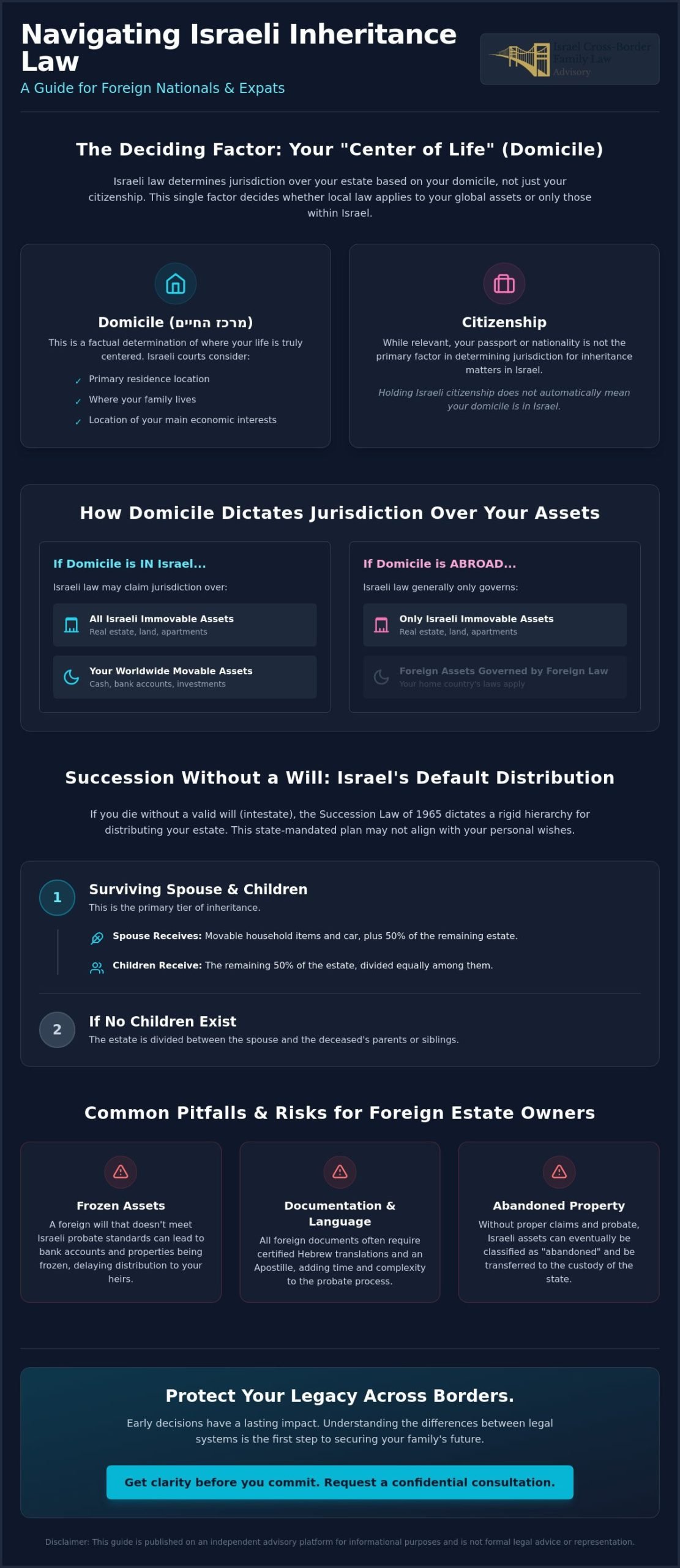
The core of israeli inheritance law for foreigners rests on the concept of Domicile, known in Hebrew as Merkaz HaChaim. This isn’t a simple check of your passport or citizenship. Instead, it’s a factual determination of where your life is truly centered. This distinction is vital because it dictates whether Israeli law applies to your entire global estate or just the specific assets located within Israel’s borders. Getting this right early prevents the shock of having assets frozen during a sensitive time.
To better understand how these laws apply when no legal planning is in place, watch this helpful video:
Domicile vs. Citizenship in Israeli Law
Israeli courts determine your domicile by looking at where you live, where your family resides, and where your primary economic interests lie. If you’re an expat holding property in Israel while living in the US, the court may view your domicile as foreign. In this case, Israeli law generally governs only your immovable assets, such as real estate. However, if the court finds you were domiciled in Israel at the time of death, the law could potentially claim jurisdiction over your worldwide movable property. This creates significant risks for families who maintain active homes in both jurisdictions without a clear cross-border strategy for expats and foreign nationals.
The Scope of the 1965 Inheritance Law
The law is designed to be universal, applying to all individuals regardless of their religious or secular backgrounds. It focuses heavily on the nature of the assets involved. Early classification of your estate is a critical first step for any foreigner. The law distinguishes between two main types of property:
- Immovable Assets: Real estate and land are always governed by the laws of the country where they’re located. If you own an apartment in Tel Aviv or Jerusalem, Israeli law will dictate its distribution.
- Movable Assets: Items like cash, bank accounts, and investment portfolios are typically governed by the law of the deceased’s domicile.
Understanding these categories helps you identify which parts of your estate are vulnerable to local probate requirements. This guide is published on an independent advisory platform, not a law firm, and focuses on helping you understand the strategic risks involved in cross-border estate management rather than providing formal legal representation.
Succession Without a Will: How Israeli Law Distributes Assets
When an individual passes away without leaving a valid will, the state applies a default set of rules known as intestate succession. For those navigating israeli inheritance law for foreigners, these rules can feel surprisingly rigid compared to common law systems in the US or UK. The law seeks to protect immediate family members, but the lack of a personalized plan often leads to administrative delays or family friction. Without a will, the state effectively makes your final decisions for you based on a fixed hierarchy.
The hierarchy of heirs starts with the surviving spouse and children. If there are no children, the estate may be divided between the spouse and the deceased’s parents or siblings. It’s important to understand that the spouse’s share isn’t just a flat percentage of the total estate. In many cases, the spouse is entitled to the movable property of the household, such as the family car and furniture, before the remaining assets are split. This initial “off-the-top” distribution ensures the surviving partner can maintain their immediate living standard.
For Jewish couples, the “Ketubah” (marriage contract) also plays a role in the final calculation. The amount promised in the Ketubah may be deducted from the spouse’s share of the inheritance to prevent “double recovery.” This is one of many cultural nuances that can complicate the process for foreign families. If you’re concerned about how these default rules might impact your specific situation, it’s wise to seek professional guidance before these legal defaults take effect.
The Order of Distribution (Intestate)
Under the standard distribution, a surviving spouse typically receives 50% of the estate, while the children share the remaining 50% equally. If the deceased had no children but left behind parents, the spouse’s share may increase to two-thirds. If no spouse, children, or parents survive, the estate moves to more distant relatives like siblings or grandparents. Israeli law also recognizes “common-law” partners, known as Yeduim BaTzibur. If a couple lived together as a family and maintained a joint household without being married to others, the surviving partner may have the same inheritance rights as a legal spouse. However, this status often requires formal proof in court.
Civil Courts vs. Religious (Rabbinical) Courts
Israel maintains a dual jurisdiction system. While the Civil Family Court is the default for most inheritance matters, Rabbinical courts also have the authority to issue succession orders. A religious court can only take jurisdiction if all heirs provide their written, informed consent. Foreign beneficiaries should be aware that religious courts apply Halacha (Jewish law), which can differ from secular law in its treatment of gender or lineage. Most international families prefer the Civil Court system because it aligns more closely with Western legal expectations. Deciding which court to use is a critical early choice that can significantly alter the outcome of the estate distribution.
Are Foreign Wills Valid in Israel? Navigating Cross-Border Conflict of Laws
The general principle of israeli inheritance law for foreigners is one of recognition and international cooperation. Under the Succession Law of 1965, Israeli courts typically honor a will if it was validly executed according to the laws of the place where it was drafted, the testator’s place of residence, or their country of citizenship. This means that a properly drafted US or UK will can, in theory, be used to distribute assets located in Tel Aviv or Haifa. However, the gap between theoretical recognition and practical enforcement is where many international families encounter significant delays.
The “Conflict of Laws” principle dictates which nation’s legal standards take precedence when an estate spans multiple jurisdictions. For US citizens, this often creates a complex interaction between American testamentary freedom and Israeli procedural requirements. While Israel respects your right to choose your heirs, the local court must still validate the document through a formal probate process. This requires more than just a signature; it involves a meticulous verification of the document’s origin and its alignment with local public policy. For deeper insights into these requirements, you can explore our guidance for expats and foreign nationals.
The Validity of a US Will in the Israeli System
To be accepted by the Israeli Registrar of Inheritance Affairs, a foreign will must undergo a rigorous authentication process. This includes obtaining an Apostille stamp to verify the notary’s credentials and commissioning a sworn Hebrew translation by an authorized professional in Israel. Beyond these technicalities, the court applies a “Public Policy” exception. If a foreign will contains provisions that the court deems fundamentally contrary to Israeli values, such as extreme discriminatory clauses, the court may refuse to enforce those specific sections. This friction often surprises foreigners who expect their home country’s “testamentary freedom” to be absolute across all borders.
The Strategic Advantage of Dual Country Wills
Relying on a single global will often complicates the probate process, leading to months of administrative hurdles and increased costs. A highly effective strategy is the use of dual country wills. By creating a separate Israeli will that specifically addresses assets within Israel, you allow the local probate process to move forward independently of your foreign estate. This approach minimizes the need for complex legal opinions on foreign law, which are often required when a foreign will is the only document available.
When drafting these documents, you must ensure they’re carefully synchronized. A common risk is that a later US will might contain a “boilerplate” revocation clause that accidentally cancels your previous Israeli will. Strategic coordination is essential to ensure that each document governs its respective jurisdiction without conflict. You can learn more about this approach in our article on how to create a will for assets in Israel & US. This guide is published on an independent advisory platform and provides strategic decision-making guidance rather than formal legal advice.
The Probate Process: A Step-by-Step Guide for Foreign Beneficiaries
Securing an inheritance in Israel is managed through a centralized administrative body known as the Registrar of Inheritance Affairs (Rasham HaYerushot). For those unfamiliar with israeli inheritance law for foreigners, it’s vital to recognize that the process is almost entirely paper-based and digital. You don’t need to be physically present in Israel to secure your rights. Most applications are handled through legal representatives who manage the filing, documentation, and communication with the authorities on your behalf. This content is published on an independent advisory platform and focuses on strategy and decision-making rather than formal legal advice.
The first step is determining whether you need a Succession Order or a Probate Order. A Succession Order (Tzav Yerusha) is required when the deceased left no will, serving as a formal declaration of the legal heirs. Conversely, a Probate Order (Tzav Kiyum Tzava’ah) is necessary to validate an existing will and give it the force of law. For an uncontested estate, you should expect a timeline of four to nine months from the initial filing to the final order. If you’re managing an estate from abroad, you can request a confidential consultation to discuss the logistics of your specific case.
Filing the Petition for a Succession Order
The petition process begins with gathering essential documents, starting with the original death certificate and the original will. These must be authenticated with an Apostille stamp from the issuing jurisdiction to be recognized by Israeli authorities. Once authenticated, the documents require a professional Hebrew translation. After filing, the Registrar publishes a public notice in Israeli newspapers to allow any creditors or unknown heirs to come forward. This is a standard procedure that typically provides a two-week window for objections before the file moves to the next stage of review.
Required Documentation for Foreign Nationals
If the deceased was domiciled outside of Israel, the court often requires an “Affidavit of Foreign Law.” This is a specialized legal document that explains the inheritance statutes of the foreign jurisdiction, such as a specific US state, to the Israeli court. It ensures that the Israeli distribution doesn’t conflict with the laws of the deceased’s home. Additionally, the Administrator General (Apotropos Klali) reviews every file involving foreign beneficiaries to protect the integrity of the estate. Signatures on these petitions can be verified at an Israeli Consulate or through a local notary, provided they are followed by the appropriate Apostille authentication. These steps are essential for bridging the gap between two different legal cultures.
Managing Risks and Taxes in Cross-Border Estates
One of the most significant advantages of israeli inheritance law for foreigners is that Israel currently does not impose an inheritance or estate tax. This tax was abolished in 1981 and remains inactive as of June 2026. While this provides immediate relief for many families, it’s a mistake to assume the process is entirely tax-free. Heirs who eventually sell inherited real estate in Israel are subject to a capital gains tax, known as Mas Shevach, which is typically 25% of the gain in value. Because Israel doesn’t offer a “step-up” in tax basis, the gain is calculated from the date the deceased originally purchased the property, which can result in a substantial tax liability for the beneficiaries.
Beyond taxation, a major risk for international families is the classification of assets as “unclaimed property.” If heirs don’t initiate the probate process within a reasonable timeframe, the Administrator General (Apotropos Klali) may take control of abandoned bank accounts or real estate. This often happens when children of expats are unaware of their parents’ holdings in Israel or find the Hebrew-centric documentation too daunting to approach. Proactive management is the only way to ensure these assets remain within the family legacy rather than falling under state administration.
Tax Considerations for US Beneficiaries
For US citizens and residents, the lack of an Israeli inheritance tax doesn’t eliminate their obligations to the IRS. The US taxes its citizens on their worldwide estate, meaning assets located in Tel Aviv or Jerusalem must be reported and may be subject to US federal estate tax if the total estate exceeds current exemption thresholds. Additionally, beneficiaries must often navigate complex reporting requirements, such as the FBAR for foreign bank accounts or Form 3520 for foreign gifts and inheritances. Understanding the nuances of the US-Israel Tax Treaty is essential for avoiding double taxation and ensuring full compliance. You can find detailed analysis on this in our guide to Israeli inheritance tax for US beneficiaries.
Next Steps: Securing Your International Legacy
The most effective tool for mitigating these risks is the implementation of a “Dual Will” strategy. By creating a specific Israeli will to handle local assets, you bypass the friction often caused by trying to apply a foreign legal document to a domestic system. This approach prevents “frozen” bank accounts and significantly reduces the timeline for asset distribution. This guide is published on an independent advisory platform, not a law firm, and focuses on helping you understand the strategic risks involved in cross-border estate management.
Early decisions carry immense weight in international succession. Seeking professional clarity before the system’s inherent complexity becomes an administrative burden can save your family years of litigation. If you’re ready to evaluate your specific situation, you can request a confidential case review to begin your roadmap. Get clarity before you commit. Request a confidential consultation.
Securing Your Cross-Border Legacy
Protecting your international assets requires a proactive approach that recognizes the inherent complexity of cross-border estates. By understanding how domicile impacts jurisdiction and why a dual-will strategy is the gold standard for risk mitigation, you can prevent the administrative delays that often plague foreign heirs. The Israeli legal system is highly structured; early decisions regarding your estate will carry significant weight for your family’s future security. This guide is published on an independent advisory platform, not a law firm, and focuses on strategy for international families navigating israeli inheritance law for foreigners.
Our advisory is specialized in the specific cross-border friction between US and Israeli jurisdictions. We focus on providing the clarity you need to manage dual-jurisdiction wills and complex probate requirements without the stress of the unknown. Taking the time to align your global assets now ensures that your legacy is preserved according to your exact wishes. Get clarity before you commit. Request a confidential consultation.
Frequently Asked Questions
Is there an inheritance tax in Israel for foreign citizens?
Israel does not currently impose an inheritance or estate tax; this tax was officially abolished in 1981. While the transfer of assets is tax-free, heirs must prepare for a 25% capital gains tax if they choose to sell inherited real estate later. It’s also vital for US citizens to consider how these assets impact their federal estate tax reporting requirements and potential liabilities back home.
Can I inherit property in Israel if I am not an Israeli citizen?
Yes, you can legally inherit property and other assets in Israel without holding Israeli citizenship. The israeli inheritance law for foreigners grants the local courts jurisdiction over any assets physically located within the country. Your rights as a beneficiary are protected regardless of your nationality, though the administrative process requires specific documentation to verify your identity and legal standing before the Registrar of Inheritance Affairs.
Is a US will valid for assets located in Israel?
Israeli courts generally recognize a US will as long as it was validly executed under the laws of the state where it was signed. To be enforceable in Israel, the document must be authenticated with an Apostille stamp and accompanied by a sworn Hebrew translation. Many international families choose to draft a separate Israeli will to avoid the procedural delays often associated with validating foreign documents locally.
How long does the probate process take in Israel for a foreigner?
For an uncontested estate, the process of obtaining a probate or succession order typically takes between four to nine months. This timeline includes the period for public notification and the mandatory review by the Administrator General. Cases involving foreign domiciles may take longer if the court requires additional clarifications regarding foreign legal standards or if the submitted documentation requires extensive verification or translation.
Do I need to travel to Israel to claim my inheritance?
You don’t need to travel to Israel to manage the probate process or claim your inherited assets. Most beneficiaries work with a legal representative through a power of attorney, allowing all filings to be handled digitally or through the Registrar of Inheritance Affairs. This remote approach is standard for international families and covers everything from the initial petition to the final distribution of funds and property titles.
What happens if a foreigner dies in Israel without a will?
If a person dies without a will, their assets are distributed according to the default rules of the Succession Law of 1965. This legal framework establishes a clear hierarchy, typically dividing the estate between the surviving spouse and the children. Because these default rules are rigid and may not account for your specific family dynamics, early estate planning is essential for those with significant local holdings.
Can I use a Rabbinical court for inheritance if I am not Jewish?
No, Rabbinical courts only have jurisdiction over Jewish individuals. Non-Jewish foreigners must have their cases heard in the Civil Family Court system. Even for Jewish beneficiaries, the religious court can only take jurisdiction if every single heir provides written, informed consent to the process. Otherwise, the case remains in the civil system by default, which is the preferred route for most international families.
What is an Affidavit of Foreign Law and why do I need one?
An Affidavit of Foreign Law is a specialized document that explains the inheritance rules of your home country to the Israeli court. This is a common requirement under israeli inheritance law for foreigners when the deceased was domiciled outside of Israel. It ensures the local court understands how your home state would distribute the assets, preventing legal conflicts and ensuring the distribution aligns with cross-border standards.

Article by
Gabriel Lior
A Personal Journey That Became a Mission
The advisory was founded by an American father Gabriel Lior, LLB, MBA , global entrepreneur, and cross-border advisor who spent more than a decade navigating the Israeli family court system firsthand and now lives in Singapore with his son.
As a divorced parent in a cross-border family, Gabriel faced nearly every legal challenge a foreign parent can encounter in Israel — including child custody disputes, child support proceedings, property matters in Israel and abroad, false accusations, and complex immigration and relocation proceedings.
Over the years, he learned the hard way how difficult it is for non-Israeli parents to understand the system, identify the right legal strategy, and choose the right legal representation — especially when language, culture, and jurisdictional differences are involved. He also witnessed how foreign parents and new immigrants are often disadvantaged or taken advantage of by service providers and institutions simply because they lack local knowledge or fluency.
From Client to Advisor
To truly understand — and survive — the system, Gabriel pursued formal legal education in Israel, completing two Israeli law degrees, alongside a BA and MBA earned in the United States. This was never about becoming a practicing attorney, but about gaining a deep, structural understanding of how the system works — and where it breaks down for foreign parents.
This rare combination of:
Firsthand client experience
Israeli legal and US business education
International business and negotiation training
Decades of commercial execution
created a unique perspective – one that understands both sides of the table.
After years of litigation, persistence, and at times self-representation, he ultimately succeeded in securing custody of his son and relocating abroad through a rare legal victory in the Israeli Supreme Court — becoming one of the first fathers in Israel to do so under these circumstances.
Disclaimer
Important Disclaimer:
The information provided on this website and in its content is for general informational and educational purposes only and does not constitute legal advice, legal opinion, or legal representation.
Gabriel Lior is not licensed to practice law in Israel (nor is he interested in doing so) and does not provide legal services, despite having completed 2 Law Degrees. The services offered are advisory in nature and are intended to provide general guidance, strategic insight, and information regarding cross-border family law considerations.
No attorney-client relationship is formed by accessing this website, reading its content, or communicating with us.
Any decisions made based on this information are at your own discretion and risk. For legal advice specific to your situation, you should consult a licensed attorney in the relevant jurisdiction.
Where appropriate, we may refer clients to independent, licensed attorneys or professionals. Such referrals do not constitute legal representation and no liability is assumed for services provided by third parties.