For international and cross-border couples contemplating marriage, the complexities of protecting pre-marital, inherited, and business assets within Israel’s unique legal landscape can be a significant source of uncertainty. Navigating the intersection of civil and religious law, and questioning the validity of a foreign-drafted agreement within this multi-jurisdictional framework, creates a high-stakes environment where financial security is paramount. Achieving peace of mind requires a meticulously crafted and legally sound enforceable prenuptial agreement in Israel that is specifically designed to withstand judicial scrutiny and safeguard your financial future.
This comprehensive guide provides a definitive overview of the critical legal requirements, procedural steps, and strategic considerations essential for creating a valid prenuptial agreement under Israeli law. We will demystify the process, from securing the necessary approvals by the Family Court or a qualified notary to outlining the specific clauses that effectively protect your assets. Our objective is to deliver the clarity and confidence you need to move forward, ensuring your pre-marital wealth is secure and your financial interests are protected with a robust legal foundation.
Key Takeaways
- A prenuptial agreement in Israel is legally invalid without official validation through one of two exclusive channels: certification by a Notary or approval by the Family Court.
- Creating an enforceable prenuptial agreement in Israel is the only way to override the default legal regime of equal marital asset division, requiring strict adherence to procedural law.
- For international couples, effectively protecting multi-jurisdictional assets requires specific, expertly drafted clauses addressing choice of law, foreign property, and inheritance.
- Determine whether an Israeli court may recognize a prenuptial agreement executed abroad under the principle of comity and what steps can bolster its cross-border validity.
- Identify common yet critical errors, from inadequate financial disclosure to the use of generic templates, that can render an agreement entirely unenforceable before Israeli authorities.
The Legal Foundation: Understanding Israel’s Spouses’ Property Relations Law
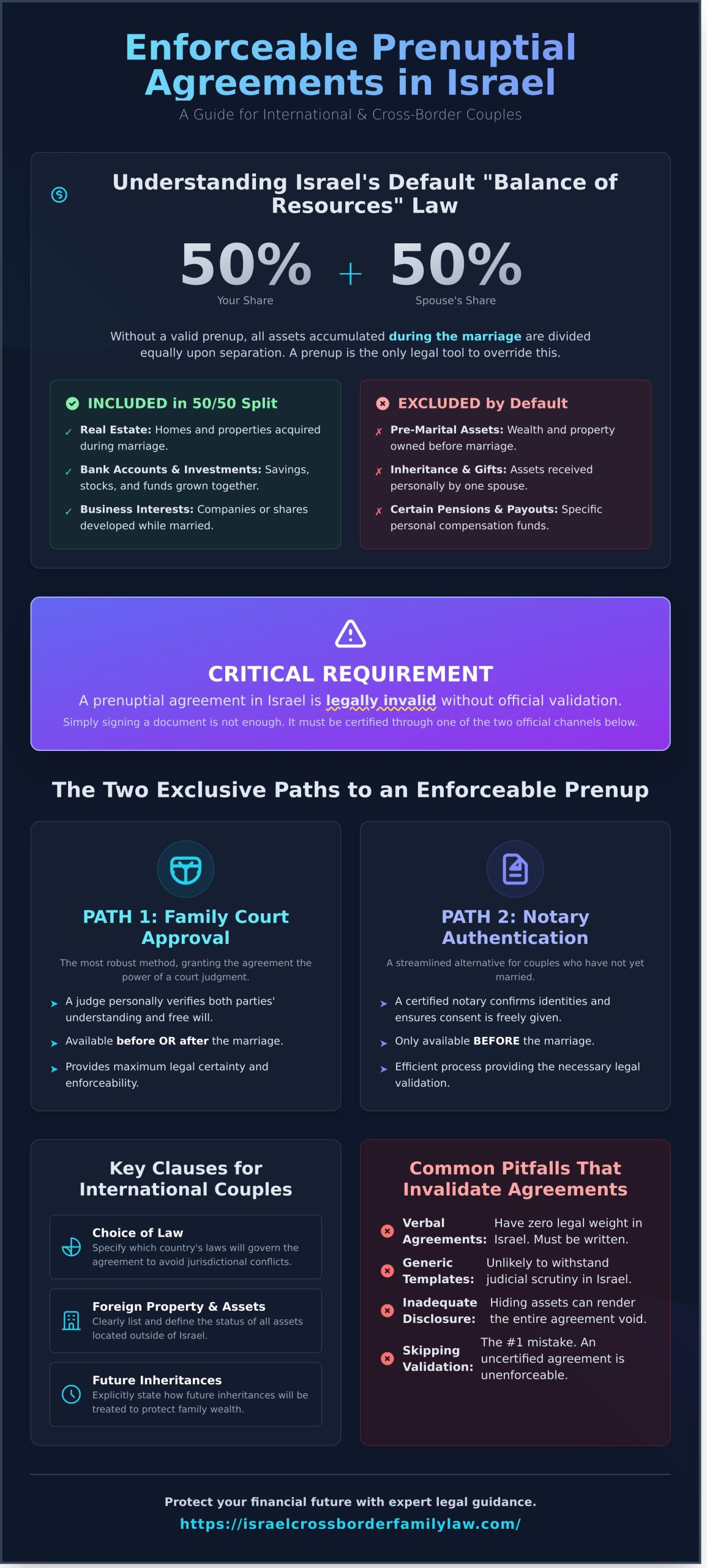
In Israel, the financial landscape of a marriage is governed by a robust statutory framework, not by ambiguous assumptions. The cornerstone of this framework is the Israel’s Spouses’ Property Relations Law, 1973. This legislation establishes the default “balance of resources” arrangement, which mandates an equal, 50/50 division of all assets and rights accumulated by a couple from the day of their marriage until its dissolution. This includes real estate, bank accounts, investments, and business interests acquired during the marital period.
However, the law also specifies assets that are automatically excluded from this communal pool. These typically include:
- Assets owned by either spouse prior to the marriage.
- Inheritances or gifts received by one spouse during the marriage.
- Certain pension entitlements and specific types of compensation payments.
A prenuptial agreement serves as the primary legal instrument for couples wishing to customize or entirely opt out of this default regime. It allows for the creation of a bespoke financial arrangement, providing clarity and protecting specific assets. Crafting this document with precision is the first critical step toward creating a fully enforceable prenuptial agreement israel.
Civil Family Court vs. Rabbinical Court Jurisdiction
Couples in Israel have a choice of venue for the authorization of their prenuptial agreement: the civil Family Court or the religious Rabbinical Court (Beit Din). The Family Court is the primary secular authority for adjudicating property disputes and validating such agreements. In contrast, the Rabbinical Court’s principal jurisdiction pertains to the religious act of marriage and divorce itself (the get). However, a prenuptial agreement that has been properly ratified and given the force of a judgment by the Family Court is typically respected by the Rabbinical courts, ensuring comprehensive legal standing across both systems.
Why a Verbal Agreement is Not Enough
Under Israeli law, any agreement that deviates from the default property-sharing rules must be in writing and formally approved by a competent legal authority. A verbal or informal understanding between spouses regarding the division of assets holds no legal weight and is entirely unenforceable. This stringent requirement is not a mere formality; it is a critical safeguard designed to prevent future disputes, ensure that both parties fully comprehend their rights and obligations, and provide indisputable evidence of their mutual intent, which is foundational to any enforceable prenuptial agreement israel.
The Two Paths to Validity: Essential Requirements for an Enforceable Prenup
In Israel, a prenuptial agreement is more than just a private contract between two individuals; it is a legal instrument that requires official state validation to be binding. Simply drafting and signing a document, even with witnesses, is insufficient. The agreement is entirely unenforceable without authentication through one of two exclusive legal channels. This validation process serves a critical function: it provides a formal record that both parties entered into the agreement with full comprehension and free will, devoid of coercion. For expats and foreign nationals accustomed to different legal norms, understanding this mandatory step is paramount to creating a secure and legally sound agreement.
Path 1: Approval by the Israeli Family Court
One of the most robust methods for validation is submitting the prenuptial agreement to the Israeli Family Court. During this process, a judge personally meets with the couple to verify that they understand the full scope and consequences of the document they are signing. The judge’s primary role is to ensure that consent is given freely and intelligently. This path is available both before and after the marriage, and upon approval, the agreement is granted the powerful legal status of a court judgment, providing maximum certainty and enforceability.
Path 2: Authentication by a Notary
As an alternative for couples who have not yet married, Israeli law empowers a certified notary to validate a prenuptial agreement. The notary is legally obligated to confirm the identities of both parties, witness their signatures, and certify that they are signing the agreement of their own free will and have declared their understanding of its meaning. This process can often be more private and expeditious than a court hearing, making it a preferred option for many couples seeking to finalize their financial arrangements before the wedding.
Universal Requirements: Disclosure and Independent Counsel
Regardless of the validation path chosen, the foundation of an enforceable prenuptial agreement in Israel rests on two universal principles. First is the duty of full and frank financial disclosure. Each party must provide a transparent account of their assets, debts, and income. Any attempt to hide assets can jeopardize the entire agreement’s validity. Second, it is strongly advised that each party retain separate, independent legal counsel. This crucial step prevents future claims of duress or undue influence and ensures both individuals can navigate complex clauses, such as those found in the Tzohar Prenuptial Agreement, with a complete understanding of their rights and obligations.
Crafting Your Agreement: Key Clauses for International Couples
Once the procedural requirements for a valid prenuptial agreement are met, the focus shifts to the substance of the document. For international and cross-border families, the complexity escalates due to multi-jurisdictional assets, differing legal systems, and sophisticated financial structures. A generic template is insufficient; your agreement must be a bespoke legal instrument designed to address your unique global circumstances. Crafting a truly enforceable prenuptial agreement in Israel requires meticulous attention to these cross-border financial details.
Defining and Separating Assets
The cornerstone of any prenuptial agreement is the clear delineation between ‘separate property’ (assets owned by one spouse prior to the marriage) and ‘marital property’ (assets acquired jointly during the marriage). For international couples, this may include:
- Pre-marital real estate in the United States or Europe.
- Interests in a family-owned business headquartered in Tel Aviv.
- Inheritances or significant gifts received from family abroad.
The agreement must precisely define how the appreciation of these separate assets will be treated. Furthermore, it should establish clear protocols to prevent ‘commingling’-the mixing of separate and marital funds-which can inadvertently convert a separate asset into a marital one under Israeli law.
Addressing Spousal Support (Alimony)
Israeli law provides couples with significant latitude to define their own terms for spousal support (alimony). An agreement can stipulate a complete waiver of support, set a specific amount or duration, or establish a formula for its calculation. This differs notably from the legal frameworks in many U.S. states, where such waivers are subject to strict fairness reviews at the time of divorce. This jurisdictional variance makes precise drafting essential. The approach to support can also be influenced by religious considerations, as seen in instruments like the Jewish prenuptial agreement, which addresses financial obligations within a religious context.
What a Prenup Cannot Cover: Child Custody and Support
It is crucial to understand the legal boundaries of an enforceable prenuptial agreement in Israel. Israeli family law unequivocally states that matters of child custody and child support cannot be predetermined in a prenuptial agreement. The court’s mandate to protect the “best interests of the child” is paramount and supersedes any prior arrangement made by the parents. While a prenup is a powerful tool for financial planning, complex custody issues are a separate legal matter and part of our dedicated services for international families.
Foreign Prenups and the Israeli Legal System
For international couples with connections to Israel, a critical question often arises: Will a prenuptial agreement drafted and signed abroad, such as in the United States or Europe, be recognized by Israeli courts? The answer lies in the sophisticated interplay between international legal principles and Israeli domestic law. While Israeli courts may recognize a foreign agreement under the legal doctrine of ‘comity’-respect for the laws and judicial decisions of other nations-this recognition is not automatic and is subject to rigorous scrutiny.
Criteria for Recognition of a Foreign Agreement
An Israeli court will not simply rubber-stamp a foreign prenuptial agreement. For a foreign-drafted agreement to be considered valid, it must typically satisfy several key conditions. The court will assess whether the agreement:
- Was validly executed and is considered legally binding in the jurisdiction where it was created.
- Does not contradict the fundamental principles of Israeli public policy. For instance, provisions that are seen to undermine the welfare of a child or violate basic moral tenets may be struck down.
- Was entered into freely and with full comprehension by both parties, ideally demonstrated by each party having received independent and competent legal advice prior to signing.
The ‘Belt and Suspenders’ Approach: Ratifying Your Foreign Prenup
Relying solely on the principle of comity introduces an element of uncertainty and potential for future litigation. The most secure and strategically sound approach for international couples is to have their foreign prenuptial agreement ratified in Israel. This involves having the existing agreement reviewed by experienced Israeli counsel and then submitting it for formal approval to an Israeli Family Court or a certified notary. This process effectively converts the foreign contract into a binding Israeli judgment, providing the highest level of legal certainty. This proactive measure is a core component of a robust cross-border asset protection strategy, ensuring you have an enforceable prenuptial agreement israel that withstands legal challenges. Navigating these multi-jurisdictional requirements is a complex task, and securing expert guidance is paramount. For comprehensive advice on ratifying your international agreement, it is advisable to consult with counsel experienced in both legal systems.
Common Pitfalls and How to Avoid Them
Crafting a prenuptial agreement that withstands judicial scrutiny requires meticulous attention to both procedural and substantive legal standards. Even with the best intentions, couples can make critical errors that compromise the validity of their agreement. Navigating these complexities is fundamental to creating an enforceable prenuptial agreement Israel will uphold in the event of a divorce. Understanding these common pitfalls is the first step toward safeguarding your assets and intentions.
To avoid having your agreement invalidated, it is imperative to avoid the following common mistakes:
- Using generic online templates that fail to address the specific nuances of Israeli law and your unique financial situation.
- Failing to have the agreement properly authenticated by a Notary or the Family Court as required.
- Including provisions that are contrary to public policy or Israeli law, such as those attempting to pre-determine matters of child custody.
- Creating an agreement that is so one-sided or unconscionable that a court may deem it grossly unfair.
The Risk of Duress and Coercion
An agreement signed under duress, where one party is improperly pressured into signing, will not be enforced. An ultimatum such as, “sign this agreement or the wedding is cancelled,” particularly when presented days before the ceremony, can be considered legal coercion. To mitigate this risk, the process should commence months in advance, allowing ample time for negotiation. Furthermore, ensuring each party is represented by independent legal counsel provides powerful evidence that the agreement was entered into freely and voluntarily.
Inadequate or Fraudulent Financial Disclosure
Full and frank financial disclosure is the bedrock of a valid prenuptial agreement. Each party has a duty to provide a complete and accurate summary of all significant assets, debts, and sources of income. A material omission or misrepresentation-whether intentional or accidental-can be grounds for a court to set aside the entire agreement. We strongly advise clients to attach detailed financial statements as exhibits, providing a transparent and unimpeachable record of the financial circumstances at the time of signing.
Vague Language and Ambiguity
The enforceability of an agreement often hinges on the precision of its language. Vague terms create ambiguity that can lead to costly and contentious disputes over interpretation years later. For instance, a clause stating “pre-marital business assets remain separate” is dangerously imprecise. A robust clause would identify the specific business entity by name and registration number, detailing its assets and how future growth will be treated. Engaging a specialist family law attorney ensures the use of unambiguous legal language, which is critical for a truly enforceable prenuptial agreement Israel‘s courts will respect.
Navigating the intricate requirements of Israeli family law demands sophisticated legal guidance. To ensure your agreement is structured for maximum enforceability, contact our experienced legal team for a confidential consultation.
Finalizing Your Cross-Border Prenuptial Agreement in Israel
Navigating the legal landscape of Israeli marital law demands meticulous planning and precise execution. As this guide has detailed, an agreement’s validity rests upon strict adherence to the Spouses’ Property Relations Law-requiring either judicial or notarial approval-and a sophisticated approach to the unique challenges faced by international couples. Crafting an enforceable prenuptial agreement israel is therefore not merely a procedural formality but a foundational act of financial foresight, safeguarding assets by proactively avoiding common pitfalls like incomplete disclosure or procedural missteps.
For international families, these complexities are magnified. Our firm’s dedicated expertise in multi-jurisdictional family law, combined with a deep understanding of both the US and Israeli legal systems, provides the strategic counsel necessary to protect your financial future. We are committed to guiding you through this intricate process with confidence and clarity, ensuring your cross-border life together begins on a secure foundation. Secure your assets with expert legal guidance. Schedule a Confidential Case Review today.
Frequently Asked Questions
What is the difference between a prenuptial and a postnuptial agreement in Israel?
The fundamental distinction between a prenuptial and a postnuptial agreement in Israel lies in the timing of their execution. A prenuptial agreement is formalized prior to the marriage ceremony, whereas a postnuptial agreement is established by spouses who are already legally married. Both instruments serve the identical purpose of delineating the financial relationship and asset division between the parties, deviating from the default provisions of the Spouses’ Property Relations Law, and both require validation by the Family Court or a notary.
What happens if a couple divorces in Israel without a prenuptial agreement?
In the absence of a prenuptial agreement, the division of assets upon divorce in Israel is governed by the Spouses’ Property Relations Law, 5733-1973. This legislation mandates an equal, 50/50 distribution of all assets and rights accumulated by the couple from the date of marriage until its dissolution. This includes real estate, savings, pensions, and business interests, regardless of whose name they are registered in. This default legal framework can lead to complex and protracted litigation over asset valuation and division.
Can an Israeli prenuptial agreement be changed or cancelled after marriage?
Yes, a prenuptial agreement can be modified or entirely cancelled after the marriage has commenced. However, such amendments are subject to stringent formal requirements. Any changes must be made in writing and agreed upon by both spouses. Crucially, the revised agreement must undergo the same validation process as the original document, requiring approval from either the Family Court or a certified notary to ensure its legal standing and enforceability. Unilateral alterations by one party are not permissible.
How much does it typically cost to draft and validate a prenuptial agreement in Israel?
The cost associated with drafting and validating a prenuptial agreement in Israel is variable, contingent upon the complexity of the couple’s financial portfolio and the extent of negotiations required. Legal fees for drafting by an experienced attorney typically range from ₪5,000 to ₪20,000 or more for highly complex cases involving international assets. Additionally, there are separate, fixed fees for validation by either a notary or the Family Court, which are comparatively modest.
Does a prenuptial agreement in Israel cover assets acquired after the wedding?
Absolutely. A primary function of an enforceable prenuptial agreement in Israel is to prospectively govern the division of assets and income acquired during the marriage. The agreement can be meticulously drafted to stipulate that future earnings, investments, real estate purchases, or business interests remain separate property, thereby overriding the default legal presumption of joint marital property. This provides crucial clarity and financial protection for assets accumulated long after the wedding day, ensuring the agreement remains relevant and effective.
How does a civil prenup interact with the religious obligations of a Ketuba?
A civil prenuptial agreement and a Ketuba operate in parallel legal spheres and govern distinct obligations. The prenuptial agreement is a civil contract enforced by the Family Court, dealing with the division of marital property. The Ketuba is a religious document, enforced by the Rabbinical Court, which details a husband’s financial obligations to his wife. A strategically drafted prenuptial agreement can address the Ketuba payment, clarifying that it is included within, or separate from, the civil property settlement to prevent potential conflicts.

Article by
Gabriel Lior
A Personal Journey That Became a Mission
The advisory was founded by an American father Gabriel Lior, LLB, MBA , global entrepreneur, and cross-border advisor who spent more than a decade navigating the Israeli family court system firsthand and now lives in Singapore with his son.
As a divorced parent in a cross-border family, Gabriel faced nearly every legal challenge a foreign parent can encounter in Israel — including child custody disputes, child support proceedings, property matters in Israel and abroad, false accusations, and complex immigration and relocation proceedings.
Over the years, he learned the hard way how difficult it is for non-Israeli parents to understand the system, identify the right legal strategy, and choose the right legal representation — especially when language, culture, and jurisdictional differences are involved. He also witnessed how foreign parents and new immigrants are often disadvantaged or taken advantage of by service providers and institutions simply because they lack local knowledge or fluency.
From Client to Advisor
To truly understand — and survive — the system, Gabriel pursued formal legal education in Israel, completing two Israeli law degrees, alongside a BA and MBA earned in the United States. This was never about becoming a practicing attorney, but about gaining a deep, structural understanding of how the system works — and where it breaks down for foreign parents.
This rare combination of:
Firsthand client experience
Israeli legal and US business education
International business and negotiation training
Decades of commercial execution
created a unique perspective – one that understands both sides of the table.
After years of litigation, persistence, and at times self-representation, he ultimately succeeded in securing custody of his son and relocating abroad through a rare legal victory in the Israeli Supreme Court — becoming one of the first fathers in Israel to do so under these circumstances.
Disclaimer
Important Disclaimer:
The information provided on this website and in its content is for general informational and educational purposes only and does not constitute legal advice, legal opinion, or legal representation.
Gabriel Lior is not licensed to practice law in Israel (nor is he interested in doing so) and does not provide legal services, despite having completed 2 Law Degrees. The services offered are advisory in nature and are intended to provide general guidance, strategic insight, and information regarding cross-border family law considerations.
No attorney-client relationship is formed by accessing this website, reading its content, or communicating with us.
Any decisions made based on this information are at your own discretion and risk. For legal advice specific to your situation, you should consult a licensed attorney in the relevant jurisdiction.
Where appropriate, we may refer clients to independent, licensed attorneys or professionals. Such referrals do not constitute legal representation and no liability is assumed for services provided by third parties.