Navigating the complexities of a cross-border family law matter presents significant challenges, particularly when it involves a court-ordered child custody evaluation in Israel for relocation. For parents facing this critical juncture, the process can feel opaque and fraught with uncertainty, raising profound concerns about the evaluation’s impact on their child and the outcome of their case. The unfamiliarity of the Israeli legal framework often compounds this anxiety, making strategic preparation not just beneficial, but essential for a favorable resolution. This comprehensive guide is engineered to provide clarity and strategic direction. We will meticulously deconstruct the evaluation process, detailing the role of the court-appointed expert, the specific criteria under consideration, and the structure of the final report. By arming you with this sophisticated understanding and actionable preparation advice, our objective is to equip you with the confidence and control needed to navigate this demanding legal requirement, ensuring your position is represented with precision and strength.
Key Takeaways
- Grasp the structured process of the ‘Taskir’, the formal evaluation ordered by the Israeli Family Court to guide its decision in complex relocation disputes.
- Identify the key factors a court-appointed expert assesses when determining the child’s best interests, providing a strategic advantage in presenting your case.
- Effective preparation is paramount for navigating a child custody evaluation in Israel for relocation; learn how to communicate your position clearly and consistently.
- Understand the significant impact of the final evaluation report on the court’s ruling and how its recommendations can shape the outcome of your case.
The Role of the Custody Evaluation in Israeli Relocation Cases
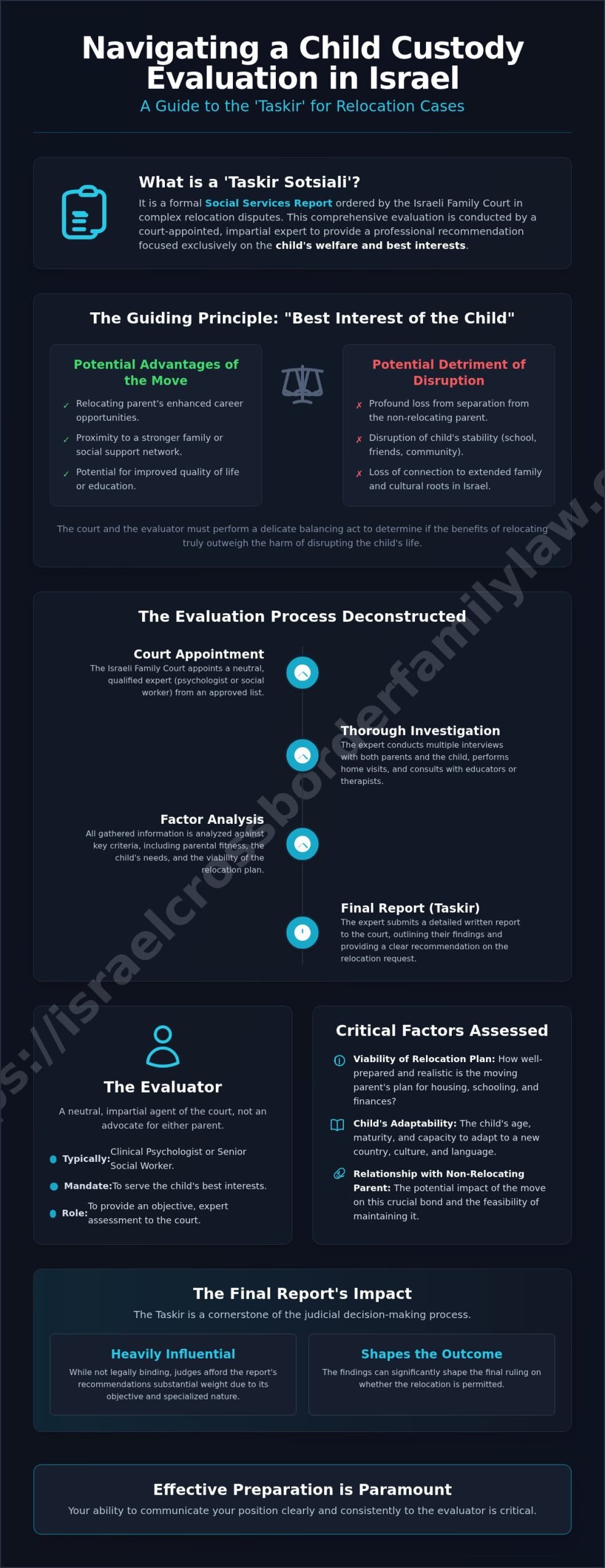
In complex international family law matters, particularly those involving a parent’s request to move abroad with a child, the Israeli Family Court frequently relies on a critical diagnostic tool: the Child Custody Evaluation. Known in Israel as a Taskir Sotsiali (Social Services Report), this comprehensive assessment is conducted by a court-appointed expert, typically a social worker or psychologist, to provide an impartial recommendation on the proposed relocation. Its purpose is to move beyond the conflicting narratives of the parents and offer the court a professional, in-depth analysis focused squarely on the child’s welfare. To better understand the multifaceted nature of relocation disputes, the following video provides a valuable overview of the core issues involved.
The significance of the Taskir cannot be overstated; its findings and final recommendation heavily influence the court’s final judgment. While not legally binding, judges afford these reports substantial weight due to their objective and specialized nature. Unlike a general custody dispute, the evaluation in a relocation case is laser-focused. It examines the viability of the relocating parent’s plan, the potential impact on the child’s relationship with the non-relocating parent, and the child’s capacity to adapt to a new country, culture, and language. The comprehensive nature of a child custody evaluation in Israel for relocation makes it a cornerstone of the judicial decision-making process.
Why is an Independent Expert Needed?
The Family Court appoints an independent expert because parental testimony, while essential, is inherently subjective. Each parent understandably presents a case that favors their desired outcome. The court requires a neutral, professional assessment to navigate these competing claims. These court-appointed experts possess specialized training in child psychology, family systems, and developmental needs, enabling them to conduct a thorough investigation that includes interviews with the parents and child, home visits, and consultation with educators or therapists. The resulting report provides the court with an objective opinion on how the proposed move aligns with the child’s best interests.
The Legal Standard: ‘Best Interest of the Child’ in Relocation
The guiding principle in all Israeli family law is the “best interest of the child” (tovat ha’yeled). This doctrine governs the entire legal and practical relationship between a parent or guardian and a child, ensuring their physical, emotional, and psychological welfare is the court’s paramount consideration. In relocation cases, this standard requires a delicate balancing act. The court must weigh the potential advantages of the move-such as the relocating parent’s enhanced career opportunities or proximity to a support network-against the profound loss the child would experience by being separated from their other parent, extended family, school, and community in Israel. The evaluation is therefore instrumental in helping the court determine if the benefits of relocating truly outweigh the detriment of disrupting the child’s stability and core relationships.
The Evaluator: Who They Are and What They Do
In any contentious family law matter involving children, particularly a complex cross-border relocation, the court’s primary duty is to ascertain and protect the child’s best interests. To achieve this, the Israeli Family Court relies on the objective, expert assessment of a court-appointed evaluator. These professionals are typically clinical psychologists or senior social workers with specialized qualifications and extensive experience in child development, family dynamics, and the nuances of Israeli family law. Their mandate is not to advocate for either parent but to serve as a neutral, impartial agent of the court, conducting a thorough investigation and providing a professional opinion on the child’s welfare in the context of the proposed move.
Appointment of the Evaluator
The appointment process is a formal procedure designed to ensure impartiality. Typically, the court selects an expert from a pre-approved list of qualified professionals maintained by the judiciary. Alternatively, the legal counsel for both parents may mutually agree upon a specific evaluator, a collaborative approach that can sometimes streamline the process. A critical prerequisite in either scenario is the verification that the chosen expert has no prior relationship with the family or any other potential conflicts of interest, thereby safeguarding the integrity of the evaluation.
The Scope of the Evaluator’s Investigation
The evaluator’s investigation is not an open-ended inquiry; it is strictly defined by the questions and directives issued by the court in its appointment order. When conducting a child custody evaluation in Israel for relocation, their primary focus is to assess the potential impact of the move on the child’s psychological, emotional, and developmental well-being. To form a comprehensive picture, the evaluator will gather information from multiple sources, including:
- Individual interviews with each parent and the child (or children).
- Observations of parent-child interactions.
- Reviews of relevant documents, such as school records and medical reports.
- Collateral interviews with teachers, therapists, or other relevant third parties.
The final, detailed report submitted to the court will directly address the feasibility of the relocation, the suitability of each parent’s plan, and provide a recommendation grounded in the child’s best interests. This expert opinion is a critical piece of evidence that assists the court in making a determination consistent with Israeli law and international legal principles, such as those detailed within the framework of The Hague Convention in Israel.
The Evaluation Process Deconstructed: A Step-by-Step Overview
Understanding the framework of a child custody evaluation in Israel for relocation is critical for any parent facing this complex legal challenge. This is not an arbitrary process but a structured, multi-stage investigation designed to provide the Family Court with an objective, in-depth understanding of your family’s unique dynamics. The evaluation timeline can span several weeks to a few months, contingent on the complexity of the case and the evaluator’s schedule. It is a methodical and confidential process central to all international custody and relocation cases, operating within the legal principles that govern such sensitive cross-border matters. The gravity of these proceedings is underscored by the framework outlined in the Israeli Law on International Child Relocation, which prioritizes the child’s welfare above all else.
Stage 1: Interviews with Parents
The process commences with a series of separate, in-depth clinical interviews with each parent. These sessions are comprehensive, exploring topics such as your personal history, relationship with the other parent, parenting philosophy, and your specific reasons for proposing or opposing the relocation. The evaluator’s objective is to assess your capacity to understand and meet your child’s developmental, emotional, and practical needs, both now and in the context of the proposed move. This is your opportunity to present your perspective in a structured, professional setting.
Stage 2: Interviews and Observation with the Child
Direct interaction with the child is a cornerstone of the evaluation. The expert employs age-appropriate methods-such as play therapy for younger children or guided conversation for adolescents-to create a comfortable environment. The primary goals are to observe the child’s bond and relationship with each parent individually and to sensitively explore the child’s own wishes, feelings, attachments, and understanding of the potential relocation. The evaluator is highly trained to elicit the child’s authentic perspective without exerting pressure.
Stage 3: Collateral Information and Document Review
To form a holistic view, the evaluator gathers information from neutral, third-party sources. This may involve speaking with individuals who know the child well, such as teachers, therapists, or pediatricians, with your prior consent. The evaluator will also conduct a thorough review of relevant documents, which can include court filings, school records, and any prior psychological or medical reports. In some cases, home visits are conducted to observe the child’s living environment and daily routines firsthand, ensuring a complete and well-rounded assessment.
Critical Factors Assessed in a Relocation Evaluation
The recommendation provided to the Israeli Family Court is not based on general impressions but on a meticulous and structured analysis of specific criteria. During a child custody evaluation in Israel for relocation, the appointed expert methodically weighs a series of factors, all viewed through the primary lens of the child’s best interests and welfare. Each element is considered within the unique context of the family’s circumstances, forming the foundation of the final report. This process can be especially complex and daunting for expats and foreign nationals who may be unfamiliar with the Israeli legal system’s rigorous approach.
The Viability of the Relocation Plan
The moving parent must present a concrete and well-researched plan, not merely an aspiration. The evaluator subjects this proposal to intense scrutiny, assessing its practicality and the potential quality of life for the child. Key areas of this analysis include:
- Housing and Community: Evidence of suitable accommodation, proximity to family or social networks, and access to community resources.
- Education: Confirmed enrollment or a clear educational plan, including research into school quality and curriculum.
- Financial Stability: A verifiable job offer, detailed budget, and proof of financial resources to support the child in the new location.
The Motives for and Against the Move
The evaluator delves into the underlying reasons for both the proposed relocation and the opposition to it. A central question is whether the move is proposed in good faith-for instance, for a significant career opportunity or to be closer to an essential family support system that will ultimately benefit the child. Conversely, the evaluator assesses if the opposition is rooted in genuine concern for the child’s welfare or if it stems from a desire to obstruct the other parent’s life, sometimes as a form of parental alienation.
The Impact on the Child’s Relationship with the Non-Moving Parent
Preserving the child’s bond with both parents is a paramount concern for the court. The evaluator will therefore conduct a thorough assessment of the current relationship between the child and the parent who would be left behind. A critical component of any successful child custody evaluation in Israel for relocation is the proposed plan for maintaining frequent and meaningful contact. The evaluator will rigorously test the practical and financial feasibility of this plan, looking for a detailed schedule of visits, clear arrangements for communication technology, and a realistic allocation of travel costs.
The Final Report (Taskir) and Its Impact on Your Case
Upon completion of the meticulous evaluation process, the court-appointed expert will compile a comprehensive written report, known in Israel as a Taskir. This document is the culmination of all interviews, observations, and assessments, and it serves as a critical piece of evidence in your case. The findings presented within the Taskir are instrumental in any child custody evaluation in Israel for relocation, as they provide the court with a professional opinion on the child’s best interests. The weight attributed to the Taskir by the Israeli Family Court cannot be overstated. While judges are the ultimate arbiters, they rely heavily on the evaluator’s specialized expertise to navigate the complex psychological and familial dynamics at play. A favorable recommendation can significantly bolster your case, while an unfavorable one presents a formidable challenge that requires a sophisticated legal strategy.
Anatomy of the Evaluator’s Report
This formal report is methodically structured to provide a clear and detailed overview. Key sections typically include the case background, the evaluation methodology employed, summaries of all interviews conducted, detailed findings, and a concluding analysis. Crucially, the report culminates in a definitive recommendation on whether the proposed relocation is deemed to be in the child’s best interest, often accompanied by specific suggestions for future custody arrangements and visitation schedules.
Challenging the Report
Although highly influential, the evaluator’s report is not legally binding. Your legal counsel retains the critical right to challenge its conclusions. This is most effectively accomplished through the cross-examination of the evaluator in court. Grounds for a successful challenge often involve identifying factual inaccuracies, exposing a flawed or biased methodology, or demonstrating that the expert failed to consider pertinent information during the evaluation process. Receiving and analyzing the Taskir is a pivotal moment in your relocation proceedings. Your legal team must meticulously review the document to prepare an appropriate response, whether it involves reinforcing a positive recommendation or constructing a robust challenge to a negative one. Navigating this stage requires experienced counsel capable of scrutinizing complex psychological reports and advocating effectively in court. For expert guidance on responding to a child custody evaluation, our firm provides strategic representation tailored to the unique complexities of international family law.
How to Prepare for a Child Custody Evaluation
Successfully navigating a child custody evaluation in Israel for relocation requires meticulous and strategic preparation. The evaluator’s recommendation carries significant weight with the Family Court, making your presentation and conduct throughout the process of paramount importance. A well-prepared parent can effectively communicate their position, demonstrate their commitment to the child’s welfare, and present a compelling case for the proposed move. The following guidance provides a strategic framework for parents undergoing this complex assessment.
Documentation and Organization
Comprehensive and organized documentation is the foundation of your case. The evaluator will require objective evidence to support your claims. It is imperative to gather and systematically arrange all pertinent records before your first meeting. This demonstrates foresight and credibility.
- Relocation Plan: A detailed proposal outlining prospective housing, schooling, healthcare, and community support in the new location.
- Financial Records: Proof of income, employment stability, and the financial capacity to support the child post-relocation.
- Child-Related Documents: School reports, medical records, and letters from teachers or caregivers that speak to the child’s needs and your involvement.
- Proposed Visitation Plan: If you are the relocating parent, present a realistic, detailed, and generous plan for the other parent’s contact, including travel logistics and costs.
Your Conduct During Interviews
Your demeanor during interviews provides the evaluator with critical insight into your character and parenting style. Maintain a calm, respectful, and truthful disposition at all times, even when discussing contentious issues. The focus must consistently remain on your child’s best interests, not on personal conflicts with the other parent. Instead of making broad accusations, provide specific, fact-based examples that illustrate your parenting skills and your understanding of your child’s unique needs.
Preparing Your Child for the Evaluation
How you prepare your child is a direct reflection of your parental judgment. Explain the evaluator’s role in simple, age-appropriate, and neutral terms, framing it as a person who is there to listen and help the family. Encourage your child to be honest about their thoughts and feelings. Critically, you must never coach your child on what to say or speak negatively about the other parent in their presence. Any attempt to influence the child will be transparent to a trained professional and can severely damage your credibility. The complexities of a child custody evaluation in Israel for relocation demand careful handling and expert legal insight. Ensuring you are thoroughly prepared is the most effective step you can take. For tailored advice on your specific circumstances, it is advisable to seek specialized legal counsel to guide you through these proceedings.
Securing a Favorable Outcome in Your Relocation Case
Successfully navigating an international relocation case hinges on a comprehensive understanding of its most critical component: the custody evaluation report, or taskir. As we have detailed, this assessment is an intricate process where the evaluator’s recommendations carry immense weight with the Family Court. Therefore, strategic preparation and a clear presentation of the factors central to your child’s best interests are not merely advantageous-they are imperative for anyone undertaking a child custody evaluation in israel for relocation. The complexities of these multi-jurisdictional disputes demand sophisticated legal counsel. Our firm provides precisely that, offering specialized expertise in US-Israel cross-border relocation cases, a deep understanding of the Israeli Family Court system, and strategic counsel for high-stakes international custody disputes. Navigate this complex process with expert guidance. Schedule a Confidential Case Review. With dedicated and experienced representation, you can approach this pivotal stage with the confidence required to protect your family’s future.
Frequently Asked Questions
How long does a child custody evaluation in Israel typically take?
The timeline for a custody evaluation in Israel is contingent upon the complexity of the case and the professional’s schedule. Generally, the process spans from three to six months from the initial appointment to the submission of the final report to the Family Court. Delays can occur due to factors such as uncooperative parties, the need for additional psychological testing, or the intricate nature of cross-border relocation issues. Our firm guides clients through each stage to ensure timely progress.
Can I choose the custody evaluator for my relocation case?
In many instances, the parties, through their legal counsel, can mutually agree upon a qualified psychologist or social worker to serve as the custody evaluator. If an agreement cannot be reached, the Israeli Family Court will appoint an expert from its approved list. It is strategically vital to select or be assigned an evaluator with substantial experience in complex, international relocation matters to ensure a thorough and nuanced assessment of the child’s best interests in a global context.
What happens if I strongly disagree with the evaluator’s final report?
Should you fundamentally disagree with the conclusions of the evaluator’s report, your legal counsel has the right to challenge its findings. The primary mechanism for this is the cross-examination of the evaluator during court proceedings. An experienced attorney can meticulously question the expert’s methodology, sources, and conclusions to highlight potential biases or errors for the judge. This is a critical phase where skilled legal representation can significantly influence the court’s final determination.
How much does a child custody evaluation cost, and who pays for it?
The cost for a comprehensive child custody evaluation in Israel for relocation can vary significantly, typically ranging from ₪20,000 to ₪40,000, depending on the expert’s seniority and the case’s complexity. By default, the Israeli Family Court orders the parents to share the cost equally. However, the court retains the discretion to apportion the fees differently based on the financial circumstances of each party or other relevant factors presented during the proceedings.
Will my child be forced to choose between parents during the evaluation?
No, a child is never forced to explicitly choose between parents during a custody evaluation. The professional evaluator is trained to engage with children in an age-appropriate and non-leading manner. The objective is to understand the child’s perspective, feelings, and relationship dynamics with each parent, not to place them in the untenable position of making a final decision. The child’s stated wishes are one of many factors considered within the broader “best interests” framework.
Can the evaluator’s recommendation be ignored by the Israeli Family Court judge?
While the recommendations from a custody evaluation carry substantial weight, they are not legally binding on the Family Court judge. The judge makes the final determination based on all evidence presented, including parental testimony and legal arguments. However, courts give significant deference to these expert reports, and a compelling legal basis is required to persuade a judge to deviate from the evaluator’s professional recommendations concerning the child’s welfare in a relocation matter.

Article by
Gabriel Lior
A Personal Journey That Became a Mission The advisory was founded by an American father Gabriel Lior, LLB, MBA , global entrepreneur, and cross-border advisor who spent more than a decade navigating the Israeli family court system firsthand and now lives in Singapore with his son.
As a divorced parent in a cross-border family, Gabriel faced nearly every legal challenge a foreign parent can encounter in Israel — including child custody disputes, child support proceedings, property matters in Israel and abroad, false accusations, and complex immigration and relocation proceedings. Over the years, he learned the hard way how difficult it is for non-Israeli parents to understand the system, identify the right legal strategy, and choose the right legal representation — especially when language, culture, and jurisdictional differences are involved. He also witnessed how foreign parents and new immigrants are often disadvantaged or taken advantage of by service providers and institutions simply because they lack local knowledge or fluency. From Client to Advisor To truly understand — and survive — the system, Gabriel pursued formal legal education in Israel, completing two Israeli law degrees, alongside a BA and MBA earned in the United States. This was never about becoming a practicing attorney, but about gaining a deep, structural understanding of how the system works — and where it breaks down for foreign parents. This rare combination of: Firsthand client experience Israeli legal and US business education International business and negotiation training Decades of commercial execution created a unique perspective – one that understands both sides of the table. After years of litigation, persistence, and at times self-representation, he ultimately succeeded in securing custody of his son and relocating abroad through a rare legal victory in the Israeli Supreme Court — becoming one of the first fathers in Israel to do so under these circumstances.
Disclaimer
Important Disclaimer: The information provided on this website and in its content is for general informational and educational purposes only and does not constitute legal advice, legal opinion, or legal representation. Gabriel Lior is not licensed to practice law in Israel (nor is he interested in doing so) and does not provide legal services, despite having completed 2 Law Degrees. The services offered are advisory in nature and are intended to provide general guidance, strategic insight, and information regarding cross-border family law considerations. No attorney-client relationship is formed by accessing this website, reading its content, or communicating with us. Any decisions made based on this information are at your own discretion and risk. For legal advice specific to your situation, you should consult a licensed attorney in the relevant jurisdiction. Where appropriate, we may refer clients to independent, licensed attorneys or professionals. Such referrals do not constitute legal representation and no liability is assumed for services provided by third parties.