A valid US probate order carries no legal weight in Israel, a fact that surprises many international families until they attempt to claim an inheritance or manage property abroad. If you feel overwhelmed by the prospect of communicating with Israeli authorities or worry about losing assets to a system you don’t understand, you aren’t alone. It’s natural to seek clarity before committing to a legal path. Evaluating specialized expertise, such as the cross-border services provided by Aharoni Law Firm, requires an understanding of how two very different legal cultures intersect.
This article provides a clear overview of the US-Israel legal landscape to help you protect your international assets. You’ll learn about the mandatory digital filing requirements for foreign residents and how to identify a firm with the dual-jurisdiction experience needed to resolve probate or property issues efficiently. We’ll outline the critical steps for securing your family’s future while avoiding common cross-border pitfalls. This content is published on an independent advisory platform and is not a law firm. It focuses on strategy, risks, and decision-making guidance. Formal legal representation is only provided by licensed attorneys under a separate engagement.
Key Takeaways
- Understand why a US legal license does not grant authority in the Israeli family court system and how to navigate the resulting jurisdictional gap.
- Learn the specific steps for probating an estate in Israel and managing local property as an international executor or beneficiary.
- Identify the hallmarks of a reputable cross-border practice, such as the specialized expertise found at Aharoni Law Firm.
- Recognize the risks of using US-style estate documents for Israeli assets and the importance of addressing international tax obligations early in the process.
- Discover why a strategic advisory approach is often more effective than traditional litigation for resolving complex cross-border family and estate issues.
Understanding the Role of a US-Israel Cross-Border Law Firm
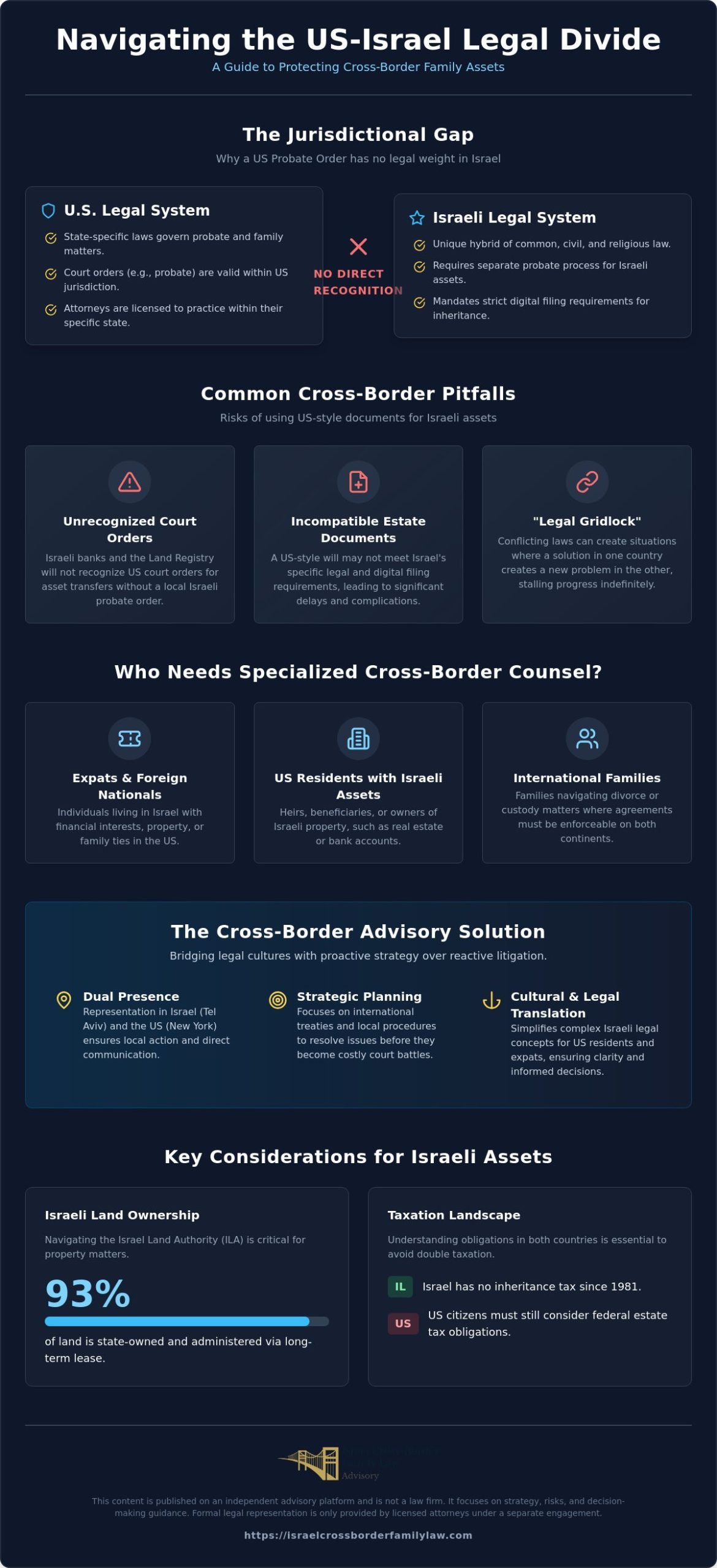
Managing legal affairs across borders is fundamentally different from local litigation. When assets or family members are split between the United States and Israel, legal requirements don’t just double; they multiply in complexity. A standard US attorney, while expert in their state’s laws, lacks the standing and specific procedural knowledge required by the Israeli family court system. This gap often leads to stalled probate cases or unenforceable custody agreements because the systems don’t communicate automatically. Success in these matters requires a strategy that accounts for two distinct legal cultures simultaneously.
The foundations of Israeli law are a unique hybrid of common law, civil law, and religious principles. This creates a significant cultural and procedural barrier for those accustomed to the American system. Specialized firms like Aharoni Law Firm serve as a critical bridge, translating these complex concepts into terms that US residents and expats can understand. They maintain a physical presence in both Tel Aviv and major US hubs like New York. This dual presence ensures that clients have local representation in Israel while maintaining direct communication in their own language and time zone.
To better understand how this specialized expertise supports international families, watch this helpful video:
The Complexity of Multi-Jurisdictional Disputes
Conflicting laws often create “legal gridlock” where a solution in one country creates a new problem in the other. For instance, a US-style will might not meet the strict digital filing requirements mandated by the Israeli Registrar of Inheritance Affairs. Without dual-jurisdiction awareness, an executor might find that US court orders aren’t recognized by Israeli banks or the Land Registry. Early strategic planning focuses on international treaties and local procedures to resolve these issues before they become expensive courtroom battles. Reactive litigation is almost always more costly than seeking proactive advisory guidance before a crisis occurs.
Who Benefits from Specialized Cross-Border Counsel?
Several groups find this specialized approach essential for protecting their interests. Expats and foreign nationals living in Israel often maintain significant financial interests in the US, requiring a strategy that respects both tax systems. Similarly, US residents who inherit Israeli property must navigate the Israel Land Authority (ILA) system, where over 93% of land is state-owned and administered on a long-term lease basis. International families navigating divorce or custody matters also rely on this expertise to ensure that agreements are enforceable on both continents. This content is published on an independent advisory platform and focuses on strategy, risks, and decision-making rather than an attorney-client relationship. Legal services are only provided by licensed attorneys under a separate engagement.
Key Practice Areas: From Israeli Probate to Real Estate
Managing assets across the Atlantic requires more than just legal knowledge; it demands a strategic grasp of regulatory compliance. For individuals navigating these waters, the U.S.-Israel Tax Treaty serves as a primary framework for avoiding double taxation on income and corporate assets. While Israel has not had an inheritance tax since 1981, US citizens must still consider their federal estate tax obligations, which in 2026 apply to estates valued above $13.99 million. Aharoni Law Firm provides the necessary oversight to ensure that transfers of funds and property titles remain compliant with both Israeli regulations and US reporting standards. This content is published on an independent advisory platform and focuses on strategy and risk management; formal legal representation is only provided by licensed attorneys under a separate engagement.
Success in these matters often hinges on identifying risks before they escalate. Whether you’re dealing with a complex corporate structure or a simple bank account, the procedural differences between the two countries are stark. It’s often helpful to discuss your situation with an advisor who understands the weight of these early decisions.
Israeli Inheritance and Succession Law
The probate process in Israel involves two distinct paths: a petition for a Probate Order, when a will exists, or a Succession Order, when there’s no will. A will, known as a tzavaah, must be validated by local authorities even if it was already probated in a US court. The Israeli Succession Authority acts as the central administrative body responsible for overseeing all inheritance petitions and issuing formal orders for estates involving international assets. This process includes navigating the mandatory digital portal for foreign residents and locating “abandoned” property or dormant bank accounts that may have been transferred to the Israeli Administrator General if left unclaimed for long periods.
Cross-Border Real Estate Transactions
Purchasing property in high-demand areas like Tel Aviv or Jerusalem involves unique hurdles for non-residents. Most land in Israel, over 93%, is state-owned and managed by the Israel Land Authority (ILA) on a long-term lease basis, requiring specific due diligence to ensure a clear title. Sellers must also account for the Betterment Tax, or Heitel Hashbacha, which is a local levy on the increase in property value resulting from approved building plans or zoning changes. Additionally, when selling inherited property, the 25% capital gains tax (Mas Shevach) is calculated from the deceased’s original purchase price rather than the value at the time of death. These nuances make specialized guidance for foreign nationals essential for protecting the value of your investment.
Evaluating Firms Like Aharoni Law Firm: A Benchmark for Quality
Selecting a cross-border legal partner requires a level of due diligence that goes beyond standard local searches. A reputable firm must demonstrate more than just a presence in two countries; it must show a profound integration into both legal frameworks. A primary benchmark for quality in this field is the presence of dual-qualified practitioners. These attorneys, like those at Aharoni Law Firm, hold licenses in both the US and Israel. This allows them to act as a single point of contact for complex matters that would otherwise require multiple separate legal teams. This content is published on an independent advisory platform and focuses on strategy, risks, and decision-making guidance. Formal legal representation is only provided by licensed attorneys under a separate engagement.
Beyond licensing, look for a firm that prioritizes transparent communication. The Israeli legal system uses procedural terms that don’t always translate directly to American concepts. A quality firm will provide “plain English” explanations of every step, ensuring you understand the weight of your decisions. They should be able to explain the advisory approach to international law, which focuses on resolving issues through strategic planning rather than jumping immediately into reactive litigation. This transparency helps you understand the inherent complexity of your case without the confusion of unnecessary legal jargon.
What to Look for in Client Testimonials and Ratings
Generic praise like “excellent lawyer” doesn’t tell you if a firm can handle the specific hurdles of international law. Look for testimonials that detail successful outcomes in cross-border probate or property recovery. These accounts verify the firm’s ability to navigate Israeli authorities from abroad. Peer recognition in international legal directories also signals an elite status and historical longevity. However, local Israeli expertise is non-negotiable. A firm must have practitioners who are physically present in Israel to handle filings with the Registrar of Inheritance Affairs or the Israel Land Authority. This local engagement is what ensures your assets are protected according to current Israeli regulations.
Questions to Ask During an Initial Consultation
To gain clarity on a firm’s capabilities, ask targeted questions during your first meeting.
- How do your US and Israeli offices coordinate on a daily basis to manage my case?
- What is your specific experience with cross-border enforcement of child support or Hague Convention issues?
- Do you provide a clear breakdown of fees, such as flat fees for uncontested probate versus hourly rates for complex litigation?
Standard attorney fees for uncontested probate in Israel typically range from ₪20,000 to ₪50,000. For complex estates, fees may be calculated as a percentage of the asset value. Understanding these costs and the firm’s strategic process helps you move forward with confidence and protects you from unexpected financial commitments.
Common Pitfalls in US-Israel Legal Planning
One of the most frequent errors international families make is assuming that legal documents drafted in the United States will be seamlessly accepted by Israeli authorities. Using a standard US-style will for assets located in Israel often leads to significant delays, as the document may not align with local formal requirements or the mandatory digital filing system. These oversights can extend the standard 3 to 12-month timeline for obtaining an Israeli probate order, leaving assets frozen and beneficiaries in limbo. Seeking clarity through a specialized practice like Aharoni Law Firm helps identify these inconsistencies before they become insurmountable hurdles. This content is published on an independent advisory platform and focuses on strategy, risks, and decision-making; legal services are only provided by licensed attorneys under a separate engagement.
Another critical pitfall involves the financial implications of transferring funds between the two countries. While Israel does not currently impose an inheritance tax, the process of moving large sums from an Israeli bank to a US account requires strict adherence to anti-money laundering regulations and reporting standards. Ignoring the weight of these early decisions can result in unexpected bank freezes or tax scrutiny. It’s vital to request a confidential consultation to understand how your specific financial structure interacts with the US-Israel Tax Treaty before you initiate any major transfers.
The Risk of Inconsistent Legal Documents
Many clients mistakenly believe a US prenuptial agreement is automatically enforceable in Israel. In reality, Israeli courts may require these agreements to be formally approved by a local judge to hold weight in a cross-border divorce. For those with property on both continents, “mirror wills” are often a necessity; these are separate but coordinated documents designed to satisfy the specific legal formalities of each jurisdiction. Failing to coordinate these documents can lead to “forum shopping,” which is the practice of one party rushing to initiate legal proceedings in the country they believe will provide a more favorable financial or custody outcome. This race to the courthouse can be avoided through proactive, multi-jurisdictional planning.
Navigating the Israeli Bureaucracy
The Israeli bureaucratic landscape is notoriously complex for those unfamiliar with its specific rhythms. Common delays often occur at the Ministry of Interior or the Land Registry due to missing apostilles or improperly notarized documents. Every legal instrument intended for use in Israel must be authenticated according to international standards to be recognized by local officials. For expats and foreign nationals, navigating the mandatory digital portal for inheritance affairs is a specialized task that requires local expertise. Understanding these procedural requirements early on prevents the frustration of repetitive filings and ensures that your international assets remain protected under both legal systems.
Seeking Clarity: The Advisory Approach to Cross-Border Law
Choosing the right legal path in international matters often requires a shift in perspective. While traditional litigation firms typically focus on the courtroom as the primary venue for resolution, a legal advisory approach prioritizes strategy and risk mitigation before any formal action is taken. In the complex world of US-Israel law, jumping straight into reactive litigation can lead to jurisdictional deadlocks and high costs. The advisory model acts as a strategic bridge, helping you understand how a decision made in Tel Aviv might impact your legal standing or tax obligations in the United States. Aharoni Law Firm exemplifies this specialized model, providing the oversight needed to navigate two fundamentally different legal cultures. This content is published on an independent advisory platform and focuses on strategy, risks, and decision-making; legal services are only provided by licensed attorneys under a separate engagement.
Getting clarity before you commit is the most important step in any international legal journey. In cross-border cases, the weight of early decisions is significant and often irreversible. For instance, choosing where to file an initial petition can determine which country’s laws will govern your assets for years to come. An advisory review provides a comprehensive roadmap, identifying potential pitfalls such as non-compliance with the US-Israel Tax Treaty or the use of unenforceable legal templates. This strategic foresight allows specialized advisors to work seamlessly alongside your existing local professional teams, such as US-based CPAs or family lawyers, ensuring that your global interests are managed with a unified strategy.
Strategic Guidance for Complex Situations
The advisory model focuses on conflict resolution rather than aggressive, high-conflict litigation. By understanding how the advisory works, families can see that the goal is to find the most efficient and least disruptive path through the Israeli system. For Anglo and expat families, this means tailoring legal strategies to account for cultural nuances and procedural differences that a standard local firm might overlook. Whether you’re managing a multi-generational inheritance or a transnational custody issue, the priority is always to achieve your objectives while minimizing legal friction and protecting your family’s privacy.
Your Next Steps in the US-Israel Legal Journey
Seeking an independent second opinion is a vital part of protecting your international assets. Cross-border law is too intricate for generic solutions, and a fresh perspective can often uncover risks that were previously ignored. Initiating a confidential review of your case allows you to assess the strength of your position with a professional who holds dual-jurisdiction expertise. This process isn’t just about legal advice; it’s about gaining the confidence to move forward with a clear plan. It ensures you aren’t making commitments based on a partial understanding of the Israeli legal landscape.
Get clarity before you commit. Request a confidential consultation.
Securing Your International Legacy
Navigating the intersection of US and Israeli legal systems requires a proactive strategy that accounts for inherent cultural and procedural differences. By prioritizing an advisory approach, you can identify potential risks in probate, property, or family law before they become costly public disputes. This guide has emphasized the importance of seeking dual-jurisdiction expertise and the necessity of coordinating legal documents to satisfy both American and Israeli authorities simultaneously. Understanding the weight of these early decisions is the most effective way to protect your family’s future.
This independent advisory platform is dedicated to providing strategy and risk mitigation guidance for international families. We offer educational resources specifically designed for Anglos and expats who need to protect their global assets without the stress of navigating a foreign bureaucracy alone. Evaluating specialized practitioners like those at Aharoni Law Firm is a critical benchmark for quality in your cross-border journey. Taking the time to understand these complexities now ensures that your international interests remain secure and compliant for the long term. You can move forward with confidence when you have a clear roadmap for your assets.
Get clarity before you commit. Request a confidential consultation.
Frequently Asked Questions
Is Aharoni Law Firm licensed to practice in both the US and Israel?
Dually qualified firms like Aharoni Law Firm typically employ practitioners who hold active licenses in both the United States and Israel. This dual qualification is essential for bridging the procedural gaps between the two legal systems and ensuring that your strategy respects the regulations of both countries. Having a single point of contact with this expertise prevents the confusion that often arises when managing separate legal teams across different time zones.
What are the main differences between US and Israeli inheritance laws?
The most significant difference is that Israel abolished its inheritance and estate tax in 1981, while the US maintains a federal estate tax with a 2026 exemption of $13.99 million. Procedurally, Israel requires a separate local probate process for any real estate located within its borders, regardless of where the deceased resided. As of May 2026, all inheritance petitions involving foreign residents must be submitted through a mandatory digital portal to the Registrar of Inheritance Affairs.
Can I sell my inherited property in Israel without traveling there?
You can sell inherited property in Israel without physically traveling to the country by utilizing a power of attorney that is properly notarized and apostilled. This legal instrument allows a local representative to manage the entire transaction, from listing the property to signing the final deed at the Land Registry. It’s important to coordinate this process carefully to ensure all documents meet the specific formal requirements of the Israel Land Authority.
Are US prenuptial agreements valid in the Israeli family court system?
A US prenuptial agreement isn’t automatically enforceable in Israel and often requires formal validation by an Israeli family court judge to be recognized. The court will review the document to ensure it doesn’t contradict local public policy and that both parties entered the agreement voluntarily. International families often find that coordinating their legal documents to satisfy the standards of both jurisdictions is the most effective way to protect their interests.
How long does the probate process typically take in Israel for US residents?
For US residents, the uncontested probate process in Israel typically takes between 3 and 12 months from the time the petition is filed. This timeline accounts for the mandatory digital submission and the administrative review by the Succession Authority. Working with a specialized practice like Aharoni Law Firm can help ensure that all documentation, including foreign death certificates and wills, is correctly authenticated to prevent unnecessary bureaucratic delays during this period.
What is the role of an international family law advisor compared to a trial lawyer?
An international family law advisor focuses on strategy, risk mitigation, and conflict resolution before a case escalates to litigation, whereas a trial lawyer primarily manages courtroom proceedings. This content is published on an independent advisory platform and focuses on strategic decision-making guidance. It’s important to understand that legal services are only provided by licensed attorneys under a separate engagement, and an advisory approach helps you gain clarity before making significant legal commitments.
How does the US-Israel tax treaty affect my inheritance?
The US-Israel Tax Treaty provides a framework to prevent double taxation on income and assets held by individuals with interests in both countries. While Israel doesn’t impose a tax on the inheritance itself, the treaty governs how capital gains from the sale of inherited property or income from Israeli bank accounts are reported. Compliance with these rules is essential for avoiding penalties from the IRS or the Israeli Tax Authority when transferring funds across borders.
What should I do if I find abandoned property in Israel belonging to my family?
If you discover abandoned property or dormant bank accounts, you must initiate a search through the Administrator General’s office to confirm the asset’s status. Once identified, you’ll need to obtain an Israeli Succession Order to prove your legal right to the property and petition for its release. Because 93% of land in Israel is state-owned, you must also verify the lease terms with the Israel Land Authority to ensure the title is clear and transferable.

Article by
Gabriel Lior
A Personal Journey That Became a Mission
The advisory was founded by an American father Gabriel Lior, LLB, MBA , global entrepreneur, and cross-border advisor who spent more than a decade navigating the Israeli family court system firsthand and now lives in Singapore with his son.
As a divorced parent in a cross-border family, Gabriel faced nearly every legal challenge a foreign parent can encounter in Israel — including child custody disputes, child support proceedings, property matters in Israel and abroad, false accusations, and complex immigration and relocation proceedings.
Over the years, he learned the hard way how difficult it is for non-Israeli parents to understand the system, identify the right legal strategy, and choose the right legal representation — especially when language, culture, and jurisdictional differences are involved. He also witnessed how foreign parents and new immigrants are often disadvantaged or taken advantage of by service providers and institutions simply because they lack local knowledge or fluency.
From Client to Advisor
To truly understand — and survive — the system, Gabriel pursued formal legal education in Israel, completing two Israeli law degrees, alongside a BA and MBA earned in the United States. This was never about becoming a practicing attorney, but about gaining a deep, structural understanding of how the system works — and where it breaks down for foreign parents.
This rare combination of:
Firsthand client experience
Israeli legal and US business education
International business and negotiation training
Decades of commercial execution
created a unique perspective – one that understands both sides of the table.
After years of litigation, persistence, and at times self-representation, he ultimately succeeded in securing custody of his son and relocating abroad through a rare legal victory in the Israeli Supreme Court — becoming one of the first fathers in Israel to do so under these circumstances.
Disclaimer
Important Disclaimer:
The information provided on this website and in its content is for general informational and educational purposes only and does not constitute legal advice, legal opinion, or legal representation.
Gabriel Lior is not licensed to practice law in Israel (nor is he interested in doing so) and does not provide legal services, despite having completed 2 Law Degrees. The services offered are advisory in nature and are intended to provide general guidance, strategic insight, and information regarding cross-border family law considerations.
No attorney-client relationship is formed by accessing this website, reading its content, or communicating with us.
Any decisions made based on this information are at your own discretion and risk. For legal advice specific to your situation, you should consult a licensed attorney in the relevant jurisdiction.
Where appropriate, we may refer clients to independent, licensed attorneys or professionals. Such referrals do not constitute legal representation and no liability is assumed for services provided by third parties.