What if the most important decision in your Israeli divorce case happens before you even step into a courtroom? For many expats and international families, the realization that Israel operates under a dual system of civil and religious courts often brings immediate confusion and anxiety. It’s difficult to feel secure when you’re managing complex issues like international child custody or property division across borders, especially when language barriers and unfamiliar procedures are involved. The Amihoud Borochov Law Office provides the authoritative expertise required to navigate these multi-jurisdictional challenges with clarity and composure.
In this article, you’ll discover the specialized capabilities of the firm and learn how to manage the intricacies of cross-border family law in Israel. We’ll provide an overview of how the local legal framework addresses international disputes and explain the strategic importance of early decision-making. By understanding these core concepts, you’ll gain the perspective needed to determine the best path forward for your family’s future.
Key Takeaways
- Learn why the Amihoud Borochov Law Office is uniquely positioned to bridge the gap between Israeli and international legal systems for English-speaking families.
- Understand the fundamental differences between Israel’s Civil Family Courts and the Rabbinical Court system to avoid unexpected jurisdictional outcomes.
- Discover how multilingual representation ensures that cultural nuances and legal strategies are accurately communicated across different jurisdictions.
- Gain clarity on the strategic importance of conducting a risk assessment of your assets and jurisdictional ties before initiating legal proceedings.
- Recognize why early decisions in cross-border divorce or custody cases carry significant weight and require a well-informed strategy.
An Overview of Amihoud Borochov Law Office
The Amihoud Borochov Law Office stands as a pioneer in the field of Israeli international family law. Since its establishment in 1989, the firm has focused on cases that carry a significant global dimension. This historical longevity is not just a measure of time; it represents a deep understanding of how the Israeli legal system has evolved over decades. For families moving between jurisdictions, this experience provides a steady hand in a landscape that is often confusing. It’s essential to understand that this content is published on an independent advisory platform, not by a law firm. We provide this information to help you understand your options before you seek formal representation.
A Legacy of International Expertise
The firm’s foundation in 1989 marked a shift toward specialized cross-border representation. Practitioners from the firm have appeared across all levels of the judiciary, including the Supreme Court. This extensive history has allowed the Amihoud Borochov Law Office to play a role in shaping precedents that affect international families in Israel today. Whether dealing with complex asset division or sensitive custody arrangements, the firm’s background ensures that clients aren’t just reacting to the law but are guided by decades of established practice. Decisions made in the early stages of a case often carry the most weight, and having a guide with historical perspective helps mitigate long-term risks.
Multilingual Counsel for Expats and Anglos
Clarity is the most valuable asset in any legal proceeding. For expats and Anglos, the ability to communicate in one’s mother tongue is critical for ensuring that strategic goals are met. The firm provides counsel in Hebrew, English, and French, bridging the gap between foreign legal expectations and the specific realities of the Israeli courts. This goes beyond simple translation; it involves interpreting cultural nuances that can influence a judge’s perspective or a negotiator’s stance. You can find more Information for expats and foreign nationals regarding how these services align with your specific needs. Language barriers often lead to significant risks in cross-border cases, making mother-tongue proficiency a foundational requirement for effective representation. When you’re dealing with the pressure of a family dispute, you don’t want to worry about your message getting lost in translation.
Specialized Practice Areas in International Family Law
International family law isn’t just about local statutes; it’s about how those statutes interact with foreign codes. The Amihoud Borochov Law Office operates at the intersection of US and Israeli law, managing the friction that arises when two different legal cultures meet. High-stakes litigation in this field requires more than just legal knowledge. It demands a strategic understanding of how a ruling in one country might affect assets or rights in another. The firm focuses on these multi-jurisdictional complexities, ensuring that clients understand the weight of every procedural move.
Property distribution is a prime example of this complexity. When an estate includes assets in multiple jurisdictions, the tax implications and ownership rules can vary significantly. For instance, while Israel does not have an inheritance tax as of July 2026, heirs are subject to Capital Gains Tax (Mas Shevach) when they eventually sell an inherited asset. This tax is calculated based on the original purchase price paid by the deceased, not the value at the time of inheritance. Failing to account for these details can lead to unexpected financial burdens during the distribution of an estate.
International Child Abduction and the Hague Convention
Cases involving the potential abduction of a child require immediate, decisive action. The 1980 Hague Convention provides a framework for the return of children taken across borders, but its application in Israel is rigorous and time-sensitive. The Amihoud Borochov Law Office represents both left-behind parents seeking a return and parents currently in Israel, providing a balanced perspective on these high-pressure situations. Understanding the nuances of Navigating Hague Convention child abduction is essential for anyone facing this crisis, as delays can lead to the loss of critical legal protections.
Cross-Border Divorce and Maintenance
Determining where to file for divorce is often the most critical decision a spouse will make. In Israel, the “race to jurisdiction” remains a defining factor, where filing first in either the civil Family Court or the Rabbinical Court can change the legal framework of the case. If a spouse has a US support order, enforcing those payments within the Israeli system presents its own set of hurdles. Gaining clarity on Child support and cross-border enforcement helps families manage expectations regarding financial stability. Managing these multi-layered challenges requires a clear strategy before any formal steps are taken. You might find it helpful to discuss your specific jurisdictional ties to better understand the risks involved.
Navigating the Israeli Family and Religious Court Systems
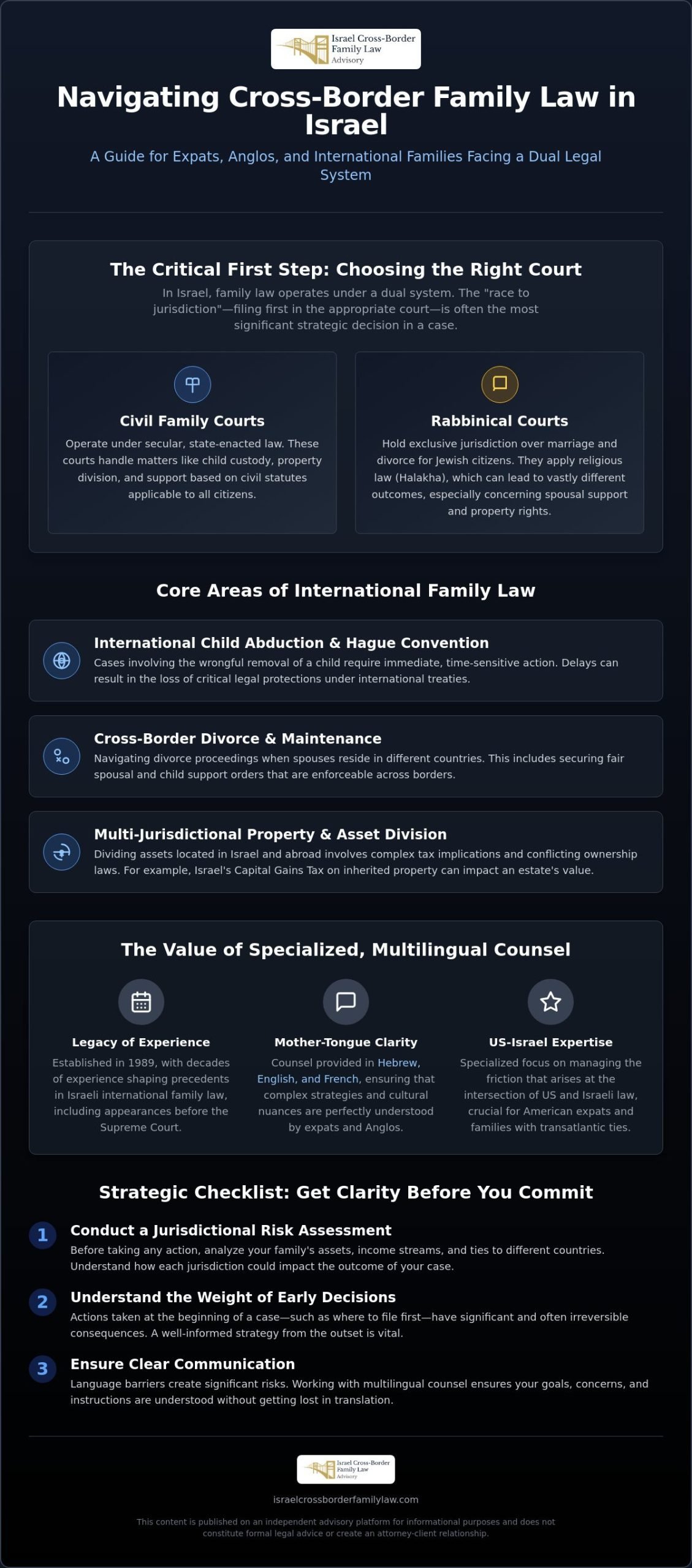
Israel’s approach to family law is unique because it operates under a dual court system. This structure splits authority between state-run civil Family Courts and religious Rabbinical Courts. For Jewish citizens, the Rabbinical Court holds exclusive jurisdiction over the act of marriage and divorce itself. However, both court systems often have overlapping authority regarding related issues like property division or alimony. The Amihoud Borochov Law Office provides the specialized expertise necessary to navigate this overlap, ensuring that international clients understand which system best protects their interests. A defining feature of this system is the “race for jurisdiction,” known in Hebrew as mirahtz samchuyot. This means the court where a case is filed first typically retains the right to hear the entire dispute, making early strategic decisions vital.
As this content is published on an independent advisory platform, it’s intended to provide strategic guidance rather than formal legal representation. Understanding the risks and procedural differences between these two systems is the first step toward a stable resolution. Recognition of foreign decrees is another complex layer, as Israeli authorities must formally validate overseas judgments before they can be enforced locally. This process requires a clear understanding of both international treaties and local procedural requirements.
The Role of the Israeli Family Court
The civil Family Court is a secular judiciary that handles matters such as child custody, visitation, and the distribution of assets. While it shares some similarities with US Probate or Family Courts, the procedural rules in Israel are distinct. For example, the court emphasizes the “best interests of the child” through a secular lens, often relying on social workers and court-appointed experts. Decisions made during the initial stages of civil litigation carry significant weight and can be difficult to reverse later. Because the Israeli system moves quickly once a case is opened, seeking clarity before making formal commitments is essential for protecting your long-term rights.
Engagement with Religious Tribunals
A case may enter the Rabbinical Court system if a divorce claim is filed there first and other matters are “attached” to it. These tribunals operate according to religious law, which can differ significantly from civil standards. Recent legislative changes in November 2025 granted Rabbinical Courts a two-year interim authority to rule on child support payments to help resolve stalled divorce cases. Managing these proceedings requires a delicate balance of religious law and international legal standards. The Amihoud Borochov Law Office has extensive experience representing clients in these sensitive environments, including appearances before the Grand Rabbinical Court of Appeals. This high-level experience is crucial for families who need to ensure their global assets and rights are respected within a religious framework.
Why Multilingual Representation Matters for Expats
Effective representation in cross-border family law requires more than just a passing familiarity with a second language. For expats and international families, the ability to communicate nuances in English or French is a strategic necessity rather than a convenience. Language barriers often mask deeper legal risks, where a simple misunderstanding of a term could lead to the unintended waiver of rights or the misinterpretation of a court order. The Amihoud Borochov Law Office prioritizes this level of clarity, ensuring that clients fully grasp the implications of every document they sign and every strategy they approve.
Beyond the written word, cultural nuance plays a decisive role in how a case is presented to an Israeli judge. Legal systems are products of their cultures; what seems like a standard request in a US Probate Court might be viewed differently in an Israeli civil or religious tribunal. The practitioners at Amihoud Borochov Law Office focus on bridging these gaps by translating not just the language, but the expectations of the court. Viewing guidance on the Israel Family Law YouTube channel can help you visualize these differences and understand the practical realities of the local judiciary. This visual context, paired with professional advice, helps reduce the emotional burden often associated with multi-jurisdictional litigation.
Bridging Divergent Legal Cultures
Explaining Israeli legal concepts using terms familiar to US or UK citizens is the first step in building a coherent strategy. For example, the way Israeli courts handle the “best interests of the child” may differ from the expectations of a parent accustomed to British or American standards. A cross-cultural legal bridge is a practitioner who interprets the procedural intent of one legal system through the cultural and linguistic lens of another to ensure strategic alignment. This approach ensures that your goals remain the priority, regardless of the complexity of the local framework.
Evaluating Experience in Multi-Jurisdictional Disputes
When selecting a representative, it is vital to look beyond surface-level claims of “international experience.” You should ask specific questions about a firm’s track record with cases involving your home country. Consider whether they have a physical presence in major Israeli hubs, as active local engagement is often more effective than remote counsel. A firm’s ability to collaborate seamlessly with your existing legal team in the US or UK is another critical differentiator. This partnership ensures that your global assets and rights are protected on both sides of the border. If you are unsure how your specific circumstances fit into the Israeli system, you can request a confidential review of your jurisdictional ties to gain immediate clarity.
Strategic Steps for Managing Cross-Border Legal Challenges
Managing a family dispute that spans multiple countries requires a proactive strategy rather than a reactive one. The most critical step you can take is seeking clarity before you make any formal legal commitments or sign documents. In the Israeli system, even a single court appearance or a signed statement can inadvertently grant jurisdiction to a court that may not be the most advantageous for your specific situation. This content is published on an independent advisory platform, not a law firm. Our role is to provide a neutral space for strategy and risk assessment, helping you understand your options before you transition to formal representation with a practitioner such as the Amihoud Borochov Law Office.
A thorough risk assessment is the foundation of any successful cross-border strategy. You must evaluate your assets, your jurisdictional ties, and the long-term implications of where your case is heard. This process involves looking at your global footprint to ensure that a decision made in an Israeli court won’t negatively impact your rights or property in your home country. For more visual guidance on how these systems interact, we encourage you to view the resources on the Israel Family Law YouTube channel. Understanding the practical realities of the judiciary helps you move from a state of anxiety to one of informed decision-making.
The Importance of Early Advisory
The first 30 days of a cross-border dispute are often the most critical. This is the window where jurisdictional “traps” are most common. If you respond to a claim in the Rabbinical Court without the proper legal reservations, you might find yourself bound to that system for all related matters, including property and custody. Avoiding these common mistakes requires a baseline understanding of your current legal standing. Requesting a confidential case review allows you to establish this baseline and identify potential risks before they become permanent legal hurdles. Early advisory isn’t about rushing into litigation; it’s about ensuring your first step is the right one.
Setting Realistic Expectations
It is vital to understand that cross-border cases are inherently complex and often lengthy. They involve multiple layers of law, cultural differences, and procedural requirements that don’t exist in domestic cases. A calm, authoritative approach is almost always more effective than aggressive litigation, which can lead to unnecessary delays and increased costs. By focusing on strategy and clear communication, you can manage the “long game” of international family law with greater composure.
Get clarity before you commit. Request a confidential consultation.
Securing a Clear Path for Your Cross-Border Family Future
Navigating the dual court system in Israel requires a deep understanding of the “race for jurisdiction” and the significant differences between civil and religious tribunals. Success in these complex matters often depends on early risk assessments and the clarity that comes from multilingual representation. By prioritizing strategy over immediate litigation, you protect your global assets and your parental rights. It’s essential to remember that the decisions you make in the first few weeks of a dispute often carry the most weight for years to come.
This platform serves as an independent advisory space where strategy and risk take precedence. We provide tailored guidance for international families and expats who need to bridge the gap between divergent legal cultures. When you’re ready to transition from planning to formal representation, the Amihoud Borochov Law Office offers the established expertise required to manage high-stakes international disputes with professional composure. You don’t have to face these multi-jurisdictional complexities without a steady guide.
Get clarity before you commit. Request a confidential consultation. Taking the time to understand your options today ensures a more stable and predictable outcome for your family tomorrow.
Frequently Asked Questions
Who is Amihoud Borochov and what is the firm’s specialty?
Amihoud Borochov is the founding attorney of the firm, which has been a fixture in the Israeli legal community since 1989. The Amihoud Borochov Law Office specializes in complex international family law, including divorce, child custody, and estate planning. They are recognized for their ability to navigate the intersection of Israeli law and foreign legal systems. This focus is essential for families who need a guide through the unique challenges of multi-jurisdictional disputes.
Does the Amihoud Borochov Law Office handle cases for US citizens?
Yes, the firm has extensive experience representing US citizens and other expats with ties to Israel. They manage cases where assets or family members are spread across multiple countries, ensuring that US legal expectations are balanced with Israeli reality. Their practitioners understand the specific needs of Anglos who are unfamiliar with the local judiciary and require clear, English-language guidance throughout the duration of their case.
What is the difference between the Family Court and the Rabbinical Court in Israel?
The Family Court is a secular civil court, whereas the Rabbinical Court is a religious tribunal. While only the Rabbinical Court can formally grant a Jewish divorce, the Family Court handles most civil matters like custody and property. The “race for jurisdiction” determines which court will hear the case based on where it was filed first. Choosing the right court is a strategic decision that carries significant weight for the final outcome.
Can this firm help with international child abduction cases under the Hague Convention?
The firm maintains a dedicated focus on international child abduction cases governed by the 1980 Hague Convention. They provide representation for parents seeking the return of a child and for those defending against such claims within Israel. Because these cases move quickly and involve strict timelines, the firm emphasizes immediate risk assessment and strategic planning to protect the child’s best interests and the parent’s legal rights under international law.
How does the firm handle inheritance and wills for assets located in both the US and Israel?
Managing estates with assets in both the US and Israel requires a strategy that accounts for different tax and probate rules. While Israel does not currently have an inheritance tax, heirs may face capital gains tax when selling inherited property. The Amihoud Borochov Law Office helps families structure their wills to address these multi-jurisdictional complexities. This ensures that assets are distributed according to the deceased’s wishes without unnecessary legal friction or unexpected tax burdens.
Is it possible to get a second opinion on an ongoing Israeli family law case?
Obtaining a second opinion is a prudent step if you feel your ongoing case lacks a clear cross-border strategy. This independent advisory platform provides a neutral space to review your current legal path and identify potential risks. A second opinion can offer the clarity needed to decide whether to adjust your strategy or seek new representation that better understands the nuances of international family law and jurisdictional challenges.
What are the risks of not having a multilingual lawyer in Israel?
Not having a multilingual lawyer can lead to significant risks, such as misunderstanding court procedures or misinterpreting legal documents. In Israel, legal terminology often carries cultural weight that doesn’t translate directly into English. A lawyer who is fluent in both languages ensures that your intent is accurately represented in court. It also ensures that you fully understand the implications of every decision made during the legal process.
How can I schedule a consultation for a cross-border legal matter?
You can schedule a strategy session by requesting a confidential review through this advisory platform. It’s important to note that this content is published on an independent advisory platform and is not a law firm. Our focus is on providing strategy and risk assessment to help you gain clarity. Once you have established a clear path, you can transition to formal representation to manage your family law matter in the Israeli courts.

Article by
Gabriel Lior
A Personal Journey That Became a Mission
The advisory was founded by an American father Gabriel Lior, LLB, MBA , global entrepreneur, and cross-border advisor who spent more than a decade navigating the Israeli family court system firsthand and now lives in Singapore with his son.
As a divorced parent in a cross-border family, Gabriel faced nearly every legal challenge a foreign parent can encounter in Israel — including child custody disputes, child support proceedings, property matters in Israel and abroad, false accusations, and complex immigration and relocation proceedings.
Over the years, he learned the hard way how difficult it is for non-Israeli parents to understand the system, identify the right legal strategy, and choose the right legal representation — especially when language, culture, and jurisdictional differences are involved. He also witnessed how foreign parents and new immigrants are often disadvantaged or taken advantage of by service providers and institutions simply because they lack local knowledge or fluency.
From Client to Advisor
To truly understand — and survive — the system, Gabriel pursued formal legal education in Israel, completing two Israeli law degrees, alongside a BA and MBA earned in the United States. This was never about becoming a practicing attorney, but about gaining a deep, structural understanding of how the system works — and where it breaks down for foreign parents.
This rare combination of:
Firsthand client experience
Israeli legal and US business education
International business and negotiation training
Decades of commercial execution
created a unique perspective – one that understands both sides of the table.
After years of litigation, persistence, and at times self-representation, he ultimately succeeded in securing custody of his son and relocating abroad through a rare legal victory in the Israeli Supreme Court — becoming one of the first fathers in Israel to do so under these circumstances.
Disclaimer
Important Disclaimer:
The information provided on this website and in its content is for general informational and educational purposes only and does not constitute legal advice, legal opinion, or legal representation.
Gabriel Lior is not licensed to practice law in Israel (nor is he interested in doing so) and does not provide legal services, despite having completed 2 Law Degrees. The services offered are advisory in nature and are intended to provide general guidance, strategic insight, and information regarding cross-border family law considerations.
No attorney-client relationship is formed by accessing this website, reading its content, or communicating with us.
Any decisions made based on this information are at your own discretion and risk. For legal advice specific to your situation, you should consult a licensed attorney in the relevant jurisdiction.
Where appropriate, we may refer clients to independent, licensed attorneys or professionals. Such referrals do not constitute legal representation and no liability is assumed for services provided by third parties.