Imagine discovering that a legal decision made in a New York office could inadvertently trigger a “race to the court” in Jerusalem, fundamentally altering the trajectory of your family’s future. For many expats and international families, the realization that Israeli and American legal systems often conflict is both startling and stressful. You might feel confused about which jurisdiction applies to your specific case or fear that one wrong move early in the process will lead to irreversible consequences. The Amir Cohen Law Firm understands these anxieties, providing the authoritative guidance needed to navigate the multi-jurisdictional complexity of family and estate law.
We agree that the stakes are incredibly high when your life is split between two nations. This article offers a comprehensive overview of the expertise and strategic approach required for managing complex legal matters between Israel and the United States. You’ll gain clarity on the inherent risks of cross-border litigation and understand the significant differences between legal cultures, such as the dual system of civil and religious courts. We will preview the firm’s role as a strategic bridge, ensuring you have a clear path toward professional engagement. For more visual insights into these topics, you can explore the Israel Family Law YouTube channel.
Key Takeaways
- Understand how the Amir Cohen Law Firm bridges the gap between the Israeli and American legal systems to provide strategic clarity for international families.
- Identify common “jurisdictional traps” that arise from the unique hybrid nature of Israel’s legal framework compared to the US.
- Learn about the critical risks involved in cross-border matters, including whether a US court judgment can actually be enforced within Israel.
- Discover the essential criteria for selecting legal representation, focusing on the importance of multi-jurisdictional experience and clear, jargon-free communication.
- Transition from legal uncertainty to a documented strategy by prioritizing early decisions and seeking a confidential case review.
Disclaimer: This content is published on an independent advisory platform and is not a law firm. The information provided is for educational and advisory purposes only and does not constitute legal representation or formal legal advice. Legal services are only provided by licensed attorneys under a separate, formal engagement.
Who is Amir Cohen and What Defines the Firm’s Practice?
Managing legal affairs between two countries requires a deep understanding of how different systems interact. The Amir Cohen Law Firm has established a reputation within the Israeli legal community for handling these exact complexities. The firm doesn’t just offer local counsel; it acts as a strategic bridge for individuals whose lives and assets span the Atlantic. Amir Cohen’s professional standing is built on a foundation of clarity and precision, helping clients who feel overwhelmed by the differences between Israeli and American legal cultures. You can learn more about this specialized approach on our about the advisory page.
The firm is recognized for its sophisticated handling of multi-jurisdictional matters. This expertise is particularly vital when dealing with international treaties like the Hague Convention on International Child Abduction. In these sensitive cases, a single misstep in the early stages can lead to long term consequences. The firm’s role is to provide a steady hand, ensuring that clients understand the weight of every decision before they commit to a course of action.
Core Practice Areas and Specializations
The Value of Local Presence in Tel Aviv and New York
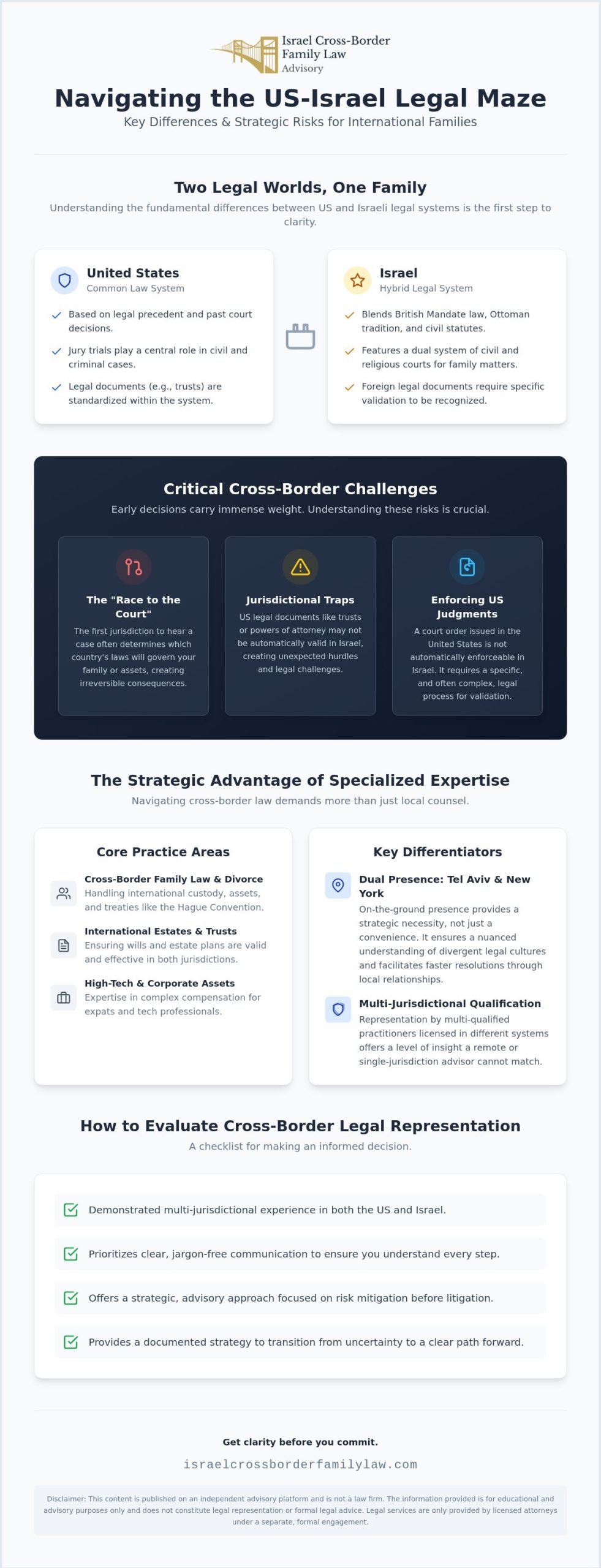
Physical presence in both Tel Aviv and New York isn’t just a convenience; it’s a strategic necessity. Cross-border clients benefit from practitioners who are multi-qualified and hold licenses in different legal systems. This dual qualification ensures a nuanced understanding of divergent business and legal cultures that a remote advisor simply cannot match. Local relationships in Israel are equally important. These connections often facilitate faster resolutions and provide a more direct path through the Israeli court system. Being on the ground in these innovation hubs allows the firm to act as a true partner to your local professional teams, rather than just a distant consultant.
Understanding the US-Israel Legal Bridge
The legal connection between the United States and Israel is often more complex than clients anticipate. While both nations share democratic values, their legal foundations differ significantly. The US system is rooted in English Common Law, where precedent and jury trials play central roles. Israel, by contrast, operates a hybrid system. It incorporates elements of British Mandate law, Ottoman traditions, and modern civil statutes. This blend creates a unique environment where the Amir Cohen Law Firm serves as a vital guide for those navigating both sides of the bridge.
Foreign nationals and expats often fall into jurisdictional traps. These traps occur when a person assumes that a legal document or status from one country is automatically recognized in the other. For instance, a US trust or power of attorney might not meet the specific formal requirements of Israeli law. Early strategic decisions carry immense weight in these cases. The decision of where to initiate a legal proceeding can determine which country’s laws will govern your family or assets for years to come. Understanding these risks before making a commitment is the first step toward a successful resolution.
An international lawyer acts as both a legal and cultural translator. It isn’t just about the text of the law; it’s about how that law is applied in practice. The cultural nuances of the Israeli court system, such as the absence of juries in civil matters, can be startling to those accustomed to the American process. If you find yourself confused by these overlapping systems, you can request a confidential discussion to clarify your standing.
Corporate and Investment Complexity
Israeli startups looking to scale often find that US market entry requires a total shift in regulatory compliance. From tax obligations to employment laws, the transition is rarely seamless. Similarly, US investors in Israel must account for local regulatory hurdles and the specific provisions of the US-Israel tax treaty. These treaties are designed to prevent double taxation, but they require precise business structuring to be effective. The firm helps bridge these gaps, ensuring that commercial goals aren’t sidelined by administrative oversights.
Family Law and Private Client Matters
Cross-border family law is inherently more complex than domestic practice. It requires a deep understanding of how US and Israeli divorce and inheritance laws intersect. A primary example is how Israeli law on international child abduction interprets treaty obligations within the local court system. These matters are never just local; they are transnational. For those managing assets or custody across borders, reading further on international family law can provide essential context for your next steps.
Strategic Risks in Cross-Border Legal Matters
Understanding the strategy behind cross-border law is as important as knowing the law itself. Many families assume that a legal victory in the United States automatically translates to a result in Israel. This is rarely the case. Strategic risks often center on the conflict of laws. When your contract or family matter involves two countries, you must determine which set of rules will take precedence. The Amir Cohen Law Firm focuses on identifying these conflicts before they become insurmountable obstacles.
Enforcement challenges represent a significant hurdle for many. While a Memorandum of Understanding between the US and Israel facilitates child support enforcement, other civil judgments aren’t as easily executed. You must also consider the risk of forum shopping. This is the practice of choosing a court that might offer a more favorable outcome. In Israel, the “race to the court” is a real phenomenon. The court that first takes jurisdiction often maintains it. This carries immense weight, especially with the March 2026 expansion of religious court authority in Israel. These courts can now arbitrate civil disputes with the consent of both parties, adding a new layer of regulatory complexity to multi-jurisdictional compliance.
Protecting Assets Across Borders
Asset protection requires a sophisticated approach that accounts for two different tax and legal regimes. Trusts and corporate structures are common tools, but they must be structured correctly to avoid being viewed as “undisclosed foreign assets” by tax authorities. Strategic planning for cross-border inheritance and wills is equally vital. Without a clear plan, your estate could face years of litigation in both jurisdictions. The Amir Cohen Law Firm assists in documenting these strategies to ensure that assets are protected and that international inheritance laws are respected.
Litigation and Dispute Resolution
International private litigation is both costly and complex. It often involves investigations that span multiple government agencies across borders. Managing these disputes requires a firm with “boots on the ground” in both locations. This local presence allows for real-time adjustments to legal strategy based on the specific nuances of the local court’s behavior. Choosing a firm that understands the cultural and legal environment of both Israel and the US is essential for achieving a predictable resolution. If you are facing these uncertainties, you can request a confidential case review to gain strategic clarity.
How to Evaluate Cross-Border Legal Representation
Choosing a legal partner for a case spanning the United States and Israel is a high-stakes decision that requires more than a simple search for local counsel. For Anglos and expats, the primary challenge is finding a firm that understands the specific procedural gaps between the two countries. The Amir Cohen Law Firm is designed for those who need a bridge, not just a representative. When evaluating your options, you should verify if the firm holds multi-jurisdictional licensing or has a documented track record of managing cases that involve both Israeli statutes and American legal expectations.
Communication is often the first point of failure in cross-border matters. If a firm cannot explain the complexities of Israeli law in plain English, you risk making decisions based on a misunderstanding. A high-quality firm will focus on clarity and avoid unnecessary legal jargon. They should also demonstrate a collaborative spirit. In high-stakes cases, your Israeli counsel must work seamlessly with your existing US professional team, including accountants or estate planners. This ensures that a strategic move in Israel doesn’t create an unintended tax or legal liability in the US. You should also verify the firm’s reputation through industry directories to ensure they have an established standing in the international legal community.
Key Questions for Your Initial Consultation
A consultation is your opportunity to test the firm’s specific expertise. You don’t need general answers; you need data that reflects your reality. Consider asking these specific questions:
- How many cases involving the US-Israel corridor have you handled in the last twelve months?
- What are the three primary risks you see in my specific US-Israel legal connection?
- How exactly will you manage the communication and document sharing between my different legal teams?
The Importance of Strategic Clarity
Many international families rush into full representation before they have a clear strategy in place. This can lead to expensive mistakes. Seeking an advisory review first allows you to assess the risks and potential outcomes without a long-term commitment. You can learn more about how it works to understand how an advisory-first approach provides better results. Independent strategy is the most valuable asset in high-stakes cases where early decisions carry immense weight. Get the clarity you need to protect your interests across borders. Schedule a confidential advisory session today.
This content is published on an independent advisory platform and is not a law firm. The information provided is for educational and advisory purposes only and does not constitute legal representation or formal legal advice. Legal services are only provided by licensed attorneys under a separate, formal engagement.
Achieving Resolution: The Advisory Approach
Moving from the initial confusion of overlapping laws to a documented legal strategy is the core objective of the Israel Cross Border Law Firm. This transition ensures that your decisions are based on objective data rather than the stress of uncertainty. While previous sections detailed the risks of forum shopping and the 2026 expansion of religious court jurisdiction, the advisory approach focuses on applying these facts to your specific assets and family structure. The Amir Cohen Law Firm provides the high-level expertise required to turn this strategic roadmap into a reality within the Israeli court system.
A confidential review allows you to weigh the costs and benefits of different legal paths before any formal filings occur. This proactive step is particularly beneficial for international families who need to synchronize their legal standing in both Israel and the United States. By establishing a clear strategy early, you can avoid common pitfalls and ensure that your family’s interests are protected across both jurisdictions.
The Path to Professional Engagement
There is a clear distinction between informational strategy and formal legal representation. The initial phase involves the Israel Cross Border Law Firm providing a strategic framework to help you understand your options. This is a separate process from entering a courtroom or filing motions. Once you decide to move forward with a specific course of action, a separate engagement letter is required for the Amir Cohen Law Firm to provide formal legal services. This structured progression protects you by ensuring you have a clear understanding of the roadmap before committing to the costs of active litigation. You can start this process by requesting a confidential case review.
Final Strategic Considerations
Success in the US-Israel legal corridor depends on acting with caution and seeking specialized guidance before a crisis occurs. A documented strategy acts as your primary defense against the complexities of a hybrid legal system. We encourage you to gather as much information as possible to make an informed decision about your representation. For further educational context on these matters, you can view the Israel Family Law YouTube channel. Get clarity before you commit. Request a confidential consultation.
Securing Your Cross-Border Future
Managing a life across the US-Israel corridor requires more than just local legal knowledge; it demands a comprehensive strategy that accounts for the conflict of laws and procedural differences. We’ve explored how early decisions carry immense weight and how jurisdictional traps can complicate even the most straightforward family or estate matter. By prioritizing independent strategic advisory and seeking a bridge between these two distinct legal systems, you can move from a state of uncertainty toward a documented path for resolution. The Amir Cohen Law Firm brings decades of cross-border experience to this specialized focus, ensuring that your international interests are handled with the necessary precision and care.
Get clarity before you commit. Request a confidential consultation. Taking the time to understand your standing today is the most effective way to protect your family’s future tomorrow.
This content is published on an independent advisory platform and is not a law firm. The information provided is for educational and advisory purposes only and does not constitute legal representation or formal legal advice. Legal services are only provided by licensed attorneys under a separate, formal engagement.
Frequently Asked Questions
Is Amir Cohen licensed to practice law in both Israel and the US?
Practitioners at the firm are multi-qualified, holding active licenses to practice in both Israel and the United States. This dual qualification is essential for understanding how a decision in one country impacts your standing in the other. It ensures that the legal strategy accounts for the procedural differences between the US Common Law system and the hybrid Israeli framework.
Does the firm handle cross-border divorce and child custody cases?
The firm maintains a specialized focus on cross-border family law, including complex divorce and child custody matters. These cases often involve the intersection of international treaties and local statutes. The Amir Cohen Law Firm provides the strategic oversight required to manage these sensitive issues, particularly when they involve relocation or assets held in multiple countries.
Can this firm help with enforcing a US court order in Israel?
Enforcing a US court order in Israel requires a formal recognition process, as foreign judgments are not automatically executed. While child support orders are often enforceable through reciprocating agreements, property or custody orders must meet specific criteria under Israeli law. The firm assists in evaluating your foreign judgment and navigating the procedural steps required for local recognition.
What industries does the firm typically represent in corporate matters?
The firm primarily represents clients in the high-tech, venture capital, and startup sectors within the US-Israel corridor. These industries require a nuanced understanding of how local regulations and international tax treaties affect business structuring. The firm acts as a bridge for entrepreneurs and investors who need to ensure their corporate interests remain compliant in both jurisdictions.
How does the firm handle communication with clients based in the US?
Communication is handled through a structured, collaborative model that respects time zone differences and prioritizes clarity. The firm translates complex Israeli legal developments into plain English, ensuring you remain fully informed. We also coordinate directly with your existing US legal or financial teams to ensure a unified approach to your cross-border affairs.
What is the role of an independent advisory platform like Israel Cross Border Law Firm?
The Israel Cross Border Law Firm operates as an independent platform to provide strategic clarity before you commit to a formal attorney-client relationship. Its role is to help you assess the specific risks of your US-Israel connection and determine the most effective path forward. This advisory phase ensures that you understand the weight of your early decisions before initiating active litigation.
Are US prenuptial agreements recognized by Israeli courts?
US prenuptial agreements are not automatically enforceable in Israel and often require a validation process in the Israeli Family Court. The court examines if the agreement was entered into freely and if the financial disclosures were sufficient under local standards. It is often necessary to have these agreements reviewed or mirrored in Israel to ensure your assets remain protected in both jurisdictions.
How much does it cost to hire an international law firm for a US-Israel case?
The cost of hiring an international firm depends on the multi-jurisdictional complexity and the specific legal objectives of your case. Because cross-border matters involve overlapping systems and potential conflicts of law, fees are determined based on the scope of the strategy required. The firm offers a confidential case review to provide a clear understanding of the potential costs involved in your unique situation.

Article by
Gabriel Lior
A Personal Journey That Became a Mission
The advisory was founded by an American father Gabriel Lior, LLB, MBA , global entrepreneur, and cross-border advisor who spent more than a decade navigating the Israeli family court system firsthand and now lives in Singapore with his son.
As a divorced parent in a cross-border family, Gabriel faced nearly every legal challenge a foreign parent can encounter in Israel — including child custody disputes, child support proceedings, property matters in Israel and abroad, false accusations, and complex immigration and relocation proceedings.
Over the years, he learned the hard way how difficult it is for non-Israeli parents to understand the system, identify the right legal strategy, and choose the right legal representation — especially when language, culture, and jurisdictional differences are involved. He also witnessed how foreign parents and new immigrants are often disadvantaged or taken advantage of by service providers and institutions simply because they lack local knowledge or fluency.
From Client to Advisor
To truly understand — and survive — the system, Gabriel pursued formal legal education in Israel, completing two Israeli law degrees, alongside a BA and MBA earned in the United States. This was never about becoming a practicing attorney, but about gaining a deep, structural understanding of how the system works — and where it breaks down for foreign parents.
This rare combination of:
Firsthand client experience
Israeli legal and US business education
International business and negotiation training
Decades of commercial execution
created a unique perspective – one that understands both sides of the table.
After years of litigation, persistence, and at times self-representation, he ultimately succeeded in securing custody of his son and relocating abroad through a rare legal victory in the Israeli Supreme Court — becoming one of the first fathers in Israel to do so under these circumstances.
Disclaimer
Important Disclaimer:
The information provided on this website and in its content is for general informational and educational purposes only and does not constitute legal advice, legal opinion, or legal representation.
Gabriel Lior is not licensed to practice law in Israel (nor is he interested in doing so) and does not provide legal services, despite having completed 2 Law Degrees. The services offered are advisory in nature and are intended to provide general guidance, strategic insight, and information regarding cross-border family law considerations.
No attorney-client relationship is formed by accessing this website, reading its content, or communicating with us.
Any decisions made based on this information are at your own discretion and risk. For legal advice specific to your situation, you should consult a licensed attorney in the relevant jurisdiction.
Where appropriate, we may refer clients to independent, licensed attorneys or professionals. Such referrals do not constitute legal representation and no liability is assumed for services provided by third parties.