What if the most expensive part of your divorce isn’t the court fee, but a single strategic decision made in the first 24 hours? For expats and international families, the financial landscape of ending a marriage in Israel often feels like a maze of competing jurisdictions and hidden costs. You’re likely asking how much does a divorce cost in Israel? while navigating the anxiety of the “Race of Jurisdiction” between Rabbinical and Family courts. This complexity is naturally amplified when you manage assets across different borders or deal with currency conversions.
This article provides a clear framework to help you understand mandatory court fees, estimate legal representation for complex cross-border cases, and identify strategies to minimize litigation expenses through mediation. We’ll examine the specific costs associated with the dual-court system and the financial implications of managing international assets. Please note that this content is published on an independent advisory platform and does not constitute legal representation or formal legal advice. Our goal is to provide strategic guidance to help you make informed decisions before you commit to a legal path.
Key Takeaways
- Discover how the “Race of Jurisdiction” between Rabbinical and Family courts creates a unique financial framework that directly impacts your initial legal budget.
- Navigate the mandatory court filing fees and the “Settlement of Dispute” process to understand how much does a divorce cost in Israel? at a baseline level.
- Identify the specific “cross-border factors,” such as foreign law opinions for international assets and certified translations, that often drive up costs for expat families.
- Evaluate the financial anatomy of mediation versus contested litigation to determine which strategy best protects your global assets and long-term stability.
- Learn the importance of seeking professional clarity before making formal legal commitments to effectively manage costs in a transnational divorce.
The Framework: Why Divorce Pricing Varies in the Israeli Legal System
Understanding how much does a divorce cost in Israel? requires looking beyond simple hourly rates. The total expenditure is heavily dictated by a unique dual-track legal system where religious and civil authorities often overlap. This structure, detailed in The Framework: Why Divorce Pricing Varies, means your initial legal budget must account for distinct procedural requirements depending on whether you were married in a religious or civil ceremony. For many international families, the baseline costs are established the moment a file is opened, but the trajectory of those costs depends on early strategic choices.
The Spouses Property Relations Law (1973) serves as the foundation for asset division in Israel. It dictates that the net increase in assets accumulated during the marriage should be divided equally between the parties. However, the valuation process is where many families encounter unexpected expenses. When a case involves high-tech options, international real estate, or complex pension funds, the cost of professional financial balancing can be significant. Cross-border cases require a specialized strategic approach from day one to ensure these valuations are recognized in all relevant jurisdictions.
The Dual Court System and Filing Fees
In Israel, the Rabbinical Court holds exclusive jurisdiction over the marriage and divorce itself for Jewish couples. At the same time, the Civil Family Court has the authority to handle matters like property division, child support, and custody. If a case is not managed correctly, a spouse might find themselves paying court fees in both systems simultaneously. These administrative costs are fixed by the government, but the legal hours required to manage two parallel tracks can quickly inflate a budget. Your marriage status, whether religious or civil, will dictate which procedural path you must follow, directly impacting the number of filings required.
The “Race of Jurisdiction” Financial Trap
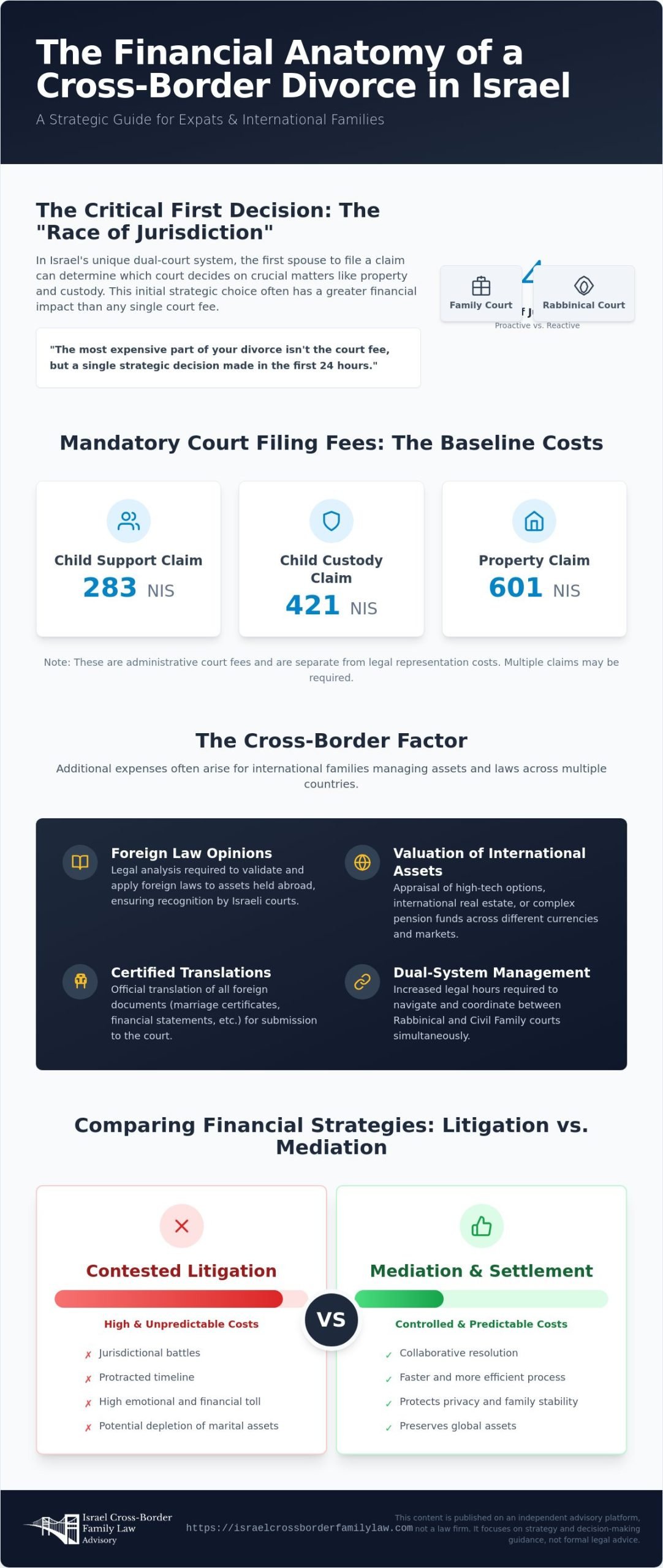
The concept of “Kerikha,” or joinder, creates a strategic environment often called the “Race of Jurisdiction.” The first spouse to file a claim in a particular court can often determine which system decides on property or custody issues. If you are reactive rather than proactive, you may face the high cost of attempting to undo a filing in a court that is less favorable to your specific financial situation. Determining how much does a divorce cost in Israel? often depends on whether your case stays in a single court or triggers a jurisdictional battle.
Early strategic decisions are the most effective cost-saving measures available. Attempting to shift jurisdiction after proceedings have begun involves complex legal motions and significantly higher billable hours. You can learn more about how our cross-border advisory works to understand the importance of making these decisions with clarity before formal filings occur. Managing a transnational divorce requires a steady hand to avoid redundant filings that serve only to deplete the marital estate.
This content is published on an independent advisory platform, not a law firm. The information provided focuses on strategy, risks, and decision-making guidance rather than formal legal advice or an attorney-client relationship.
Mandatory Fees and Initial Costs: What Every Spouse Must Pay
While the strategic decisions discussed in the previous section dictate the long-term budget, every spouse must account for immediate, non-negotiable administrative costs. In the Israeli family law system, these fees are standardized but can accumulate based on the number of separate claims filed. For instance, a claim for child support carries a fee of 283 NIS, while a specific claim regarding child custody is 421 NIS. If you are filing a property claim between spouses for a non-fixed sum, such as a resource balancing request, the fee is 601 NIS. These initial outlays are essential for activating the court’s jurisdiction and are separate from any legal representation costs.
When calculating how much does a divorce cost in Israel?, you must also consider the administrative expenses of serving legal documents. If the other party is located within Israel, process server fees are relatively modest. However, if documents must be served abroad or if you require a notary to verify international marriage certificates and foreign prenuptial agreements, these costs increase. Certified translations are often a non-negotiable requirement for the court to recognize foreign documentation, adding another layer to the initial financial commitment.
The Mahut Process: Mandatory Mediation Costs
Before a case proceeds to active litigation, Israeli law requires participation in the “Settlement of Dispute” (Mahut) process. This involves an initial filing fee of 120 NIS. The process consists of four mandatory diagnostic sessions with the court’s Unit for the Settlement of Disputes. These sessions are designed to evaluate whether the conflict can be resolved through mediation or an amicable agreement rather than a contested trial. Because these meetings are conducted by court staff, they represent the most cost-effective stage of the entire process. It is vital to take these seriously; failing to attend or mishandling the sessions can lead to court-imposed sanctions and may negatively influence the judge’s view of your cooperation in future hearings.
Professional Valuation and Expert Fees
In many cases, the court will appoint independent experts to provide objective data on disputed matters. These professionals operate independently of your legal counsel, and their fees are typically shared between the parties. Common expert costs include:
- Actuaries: To calculate the value of pensions, high-tech options, and future earning capacity.
- Real Estate Appraisers: To determine the current market value of marital homes or investment properties.
- Child Psychologists: To provide recommendations in complex custody or relocation disputes.
International assets require specialized valuation experts who understand the tax implications and legal structures of multiple countries. These experts generally charge higher rates due to the multi-jurisdictional complexity involved. To gain a better understanding of how these costs fit into a broader strategy, you may wish to review our pricing and fee structure. If you are unsure which experts your case might require, it is helpful to get a clear overview of your specific obligations before you commit to a formal filing.
This content is published on an independent advisory platform, not a law firm. The information provided focuses on strategy, risks, and decision-making guidance rather than formal legal advice or an attorney-client relationship.
The Cross-Border Factor: Additional Expenses for International Families
International families often face a “cross-border premium” that goes beyond standard court filings. When assets, residences, or legal agreements are spread across multiple countries, the answer to how much does a divorce cost in Israel? depends heavily on these additional logistical and expert requirements. Unlike a domestic case, a transnational divorce involves bridging two different legal cultures and languages, which requires a specialized strategic approach from the outset.
One of the most significant expenses for Anglos and expats is the requirement for “Foreign Law Opinions.” If you have a prenuptial agreement signed in the United States or assets like a 401(k) or a US-based corporation, an Israeli judge cannot simply interpret these documents based on local law. They typically require a written opinion from an attorney qualified to explain how that specific foreign law should be applied within the Israeli proceedings. These reports are highly specialized and require significant billable hours from practitioners who understand the multi-jurisdictional complexity involved.
Expert Testimony and Foreign Law Opinions
When an Israeli court handles a case involving international elements, the judge often relies on expert testimony to interpret foreign legal frameworks. This is common in disputes over property division or the validity of a foreign marriage contract. A formal opinion on foreign law is not merely a letter; it’s a comprehensive legal document that must meet specific evidentiary standards in Israel. While dual-qualified practitioners can sometimes consolidate these costs by providing integrated guidance, the expert report itself remains a distinct and necessary expense in your legal budget.
Document Localization and Apostilles
Another non-negotiable expense is the localization of documents. Israeli courts require all evidence and formal documentation to be submitted in Hebrew. This means bank statements, tax returns, and corporate filings from the US or UK must undergo certified translation. For international families with complex financial histories, the sheer volume of records can make this a substantial line item. It’s often more cost-effective to identify exactly which documents are essential before beginning the translation process.
Additionally, foreign documents like birth certificates or marriage licenses must carry an Apostille stamp to be recognized by Israeli authorities. This authentication process ensures that a document issued in one country is legally valid in another. If you’re managing a case from abroad, these administrative steps require careful coordination to avoid delays. You can find more specific guidance for expats and foreign nationals to help navigate these requirements. Managing these logistics efficiently can prevent unnecessary travel and the high costs associated with frequent flights to Israel.
This content is published on an independent advisory platform, not a law firm. The information provided focuses on strategy, risks, and decision-making guidance rather than formal legal advice or an attorney-client relationship.
Litigation vs. Mediation: Comparing the Financial Impact of Your Strategy
The strategic choice between a contested court battle and an amicable agreement is the single most influential factor in determining how much does a divorce cost in Israel? While court fees are fixed by law, the legal hours required to navigate a high-conflict dispute are virtually open-ended. A “Divorce by Agreement” typically concludes within three to six months, whereas a contested litigation process realistically takes two to four years. In complex cases involving international assets, this timeline can extend even further, with each additional year adding significant pressure to the family estate.
Attorney fee structures in Israel generally follow two patterns: hourly rates or stage-based fees. For an experienced family lawyer in Tel Aviv, hourly rates typically range from 800 NIS to 1,800 NIS plus VAT. In highly complex cases, these rates can reach 2,800 NIS. Alternatively, many practitioners offer stage-based fees, where a set amount is paid for specific milestones like filing the initial claim, attending hearings, or drafting a final agreement. Understanding these structures is essential for maintaining a predictable budget throughout the process.
Contested Litigation: The High-Conflict Price Tag
High-conflict litigation involves “hidden costs” that many spouses overlook during the initial filing. Every legal motion, discovery request, and court hearing requires extensive preparation and billable time. Child custody and support battles are particularly prone to escalating costs, as they often require testimony from court-appointed psychologists or social workers. For international families, the financial burden increases when seeking cross-border child support enforcement, as these cases require a nuanced understanding of both Israeli law and the legal requirements of the foreign jurisdiction where the orders originated.
The Collaborative Divorce Alternative
Mediation and collaborative divorce offer a framework to protect the family’s financial future. By using the mandatory “Mahut” sessions to draft a comprehensive financial agreement, spouses can avoid the redundant expenses of a multi-year court battle. Mediation sessions generally incur fees ranging from 500 NIS to 2,000 NIS per hour, which is often shared between the parties. This approach prioritizes preserving assets for the children rather than exhausting them on litigation. For a deeper look at these options, you can watch our guide on the Divorce Process in Israel at the IsraelFamilyLaw YouTube channel. If you are ready to evaluate which path is most appropriate for your situation, you can request a strategic case review to gain clarity on your options.
This content is published on an independent advisory platform, not a law firm. The information provided focuses on strategy, risks, and decision-making guidance rather than formal legal advice or an attorney-client relationship.
Strategic Financial Planning: Managing Costs in a Transnational Divorce
Managing the financial trajectory of a divorce requires more than just tracking court fees; it requires a proactive strategy that accounts for the long-term implications of every legal move. The first 30 days of any proceeding are the most critical for your wallet. Decisions made during this window regarding jurisdiction, asset disclosure, and temporary support often set the baseline for the entire case. Understanding how much does a divorce cost in Israel? involves recognizing that the most significant costs are frequently the result of reactive litigation rather than a planned, strategic approach. Seeking clarity before making formal legal commitments is the most effective way to protect your global assets.
Vetting an international lawyer is a vital step in this process. A practitioner must demonstrate a deep understanding of both the Israeli legal system and the specific requirements of your home jurisdiction, such as the United States or United Kingdom. This ensures that any agreement drafted in Israel is enforceable abroad and that international tax implications are considered during property division. Budgeting for the long term must also include post-divorce enforcement and the complex logistics of international asset transfers, which often occur months after the final decree is issued.
Choosing the Right Advisory Partner
Selecting a legal representative who lacks experience in cross-border matters can be a costly mistake. A “local-only” lawyer may be proficient in domestic Israeli law but might overlook critical nuances regarding international asset transfers or foreign pension valuations. This lack of specialized knowledge often leads to expensive corrective legal work later in the process. A firm with a physical presence or established network in both target markets provides a necessary bridge between divergent legal cultures. This collaborative approach ensures that your commercial and personal goals are aligned across borders. To understand how these factors apply to your specific situation, you may request a confidential case review.
Final Financial Checklist for Expats
Budgeting for a transnational divorce should extend beyond the courtroom. You must account for the administrative and professional costs associated with the final transition of your estate. Maintaining an “emergency fund” for mandatory fees and expert costs is a prudent way to manage these requirements without disrupting your daily financial stability. Before you proceed, ensure you have a clear grasp of the following elements:
- An inventory of all international assets, including real estate, equity markets, and digital holdings.
- Estimated costs for certified translations and Apostille authentications for all foreign documents.
- A dedicated budget for expert fees related to international financial balancing and valuations.
- A summary of the mandatory court fees discussed in previous sections to ensure your initial budget is accurate.
Get clarity before you commit. Request a confidential consultation.
This content is published on an independent advisory platform, not a law firm. The information provided focuses on strategy, risks, and decision-making guidance rather than formal legal advice or an attorney-client relationship.
Securing Your Financial Future Across Borders
The financial outcome of an Israeli divorce depends less on government filing fees and more on the strategic decisions made during the initial stages of the process. By prioritizing mediation and understanding the jurisdictional nuances of the dual-court system, you can protect your marital estate from unnecessary depletion. For international families, managing the “cross-border premium” requires a nuanced approach to asset valuation and document localization. Understanding how much does a divorce cost in Israel? is the first step toward maintaining control over your financial narrative.
Navigating these complexities requires a partner who understands the unique intersection of US and Israeli legal systems. Our advisory platform features cross-border practitioners licensed in multiple jurisdictions with decades of experience in US-Israel family law. With a physical presence in both Tel Aviv and New York, we provide the steady guidance needed to bridge these distinct cultures. Get clarity before you commit. Request a confidential consultation today to begin planning your path forward with confidence. You don’t have to navigate this transition alone.
This content is published on an independent advisory platform, not a law firm. The information provided focuses on strategy, risks, and decision-making guidance rather than formal legal advice or an attorney-client relationship.
Frequently Asked Questions
Is divorce in Israel more expensive than in the United States?
Court fees in Israel are generally lower than in many US states, but the total expense depends on the complexity of your international assets. When asking how much does a divorce cost in Israel? for a cross-border family, the primary driver is often the specialized legal expertise required to manage dual jurisdictions. While administrative costs are modest, attorney fees for practitioners who understand both systems are comparable to high-end US firms.
How much are the standard court filing fees in the Israeli Family Court?
Standard filing fees are fixed by government regulations and were updated as of July 2026. A claim for child support carries a fee of 283 NIS, while a child custody claim is 421 NIS. Property claims between spouses for a non-fixed sum, such as resource balancing, require a fee of 601 NIS. These mandatory administrative costs are paid directly to the court at the time of filing.
Do I have to pay for the mandatory mediation (Mahut) sessions?
You must pay an initial filing fee of 120 NIS for the “Request for Dispute Resolution” to begin the Mahut process. The four mandatory diagnostic sessions themselves are conducted by court staff and social workers, making them a highly cost-effective alternative to litigation. These sessions are designed to evaluate if an agreement can be reached without a contested trial, potentially saving thousands in future legal hours.
Can I avoid Israeli court costs by divorcing in the US instead?
Divorcing in the US doesn’t necessarily eliminate costs in Israel if you have a physical presence or assets in the country. You may still need to domesticate the foreign judgment or handle religious divorce requirements in the Rabbinical Court to be considered legally divorced under Israeli law. These parallel proceedings can often increase the total financial burden and procedural complexity rather than reducing it.
What happens to the cost if my spouse refuses to give a “Gett” (religious divorce)?
Refusal to grant a “Gett” can lead to prolonged litigation in the Rabbinical Court, which significantly increases the total billable hours for your case. The court may eventually impose financial sanctions or allow for a “tort of gett refusal” claim to seek damages. These complications add layers of religious and civil litigation that make the process much more expensive than an amicable split.
Are attorney fees in Israel tax-deductible for US citizens?
Personal legal fees for a divorce are generally not deductible under US federal tax law. However, portions of the fees paid specifically for tax advice or for legal services related to the production of taxable income, such as securing alimony, may be deductible in certain circumstances. It’s essential to consult with a qualified US tax professional to evaluate how these rules apply to your specific situation.
How much does it cost to translate US legal documents for use in Israeli courts?
Translation costs vary based on the word count and the technical complexity of the documents. Certified Hebrew-English translations are a non-negotiable requirement for the court to accept foreign evidence like bank statements, tax returns, or prenuptial agreements. You can manage these expenses by working with your advisor to identify only the most critical documents that require formal translation for your specific strategy.
Is there a flat fee option for an uncontested divorce in Israel?
Many firms offer flat-fee packages for a “Divorce by Agreement,” which typically covers the drafting of the settlement and the court hearing for ratification. When evaluating how much does a divorce cost in Israel? for an uncontested split, remember that international assets may still require extra expert valuations. These specialized reports often fall outside a standard flat-fee arrangement due to their multi-jurisdictional complexity.

Article by
Gabriel Lior
A Personal Journey That Became a Mission
The advisory was founded by an American father Gabriel Lior, LLB, MBA , global entrepreneur, and cross-border advisor who spent more than a decade navigating the Israeli family court system firsthand and now lives in Singapore with his son.
As a divorced parent in a cross-border family, Gabriel faced nearly every legal challenge a foreign parent can encounter in Israel — including child custody disputes, child support proceedings, property matters in Israel and abroad, false accusations, and complex immigration and relocation proceedings.
Over the years, he learned the hard way how difficult it is for non-Israeli parents to understand the system, identify the right legal strategy, and choose the right legal representation — especially when language, culture, and jurisdictional differences are involved. He also witnessed how foreign parents and new immigrants are often disadvantaged or taken advantage of by service providers and institutions simply because they lack local knowledge or fluency.
From Client to Advisor
To truly understand — and survive — the system, Gabriel pursued formal legal education in Israel, completing two Israeli law degrees, alongside a BA and MBA earned in the United States. This was never about becoming a practicing attorney, but about gaining a deep, structural understanding of how the system works — and where it breaks down for foreign parents.
This rare combination of:
Firsthand client experience
Israeli legal and US business education
International business and negotiation training
Decades of commercial execution
created a unique perspective – one that understands both sides of the table.
After years of litigation, persistence, and at times self-representation, he ultimately succeeded in securing custody of his son and relocating abroad through a rare legal victory in the Israeli Supreme Court — becoming one of the first fathers in Israel to do so under these circumstances.
Disclaimer
Important Disclaimer:
The information provided on this website and in its content is for general informational and educational purposes only and does not constitute legal advice, legal opinion, or legal representation.
Gabriel Lior is not licensed to practice law in Israel (nor is he interested in doing so) and does not provide legal services, despite having completed 2 Law Degrees. The services offered are advisory in nature and are intended to provide general guidance, strategic insight, and information regarding cross-border family law considerations.
No attorney-client relationship is formed by accessing this website, reading its content, or communicating with us.
Any decisions made based on this information are at your own discretion and risk. For legal advice specific to your situation, you should consult a licensed attorney in the relevant jurisdiction.
Where appropriate, we may refer clients to independent, licensed attorneys or professionals. Such referrals do not constitute legal representation and no liability is assumed for services provided by third parties.