This article is published on an independent advisory platform and does not constitute legal representation or an attorney-client relationship.
What if the language you use to build your business or family life in Israel is the very thing that puts your legal rights at risk in a courtroom? Many expats and international investors assume that because English is the common language of Israeli commerce, they can simply walk into a courtroom and be understood. However, when you ask, can i request a trial in english in israel, the answer is more complex than a simple yes or no. While the Israeli legal system is sophisticated and internationally focused, the official language of the court remains Hebrew.
It’s completely natural to feel anxious about being misunderstood by a judge or overwhelmed by the potential costs of professional translations. This guide explains how the legal reality of language barriers works in IL courts and how you can effectively manage cross-border litigation. We will cover the specific steps to secure a state-funded interpreter, how the 2026 shift toward textualism in contract law affects your strategy, and how to submit English documents without compromising your case. By understanding these procedural requirements, you can lower the risk of legal errors and gain clarity before you commit to a specific course of action.
Key Takeaways
- Understand that while English is common in business, Hebrew is the only official language in IL courts, making professional translation a critical strategic consideration.
- Learn the specific procedures for how can i request a trial in english in israel by utilizing the state-funded interpreter services available through the National Identification System.
- Identify which types of English evidence, such as contracts or digital messages, may be accepted by a judge without the need for a formal and costly Hebrew translation.
- Recognize the cultural and systemic differences between “Anglo” and “Sabra” courtroom styles that can impact how your testimony and presence are perceived during proceedings.
- Discover why early strategic advisory and decision-making before reaching the trial stage are often more impactful than the courtroom appearance itself.
The Legal Reality: Is English an Official Court Language in Israel?
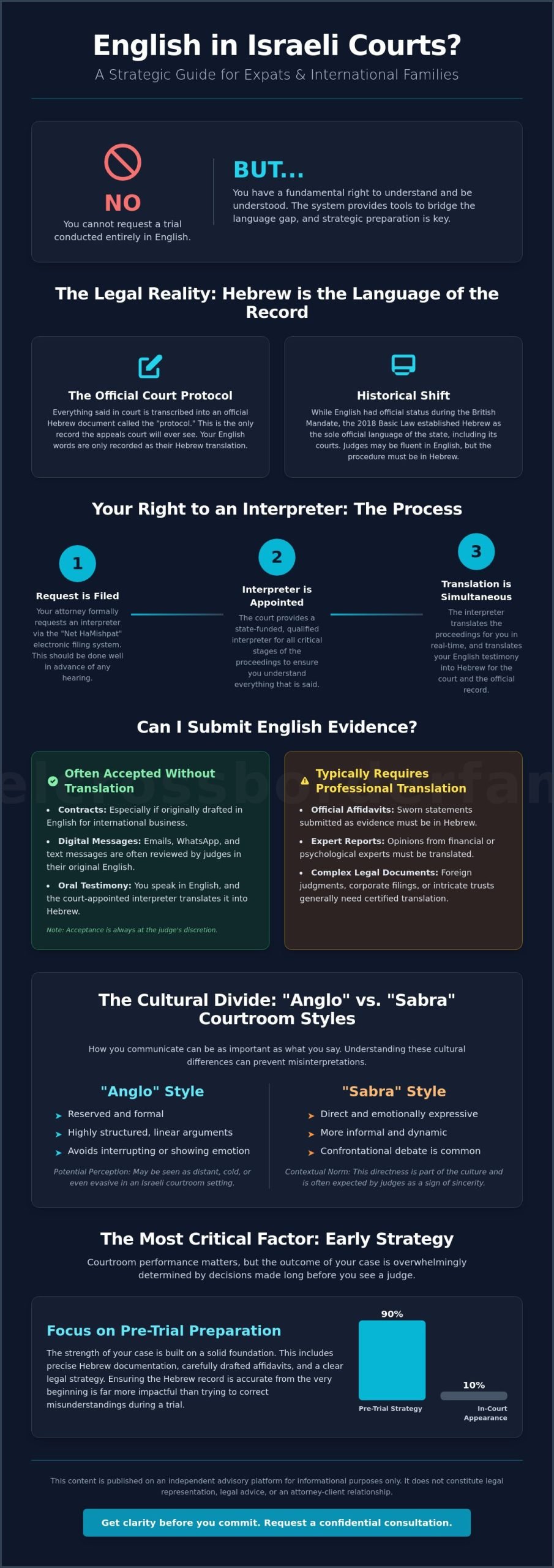
Many expats and international business owners arrive in IL expecting a legal system that mirrors the bilingual nature of the streets of Tel Aviv or Jerusalem. However, when you ask, can i request a trial in english in israel, you’ll find that the legal machinery operates under a different set of rules. While you can certainly communicate through interpreters, the trial itself is a Hebrew-language event. This distinction is vital for anyone facing litigation, as the gap between what you say in English and what is recorded in Hebrew can change the outcome of a case.
The Legacy of the British Mandate
The history of language in the Israeli legal system is a story of gradual transition. During the British Mandate, Article 82 of the Palestine Order in Council recognized English as one of the official languages. This legacy is why many foundational legal concepts in IL are still rooted in English common law. However, the 2018 Basic Law: Israel as the Nation-State of the Jewish People fundamentally shifted the status of Official Languages in Israel. This law established Hebrew as the sole official language of the state. While English remains the “lingua franca” of high-tech and international finance, it no longer holds a formal seat in the courtroom. Judges are often highly proficient in English and may even read your documents in their original form, but they’re legally bound to conduct the process in Hebrew.
To understand the formal environment of an Israeli courtroom, watch this brief overview:
Hebrew as the Language of the Record
The most critical aspect of any trial is the “protocol,” which is the official transcript of everything said during the hearing. Even if a judge allows you to speak English, the court transcriber will only record the Hebrew translation. This is where the question of can i request a trial in english in israel meets its hardest reality. The transcriber isn’t recording your exact words; they’re recording what the interpreter says you said.
This process creates a risk of nuance being lost in translation. If you eventually need to appeal a decision to the District Court or the Supreme Court, those judges won’t hear your original English testimony. They’ll only read the Hebrew protocol. Because of this, strategy in IL courts often focuses on ensuring that the Hebrew record is precise. You can’t have a trial entirely in English, but you can take steps to ensure your English testimony is accurately reflected in the Hebrew record. Understanding this early helps you avoid the common trap of assuming the judge’s personal English fluency replaces the need for a formal, accurate Hebrew transcript.
Requesting an Interpreter: Procedures and Practicalities
Every person participating in the Israeli legal system has a fundamental right to understand the proceedings. This isn’t merely a courtesy; it’s a constitutional protection derived from the Basic Law: Human Dignity and Liberty. While you might still wonder, can i request a trial in english in israel, the functional reality is that you are requesting the right to hear and participate in the trial through a qualified interpreter. As of January 2026, the process for unrepresented parties has become more accessible through the National Identification System, which allows for online interpreter requests. However, most expats and international families will be working through their attorneys, who manage these requests via the “Net HaMishpat” electronic filing system.
It’s vital to distinguish between a court-appointed interpreter and a private one. For parties who are represented by counsel, the court generally expects the litigants to provide their own professional translation services. This is often a strategic advantage. A private interpreter can be briefed on the specific context of your family or business history, ensuring that technical terms are handled with precision. These requests must be submitted to the court clerk well in advance of the hearing date. If an interpreter is not present when the hearing begins, the judge is generally required to postpone the session, which can lead to significant delays and increased costs.
The Role of the Court Interpreter
A courtroom interpreter acts as a bridge between your English testimony and the Hebrew court record. In a family law setting, they typically use consecutive translation, where they speak after you finish a sentence, or simultaneous translation, where they whisper the judge’s words as they are spoken. A common pitfall occurs when an interpreter begins to summarize instead of translating word-for-word. If an interpreter gives you the “gist” of what the judge said, they’re filtering the legal reality. You need an advocate who ensures the protocol reflects your exact meaning. If you’re concerned about how language gaps might impact your strategy, you can reach out for a strategic review of your situation.
Costs and Financial Considerations
In 2026, hiring a professional legal interpreter involves a daily fee that reflects their specialized expertise in both languages and legal terminology. While the state covers costs for unrepresented parties, represented litigants usually bear this expense upfront. However, Israel operates on a “loser pays” principle. If the court rules in your favor, the judge may order the opposing party to reimburse your translation and interpreter costs as part of the final judgment. You should also account for the cost of translating the final Hebrew court protocols back into English so you can verify the accuracy of the record for your own files or for use in foreign jurisdictions.
English Evidence: Documents, Emails, and Testimony
In cross-border family law, the evidence that defines a case rarely starts in Hebrew. International families often rely on English-language prenuptial agreements, emails, and WhatsApp messages to prove intent or financial arrangements. While the question of can i request a trial in english in israel usually focuses on spoken words, the way you handle your written evidence is just as vital. The Israeli legal system is generally pragmatic about English documents, but you must navigate specific procedural hurdles to ensure your evidence is actually admitted and given weight by the judge.
Foreign official documents, such as birth certificates, marriage licenses, or court orders from the US or UK, require a more formal approach. These documents must typically be authenticated with an Apostille and accompanied by a notarized translation. For more casual evidence like text messages, the rules are more flexible, yet the risks are higher. Opposing counsel may object to any document not translated into Hebrew, using it as a tactic to delay proceedings or exclude critical information from the record.
Submitting Documentary Evidence
Many Israeli judges read English fluently and may waive the requirement for a formal Hebrew translation of certain documents to save time and costs. This is often referred to as the “Judge’s Discretion” rule. However, you shouldn’t rely on this as a guarantee. A strategic approach involves translating only the most relevant excerpts of long contracts or email chains. This manages costs while ensuring the court’s official record (the protocol) contains the essential facts of your case. It’s particularly relevant following the January 2026 amendment to the Israeli Contract Law, which gives primacy to the written text of a contract over presumed intent. If your contract is in English, the accuracy of its Hebrew summary in court is paramount.
Testifying in English
When you testify through an interpreter, a psychological gap often forms between you and the judge. In family law cases, where emotional nuance and credibility are everything, an interpreter can unintentionally dampen the impact of your story. The judge hears a neutral translation rather than the raw emotion in your voice. To manage this, it’s best to speak in short, clear sentences and wait for the translation to finish before continuing. You might feel tempted to speak “broken Hebrew” to appear more integrated, but this is a significant risk. In a high-stakes trial, precision is your best defense. Using your native language ensures you don’t accidentally agree to something you don’t fully understand during a fast-paced cross-examination. For those managing these complexities, it’s helpful to understand how the advisory process works before stepping into the courtroom.
The Strategic Anglo Disadvantage in Israeli Courts
The friction in an Israeli courtroom often stems from more than just a language gap. It’s a clash of cultures. The “Sabra” courtroom environment is characterized by high energy, rapid-fire interruptions, and a level of directness that can feel aggressive to those raised in Anglo legal systems. While you might ask, can i request a trial in english in israel to ensure you’re understood, remember that even with a perfect translator, the cultural rhythm remains local. An Anglo litigant who remains calm and reserved might be perceived as indifferent or disconnected from the reality of the situation. This perception can be a silent disadvantage in high-stakes family law matters.
Bridging this gap requires a strategy that goes beyond simple translation. You must position your international background as a source of stability and global perspective rather than a hurdle to overcome. We have developed specific strategies for expats and foreign nationals to ensure their voice is heard clearly within this unique system. Choosing an advocate who moves seamlessly between these two worlds is the most effective way to mitigate the risk of being misunderstood by the bench.
Cultural Nuances in Family Law
In IL family law, the “best interests of the child” is the guiding principle, yet its application can differ significantly from US or UK standards. A central figure in these cases is the Pekidat Sa’ad, or court-appointed social worker. This professional wields significant influence over the judge’s decisions. If there’s a language barrier during your interviews with them, your parenting style or intentions could be misinterpreted through a local cultural filter. You should prepare for these Hebrew-speaking interactions as thoroughly as the trial itself. Even with an interpreter, the way you frame your family values must resonate with the Israeli social worker’s expectations.
Selecting Cross-Border Representation
Being a bilingual lawyer isn’t the same as being a cross-border expert. A representative who understands the technicalities of the law but lacks a deep connection to your native legal culture may miss the nuances of your case. Ideally, you want someone who understands how things work in both jurisdictions, particularly if they are licensed to practice in both the US and IL. This dual perspective allows them to act as a bridge, explaining your context to the judge in a way that aligns with Israeli legal norms. Ask potential counsel about their specific experience with English-speaking litigants and how they manage the risks of miscommunication during cross-examination. If you are concerned about how your international status affects your standing in court, you can request a strategic advisory session to gain clarity.
Navigating the System: An Advisory Approach
While the procedural answer to can i request a trial in english in israel is defined by Hebrew-only protocols, the ultimate outcome of your case depends on the strategic decisions you make before litigation begins. Success in a cross-border legal matter involves more than just understanding the law; it requires a clear-eyed assessment of how your language, culture, and international status interact with the local system. Strategic advisory services provide the bridge between your native expectations and the reality of the Israeli court environment. This approach focuses on risk mitigation and informed decision-making rather than just formal representation, ensuring you are never blindsided by systemic differences.
Early decisions often carry more weight than the trial itself. For instance, determining whether IL is the most favorable jurisdiction for your dispute can save years of litigation and significant financial resources. If you choose to proceed in Israel, you must account for the cross-border complexity of your assets, custody arrangements, and existing foreign court orders. Seeking clarity before you commit to a specific legal path allows you to control the narrative rather than simply reacting to a system that may feel foreign. Understanding these nuances early is the most effective way to lower the risk of legal errors due to language gaps.
Strategy Before Litigation
Before entering a Hebrew-dominant courtroom, you should evaluate whether a trial is truly the most effective venue for your dispute. Mediation offers an English-friendly alternative where you can discuss your concerns directly in your native language without the rigid protocols of a judge. This is often a more effective way to handle sensitive matters, and you can explore our divorce and separation guidance for international families to understand the benefits of this approach. By resolving disputes outside the formal court record, you eliminate the risk of your intentions being lost in translation during the creation of the Hebrew protocol.
The Voltie Advisory Model
Navigating the Sabra legal landscape requires a guide who understands the systemic differences between Israel and your home country. As an independent advisory platform, we help you navigate these complexities by providing a neutral perspective on your rights and risks. You can request a confidential review to analyze your specific cross-border situation and determine the best strategy for your family before engaging formal counsel. For those who prefer to research at their own pace, our YouTube channel provides a wealth of educational resources on the intricacies of the Israeli family law system. This knowledge empowers you to make informed choices based on strategy rather than anxiety.
Get clarity before you commit. Request a confidential consultation.
Securing Your Voice in the Israeli Legal System
Navigating the language gap in a foreign courtroom requires more than just a translator; it demands a strategy that accounts for the cultural rhythm of the Sabra legal environment and the technical requirements of the Hebrew court record. While the answer to can i request a trial in english in israel is rooted in your right to a state-funded or private interpreter, your ultimate success depends on how you manage the transition between languages. By prioritizing early advisory sessions and ensuring the precision of your English evidence, you can mitigate the risks of being misunderstood in high-stakes family law matters.
We specialize in the multi-jurisdictional complexity of US-Israel cross-border family law, providing a strategic bridge for international families. Our advisory approach ensures that you understand the systemic differences of the IL legal landscape before you step into a courtroom. Informed decisions made today prevent the costly errors that often arise from linguistic or cultural misalignments. You deserve to have your story heard clearly and accurately within the protocol.
Get clarity before you commit. Request a confidential consultation to discuss your unique situation. You don’t have to navigate these complexities alone.
Frequently Asked Questions
Is it possible to have a judge who speaks English fluently?
Many Israeli judges speak English fluently and may even read English documents without a formal translation. However, they are legally required to conduct the proceedings in Hebrew. Even if the judge understands you directly, the court protocol must be recorded in Hebrew to ensure the record can be reviewed by higher courts if an appeal is filed later.
Who is responsible for paying the court interpreter fees in Israel?
The responsibility for interpreter fees depends on whether you have legal representation. As of January 2026, the state provides free interpreters for litigants who are not represented by an attorney through the National Identification System. If you have a lawyer, you typically pay for your own private interpreter, though you can request that the court order the opposing party to reimburse these costs if you win the case.
Can I submit my US divorce decree to an Israeli court in English?
You cannot submit a US divorce decree in English without following specific authentication steps. All foreign court orders require an Apostille from the issuing state to verify their authenticity. Additionally, these documents must be translated into Hebrew by a certified professional to be recognized by the Israeli Family Court or the Rabbinical Court.
What happens if the interpreter makes a mistake during my testimony?
If you notice an interpreter making a mistake, you should inform your attorney or the judge immediately to correct the record. Since the Hebrew protocol is the only official transcript, any errors in translation that go uncorrected can negatively impact your case. Accuracy is vital because higher courts will only look at the written Hebrew record during an appeal.
Do I need to translate all my WhatsApp messages from English to Hebrew for court?
You don’t always need to translate every single message, but key evidence should be translated to avoid procedural objections. While some judges may read English messages directly, the opposing counsel can object to any non-translated evidence. A common strategy is to provide professional translations only for the specific messages that are critical to your legal argument.
Can my lawyer act as my interpreter during the trial?
Your lawyer cannot serve as your official interpreter during a trial. A lawyer’s role is to provide legal advocacy and strategy, while an interpreter must remain a neutral party who only translates the spoken word. Having a separate, professional interpreter ensures that your attorney can focus entirely on the cross-examination and the judge’s reactions.
Are there specific courts in Israel that are more English-friendly?
While all Israeli courts follow the same language laws, courts in areas with high expat populations, such as Tel Aviv or Jerusalem, are often more accustomed to international cases. These judges may have more experience handling multi-jurisdictional complexities. However, the requirement for a Hebrew protocol remains the same regardless of the court’s location.
Can I request a trial in English if both parties are US citizens?
Even if both parties are US citizens, you cannot conduct the trial in English. When you ask, can i request a trial in english in israel, the answer remains that Hebrew is the official language of the state. You will still need an interpreter and Hebrew translations for all filings, as the court must operate within the legal framework of IL.

Article by
Gabriel Lior
A Personal Journey That Became a Mission
The advisory was founded by an American father Gabriel Lior, LLB, MBA , global entrepreneur, and cross-border advisor who spent more than a decade navigating the Israeli family court system firsthand and now lives in Singapore with his son.
As a divorced parent in a cross-border family, Gabriel faced nearly every legal challenge a foreign parent can encounter in Israel — including child custody disputes, child support proceedings, property matters in Israel and abroad, false accusations, and complex immigration and relocation proceedings.
Over the years, he learned the hard way how difficult it is for non-Israeli parents to understand the system, identify the right legal strategy, and choose the right legal representation — especially when language, culture, and jurisdictional differences are involved. He also witnessed how foreign parents and new immigrants are often disadvantaged or taken advantage of by service providers and institutions simply because they lack local knowledge or fluency.
From Client to Advisor
To truly understand — and survive — the system, Gabriel pursued formal legal education in Israel, completing two Israeli law degrees, alongside a BA and MBA earned in the United States. This was never about becoming a practicing attorney, but about gaining a deep, structural understanding of how the system works — and where it breaks down for foreign parents.
This rare combination of:
Firsthand client experience
Israeli legal and US business education
International business and negotiation training
Decades of commercial execution
created a unique perspective – one that understands both sides of the table.
After years of litigation, persistence, and at times self-representation, he ultimately succeeded in securing custody of his son and relocating abroad through a rare legal victory in the Israeli Supreme Court — becoming one of the first fathers in Israel to do so under these circumstances.
Disclaimer
Important Disclaimer:
The information provided on this website and in its content is for general informational and educational purposes only and does not constitute legal advice, legal opinion, or legal representation.
Gabriel Lior is not licensed to practice law in Israel (nor is he interested in doing so) and does not provide legal services, despite having completed 2 Law Degrees. The services offered are advisory in nature and are intended to provide general guidance, strategic insight, and information regarding cross-border family law considerations.
No attorney-client relationship is formed by accessing this website, reading its content, or communicating with us.
Any decisions made based on this information are at your own discretion and risk. For legal advice specific to your situation, you should consult a licensed attorney in the relevant jurisdiction.
Where appropriate, we may refer clients to independent, licensed attorneys or professionals. Such referrals do not constitute legal representation and no liability is assumed for services provided by third parties.