This article is published on an independent advisory platform and does not constitute a law firm relationship or legal advice. Legal services are only provided by licensed attorneys under a separate engagement.
What if the trust you meticulously drafted in the United States effectively disappears the moment you establish residency in Israel? For many expats and international families, the question of whether is my us trust enforceable in israel remains a source of significant anxiety. You’ve likely spent years building a comprehensive estate plan under American law, only to realize that the Israeli 1979 Trust Law and local courts operate on entirely different principles. It’s natural to worry that your US documents might be ignored by a judge or that your beneficiaries could face unexpected double taxation.
We understand that navigating cross-border legal systems is complex and requires a strategic, informed approach. This guide provides the clarity you need to ensure your US-based trust is recognized and protected within the Israeli system. You’ll learn about the critical 2024 tax amendments that eliminate reporting exemptions for new residents starting in 2026, the 30% tax rate on foreign trust distributions, and the specific steps required to avoid local probate disputes. For more visual guidance on these topics, you can explore the resources at https://www.youtube.com/@IsraelFamilyLaw. Get clarity before you commit. Request a confidential consultation.
Key Takeaways
- Learn how the Israeli Trust Law (1979) governs foreign documents and what specific criteria your US-based trust must meet to remain valid in the local system.
- Discover the distinction between legal recognition and actual courtroom enforcement to determine is my us trust enforceable in israel during a family law or inheritance dispute.
- Understand why common American structures, like Revocable Living Trusts, may not offer the same asset protection in Israel as they do in the United States.
- Identify strategic steps, such as the “mirroring” technique and proactive reporting to the Israel Tax Authority, to shield your estate from future claims.
This article is published on an independent advisory platform and does not constitute a law firm relationship or legal advice. Legal services are only provided by licensed attorneys under a separate engagement.
Understanding the Israeli Trust Law (1979) and Foreign Instruments
Israel’s legal system doesn’t grant automatic reciprocity to US-drafted trusts. Instead, the Israeli Trust Law (1979) acts as a gatekeeper for any fiduciary arrangement operating within its borders. If you’re wondering, is my us trust enforceable in israel, you must look at how local courts interpret foreign instruments. While the general concept of a Trust (law) is recognized, the document’s validity often rests on the settlor’s residency status and the specific way the trust was established. A US trust isn’t an “automatic” entity here; it requires local validation to ensure it doesn’t conflict with Israeli statutory requirements or public policy.
To better understand the relationship between US and Israeli legal perspectives, watch this helpful video:
The 1979 Law governs any arrangement where a person holds assets for the benefit of another. It’s a national law, unlike the US system where trust rules vary significantly from state to state. This means a trust drafted in New York or Florida must be reviewed to ensure it doesn’t violate mandatory Israeli rules. For many expats and foreign nationals, the complexity arises when they move to Israel and bring their US estate plans with them, as the settlor’s residency at the time of trust creation can trigger different reporting and enforcement standards.
The Legal Definition of a Trust in Israel
Israeli law defines a trust as a three-way relationship between the Settlor (Yotzer), the Trustee (Ne’eman), and the Beneficiary (Nehene). To be recognized, there must be a “Trust Deed,” which is the foundational document outlining the trust’s terms. While a US Trust Agreement usually satisfies this requirement, Israeli law focuses more on the “obligation” placed upon the trustee than on the trust being a separate legal entity. This shift in perspective means that a US trust is often viewed as a contractual obligation that the trustee must fulfill according to Israeli standards of care and fiduciary duty.
Why the US-Israel Jurisdictional Gap Exists
The gap between these two systems is primarily due to the difference between US state-level codes and Israeli national law. In the US, you might rely on specific state precedents for asset protection or tax planning. In Israel, those precedents carry no weight. Cross-border families often fall into this gap because they assume their US lawyer’s work is globally portable. While the Israeli Registrar of Trusts primarily oversees public or charitable structures, private family trusts are still subject to the scrutiny of the Israel Tax Authority and family courts, which may apply Israeli law to assets located within the country regardless of what the US document says. Get clarity before you commit. Request a confidential consultation.
This article is published on an independent advisory platform and does not constitute a law firm relationship or legal advice. Legal services are only provided by licensed attorneys under a separate engagement.
Recognition vs. Enforceability: Will Israeli Courts Respect Your US Trust?
The distinction between a court acknowledging a trust’s existence and actually enforcing its specific clauses is a critical one for US families. When asking is my us trust enforceable in israel, you aren’t just asking if the paper is valid. You’re asking if an Israeli judge will follow the specific distribution rules or asset protections you set up in California or New York. Israeli courts generally operate under the principle of legal comity. This means they respect foreign legal acts as long as they don’t violate local “Public Policy.” This exception is broad and allows judges to ignore trust terms that conflict with fundamental Israeli laws.
To move from recognition to enforcement, procedural compliance is mandatory. Every US trust document must be accompanied by an apostille and a certified Hebrew translation. Without these, the document has no standing in an Israeli court or with the Land Registry. Even with these, a judge may refuse to enforce specific terms if they contradict fundamental Israeli legal principles, such as the rights of certain family members to claim maintenance from an estate. Strategy and risk based decision making are the best ways to ensure your intentions are respected in both jurisdictions.
The Principle of Comity for Foreign Legal Documents
Israeli judges typically look at a trust drafted under US state law through the lens of international private law. The historical development of Express trusts in Israel/Palestine shows a long history of integrating foreign concepts into the local framework. However, proving what the US law actually says in an Israeli courtroom requires a “Foreign Law” expert witness. This is a practitioner qualified in that specific US jurisdiction who provides a written opinion to the Israeli court. This step is often a prerequisite if you intend to transfer Israeli real estate into the trust, as the Land Registry requires proof that the trust is a valid entity capable of holding title.
Common Grounds for Challenging a US Trust in Israel
Enforceability often fails when a trust is deemed a “sham.” In Israel, if a settlor retains absolute control over the assets, a court may decide the trust is merely an extension of the individual rather than a separate fiduciary structure. This is a common risk for standard US Revocable Living Trusts. Other challenges include:
- Lack of Capacity: Israeli heirs might claim the settlor wasn’t of sound mind when the US document was signed.
- Undue Influence: Claims that a beneficiary pressured the settlor, which can lead to the trust being set aside under the Israeli Inheritance Law.
- Intent to Defraud: If the trust was funded to hide assets from creditors, Israeli insolvency laws allow the court to “pierce” the trust.
Before you finalize any cross border arrangements, it’s wise to request a review of your current documents to identify these vulnerabilities. Get clarity before you commit. Request a confidential consultation.
This article is published on an independent advisory platform and does not constitute a law firm relationship or legal advice. Legal services are only provided by licensed attorneys under a separate engagement.
The Impact of Trust Type: Revocable vs. Irrevocable Trusts in Israel
In the United States, the Revocable Living Trust is the standard tool for avoiding probate and maintaining privacy. However, when you ask is my us trust enforceable in israel, you’ll find that the Israeli legal system prioritizes the reality of “control” over the formal name of the document. Israeli courts and the Israel Tax Authority (ITA) often look past the trust’s label to determine who truly manages the wealth. This distinction is critical because a structure that works perfectly in a US state may offer little to no protection once it’s scrutinized under Israeli law.
The ITA applies a rigorous “Control Test” to determine how a trust is taxed and recognized. If the settlor retains the power to replace trustees, direct investments, or revoke the trust entirely, the ITA typically classifies it as a “Settlor Trust.” Under this classification, the assets are treated as belonging directly to the settlor. For Israeli residents, this means the trust’s worldwide income is subject to Israeli tax, and the assets may be vulnerable to local legal claims. Get clarity before you commit. Request a confidential consultation.
Why Revocable Living Trusts May Be Viewed Differently
Israeli legal practitioners often view a revocable trust as the “alter ego” of the settlor. Because the settlor can take the assets back at any time, a judge in a divorce or inheritance dispute might decide those assets never truly left the settlor’s personal estate. This creates a significant risk for expats and foreign nationals who move to Israel assuming their assets are shielded. If an Israeli court determines you have “true control,” the trust assets could be included in a divorce settlement or used to satisfy a “Maintenance from the Estate” claim by an heir.
Irrevocable Trusts and Asset Protection under Israeli Law
Irrevocable trusts generally enjoy a higher standard of enforceability and protection in Israel, provided they’re structured correctly. An Irrevocable Trust is a structure where the settlor permanently relinquishes control to a third-party trustee. Because the settlor cannot easily “undo” the transfer, Israeli courts are more likely to respect the trust as a separate legal entity. However, there’s often a “look-back” period where transfers made shortly before insolvency or legal disputes can be challenged. To be effective, the relinquishment of control must be genuine and documented, ensuring the trustee operates independently of the settlor’s daily whims. Strategy and risk based decision making are essential when choosing between these structures in a cross-border context.
This article is published on an independent advisory platform and does not constitute a law firm relationship or legal advice. Legal services are only provided by licensed attorneys under a separate engagement.
Enforceability in Family Law: Divorce and Inheritance Disputes
When family disputes arise, the question is my us trust enforceable in israel shifts from a tax concern to a battle for asset preservation. Israeli family courts possess broad powers to examine the “matrimonial pot,” often looking through foreign trust structures to ensure a fair division of assets. While you might rely on US “Community Property” rules or specific state statutes, Israeli law uses the “Balanced Resources” principle for couples married after 1974. This creates a friction point where assets you believe are safely tucked away in a US trust might be pulled back into the division process if a judge deems them marital property.
Recent trends show that Israeli courts are less hesitant to unravel complex financial arrangements. In one high-profile Tel Aviv case involving a $100 million estate, the court awarded a spouse nearly $40 million after finding that foreign trusts were used to conceal assets. The burden of proof can even shift to the person controlling the trust to prove its legitimacy. To navigate these risks, it’s essential to speak with a professional regarding your specific situation before a dispute begins. Get clarity before you commit. Request a confidential consultation.
When a US Trust Meets an Israeli Divorce Decree
If you transferred assets into a US trust during your marriage without your spouse’s explicit consent, an Israeli court may “pierce the trust veil.” The court will investigate whether the trust was established for a legitimate purpose or as an instrument of deception. While “pre-marital” assets held in a trust typically remain separate, the commingling of funds or the use of trust income for family expenses can blur these lines. For a deeper look at how property is divided, see our guide on divorce and separation for international families.
Forced Heirship and the Israeli Inheritance Law (1965)
Israel does not have “forced heirship” like many European countries, but the Israeli Inheritance Law (1965) provides for “Maintenance from the Estate” (Mezonot Min Ha’Izavon). This allows a surviving spouse or dependent children to claim financial support from the estate, even if the trust or will excludes them. If your US trust holds Israeli real estate, be aware that Israel does not recognize foreign probate orders. A separate probate proceeding in Israel is required to transfer those assets. In disputes where a US trust conflicts with the 1965 Law, Israeli courts often prioritize the statutory rights of dependents over the terms of a foreign trust deed. Strategy and risk-based decision-making are your best tools for ensuring your estate plan remains robust across borders.
This article is published on an independent advisory platform and does not constitute a law firm relationship or legal advice. Legal services are only provided by licensed attorneys under a separate engagement.
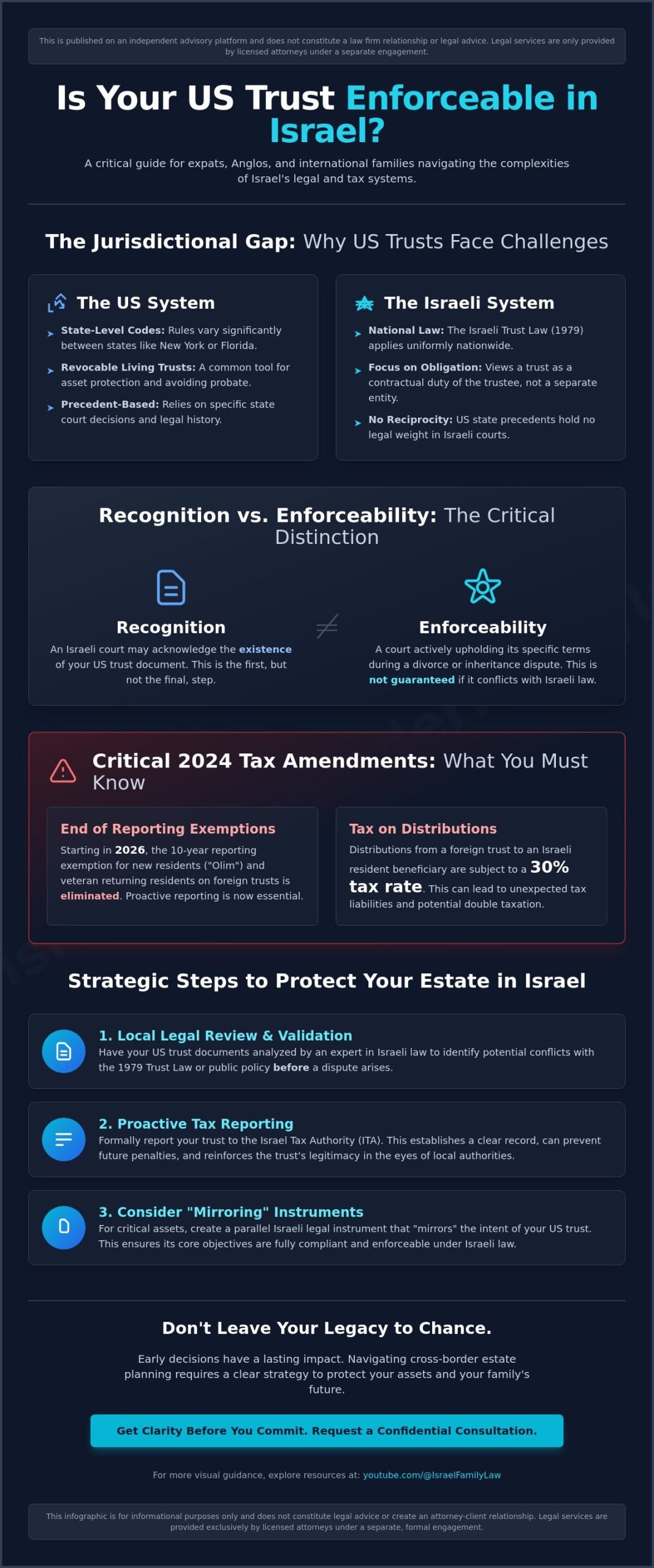
Strategic Steps to Ensure Your US Trust Works in Israel
Ensuring that your estate plan remains robust across borders requires moving beyond the standard US templates. While you may have a valid American document, the question is my us trust enforceable in israel often depends on how well that document has been “Israel-proofed.” One of the most effective strategies is the “Mirroring” technique. This involves creating an Israeli-compliant annex or a parallel document that translates your US intentions into the specific legal language of the Israeli 1979 Trust Law. This proactive step reduces the risk of an Israeli judge misinterpreting your wishes or a local bank refusing to recognize the trustee’s authority.
Beyond the text of the trust itself, the practical management of the assets plays a decisive role in local recognition. Strategy and risk-based decision-making suggest that you should evaluate your trust structure every few years, especially as Israeli tax and family law regulations evolve. Identifying jurisdictional conflicts early allows you to make adjustments before a crisis, such as a divorce or a death, occurs. For those managing complex international estates, a confidential case review can help pinpoint exactly where a US trust might fail to meet Israeli standards.
The Role of the Israeli Trustee and Local Management
Tax Reporting and ITA Compliance
Compliance is a prerequisite for enforceability. The ITA requires specific filings, such as Form 1301 and its associated trust appendices, to track foreign-held assets. It’s vital to understand the “New Olim” tax holiday. For those who became Israeli residents before January 1, 2026, a 10-year reporting and tax exemption on foreign-sourced income generally applies. However, a significant amendment passed on April 2, 2024, eliminates the reporting exemption for new immigrants arriving on or after January 1, 2026. These individuals must report their worldwide assets and trusts to the ITA, even if the income remains exempt from tax. You may wish to request a confidential consultation to discuss how these 2026 changes impact your specific trust structure. Get clarity before you commit. Request a confidential consultation.
This article is published on an independent advisory platform and does not constitute a law firm relationship or legal advice. Legal services are only provided by licensed attorneys under a separate engagement.
Securing Your Legacy Across Borders
Determining whether is my us trust enforceable in israel requires a nuanced understanding of how the 1979 Trust Law interacts with your specific American estate plan. You’ve seen that local courts prioritize the reality of control over formal titles, and that the 2026 tax reporting changes necessitate immediate strategic updates. Relying on US state law alone leaves your assets vulnerable to Israeli family court “piercing” or unexpected inheritance claims from the estate. A proactive approach is the only way to ensure your intentions are respected in both jurisdictions.
Our team brings decades of cross-border experience in both US and Israeli law to every review. We maintain a specialized focus on the unique needs of Anglo expats and international families, with practitioners licensed in multiple jurisdictions to bridge the legal gap. We understand the inherent complexity of these situations and help you make informed choices through strategy and risk-based decision-making. Get clarity before you commit. Request a confidential consultation.
Protecting your family’s future starts with understanding the risks today. With a professional strategy, you can ensure your cross-border assets remain secure and your legacy is protected according to your wishes.
This article is published on an independent advisory platform and does not constitute a law firm relationship or legal advice. Legal services are only provided by licensed attorneys under a separate engagement.
Frequently Asked Questions
Does Israel recognize a US Revocable Living Trust?
Yes, Israel recognizes the validity of foreign trusts under the 1979 Trust Law, but a US Revocable Living Trust is often viewed as an extension of the settlor. Because you retain the power to revoke the instrument, the Israel Tax Authority and family courts may treat the assets as your personal property. This means that while the document is recognized, it might not provide the specific asset protection you expect within the Israeli legal system.
Will my US trust help me avoid probate in Israel?
A US trust does not automatically bypass the probate process for assets located in Israel. While it may help with foreign accounts, Israel does not recognize foreign probate court orders. If the trust holds Israeli real estate, a separate probate proceeding in an Israeli court is required to legally transfer the title upon the settlor’s death. This is a critical distinction that often surprises international families moving to the region.
Do I need to report my US trust to the Israel Tax Authority (ITA)?
Yes, reporting is mandatory for Israeli residents who are settlors or beneficiaries of a trust. Under the April 2, 2024 amendment, new residents arriving after January 1, 2026, must report worldwide income and foreign trusts, even during their initial tax holiday. You’ll typically use Form 1301 and specific trust appendices. Failing to disclose these structures can lead to significant penalties, so it’s vital to clarify if is my us trust enforceable in israel and compliant with current ITA transparency requirements.
Can an Israeli court change the terms of my US trust?
An Israeli court cannot technically rewrite your US document, but it can refuse to enforce terms that conflict with Israeli law. For example, if trust provisions violate the “Maintenance from the Estate” rights of a spouse or child, the court may order distributions that contradict your original instructions. Judges prioritize local statutory protections over foreign contractual terms when the two systems clash in a courtroom setting. Strategy and risk based decision making are essential here.
Is Israeli real estate covered by my US trust?
Your US trust can hold Israeli real estate, but the process is not seamless. You must register the property with the Israeli Land Registry in the name of the trustee. This requires a Hebrew translation of the trust deed and an apostille. Without these local formal steps, the Israeli authorities will not recognize the trust’s ownership, potentially leaving the property subject to standard inheritance laws instead of your trust’s specific instructions.
What happens if my US trustee is not an Israeli citizen?
The citizenship of your trustee is less important than their place of residency. If a trustee is a resident of Israel, the trust may be subject to local management and control tests by the tax authorities. Having a non-resident trustee can be beneficial for maintaining the trust’s foreign status, but it can also make managing Israeli-based assets more difficult. The residency of the trustee directly impacts the trust’s reporting and tax obligations in Israel.
Can a spouse claim assets held in a US trust during an Israeli divorce?
Yes, a spouse can potentially claim trust assets if an Israeli family court deems them part of the matrimonial pot. If the court finds that you retain true control over the trust or that marital funds were used to fund it, the trust veil may be pierced. This is particularly common with revocable structures where the assets are seen as available resources for the purpose of property division during a divorce proceeding.
What is the ‘Kwong’ decision and why does it matter for my trust?
The Kwong decision is a landmark case where Israeli courts emphasized looking at the substance of a trust over its formal structure. It established that if a settlor maintains absolute control, the trust may be treated as a sham for certain legal purposes. This matters because it gives Israeli judges the precedent to ignore US trust protections if they believe the structure is being used to unfairly shield assets from creditors or family members. Get clarity before you commit. Request a confidential consultation.

Article by
Gabriel Lior
A Personal Journey That Became a Mission
The advisory was founded by an American father Gabriel Lior, LLB, MBA , global entrepreneur, and cross-border advisor who spent more than a decade navigating the Israeli family court system firsthand and now lives in Singapore with his son.
As a divorced parent in a cross-border family, Gabriel faced nearly every legal challenge a foreign parent can encounter in Israel — including child custody disputes, child support proceedings, property matters in Israel and abroad, false accusations, and complex immigration and relocation proceedings.
Over the years, he learned the hard way how difficult it is for non-Israeli parents to understand the system, identify the right legal strategy, and choose the right legal representation — especially when language, culture, and jurisdictional differences are involved. He also witnessed how foreign parents and new immigrants are often disadvantaged or taken advantage of by service providers and institutions simply because they lack local knowledge or fluency.
From Client to Advisor
To truly understand — and survive — the system, Gabriel pursued formal legal education in Israel, completing two Israeli law degrees, alongside a BA and MBA earned in the United States. This was never about becoming a practicing attorney, but about gaining a deep, structural understanding of how the system works — and where it breaks down for foreign parents.
This rare combination of:
Firsthand client experience
Israeli legal and US business education
International business and negotiation training
Decades of commercial execution
created a unique perspective – one that understands both sides of the table.
After years of litigation, persistence, and at times self-representation, he ultimately succeeded in securing custody of his son and relocating abroad through a rare legal victory in the Israeli Supreme Court — becoming one of the first fathers in Israel to do so under these circumstances.
Disclaimer
Important Disclaimer:
The information provided on this website and in its content is for general informational and educational purposes only and does not constitute legal advice, legal opinion, or legal representation.
Gabriel Lior is not licensed to practice law in Israel (nor is he interested in doing so) and does not provide legal services, despite having completed 2 Law Degrees. The services offered are advisory in nature and are intended to provide general guidance, strategic insight, and information regarding cross-border family law considerations.
No attorney-client relationship is formed by accessing this website, reading its content, or communicating with us.
Any decisions made based on this information are at your own discretion and risk. For legal advice specific to your situation, you should consult a licensed attorney in the relevant jurisdiction.
Where appropriate, we may refer clients to independent, licensed attorneys or professionals. Such referrals do not constitute legal representation and no liability is assumed for services provided by third parties.