Navigating a cross-border family law dispute presents a unique set of complex challenges. For foreign nationals, the process of determining child custody in Israel for expats can be particularly intimidating, fraught with concerns over potential judicial bias, jurisdictional ambiguities between civil and religious courts, and the formidable barrier of unfamiliar legal procedures. The fear of losing the ability to relocate with your child or of misunderstanding critical legal proceedings can feel overwhelming, placing immense pressure on an already stressful situation.
This comprehensive guide is engineered to provide clarity and strategic direction. We will meticulously navigate the core principles and procedural intricacies of the Israeli legal system, from the jurisdiction of the Family Courts versus the Rabbinical Courts to the critical concept of the “child’s best interest.” Our objective is to equip you with the essential knowledge to protect your parental rights, pursue a fair custody arrangement, and develop a sound strategy for maintaining your relationship with your child, whether in Israel or abroad.
Key Takeaways
- Understand the foundational legal principle governing all custody disputes in Israel: the court’s paramount consideration is the child’s welfare, irrespective of parental nationality.
- Navigate the complex jurisdictional landscape by identifying whether the Family Courts or specific Religious Courts will adjudicate your case, a determination with profound strategic implications.
- Gain a strategic advantage by understanding the key factors that influence judicial decisions in matters of child custody in Israel for expats, and learn how to proactively address concerns related to your foreign status.
- Apprehend the stringent legal framework and high evidentiary burden required for securing court permission to relocate a child internationally, a critical consideration for all expatriate parents.
The Legal Framework: Core Child Custody Principles for Expats in Israel
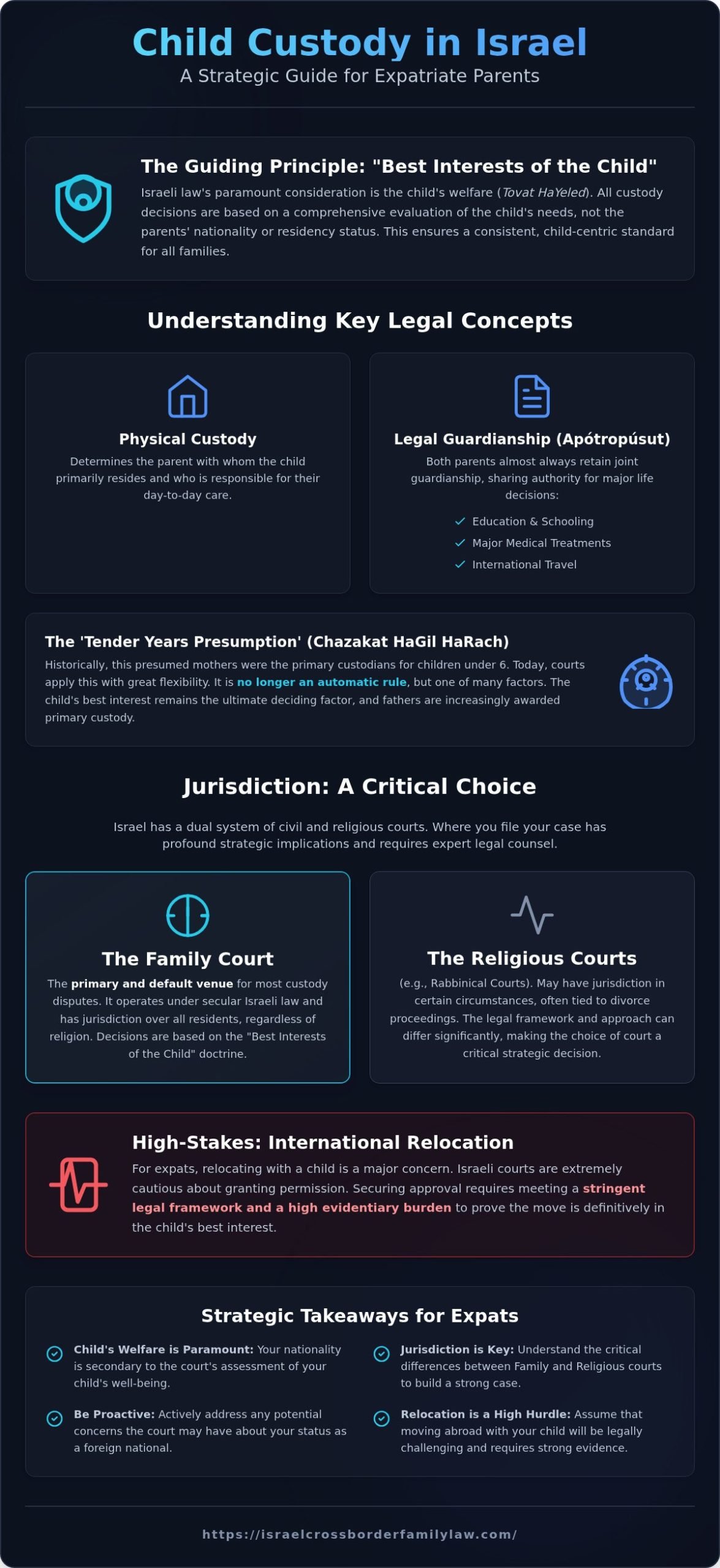
Navigating family law in a new country presents a unique set of challenges. For foreign nationals involved in separation or divorce, understanding the legal foundation for child custody in Israel for expats is the first critical step. The Israeli legal system operates on a foundational principle that governs all decisions related to minors: the child’s welfare supersedes all other considerations, including the nationality or residency status of the parents. This framework ensures a consistent and child-centric approach, providing a predictable, albeit complex, legal environment.
To better understand how Israeli courts approach these sensitive matters, the following video provides a clear overview of the decision-making process.
The ‘Best Interests of the Child’ Doctrine
The paramount principle guiding Israeli Family Courts is the “best interests of the child” (Tovat HaYeled). This doctrine is not merely a guideline but the central legal test applied in every custody determination. The court undertakes a comprehensive evaluation of various factors to ascertain the optimal arrangement for a child’s well-being, including their emotional, physical, and educational needs; the stability of each parent’s home environment; and the child’s own wishes, depending on their age and maturity. This principle is applied universally to all children residing in Israel, ensuring that an expat family is subject to the same rigorous, child-focused standard.
Physical Custody vs. Legal Guardianship (Apótropúsut)
It is essential for expats to distinguish between two key legal concepts: physical custody and legal guardianship. Physical custody refers to the parent with whom the child primarily resides. In contrast, legal guardianship (Apótropúsut) encompasses the authority and responsibility to make significant decisions for the child. Following a divorce, both parents almost invariably retain their status as legal guardians. This shared authority covers critical life decisions regarding:
- Education and school selection
- Major medical treatments
- Psychological care
- Decisions about travel abroad
This joint responsibility extends to financial matters, which are governed by specific child support laws in Israel designed to ensure the child’s needs are met.
Understanding the ‘Tender Years Presumption’ (Chazakat HaGil HaRach)
Historically, Israeli law included the ‘Tender Years Presumption’ (Chazakat HaGil HaRach), which created a legal presumption that mothers were the most suitable primary custodians for children under the age of six. While this presumption still exists in law, modern courts apply it with significant flexibility. It is no longer an automatic rule but rather one of many factors considered. The court’s primary focus remains on the child’s best interests, and fathers are increasingly being awarded primary custody when circumstances warrant it, making the landscape of child custody in Israel for expats more nuanced than in the past.
Jurisdiction: Which Court Will Hear Your Case?
One of the most complex aspects of navigating child custody in Israel for expats is determining the correct legal forum. Israel operates a dual system of civil and religious courts, and the choice of jurisdiction can have profound implications for the outcome of your case. Understanding this structure is a critical first step in protecting your parental rights. Early and strategic legal counsel is paramount to ensure your case is filed in the court most advantageous to your specific circumstances.
The Family Court: The Standard for Civil Matters
The Family Affairs Court is the primary and default venue for the majority of custody and support disputes in Israel. It exercises broad jurisdiction over all residents, regardless of their religious affiliation or lack thereof. Proceedings are conducted based on secular Israeli law, such as the Legal Capacity and Guardianship Law of 1962, which prioritizes the “best interests of the child” as the guiding principle. For most expat families, this court represents the standard and most predictable path for resolving family law matters.
The Rabbinical Court: When Does It Have Authority?
For Jewish couples, the Rabbinical Court (Beit Din) presents an alternative venue. This court has exclusive jurisdiction over marriage and divorce for Jewish citizens but can only hear custody and support matters if both parties are Jewish and explicitly consent to its authority. This can lead to a “jurisdictional race,” where the first spouse to file a comprehensive claim in their preferred court (Family or Rabbinical) secures that forum for the proceedings. The legal interpretations and potential outcomes in the Rabbinical Court can differ significantly from the Family Court, making this initial choice strategically vital.
Proving Residency and Its Impact on Your Case
For an Israeli court to assume jurisdiction over a case involving foreign nationals, it must first establish that the child is a habitual resident. This is not merely a question of physical presence but is determined by the child’s “center of life.” The court will examine a range of factors to make this determination, including:
- The type of visa held by the parents and child
- The duration of their stay in Israel
- Enrollment in local schools or daycare (gan)
- The family’s social and community connections
Establishing the child’s center of life is a pivotal issue for expats and foreign nationals, as it directly impacts the court’s authority to adjudicate. This is especially relevant in cross-border disputes, where a court’s decision on residency can determine whether Israeli law or a foreign legal system applies, and is a core tenet of the Hague Convention in Israeli Law concerning international child abduction.
Key Factors Influencing Custody Decisions for Expat Parents
When adjudicating complex cross-border custody matters, Israeli family courts operate under a single, guiding principle: the best interests of the child (tovat ha’yeled). This principle transcends nationality and requires the court to conduct a thorough, evidence-based analysis of which parent is better equipped to provide for the child’s physical, emotional, and developmental needs. Understanding the specific factors under review is critical for any parent navigating this process.
Assessing Parental Capability and Stability
The court undertakes a comprehensive evaluation of each parent’s ability to provide a stable and nurturing environment. This is not merely a financial assessment but a holistic review of parental capacity. Key considerations include:
- Emotional and Psychological Stability: The court assesses each parent’s mental health and temperament.
- Consistent Caregiving: Evidence of which parent has historically been the primary caregiver carries significant weight.
- Financial Security: The ability to provide for the child’s material needs, including housing and education.
- Support Systems: The presence of a local support network, such as family and friends, is viewed favorably.
A pivotal element in this evaluation is the social worker’s report, known as a Tazkir. This impartial assessment, prepared by a court-appointed professional, provides the judge with a detailed analysis of the family dynamic and a recommendation regarding custody and visitation arrangements.
Does Foreign Nationality Create a Disadvantage?
A prevalent concern among foreign nationals is the fear of inherent bias favoring the Israeli parent. It is crucial to understand that Israeli law does not grant preferential treatment based on nationality. The court’s focus remains squarely on the parent-child relationship and the ability to provide a stable life for the child in Israel. A successful strategy for child custody in Israel for expats hinges on demonstrating unwavering commitment and stability. A well-prepared case, supported by clear evidence of dedicated parenting, can effectively overcome any perceived disadvantage.
Maintaining Cultural and Linguistic Connections
The court recognizes the profound value of a child’s connection to both parents’ cultural and linguistic heritage. An expat parent who can demonstrate a commitment to fostering the child’s connection to Israel-including encouraging Hebrew language skills and participation in local community life-presents a much stronger case. Conversely, the court will also expect the Israeli parent to support the child’s relationship with the expat parent’s culture and language. Demonstrating that you will actively support and nurture all facets of your child’s identity is a powerful component of a successful custody claim.
International Relocation and Child Abduction Risks
For parents navigating the complexities of child custody in Israel for expats, the issue of international relocation is often the most contentious and high-stakes concern. Israel’s legal framework is designed to protect a child’s right to have a meaningful relationship with both parents, making it exceedingly difficult for one parent to leave the country with a child without the express consent of the other or a court order.
The Legal Standard for Relocating a Child from Israel
Under Israeli law, a parent cannot relocate a child to another country without the explicit written consent of the other parent or, failing that, a permissive order from the Family Court. The parent wishing to relocate bears a significant burden of proof. They must demonstrate to the court that the move is not only beneficial for them but, most critically, serves the best interests of the child. The court will meticulously evaluate all factors, including the child’s age, emotional ties to each parent and to Israel, and the potential impact of the move on the child’s relationship with the non-relocating parent. For a comprehensive analysis of this process, see our guide on international custody and relocation.
The Hague Convention and International Child Abduction
The unilateral removal of a child from Israel by one parent without the other’s consent is considered international child abduction, a severe violation of both Israeli law and international treaties. Israel, along with the United States and many other nations, is a signatory to the Hague Convention on the Civil Aspects of International Child Abduction. This treaty provides an expedited legal mechanism for the prompt return of a wrongfully removed child to their country of habitual residence. The Convention’s primary objective is to restore the pre-abduction status quo, allowing the custody dispute to be resolved in the child’s home jurisdiction. Our firm possesses deep experience in representing clients in complex Hague Convention cases.
Practical Steps: Seeking Permission to Travel or Relocate
Successfully navigating relocation or even temporary international travel requires a strategic and proactive approach. The ideal first step is to negotiate consent and establish clear travel protocols within a comprehensive parenting plan. If consent is withheld, the parent must petition the court. Success in court hinges on presenting a detailed and compelling relocation plan that addresses:
- The proposed living arrangements, schooling, and healthcare in the new country.
- A concrete plan to facilitate a strong and continuous relationship between the child and the non-relocating parent.
- The financial stability and support network available in the destination country.
These cross-border custody matters are exceptionally complex. Navigating them requires sophisticated legal counsel to protect your parental rights. Contact our legal team to discuss your specific situation.
Crafting a Custody Agreement: A Practical Strategy for Expats
Navigating the theoretical aspects of Israeli family law is foundational; translating that knowledge into a durable and effective custody agreement is the critical next step. For expatriates, this process requires a strategic approach that prioritizes clarity, stability, and the child’s best interests while accounting for multi-jurisdictional complexities. The objective is to move from dispute to resolution with a clear, enforceable plan.
The Role of Mediation vs. Litigation in Israel
The Israeli legal system encourages amicable resolution, mandating that all divorcing couples attend an initial mediation information session before proceeding to court. Mediation offers a collaborative forum where parents, guided by a neutral third party, can craft a customized agreement. This process is typically faster, less costly, and less adversarial than court litigation. A mutually agreed-upon settlement fosters better co-parenting relationships and is often more resilient than a court-imposed order, which can feel punitive to one or both parties.
Key Components of a Comprehensive Parenting Plan
A successful parenting plan is the cornerstone of a stable co-parenting future. It must be meticulously detailed to minimize ambiguity and prevent future conflicts. An effective agreement should comprehensively address:
- Residential Schedule: Precise weekly and bi-weekly schedules outlining when the child resides with each parent.
- Holidays and Vacations: A clear calendar for all Jewish and secular holidays, school breaks, and summer vacations, including protocols for international travel.
- Decision-Making Authority: Specific protocols for major decisions concerning the child’s education, religious upbringing, and non-emergency medical care.
- Communication Guidelines: Agreed-upon methods and frequency of communication between parents and between each parent and the child.
- Relocation Clauses: Terms addressing potential future relocation of a parent, both within Israel and internationally-a crucial provision for expats.
Why Expert Cross-Border Legal Counsel is Non-Negotiable
The challenges inherent in matters of child custody in Israel for expats are significant, involving the intersection of different legal systems, cultural norms, and potential international treaty implications like the Hague Convention. Retaining a law firm with deep expertise in cross-border family law is not a luxury but a necessity. An experienced attorney ensures your rights are protected, that your agreement is enforceable both in Israel and abroad, and that you can effectively navigate the Israeli court system. They act as your strategic advisor, guiding you toward a resolution that secures your child’s well-being and your parental rights. To understand how these complex factors apply to your unique situation, we invite you to request a confidential case review.
Securing Your Parental Rights: A Strategic Approach to Custody in Israel
Navigating the complexities of child custody in israel for expats requires a sophisticated understanding of Israeli family law. As this guide has detailed, the court’s unwavering focus on the child’s best interests, the critical determination of jurisdiction, and the profound implications of potential international relocation are pivotal factors that demand expert strategic foresight. A meticulously crafted custody agreement is not merely a document but a foundational tool for protecting your parental relationship across international borders.
These intricate matters demand specialized expertise in complex US-Israel cross-border family law. With a deep understanding of the unique challenges facing expats and foreign nationals, our firm provides a strategic approach dedicated to protecting your parental rights within the Israeli court system. We invite you to Schedule a Confidential Consultation to Discuss Your Case and take the first step toward a secure resolution.
Taking proactive and informed action today is the most powerful way to secure a stable and positive future for you and your children.
Frequently Asked Questions About Child Custody in Israel for Expats
What is considered ‘joint custody’ under Israeli law and how common is it?
Under Israeli law, “joint physical custody” (משמורת פיזית משותפת) refers to an arrangement where both parents share near-equal time and responsibility for raising their child. While increasingly common, it is not the default arrangement. The Family Court’s paramount consideration is the “best interests of the child,” and it will only grant joint custody if it determines that the parents can cooperate effectively and that the arrangement is stable and beneficial for the child’s welfare, a complex assessment in cross-border family matters.
Can an unmarried expat father establish custody and visitation rights in Israel?
Yes, absolutely. Israeli family law does not discriminate between married and unmarried parents concerning their rights and responsibilities towards their children. The critical first step for an unmarried expat father is to formally establish paternity. This can be achieved through a joint declaration with the mother or, if necessary, through a court-ordered paternity test. Once paternity is legally recognized, the father possesses the full legal standing to petition the court for custody, visitation schedules, and involvement in all major decisions.
How is child support calculated in Israel, especially when one parent is an expat?
Child support (Mezonot) calculations are complex, balancing the child’s essential needs with the parents’ respective income capacities. While religious law has historically influenced outcomes, modern court decisions increasingly factor in both parents’ earnings. For an expat parent, the court will assess global income and assets, converting foreign currency to Israeli Shekels (ILS) to determine a fair contribution. This multi-jurisdictional financial assessment requires sophisticated legal guidance to ensure all relevant economic factors are properly presented to the court.
What happens to my parental rights if my Israeli visa is dependent on my spouse?
Your parental rights and your immigration status are two distinct legal issues. The dissolution of your marriage does not automatically terminate your rights as a parent. However, the expiration of a spousal visa creates a significant practical challenge to exercising those rights. It is imperative to seek immediate, specialized legal counsel to regularize your visa status on alternative grounds, often on a humanitarian basis as the parent of an Israeli child, to ensure you can remain in Israel and maintain your relationship with your child.
Is it possible to modify an Israeli child custody order in the future?
Yes, Israeli child custody and support orders are not immutable and can be modified. A parent seeking to alter a court order must file a new claim and demonstrate a “material change of circumstances” (שינוי נסיבות מהותי) that has occurred since the original decree was issued. Such changes could include a parent’s international relocation, a significant shift in financial standing, or the evolving developmental needs of the child. The court will re-evaluate the situation based on the child’s best interests.
What evidence should I gather to prepare for a custody case in Israel?
To build a robust case, you must gather comprehensive evidence demonstrating your consistent and positive involvement in your child’s life. This includes school and medical records, proof of financial support (bank statements showing transfers in ILS), and documentation of suitable living arrangements. Communications with the other parent, such as emails and text messages, are also vital. For those navigating the complexities of child custody in Israel for expats, presenting clear, organized evidence is fundamental to achieving a favorable outcome.

Article by
Gabriel Lior
A Personal Journey That Became a Mission
The advisory was founded by an American father Gabriel Lior, LLB, MBA , global entrepreneur, and cross-border advisor who spent more than a decade navigating the Israeli family court system firsthand and now lives in Singapore with his son.
As a divorced parent in a cross-border family, Gabriel faced nearly every legal challenge a foreign parent can encounter in Israel — including child custody disputes, child support proceedings, property matters in Israel and abroad, false accusations, and complex immigration and relocation proceedings.
Over the years, he learned the hard way how difficult it is for non-Israeli parents to understand the system, identify the right legal strategy, and choose the right legal representation — especially when language, culture, and jurisdictional differences are involved. He also witnessed how foreign parents and new immigrants are often disadvantaged or taken advantage of by service providers and institutions simply because they lack local knowledge or fluency.
From Client to Advisor
To truly understand — and survive — the system, Gabriel pursued formal legal education in Israel, completing two Israeli law degrees, alongside a BA and MBA earned in the United States. This was never about becoming a practicing attorney, but about gaining a deep, structural understanding of how the system works — and where it breaks down for foreign parents.
This rare combination of:
Firsthand client experience
Israeli legal and US business education
International business and negotiation training
Decades of commercial execution
created a unique perspective – one that understands both sides of the table.
After years of litigation, persistence, and at times self-representation, he ultimately succeeded in securing custody of his son and relocating abroad through a rare legal victory in the Israeli Supreme Court — becoming one of the first fathers in Israel to do so under these circumstances.
Disclaimer
Important Disclaimer:
The information provided on this website and in its content is for general informational and educational purposes only and does not constitute legal advice, legal opinion, or legal representation.
Gabriel Lior is not licensed to practice law in Israel (nor is he interested in doing so) and does not provide legal services, despite having completed 2 Law Degrees. The services offered are advisory in nature and are intended to provide general guidance, strategic insight, and information regarding cross-border family law considerations.
No attorney-client relationship is formed by accessing this website, reading its content, or communicating with us.
Any decisions made based on this information are at your own discretion and risk. For legal advice specific to your situation, you should consult a licensed attorney in the relevant jurisdiction.
Where appropriate, we may refer clients to independent, licensed attorneys or professionals. Such referrals do not constitute legal representation and no liability is assumed for services provided by third parties.