This article is published on an independent advisory platform (not a law firm) and does not constitute an attorney-client relationship or legal advice. Legal services are provided only by licensed attorneys under a separate engagement.
In a country where civil marriage does not exist, living together is far more than a lifestyle choice; it’s a legal status that carries significant weight. For many expats and international families, the concept of common law marriage in Israel, known locally as Yeduim BaTzibur, remains a source of deep uncertainty. You might worry about the security of your global assets or how your status affects your standing with authorities in your home country. It’s natural to feel uneasy when the rules of your new home don’t align with the legal frameworks you’ve always known.
We’ll provide the clarity you need to move forward with confidence. This guide explains how Israeli courts define cohabitation, the specific rights you gain, and the strategic risks you must manage to protect your future. We’ll preview the essential steps for safeguarding pre-marital property and examine how the 2026 mandatory reporting requirements for new immigrants impact international couples. By understanding these systemic differences early, you can ensure your family’s interests are protected both in Israel and abroad.
Key Takeaways
- Understand why Yeduim BaTzibur serves as a critical legal alternative to religious marriage within the Israeli legal system.
- Learn the two essential legal benchmarks—an intimate relationship and a shared household—that courts use to validate a partnership.
- Discover how common law marriage in Israel grants access to National Insurance benefits and inheritance rights similar to those of married couples.
- Identify the strategic risks of the “Presumption of Partnership” and how proactive documentation can protect your pre-marital assets.
- Navigate the complexities of international recognition, specifically regarding why Israeli cohabitation status may not satisfy US immigration or tax requirements.
This article is published on an independent advisory platform (not a law firm) and does not constitute an attorney-client relationship or legal advice. Legal services are provided only by licensed attorneys under a separate engagement.
What is Common Law Marriage (Yeduim BaTzibur) in Israel?
In the Israeli legal landscape, the term Yeduim BaTzibur, or “Known in Public,” represents a sophisticated functional status for couples. Unlike many Western jurisdictions where common law rights are limited, common law marriage in Israel offers a comprehensive legal framework that mirrors most rights of a civil marriage. This status is particularly prevalent because Israel does not provide a mechanism for civil marriage within its borders. Instead, the state recognizes Unregistered cohabitation in Israel as a valid legal standing based on the actual life a couple leads together.
It’s vital to understand that this isn’t a status you “register” for at a government office. There’s no certificate issued by the Ministry of Interior to mark the start of your partnership. IL courts prioritize the lived reality of the relationship over formal documentation. They look for evidence of a shared destiny and economic entanglement. This means your status is established through your daily actions, shared finances, and how you present yourselves to your community.
To better understand how this status compares to marriage when a relationship ends, watch this helpful video:
The Distinction Between Marriage and Common Law Status
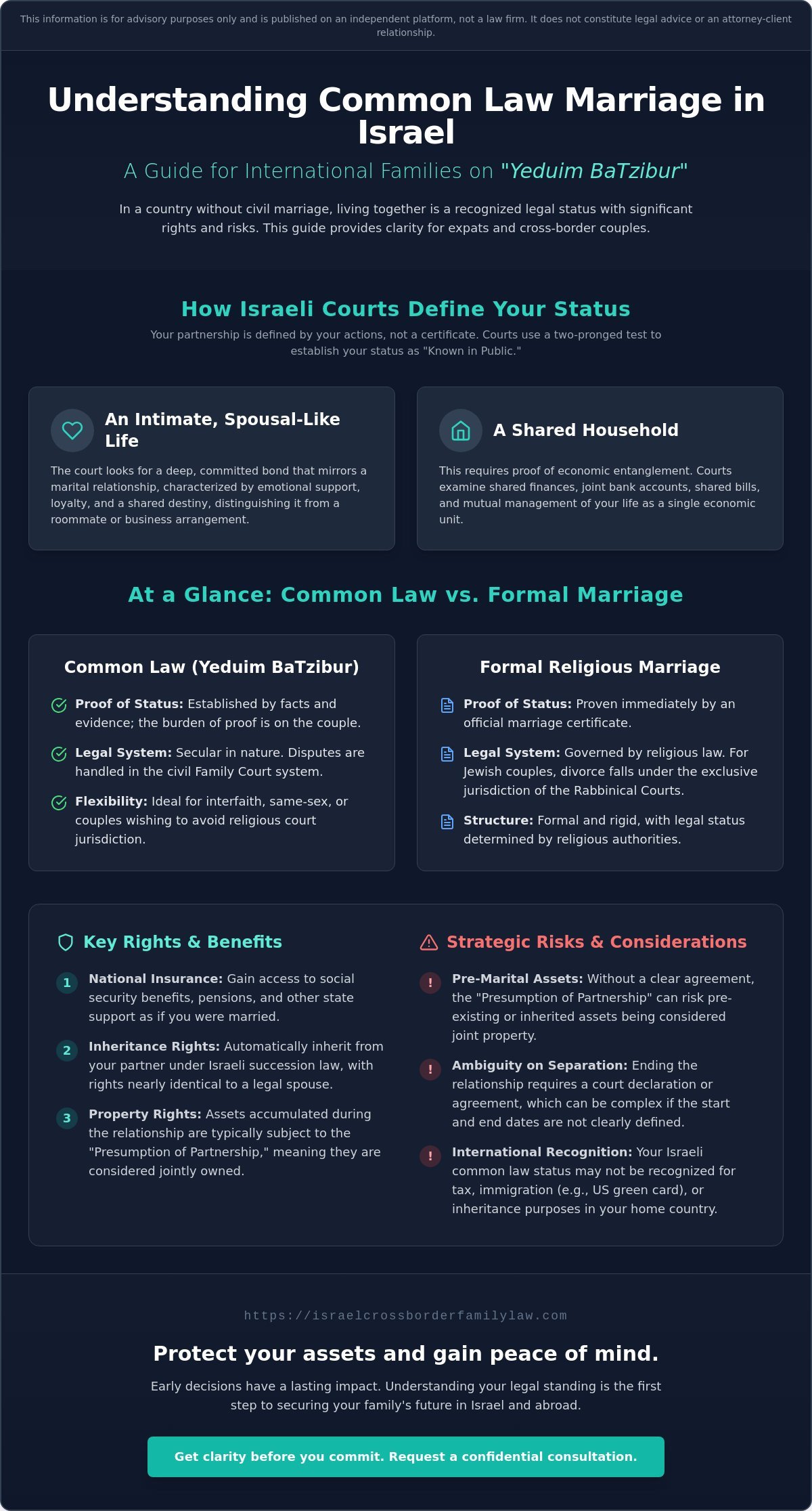
While the rights are nearly identical, the legal mechanics differ significantly. For married couples, a marriage certificate serves as immediate proof of their status. For common law partners, the burden of proof rests entirely on the couple. You must be prepared to demonstrate the depth of your commitment through financial records and social testimony. This status is secular in nature. It offers a path for those who wish to keep their personal lives outside the reach of religious authorities while still accessing state-mandated protections.
Why Many Expats Choose Common Law Status
For international families, choosing this path is often a strategic decision. One primary driver is the desire to avoid the jurisdiction of the Rabbinical Courts. In Israel, these courts hold exclusive authority over the divorce of Jewish citizens and residents. By remaining common law spouses, couples can often maintain their disputes within the civil Family Court system. This provides a more predictable environment for divorce and separation for international families. Additionally, this status provides essential flexibility for interfaith or same-sex couples who cannot legally marry under current religious laws. It also allows for more nuanced asset management for those entering a relationship with significant global wealth while navigating the complexities of common law marriage in Israel.
This article is published on an independent advisory platform (not a law firm) and does not constitute an attorney-client relationship or legal advice. Legal services are provided only by licensed attorneys under a separate engagement.
The Legal Criteria: How the Israeli Courts Define Your Status
Establishing common law marriage in Israel is a factual determination rather than a bureaucratic one. The courts rely on a two-pronged test developed through decades of case law. First, they examine the “Intimate Life” of the couple. This goes beyond the relationship of mere roommates or business partners. It requires a spousal-like bond characterized by emotional commitment and mutual support. Second, the “Joint Household” requirement looks for economic entanglement. This means the couple manages their lives as a single unit, sharing expenses and responsibilities.
Recent judicial trends in 2024 and 2025 have shifted the focus toward the “intent” of the parties. According to a Law Library of Congress report on Israeli common law marriage, the courts prioritize the functional reality of the partnership over specific administrative markers. Public perception plays a vital role here; the court often asks whether friends, family, and neighbors view you as a committed couple. If you present yourselves as a unit in social settings or on social media, this serves as strong evidence of your status.
Evidence Required for Recognition
To satisfy the court, you should maintain clear records of your shared life. Useful evidence often includes:
- Joint bank accounts or consistent transfers between individual accounts for household costs.
- Shared residential addresses reflected on Ministry of Interior records and utility bills.
- Lease or mortgage agreements signed by both partners.
- Testimony from third parties who can confirm the nature of the relationship.
If you’re unsure how your current arrangements might be viewed by a court, you may want to discuss your situation to gain a clearer perspective on your status before legal complications arise.
The “Duration” Myth
There’s a common misconception that you must live together for a specific number of years, such as seven, before you’re recognized. This is a myth. There’s no statutory minimum time in IL law. Courts have recognized a common law marriage in Israel in cases where the couple lived together for as little as six months, provided the intent was clear. A “shared intent” to marry or build a permanent future can accelerate this recognition. This flexibility allows the court to protect partners in modern relationships, but it also creates a risk of unintentional legal entanglement if you haven’t established clear boundaries through a cohabitation agreement.
This article is published on an independent advisory platform (not a law firm) and does not constitute an attorney-client relationship or legal advice. Legal services are provided only by licensed attorneys under a separate engagement.
Rights and Benefits of Common Law Spouses in Israel
The decision to maintain a common law marriage in Israel rather than pursuing a formal religious ceremony doesn’t mean sacrificing your legal security. Israeli law has evolved to provide cohabiting partners with a comprehensive range of social and economic rights. These protections ensure that the functional reality of your partnership is respected by state institutions, employers, and financial entities. It’s not a “light” version of marriage; it’s a parallel legal track that offers robust safety nets for those who document their lives correctly.
Central to these rights is the recognition by National Insurance (Bituach Leumi). Common law spouses are eligible for survivor pensions, disability benefits, and various grants. As of January 2026, the birth grant for a first child is ₪2,103, and the full disability benefit for a couple can reach ₪6,229 per month if one partner doesn’t receive their own benefit. Beyond state support, workplace rights extend to your partner. You can utilize sick leave for their care or receive bereavement leave just as a married employee would. In some cases, real estate tax exemptions for a primary residence also apply to recognized partners, though these require specific proof of your shared household.
Economic Entitlements and Pensions
Economic entanglement in a recognized partnership creates significant claims during the relationship and after it ends. You have the right to claim a deceased partner’s private pension funds and provident accounts, provided you can prove your status to the fund managers. If a separation occurs, the Israeli legal system allows for spousal support, often called “rehabilitative alimony,” to assist the lower-earning partner. Your healthcare rights are also protected under the National Health Insurance Law, ensuring you can be covered under your partner’s health fund (Kupat Cholim) if you meet the residency requirements.
Inheritance and Estate Planning
The 1965 Inheritance Law provides a critical safety net for international families. Under Section 55, a surviving common law partner inherits the same share as a married spouse if neither was married to another person at the time of death. However, relying on this default legal distribution is risky for those with assets in multiple jurisdictions. While the law is generous, it’s often wise to use a will to override these defaults and ensure your specific intentions are met. Gaining clarity on inheritance law in Israel for foreigners is an essential step in managing a complex cross-border estate.
When choosing between formal marriage and common law status, consider the administrative burden. Marriage is a documented status easily recognized by tax authorities and foreign governments. Common law status is a proven status that requires you to actively demonstrate your shared life. If you value privacy and wish to avoid religious courts, common law is a powerful tool. If you require immediate recognition for US immigration or tax purposes, the lack of a marriage certificate may present obstacles that require a different strategic approach.
This article is published on an independent advisory platform (not a law firm) and does not constitute an attorney-client relationship or legal advice. Legal services are provided only by licensed attorneys under a separate engagement.
The Risks of Ambiguity: Property and Religious Implications
While the benefits of common law marriage in Israel are extensive, the absence of a formal marriage certificate introduces a layer of legal unpredictability. One of the most significant challenges is the “Presumption of Partnership.” This is a judicial tool used by IL courts to determine that assets intended for joint use are shared, even if they’re held in only one partner’s name. This presumption can inadvertently put your pre-marital assets, foreign real estate, or family inheritances at risk if you don’t establish clear boundaries early in the relationship.
The lack of a fixed start date for the partnership often leads to “litigation of status” during a separation. Because there’s no wedding date to reference, partners may disagree on exactly when the relationship met the criteria for Yeduim BaTzibur. One partner might claim the relationship began years earlier to maximize their share of property or pension rights. This ambiguity creates a stressful and expensive environment where personal history is debated in court, highlighting the importance of seeking clarity before you commit to a shared life.
Property Division and the “Gett” Requirement
Many international couples choose common law status specifically to avoid religious authorities, yet they may still find themselves under the jurisdiction of the Rabbinical Court. If both partners are Jewish, the court may view the relationship as “doubtfully married” (Saffek Kiddushin). In such cases, a religious divorce, known as a Gett, is required to formally end the union. This introduces the risk of “Get Refusal,” where one partner withholds the divorce to gain leverage in property or custody negotiations. It’s also vital to understand the long-term consequences for future children. Mamser status refers to the severe religious legal restriction placed on children born from a mother who is considered still married to a previous partner because she did not receive a formal Gett from the Rabbinical Court.
The Solution: A Cohabitation Agreement
The only reliable method to mitigate these risks is through a written Financial Agreement, often called a Cohabitation Agreement. This document allows you to define which assets remain separate and how property should be divided if the relationship ends. To be fully binding, the agreement should be validated by the Family Court. This process ensures both parties understand the terms and that the document carries the weight of a court judgment. Proactive documentation is the most effective way to manage divorce and separation for international families while living under the framework of common law marriage in Israel.
If you’re currently cohabiting without a formal agreement, you may want to request a confidential consultation to discuss how to protect your global interests and ensure your family’s future security.
This article is published on an independent advisory platform (not a law firm) and does not constitute an attorney-client relationship or legal advice. Legal services are only provided by licensed attorneys under a separate engagement.
Cross-Border Strategy: US and International Considerations
The strategic landscape for international couples is often defined by a significant mismatch between local recognition and global requirements. While common law marriage in Israel provides a robust legal safety net within the country, this status often carries little weight once you cross international borders. For US citizens and dual nationals, this “legal dissonance” creates complex challenges in immigration, tax compliance, and asset protection. Understanding how your Israeli status interacts with foreign legal systems is essential for maintaining long-term financial and personal security.
One of the most pressing issues for American expats is the lack of federal recognition for common law unions. For the purposes of US immigration, the United States Citizenship and Immigration Services (USCIS) typically requires a formal marriage certificate from a jurisdiction where the marriage was legally contracted. This means that a couple recognized as Yeduim BaTzibur in Israel cannot apply for a spousal green card or certain visa categories based on that status alone. Similarly, the IRS generally does not recognize common law partnerships for tax filing purposes unless the couple met the specific requirements of a US state that permits such unions. This often forces couples to file as “Single” or “Head of Household,” potentially missing out on the benefits of joint filing.
Asset management also becomes more complex due to new reporting requirements. As of January 1, 2026, new immigrants (Olim) and veteran returning residents must report their foreign income and assets to the Israel Tax Authority. While the 10-year tax exemption remains, this mandatory reporting means that the financial entanglement of a common law partnership will be visible to authorities in both jurisdictions. Strategic planning is required to ensure that Israeli cohabitation agreements are drafted with an eye toward enforceability in foreign courts, especially if you hold significant assets in the US or Europe.
Immigration and Residency Challenges
While the US may be restrictive, Israel’s Ministry of Interior (Misrad HaPnim) does offer a pathway for foreign common law partners of Israeli residents. This is known as the “Gradual Process” (Hahalech HeHadragi). This procedure allows a foreign partner to obtain legal status and eventually permanent residency or citizenship. It’s a rigorous process that typically spans five to seven years and requires extensive documentation to prove the relationship is genuine. Unlike married couples, common law partners often face stricter scrutiny and more frequent interviews to maintain their residency permits.
Next Steps for International Couples
The impact of early decisions on your long-term security cannot be overstated. Because common law marriage in Israel is a proven status rather than a registered one, the way you structure your finances and residency today will dictate your rights in the future. Consulting with a cross-border specialist is a vital step for any couple managing lives in two or more countries. You should focus on creating a strategy that addresses both the immediate needs of your life in Israel and the long-term requirements of your home country’s legal and tax systems.
Get clarity before you commit to a shared life that may have unintended global consequences. You can request a confidential case review to discuss your specific strategy and protect your international interests.
This article is published on an independent advisory platform (not a law firm) and does not constitute an attorney-client relationship or legal advice. Legal services are provided only by licensed attorneys under a separate engagement.
Strategic Planning for Your International Partnership
Living under the framework of common law marriage in Israel provides significant local protections, but it also demands proactive management to avoid cross-border complications. You’ve learned that while the state grants rights to inheritance and social benefits, these protections don’t automatically extend to US immigration or tax filings. Establishing a clear cohabitation agreement is the most effective way to separate pre-marital assets and define your status on your own terms rather than leaving it to judicial interpretation.
Navigating these multi-jurisdictional complexities requires a calm, advisory approach that understands both the Israeli landscape and the specific needs of international families. Protecting your global interests starts with making informed choices before legal ambiguities arise. Our practitioners specialize in US-Israel family law and cross-border asset protection, providing the steady guidance needed to bridge divergent legal systems. By addressing these risks today, you can build a secure foundation for your life in Israel while maintaining your standing abroad. Get clarity before you commit. Request a confidential consultation.
This article is published on an independent advisory platform (not a law firm) and does not constitute an attorney-client relationship or legal advice. Legal services are provided only by licensed attorneys under a separate engagement.
Frequently Asked Questions
Is common law marriage automatically recognized in Israel?
Recognition is not automatic; it’s a factual status that must be proven through the reality of your shared life. IL courts determine your standing based on whether you maintain an intimate, spousal like relationship and manage a joint household. You don’t receive a certificate or registration to confirm this status. Instead, you must provide evidence of your lifestyle and economic entanglement to state institutions or courts when exercising your rights.
How long do you have to live together to be considered common law in Israel?
There’s no statutory minimum time required to establish a common law marriage in Israel. While some people mistakenly believe a relationship must last for years, courts prioritize the intent and depth of the partnership over its duration. In specific cases, judges have recognized couples who lived together for as little as six months. The key is demonstrating a shared destiny and a commitment to a joint household from the outset.
Do common law spouses have inheritance rights in Israel?
Yes, common law spouses possess inheritance rights that are nearly identical to those of married couples under the 1965 Inheritance Law. Section 55 grants a surviving partner the right to inherit if neither person was married to someone else at the time of death. However, this default legal distribution can be complex to prove after a partner passes away. It’s often safer to use a will to clearly define your wishes and avoid a lengthy status verification process.
Can a common law partner claim alimony (spousal support) in Israel?
Common law partners can indeed claim spousal support, which is often referred to as rehabilitative alimony. This support is designed to help a partner maintain their standard of living or transition to financial independence after a long term relationship ends. The court considers the duration of the partnership and the level of economic dependence between the partners. This right exists independently of religious law and is handled within the civil Family Court system.
Will the US government recognize my Israeli common law marriage?
The US government generally doesn’t recognize common law marriage in Israel for federal purposes like immigration or taxes. For a spousal green card or a joint tax return, US authorities typically require a formal marriage certificate from a recognized civil or religious authority. Even if you’re fully recognized as Yeduim BaTzibur in IL, you’ll likely be viewed as single under US federal law. This discrepancy creates significant challenges for dual citizens managing assets in both countries.
What happens to my house if my common law relationship ends in Israel?
Your home may be subject to the Presumption of Partnership, meaning it could be divided between both partners regardless of whose name is on the deed. If the property served as your primary joint residence, the court might rule that it’s a shared asset. This risk is particularly high for international families with significant real estate holdings. A validated cohabitation agreement is the only certain way to protect your pre-marital property from being split during a separation.
Do we need to register our status with the Ministry of Interior?
You don’t register your status as a common law couple in the same way you’d register a marriage. However, if one partner is a foreign national, you must engage with the Ministry of Interior through the Gradual Process to secure residency rights. This involves providing extensive documentation and attending interviews to prove your relationship is genuine. For IL citizens, the status remains unregistered and is only verified when you apply for specific benefits or face legal proceedings.
What is the risk of “mamser” status for children in common law unions?
The risk of mamser status arises if the mother was previously married and never received a formal religious divorce, or Gett, from the Rabbinical Court. Under religious law, children born from a second relationship while the first marriage is technically active face severe legal restrictions regarding who they can marry in the future. Even if you choose a common law path to avoid religious courts, resolving any prior marital status is critical to protecting your children’s future standing.

Article by
Gabriel Lior
A Personal Journey That Became a Mission
The advisory was founded by an American father Gabriel Lior, LLB, MBA , global entrepreneur, and cross-border advisor who spent more than a decade navigating the Israeli family court system firsthand and now lives in Singapore with his son.
As a divorced parent in a cross-border family, Gabriel faced nearly every legal challenge a foreign parent can encounter in Israel — including child custody disputes, child support proceedings, property matters in Israel and abroad, false accusations, and complex immigration and relocation proceedings.
Over the years, he learned the hard way how difficult it is for non-Israeli parents to understand the system, identify the right legal strategy, and choose the right legal representation — especially when language, culture, and jurisdictional differences are involved. He also witnessed how foreign parents and new immigrants are often disadvantaged or taken advantage of by service providers and institutions simply because they lack local knowledge or fluency.
From Client to Advisor
To truly understand — and survive — the system, Gabriel pursued formal legal education in Israel, completing two Israeli law degrees, alongside a BA and MBA earned in the United States. This was never about becoming a practicing attorney, but about gaining a deep, structural understanding of how the system works — and where it breaks down for foreign parents.
This rare combination of:
Firsthand client experience
Israeli legal and US business education
International business and negotiation training
Decades of commercial execution
created a unique perspective – one that understands both sides of the table.
After years of litigation, persistence, and at times self-representation, he ultimately succeeded in securing custody of his son and relocating abroad through a rare legal victory in the Israeli Supreme Court — becoming one of the first fathers in Israel to do so under these circumstances.
Disclaimer
Important Disclaimer:
The information provided on this website and in its content is for general informational and educational purposes only and does not constitute legal advice, legal opinion, or legal representation.
Gabriel Lior is not licensed to practice law in Israel (nor is he interested in doing so) and does not provide legal services, despite having completed 2 Law Degrees. The services offered are advisory in nature and are intended to provide general guidance, strategic insight, and information regarding cross-border family law considerations.
No attorney-client relationship is formed by accessing this website, reading its content, or communicating with us.
Any decisions made based on this information are at your own discretion and risk. For legal advice specific to your situation, you should consult a licensed attorney in the relevant jurisdiction.
Where appropriate, we may refer clients to independent, licensed attorneys or professionals. Such referrals do not constitute legal representation and no liability is assumed for services provided by third parties.