This article is published on an independent advisory platform, not a law firm. The content is for informational and advisory purposes only and does not constitute legal representation or an attorney-client relationship.
Confidentiality is not a default setting in international family law; it is a strategic asset that you must actively engineer. You likely worry that filing a case could expose your private financial records or sensitive personal history to public scrutiny in a foreign court. Maintaining confidentiality in cross-jurisdictional cases between the United States and Israel requires a deep understanding of two very different legal cultures. It’s common to feel anxious about how much transparency is required, especially when dealing with the specific rules of the Israeli Rabbinical court system.
This guide will help you understand how to protect your sensitive personal and financial information while navigating these complexities. We’ll explain the risks of cross-border disclosure and how the April 2026 regulations from the Israel Privacy Protection Authority affect your data security. You’ll learn how to choose the right jurisdiction to maximize your privacy and develop a strategy to keep your private life private. By gaining clarity on these systemic differences, you can make informed decisions that safeguard your family’s future and your personal data.
Key Takeaways
- Learn the critical distinction between physical privacy in a courtroom and the long-term protection of your sensitive financial data.
- Understand how attorney-client privilege differs between the US and Israel and what those variations mean for your private communications.
- Discover how the “race for jurisdiction” between Israeli civil and rabbinical courts directly impacts your strategy for confidentiality in cross-jurisdictional cases.
- Identify immediate, practical steps to secure your digital communications and prevent sensitive information from being accidentally exposed.
- Recognize why your initial legal decisions can dictate your level of privacy and data security for the next two years or more.
This article is published on an independent advisory platform and does not constitute an attorney-client relationship. The content is for informational and advisory purposes only.
The Role of Confidentiality in International Family Law
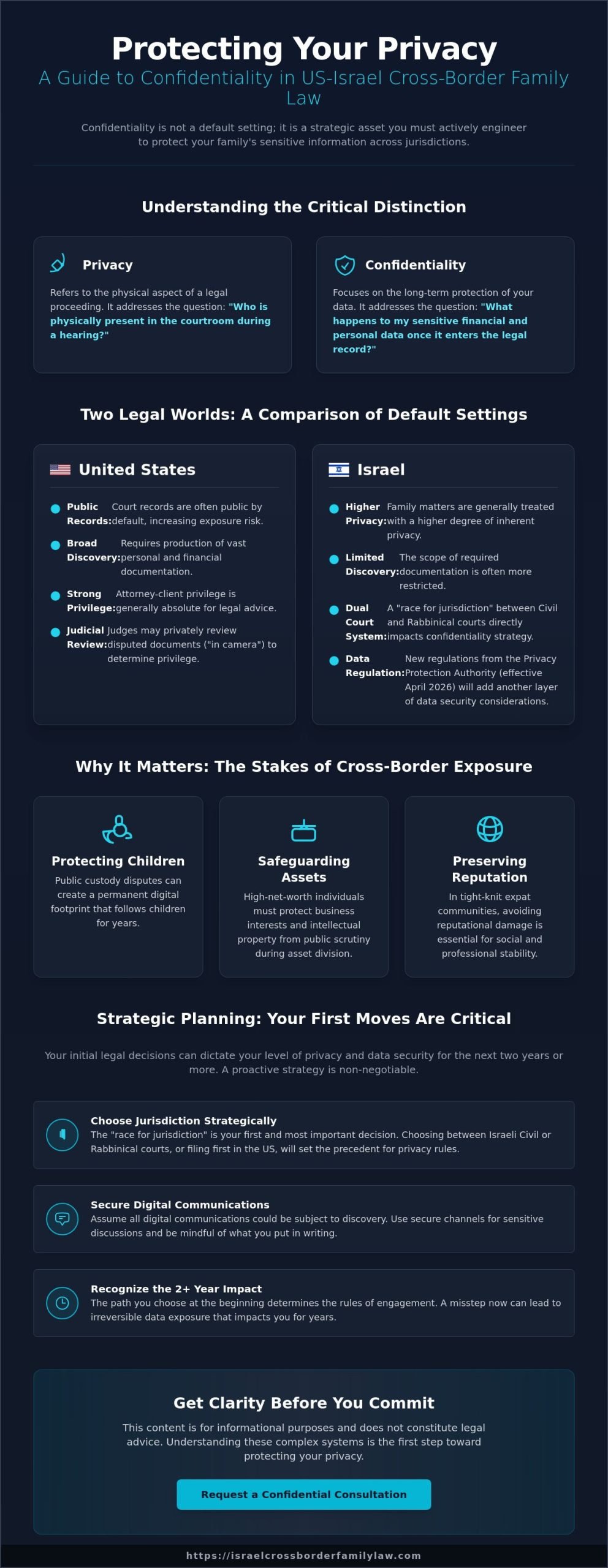
Managing a family law matter across two countries creates a wider surface area for information to leak. Ensuring confidentiality in cross-jurisdictional cases involves more than just locking a courtroom door. It requires a strategic understanding of how data moves between legal systems. While privacy refers to who is physically present in the room during a hearing, confidentiality focuses on what happens to your sensitive financial and personal data once it enters the legal record. In the United States, court records are often public by default, whereas Israel generally treats family matters with a higher degree of inherent privacy. However, once information is shared in one jurisdiction, it can often find its way into the other through various legal channels.
The foundation of these protections often rests on the concept of Legal professional privilege. This principle ensures that your communications with your legal team remain protected from disclosure. In cross-border matters, the strength of this privilege can shift depending on which country’s rules apply to a specific document or conversation. You must understand these nuances to maintain control over your narrative during negotiations. Protecting your data isn’t just about comfort; it’s about maintaining leverage for future enforcement or settlement discussions.
To better understand how these protections work in practice, watch this helpful video:
Why Families in Transition Prioritize Secrecy
International families often have complex lives that require discretion. Protecting children is the primary concern, as public custody disputes can leave a digital footprint that follows them for years. High-net-worth individuals also need to safeguard business interests and intellectual property that might be scrutinized during asset division. In tight-knit expat communities in Israel, news travels fast. Avoiding reputational damage is essential for maintaining social and professional stability during divorce or separation.
The Complexity of Multi-Jurisdictional Exposure
The risks of confidentiality in cross-jurisdictional cases increase significantly during the discovery process. US courts typically allow for broad discovery, meaning you might be required to produce a vast amount of personal and financial documentation. Once this data is part of a US proceeding, it may become accessible in an Israeli court through international cooperation or simple filing. Conversely, Israel’s discovery scope is often more limited. Seeking clarity before you commit to a specific court or jurisdiction is vital. Your first move often dictates whether your private information remains protected or becomes a matter of public record across two continents.
Legal privilege is not a universal concept that remains static as you cross borders. While both the United States and Israel value the privacy of the lawyer-client relationship, the specific mechanisms they use to protect it differ in practice. Maintaining confidentiality in cross-jurisdictional cases requires you to know which country’s rules will apply to your communications at any given time. A document protected in one system might be vulnerable in another.
Attorney-Client Privilege in the United States
In the US, attorney-client privilege is generally absolute when it concerns seeking legal advice. Courts are very protective of this right. If a dispute arises over whether a specific document is privileged, a judge may perform an “in camera” review. This means the judge looks at the document privately to decide if the other side has a right to see it. However, this protection isn’t without limits. The “crime-fraud” exception can strip away privilege if the communication was made to further a crime or a fraudulent act. This can become a complex issue in international asset disputes where financial transparency is questioned.
Legal Professional Secrecy in Israel (IL)
In Israel (IL), the protection is rooted in the Israeli Bar Association rules and is often referred to as “professional secrecy.” It’s important to remember that in this context, IL always refers to Israel, not the state of Illinois. One major difference between the two systems lies in the discovery process. US litigation is known for “fishing expeditions” where parties demand vast amounts of data. Israeli courts are generally more restrictive. They require a higher showing of relevance before ordering the disclosure of documents. For those navigating the Hague Convention on International Child Abduction or complex custody matters, these procedural variations are critical to your strategy.
The “Work Product” doctrine also varies between the two nations. In the US, this protects materials prepared by or for an attorney in anticipation of litigation. Israel offers similar protections, but they are often viewed through the lens of professional ethics rather than a standalone doctrine. A common risk in cross-border cases is the “inadvertent waiver.” If you copy a third party, like a financial advisor or a sibling, on an email to your lawyer, you might lose your right to keep that message private. Both legal systems can view the inclusion of a third party as a waiver of privilege. If you are unsure how to structure your communications to protect your data, it is wise to request a strategy session to establish clear protocols from the start.
This article is published on an independent advisory platform and does not constitute an attorney-client relationship. The content is for informational and advisory purposes only.
Privacy in Israeli Civil vs. Rabbinical Courts
Israel’s legal landscape for families is unique because it operates under a dual-court system. You have the choice between the civil Family Court and the religious Rabbinical Court (Beit Din). This creates what professionals call the “Race for Jurisdiction.” The court that receives the filing first typically gains the authority to hear the case. This decision is one of the most critical steps for maintaining confidentiality in cross-jurisdictional cases. Each system has its own culture regarding privacy and the handling of sensitive data. It’s important to remember that IL refers to Israel, and its court structures are vastly different from those in the U.S.
Understanding how these systems interact with international standards is essential. For instance, the U.S. government guidelines on Israel family law cases highlight the procedural differences that caseworkers and families must navigate. While both systems aim to resolve disputes, the way they treat your personal information can vary significantly based on the venue chosen. Decisions made in the first few days of a dispute can have a lasting impact on your privacy for years to come.
Family Court (Civil) Privacy Protections
The Israeli civil Family Court is designed with a high degree of privacy. Proceedings are held “in-camera,” which means they are closed to the public by default. It is strictly prohibited to publish the names or identifying details of the parties involved in a family dispute. This level of anonymity is often a relief for expats who wish to keep their private matters out of the public eye. When it comes to financial disclosures, the court uses specific protocols to handle valuations and asset reports. This ensures that your business interests or personal wealth details are only accessible to the parties and the judge.
Rabbinical Court (Beit Din) Nuances
The Rabbinical Court handles matters of marriage and divorce according to Jewish law. While these proceedings are also generally private, the cultural environment is different. The process of obtaining a “Get” (religious divorce) can sometimes involve a wider circle of the community. This may lead to social pressure or a perceived lack of anonymity that you wouldn’t find in a civil setting. This is a vital consideration for those navigating divorce-separation for international families.
Confidentiality also extends to the “Tazkir,” which is a report prepared by a court-appointed social worker. In the Rabbinical system, these reports are highly influential. While they are kept in the case file, the way they are discussed in hearings can feel less formal than in the civil system. This difference in atmosphere can impact how you choose to present sensitive information. Deciding between these two courts requires a clear strategy to ensure your data remains protected throughout the process.
This article is published on an independent advisory platform and does not constitute an attorney-client relationship. The content is for informational and advisory purposes only.
Practical Strategies for Safeguarding Personal Data
Protecting your sensitive information requires a proactive and disciplined approach. You shouldn’t assume your data is safe just because it’s part of a legal proceeding. In fact, confidentiality in cross-jurisdictional cases is often compromised by simple administrative oversights or poor digital habits. Adopting a ‘need-to-know’ basis for all communications is your first line of defense. Only share sensitive details with individuals directly involved in the strategic decision-making process.
One common mistake is using work email accounts for legal discussions. Most employment contracts allow companies to monitor and store employee emails. If your employer is subpoenaed or if the account is breached, your private strategy could be exposed. It’s better to use a dedicated, private email address with multi-factor authentication for all legal matters. This simple step creates a clear boundary between your professional life and your private legal affairs.
Digital Security for International Clients
Encrypted messaging platforms are a tactical necessity for international families. Standard emails are often stored on multiple servers across the globe, making them vulnerable to interception. Using apps with end-to-end encryption ensures that only you and your recipient can read the messages. You should also be cautious with cloud storage. Multi-jurisdictional warrants can sometimes allow authorities to access data stored in foreign data centers. Understanding how it works within our advisory framework helps you establish these secure boundaries before sensitive information is shared.
Managing Third-Party Disclosures
When your case involves forensic accountants or child psychologists, you must ensure they’re bound by strict confidentiality agreements. These professionals often handle the most sensitive aspects of your life, from tax returns to private family dynamics. In the US, you can use a Protective Order to manage this risk. A Protective Order is a legal tool used to restrict the use of specific documents or information to that case only. This prevents data from being shared with outside parties or used in future proceedings in IL.
Handling financial documents that travel between the US and IL requires careful coordination. Under the Israeli Privacy Protection Authority’s April 2026 regulations, any transfer of personal data from Israel to a foreign country must follow strict contractual obligations. The recipient must adhere to Israeli standards, including purpose limitation and confidentiality. By limiting the scope of discovery in US-based litigation, you reduce the amount of data that could potentially leak into the public record. If you have concerns about your current data exposure, you can request a confidential strategy review to identify and close potential gaps.
This article is published on an independent advisory platform and does not constitute an attorney-client relationship. The content is for informational and advisory purposes only.
Strategic Planning: Get Clarity Before You Commit
Your first step in a legal dispute between the U.S. and IL is often the most consequential. It sets the trajectory for the next two years or more. Decisions about where to file and which court to approach will dictate the level of privacy you can expect throughout the process. Confidentiality in cross-jurisdictional cases isn’t something that happens by accident; it’s the result of a deliberate choice made before any motions are filed. Once a document is entered into the public record or a specific jurisdiction is established, it’s very difficult to reverse the privacy implications.
A neutral, strategic overview is essential before you commit to a specific course of action. Standard legal representation often focuses on the immediate tactics of a case, such as responding to a specific claim. In contrast, a cross-border advisory looks at the entire landscape. This helps you understand how a move in a U.S. court might ripple through an Israeli proceeding. By taking a step back to view the multi-jurisdictional complexity, you can identify potential information leaks before they occur.
The Advisory Approach to Strategy
The advisory approach focuses on risk management rather than just “winning” a specific motion. It’s about looking at the long-term impact on your data and your reputation. Cultural differences often lead to accidental disclosures. For instance, a term that seems standard in English might carry different weight when translated into Hebrew legal documents. You can learn more about how this perspective helps international families by visiting our page about the advisory. We help you map out these risks before you engage local counsel for litigation.
Final Guidance for Expats and Anglos
Don’t assume that the protections you enjoy in the U.S. will automatically apply in IL, or vice versa. The two systems have different thresholds for what is considered private and what is subject to discovery. For Anglos and expats, having an “Anglo-friendly” explanation of complex Hebrew legal terms is vital. Without this clarity, you might inadvertently agree to disclosures that compromise your privacy. The goal is to ensure you fully understand the systemic differences before you sign any documents or commit to a venue.
Strategy is your best defense in protecting your personal and financial data. Get clarity before you commit. Request a confidential consultation.
This article is published on an independent advisory platform and does not constitute an attorney-client relationship. The content is for informational and advisory purposes only.
Secure Your Private Narrative
Maintaining confidentiality in cross-jurisdictional cases is a complex but manageable task when you approach it with a clear strategy. You’ve seen that your initial decisions regarding jurisdiction and venue will dictate the level of privacy you maintain for years to come. Whether you’re navigating the civil Family Court or the religious Rabbinical system, understanding the systemic differences between the U.S. and IL is vital for protecting your sensitive data. Proactive digital security and a “need-to-know” communication protocol are your best tools for preventing accidental disclosures.
Our advisory approach provides specialized US-Israel cross-border expertise specifically for international families and expats. We offer a calm, neutral perspective that helps you evaluate risks before you commit to a specific court or filing. With a deep understanding of both the civil and religious systems, we help you bridge the gap between legal cultures. You don’t have to navigate these complexities alone.
Get clarity before you commit. Request a confidential consultation via WhatsApp or our advisory call.
This article is published on an independent advisory platform and does not constitute an attorney-client relationship. The content is for informational and advisory purposes only.
Frequently Asked Questions
Is my US attorney-client privilege valid in Israeli courts?
Attorney-client privilege is recognized in Israel, but its application is governed by Israeli procedural law. Communications with your lawyer are protected by professional secrecy rules under the Israeli Bar Association. However, this privilege can be lost if you share the communication with third parties or use work email accounts. It’s vital to maintain a secure, private line of communication to preserve these protections throughout your cross-border case.
Are divorce proceedings in Israel open to the public?
No, family law proceedings in Israel are strictly private and closed to the general public by default. Both the civil Family Courts and the Rabbinical courts operate under “in-camera” rules. This means only the parties, their legal teams, and court-appointed professionals are allowed in the hearing room. Publishing names or identifying details of family disputes is also legally prohibited in IL to protect the privacy of the family.
Can my spouse use my US financial records in an Israeli Rabbinical court?
Yes, financial records from the US can be introduced in an Israeli Rabbinical court if they are relevant to asset division or support. However, the court must follow specific rules for admitting foreign evidence. Strategizing how to manage confidentiality in cross-jurisdictional cases is important when your spouse attempts to introduce sensitive US tax returns or bank statements into an Israeli proceeding without your consent.
How do I keep my home address confidential during a cross-border custody case?
You can ask the court to keep your address out of the public record or redact it from documents served to the other party. If there is a legitimate fear for your safety or a need for privacy, Israeli courts can issue orders to protect your residency details. This is especially relevant for expats moving between the US and IL who wish to maintain a level of anonymity during a dispute.
Does Israel have a discovery process similar to the US legal system?
Israel does have a discovery process, but it is significantly narrower than the US system. In the US, you might face broad “fishing expeditions” for years of records. In Israel, the court usually requires proof that the requested documents are directly relevant to the specific legal issues at hand. This limited scope acts as a natural barrier to the excessive disclosure of your personal information.
What is a Protective Order, and can it help in a US-Israel case?
A Protective Order is a legal instruction from a US court that limits how shared information can be used. It is an excellent tool for ensuring that documents produced in a US discovery process don’t get shared with third parties or used in an Israeli court without permission. It helps maintain a “need-to-know” boundary for your most sensitive financial data across both jurisdictions.
Are social worker reports in Israel kept confidential?
Yes, social worker reports, known as a “Tazkir,” are part of the confidential court file in IL. They are not available to the public or the press. While the judge and both legal teams will review the report to make decisions about custody or visitation, the details remain protected within the private legal process of the Family or Rabbinical court to safeguard the children involved.
Can I be forced to testify against my spouse in an Israeli court?
In civil family law cases, you are generally expected to provide testimony regarding relevant facts like income or custody arrangements. However, there are specific rules regarding what a spouse can be compelled to say about the other. These rules differ between civil and religious courts. It’s important to understand these boundaries before appearing at a hearing to avoid accidental disclosures of private marital communications.

Article by
Gabriel Lior
A Personal Journey That Became a Mission
The advisory was founded by an American father Gabriel Lior, LLB, MBA , global entrepreneur, and cross-border advisor who spent more than a decade navigating the Israeli family court system firsthand and now lives in Singapore with his son.
As a divorced parent in a cross-border family, Gabriel faced nearly every legal challenge a foreign parent can encounter in Israel — including child custody disputes, child support proceedings, property matters in Israel and abroad, false accusations, and complex immigration and relocation proceedings.
Over the years, he learned the hard way how difficult it is for non-Israeli parents to understand the system, identify the right legal strategy, and choose the right legal representation — especially when language, culture, and jurisdictional differences are involved. He also witnessed how foreign parents and new immigrants are often disadvantaged or taken advantage of by service providers and institutions simply because they lack local knowledge or fluency.
From Client to Advisor
To truly understand — and survive — the system, Gabriel pursued formal legal education in Israel, completing two Israeli law degrees, alongside a BA and MBA earned in the United States. This was never about becoming a practicing attorney, but about gaining a deep, structural understanding of how the system works — and where it breaks down for foreign parents.
This rare combination of:
Firsthand client experience
Israeli legal and US business education
International business and negotiation training
Decades of commercial execution
created a unique perspective – one that understands both sides of the table.
After years of litigation, persistence, and at times self-representation, he ultimately succeeded in securing custody of his son and relocating abroad through a rare legal victory in the Israeli Supreme Court — becoming one of the first fathers in Israel to do so under these circumstances.
Disclaimer
Important Disclaimer:
The information provided on this website and in its content is for general informational and educational purposes only and does not constitute legal advice, legal opinion, or legal representation.
Gabriel Lior is not licensed to practice law in Israel (nor is he interested in doing so) and does not provide legal services, despite having completed 2 Law Degrees. The services offered are advisory in nature and are intended to provide general guidance, strategic insight, and information regarding cross-border family law considerations.
No attorney-client relationship is formed by accessing this website, reading its content, or communicating with us.
Any decisions made based on this information are at your own discretion and risk. For legal advice specific to your situation, you should consult a licensed attorney in the relevant jurisdiction.
Where appropriate, we may refer clients to independent, licensed attorneys or professionals. Such referrals do not constitute legal representation and no liability is assumed for services provided by third parties.