Disclaimer: This content is published on an independent advisory platform, not a law firm. We focus on strategy, risks, and decision-making guidance rather than an attorney-client relationship. Legal services are only provided by licensed attorneys under a separate engagement.
What if your most critical legal decision occurs before you ever step into a courtroom? In the Israeli legal landscape, the “Race to Jurisdiction” means the choice between Family and Rabbinical courts can fundamentally alter your future. For international families, the confusion over cultural differences and a foreign language system often leads to high stress and fear of losing assets. You aren’t alone in feeling that the stakes are high, especially following the 2026 expansions of religious court authority regarding property and support matters.
Securing a family lawyer in Tel Aviv who possesses both local authority and a cross-border perspective is the first step toward regaining control. This article provides a clear strategic roadmap to help you navigate these complexities and manage jurisdictional overlaps with confidence. We’ll examine the specific risks of the current system, the weight of early procedural decisions, and how a professional advocate serves as a vital bridge between your home culture and the specific realities of the law in Israel.
Key Takeaways
- Understand how the “Race to Jurisdiction” between Civil and Rabbinical courts makes your initial filing the most critical strategic decision in an Israeli divorce.
- Learn the fundamental differences in how marital property is divided in Israel compared to US standards like community property or equitable distribution.
- Discover why a comprehensive audit of assets in both Israel and the US is an essential first step before initiating any legal proceedings.
- Identify the specific expertise required from a family lawyer in Tel Aviv to effectively manage the complexities of the US-Israel Tax Treaty and cross-border residency issues.
- Gain clarity on the importance of coordinating a unified strategy between your Israeli legal team and your existing international counsel to protect global interests.
Navigating Family Law in Tel Aviv for Expats and Anglos
Disclaimer: This content is published on an independent advisory platform, not a law firm. We focus on strategy, risks, and decision-making guidance rather than an attorney-client relationship. Legal services are only provided by licensed attorneys under a separate engagement.
Family law in Tel Aviv serves as the legal framework for marriage, divorce, custody, and inheritance, but it operates within a unique dual-court system that is often unfamiliar to those from common law backgrounds. Because the city is a central hub for international families, legal matters here frequently involve cross-border assets and complex residency issues. Understanding the foundations of Israel’s Dual Court System is the first step in protecting your interests, as it dictates how secular and religious authorities share power over your personal life.
To better understand the practical documents you might need when managing a life in Israel, watch this helpful video:
The legal landscape in 2026 has moved away from immediate litigation toward a focus on mediation and early advisory. For Anglos and expats, this shift is beneficial because it allows for a more measured approach to high-stakes decisions. Cultural nuances and language barriers can often lead to misunderstandings in a courtroom setting, making it vital to secure a strategic roadmap before any formal legal actions are taken.
The Cultural Bridge in Israeli Legal Proceedings
In the Tel Aviv legal market, there’s a distinct difference between being aggressive and being assertive. While the local courtroom environment can feel intense, an effective family lawyer in Tel Aviv acts as your cultural translator. US expectations of “fairness” or “discovery” often clash with Israeli statutory realities. A cross-border advisor helps manage these expectations, ensuring you don’t make critical errors based on a misunderstanding of how the local system actually functions.
Who Needs a Specialized Tel Aviv Family Lawyer?
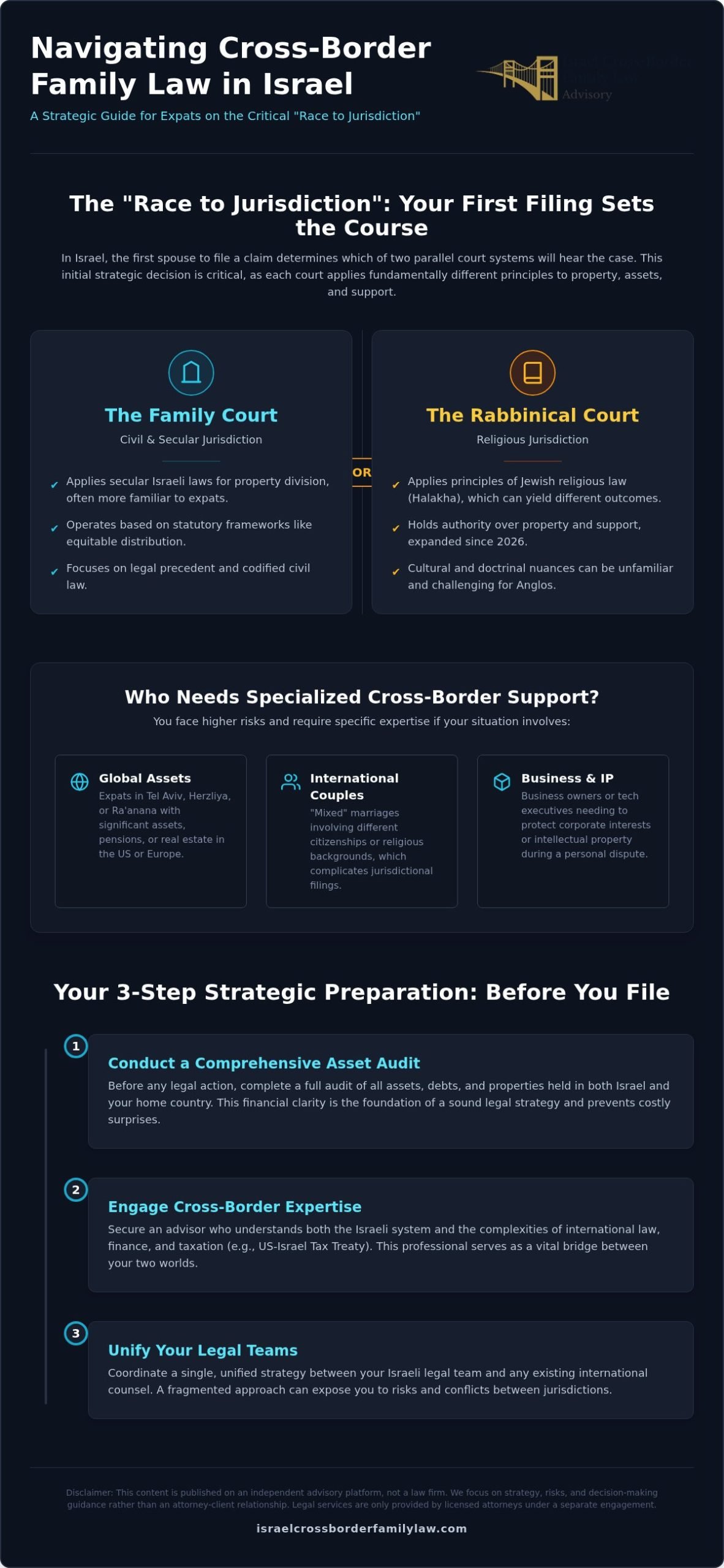
Certain situations carry higher risks and require a family lawyer in Tel Aviv with a specific focus on international transitions. You should consider specialized support if you are:
- An expat living in Tel Aviv, Herzliya, or Ra’anana with significant assets, pensions, or real estate held in the US or Europe.
- Part of a “mixed” marriage involving different citizenships or religious backgrounds, which can complicate jurisdictional filings.
- A business owner or executive in the Tel Aviv tech hub who needs to protect corporate interests or intellectual property during a personal legal dispute.
For those managing lives across two countries, our advisory provides specialized support for expats and foreign nationals to ensure every decision is made with a full understanding of the international implications.
The ‘Race to Jurisdiction’: Understanding the Dual Court System
Disclaimer: This content is published on an independent advisory platform and is intended for informational purposes only. It does not constitute formal legal representation or an attorney-client relationship.
In Israel, the process of ending a marriage is governed by two parallel systems that often overlap. The “Race to Jurisdiction” describes the legal reality where the first spouse to file a claim usually determines which court system will hear the case. This choice is critical because the Family Court and the Rabbinical Court apply different principles to matters like property division and alimony. For an expat or international family, this initial decision is often the most significant strategic step they’ll take. It’s wise to request a strategy session before any formal papers are served to ensure your global interests are considered.
As of March 2026, the legal landscape has shifted significantly. New regulations expanded the authority of religious courts to adjudicate matters previously handled primarily by civil courts, including child support and property law. Currently, the fee for a mandatory “Settlement of Dispute” application is 119 NIS, while opening a standard divorce file in the Family Court costs 568 NIS. These procedural steps are more than just administrative; they are the starting line of a jurisdictional race that can impact how your assets are treated for years to come. A family lawyer in Tel Aviv will help you evaluate which venue aligns best with your specific needs, particularly regarding cross-border assets.
The Family Court (Beit Mishpat Le’inyanei Mishpacha)
The Israeli Family Courts operate on civil law principles, focusing on modern legal standards and equity. Most Anglos prefer this system for asset division because it aligns more closely with Western legal concepts of fairness. These courts frequently utilize social workers and court-appointed financial experts to resolve disputes. If your case involves complex international property or high-tech equity, the civil system often provides a more predictable framework for valuation and distribution.
The Rabbinical Court (Beit Din Rabbany)
The Rabbinical Court has exclusive jurisdiction over the “Get,” or religious divorce, but it can also rule on financial matters if they are “bundled” into the divorce claim first. There’s a common misconception that this court is always biased; however, the reality is more nuanced. While it operates under religious law, its decisions on property and support are now more expansive due to the 2026 updates. For those managing lives across different cultures, a family lawyer in Tel Aviv must carefully weigh the strategic implications of a religious filing against the protections offered by the civil system.
Cross-Border Divorce and Asset Division in the Tel Aviv District
Disclaimer: This content is published on an independent advisory platform, not a law firm. We focus on strategy, risks, and decision-making guidance rather than an attorney-client relationship. Legal services are only provided by licensed attorneys under a separate engagement.
Dividing assets in a cross-border divorce requires a sophisticated understanding of how different legal systems interact. In Israel, the law generally follows a “balancing of resources” principle, which mirrors equitable distribution in many US states. However, if you’re from a community property state like California or Texas, the way your assets are viewed in Tel Aviv might surprise you. A family lawyer in Tel Aviv must account for the US-Israel Tax Treaty to prevent settlements from being eroded by unexpected tax liabilities or capital gains penalties when transferring funds between jurisdictions.
Tel Aviv’s status as a global tech hub, often called “Silicon Wadi,” adds another layer of complexity. Marital property often includes unvested RSUs, stock options, and startup equity. Valuation of these assets requires a strategic approach to ensure future growth is fairly addressed. Similarly, real estate holdings frequently span borders. While Israeli apartments are registered in the “Tabu” (Land Registry), US properties involve different deed structures and financing rules. Coordinating the division of a home in North America with a condo in Tel Aviv requires a unified strategy that respects both local laws and foreign tax obligations.
International Child Custody and Relocation
In 2026, Israeli courts continue to prioritize the “best interests of the child,” but there’s a growing trend toward joint parental responsibility. For international families, the risk of a parent moving a child across borders without consent is a significant concern. Israel is a strict signatory to the Hague Convention, which provides a legal framework for the return of children in cases of international abduction. It’s essential to establish clear travel protocols and legal safeguards early in the process. You can explore more about the nuances of international custody and relocation to understand how these protections apply to your family.
Enforcing Support Orders Across Borders
Enforcing a child support order across the Atlantic is a common challenge for expats. Through international treaties, a US support order can often be enforced in Israel, and vice versa. In the Tel Aviv district, the Israeli “Collection Agency” (Hotsa’a L’foal) handles the practical side of enforcement, including wage garnishments or travel restrictions for non-payment. For a detailed look at this process, see our guide on child support cross-border enforcement. Working with a family lawyer in Tel Aviv ensures that support calculations reflect the actual cost of living in both countries, protecting the financial stability of the children involved.
Essential Steps Before Engaging a Family Lawyer in Tel Aviv
Disclaimer: This content is published on an independent advisory platform, not a law firm. We focus on strategy, risks, and decision-making guidance rather than an attorney-client relationship. Legal services are only provided by licensed attorneys under a separate engagement.
Before you commit to a legal path, you need a clear strategic roadmap. Many people rush to hire a professional under stress, only to find later that their specific cross-border needs weren’t addressed. Taking a few measured steps now can prevent years of litigation and financial loss. A family lawyer in Tel Aviv can be a powerful ally, but they are most effective when you provide them with a high-level view of your global life.
Step 1: Audit your assets. Gather documentation for everything you own in both Israel and the US. This includes bank accounts, real estate registered in the Tabu, US deeds, and complex financial instruments like 401(k) plans or IRAs. Step 2: Understand your residency status. Your “center of life” is a legal determination that impacts which court has jurisdiction. Step 3: Seek a confidential advisory review. Before taking any visible action or notifying your spouse, get a neutral assessment of your risks. Step 4: Evaluate experience. Look for a professional who understands the US-Israel Tax Treaty and multi-jurisdictional property division, not just someone with a high local profile.
Questions to Ask a Potential Tel Aviv Lawyer
When interviewing a family lawyer in Tel Aviv, you shouldn’t settle for generic answers. Ask these specific questions to gauge their cross-border proficiency:
- How many US-Israel cross-border cases have you handled so far this year?
- Are you familiar with the specific tax implications and penalties associated with dividing a US-based 401(k) or pension?
- Do you work with independent strategy advisors to coordinate a unified approach across both legal systems?
The Weight of Early Decisions
In the Israeli system, the first document you sign can dictate the trajectory of your case for the next five years. There’s a significant risk in making “informal” agreements with a spouse without understanding the cross-border context. What seems like a simple compromise on child support or property could have massive tax or jurisdictional consequences later. For a deeper understanding of these intersections, read A Guide to Cross-Border US-Israel Family Law. Early clarity is your best defense against the inherent complexity of these dual systems. Get the strategy right before you file. Request a confidential strategy review today.
Disclaimer: This content is published on an independent advisory platform, not a law firm. We focus on strategy, risks, and decision-making guidance rather than an attorney-client relationship. Legal services are only provided by licensed attorneys under a separate engagement.
Navigating the end of a marriage or a complex inheritance in a foreign country requires a shift in perspective. Many families mistakenly believe that hiring a litigator is the first and only step. While a skilled family lawyer in Tel Aviv is necessary for representing your interests within the court system, a cross-border strategy advisor provides the high-level coordination required for international lives. Litigation is often reactive, but strategy is proactive. We help you look beyond the immediate conflict to see how local rulings might impact your global financial standing, tax obligations, and future mobility.
One of the most significant risks for international families is the “silo” effect. This happens when your US legal team and your Israeli legal team work without coordination. Conflicting legal advice can lead to missed deadlines, jurisdictional errors, or settlements that trigger heavy tax penalties under the US-Israel Tax Treaty. We act as the central point of coordination, ensuring that every step taken in Israel respects your obligations and rights in the United States. Maintaining a calm, authoritative presence during these high-conflict disputes is essential for protecting your interests and your family’s well-being.
Our Advisory Approach
Our focus is always on risk mitigation and long-term family stability. We believe that the best outcomes are achieved when you have a clear understanding of the legal landscape before you enter it. You can explore the details of how it works at our advisory to see how we structure our strategic reviews. Our guidance is specifically designed for expats and foreign nationals who find themselves at the intersection of two very different legal cultures. We bridge the gap between US expectations and Israeli statutory realities, ensuring your family lawyer in Tel Aviv has a clear strategic roadmap to follow.
Get Clarity Before You Commit
The value of a confidential case review lies in the options it preserves. Once a “Settlement of Dispute” application is filed or a court claim is opened, the “Race to Jurisdiction” has begun. Seeking advisory support before taking these visible actions allows you to choose the path that best protects your cross-border assets and parental rights. For additional educational resources, we invite you to watch the guidance on the Israel Family Law YouTube Channel. Knowledge is your best defense against the inherent complexity of the Israeli system. Get clarity before you commit. Request a confidential consultation.
Securing Your Future Across Borders
Managing a family legal matter between Israel and the US is inherently complex, yet clarity is achievable with a measured strategic approach. The most critical takeaway is the weight of early decisions; once the “Race to Jurisdiction” begins, your initial filing dictates the legal framework for your assets and family rights. Protecting international holdings like RSUs or US-based real estate requires an advocate who understands both the local Tabu registry and the nuances of the US-Israel Tax Treaty. By bridging the gap between these two distinct legal cultures, you can navigate high-conflict disputes with calm authority.
Finding a family lawyer in Tel Aviv who prioritizes strategy before litigation ensures that your global interests remain secure. Our practitioners often maintain qualifications in multiple jurisdictions, providing a specialized focus on the Anglo and expat communities. We act as a strategic bridge, coordinating between your international counsel and local legal teams to mitigate risks honestly. Get clarity before you commit. Request a confidential consultation. You don’t have to face these complexities alone; professional support is available to help you move forward with confidence.
Frequently Asked Questions
Is it better to file for divorce in the US or in Israel?
Choosing the correct jurisdiction depends on where your primary assets are located and which legal standard favors your specific situation. While a US court might offer more familiar discovery processes, an Israeli court might be more accessible if your center of life is currently in Israel. This decision carries significant weight and should never be made without a comprehensive risk assessment that considers both legal systems simultaneously.
Can a US prenuptial agreement be enforced in a Tel Aviv court?
An Israeli court can enforce a foreign prenuptial agreement, but it must be reviewed to ensure it doesn’t contradict local public policy. To be fully effective against assets in Israel, the agreement often requires formal approval by an Israeli Family Court. Without this local validation, you risk facing a balancing of resources claim that could override your original US intentions regarding property division or inheritance.
How long does a typical cross-border divorce take in Israel?
A mutual divorce agreement can be finalized in several months, but a contested cross-border case often spans one to three years. Factors such as forensic accounting for international assets or disputes over child relocation significantly extend the timeline. In 2026, the mandatory dispute resolution phase adds a structured waiting period designed to encourage settlement, though complex jurisdictional arguments can still delay the final decree.
What happens to my US-based assets if I get divorced in Tel Aviv?
Israeli courts have the authority to include US-based assets in a property division order if they have jurisdiction over both spouses. However, enforcing an Israeli ruling against a US bank account or real estate requires a separate legal process in the United States. A family lawyer in Tel Aviv must coordinate with US counsel to ensure any Israeli settlement is drafted in a way that US authorities will recognize.
Can my spouse take our children out of Israel without my consent?
Neither parent can legally remove a child from Israel without the other’s written consent or a specific court order. Because Israel is a signatory to the Hague Convention, wrongful removal is treated as international child abduction. In high-conflict cases, a Stay of Exit order is a common preventative measure used to ensure children remain within the jurisdiction until a final custody arrangement is reached.
How are child support amounts calculated in the Tel Aviv District?
Child support in the Tel Aviv District is calculated based on the child’s essential needs, the income of both parents, and the actual time spent with each parent. Following recent judicial shifts, there is a stronger emphasis on joint parental responsibility. This means that if parents share equal custody and have similar incomes, the traditional support obligations may be significantly reduced compared to previous years.
Do I need a Hebrew-speaking lawyer if I live in Tel Aviv?
While you may live your daily life in English, all official court proceedings, filings, and legal protocols in Israel are conducted in Hebrew. You don’t necessarily need to speak Hebrew yourself, but you must have a family lawyer in Tel Aviv who is fully bilingual. They act as your cultural and linguistic bridge, ensuring you understand the subtle nuances of the documents you are asked to sign.
What is the role of mediation in Israeli family law as of 2026?
As of 2026, mediation is a mandatory first step in nearly all Israeli family law disputes through the Settlement of Dispute procedure. This stage requires parties to attend meetings with the court’s assistance unit before they can file a formal lawsuit. The goal is to reduce the stress of the Race to Jurisdiction and encourage families to reach consensual agreements that protect their long-term stability.

Article by
Gabriel Lior
A Personal Journey That Became a Mission
The advisory was founded by an American father Gabriel Lior, LLB, MBA , global entrepreneur, and cross-border advisor who spent more than a decade navigating the Israeli family court system firsthand and now lives in Singapore with his son.
As a divorced parent in a cross-border family, Gabriel faced nearly every legal challenge a foreign parent can encounter in Israel — including child custody disputes, child support proceedings, property matters in Israel and abroad, false accusations, and complex immigration and relocation proceedings.
Over the years, he learned the hard way how difficult it is for non-Israeli parents to understand the system, identify the right legal strategy, and choose the right legal representation — especially when language, culture, and jurisdictional differences are involved. He also witnessed how foreign parents and new immigrants are often disadvantaged or taken advantage of by service providers and institutions simply because they lack local knowledge or fluency.
From Client to Advisor
To truly understand — and survive — the system, Gabriel pursued formal legal education in Israel, completing two Israeli law degrees, alongside a BA and MBA earned in the United States. This was never about becoming a practicing attorney, but about gaining a deep, structural understanding of how the system works — and where it breaks down for foreign parents.
This rare combination of:
Firsthand client experience
Israeli legal and US business education
International business and negotiation training
Decades of commercial execution
created a unique perspective – one that understands both sides of the table.
After years of litigation, persistence, and at times self-representation, he ultimately succeeded in securing custody of his son and relocating abroad through a rare legal victory in the Israeli Supreme Court — becoming one of the first fathers in Israel to do so under these circumstances.
Disclaimer
Important Disclaimer:
The information provided on this website and in its content is for general informational and educational purposes only and does not constitute legal advice, legal opinion, or legal representation.
Gabriel Lior is not licensed to practice law in Israel (nor is he interested in doing so) and does not provide legal services, despite having completed 2 Law Degrees. The services offered are advisory in nature and are intended to provide general guidance, strategic insight, and information regarding cross-border family law considerations.
No attorney-client relationship is formed by accessing this website, reading its content, or communicating with us.
Any decisions made based on this information are at your own discretion and risk. For legal advice specific to your situation, you should consult a licensed attorney in the relevant jurisdiction.
Where appropriate, we may refer clients to independent, licensed attorneys or professionals. Such referrals do not constitute legal representation and no liability is assumed for services provided by third parties.