In a cross-border divorce, the specific courtroom that hears your case often matters more than the facts of your marriage. If you’re an expat or part of an international family, you likely feel the weight of the “race to court” and the potential reach of the Israeli Rabbinical system. It’s natural to feel anxious when your life is split between two countries and the legal rules seem to change at the border. Consulting a cross border family law attorney israel allows you to move from a place of uncertainty to one of strategic clarity.
This guide provides a roadmap for managing the complexities of international custody, asset protection, and jurisdictional choice. You’ll learn how to protect your interests in both the United States and Israel while avoiding the common pitfalls of the Hague Convention and conflicting court orders. We’ll explore the essential steps for ensuring your family’s future is grounded in a secure, enforceable legal strategy. Please note that this content is published on an independent advisory platform and is intended for informational purposes only; it does not constitute legal representation or formal legal advice.
Key Takeaways
- Understand how the “race to court” in Israel’s dual-court system makes your initial filing location the most critical decision in your case.
- Learn how a cross border family law attorney israel helps you navigate conflicting legal frameworks to protect global assets and ensure international enforceability.
- Gain clarity on the legal boundaries of the Hague Convention to safely manage child relocation and avoid the risks of international abduction claims.
- Discover the significant differences between Israeli “Balance of Resources” and US asset division laws to safeguard your financial interests in both countries.
- Identify why prioritizing practitioners licensed in multiple jurisdictions is essential for managing the tax and regulatory complexities of a US-Israel lifestyle.
Understanding the Complexity of Cross-Border Family Law in Israel
Cross-border family law involves legal matters where the parties, their children, or their marital assets are situated in more than one country. While a local divorce lawyer might understand the statutes of a single city or state, they often lack the perspective needed for cases that span the Mediterranean and the Atlantic. Standard domestic legal advice frequently fails in these disputes because it doesn’t account for the way Israeli court rulings interact with foreign jurisdictions. This is why consulting a cross border family law attorney israel is vital; it ensures your strategy accounts for the specific friction between different legal cultures.
To better understand the unique challenges faced by international families in the Israeli system, watch this helpful video:
Managing the complexities of international life requires a focus on strategy and risk mitigation rather than just courtroom tactics. This content is published on an independent advisory platform and is intended for informational purposes only. It doesn’t constitute legal representation or formal legal advice, as legal services are only provided by licensed attorneys under a separate engagement.
Why International Families Need Specialized Counsel
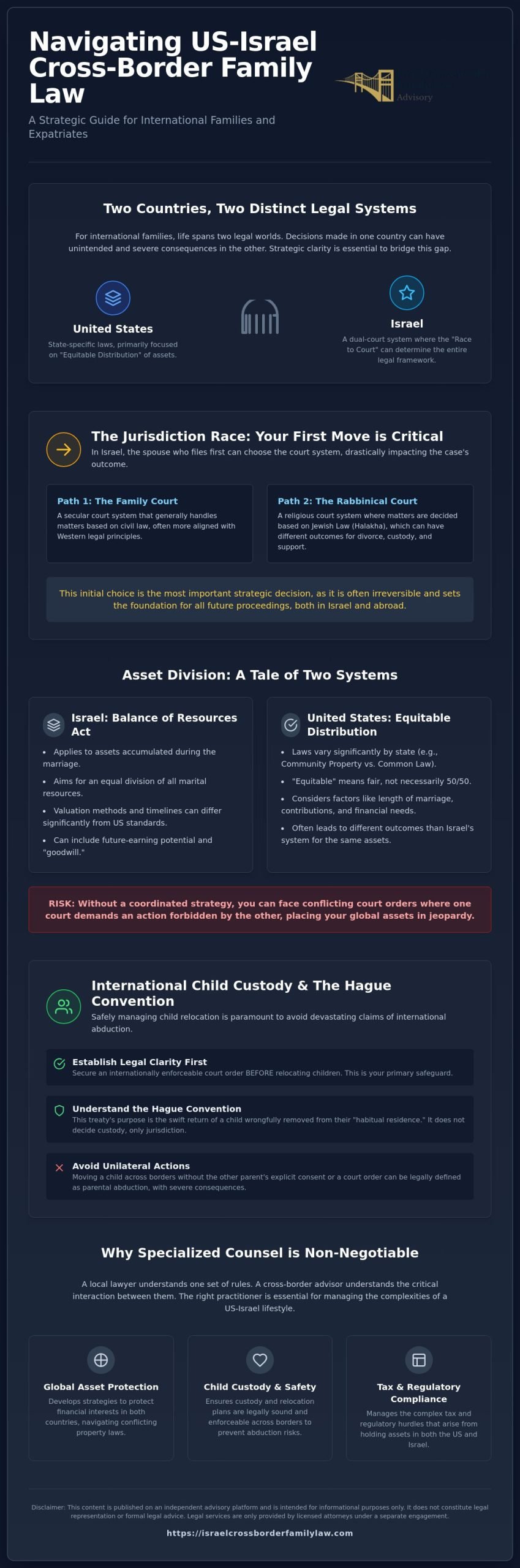
The way Israel and the US view marital property differs significantly. For instance, Israel’s “Balance of Resources” system operates on different timelines and valuation methods than American “Equitable Distribution” models. Without a cohesive strategy, you risk facing conflicting orders where one court demands an action that another forbids. In the context of Israeli family law, transnational litigation is the strategic management of legal proceedings that occur simultaneously in two or more countries to resolve issues of divorce, custody, or asset division. This often involves the Hague Convention on the Civil Aspects of International Child Abduction, which serves as the primary international mechanism for resolving custody conflicts. You can learn more about these risks by reviewing our guidance on Hague Convention matters.
Navigating the Cultural and Legal Gap
For Anglos and expats, the Israeli legal system can feel opaque. The language barrier is only the first hurdle; the deeper challenge is understanding how the “race to court” affects your rights. Early decisions in Israel carry immense weight and are often difficult to reverse. Having a partner with a physical presence in both Tel Aviv and New York provides a strategic advantage that remote counsel cannot match. This dual-market engagement allows for a nuanced understanding of how to bridge the gap between divergent business and legal cultures. It’s essential to seek clarity on international custody and relocation before making any permanent commitments.
Get clarity before you commit. Request a confidential consultation.
The Jurisdiction Race: Why Early Strategy is Critical
In the Israeli legal landscape, the timing of your filing is often the single most influential factor in the eventual outcome of your case. Unlike many Western systems where a single court handles all family matters, Israel operates under a unique dual-court system. This creates what practitioners call the “jurisdiction race,” where the spouse who files first can effectively choose the legal framework that will govern the divorce, property division, and spousal support. For international families, this decision is even more complex because it must account for how a cross border family law attorney israel can coordinate these proceedings with potential filings in a US state court.
The choice of forum impacts everything from the speed of the proceedings to the specific way assets are valued. While both systems must follow certain civil laws regarding property, the procedural nuances and judicial perspectives vary significantly. The reality is that the court that hears your case first will likely dictate the terms of your future. Engaging in a strategic case review early on is the only way to ensure you aren’t forced into a forum that disadvantages your specific financial or personal situation.
Civil vs. Rabbinical Courts: What Foreigners Must Know
The Rabbinical Court (Religious) and the Family Court (Civil) share concurrent jurisdiction over many aspects of divorce. If a spouse files for divorce in the Rabbinical court and “binds” issues like property division or alimony to that claim, that religious body gains exclusive authority over those matters. This applies even to US citizens or foreign nationals if they meet the residency requirements in Israel. For non-Jewish spouses or those in interfaith marriages, the jurisdictional rules change; however, the risk of a “race” remains if there are grounds for the civil court to take precedence. The mandatory “Settlement of Dispute” process requires couples to attend an initial mediation meeting before they can proceed to litigation. This first step, which carries a filing fee of 119 NIS, is where the clock starts ticking on your jurisdictional strategy.
Parallel Proceedings and Forum Non-Conveniens
When a divorce is filed in Israel while a parallel case is active in the United States, a complex legal conflict arises. Courts must determine which jurisdiction is the “appropriate forum” (Forum Non-Conveniens) based on where the family lived, where the assets are located, and where the children are settled. Delaying a filing in one country while your spouse moves forward in another can lead to a “limping marriage,” where you are legally divorced in one nation but still married in the other. This creates significant risks for future asset acquisition and even your ability to remarry. Managing these risks requires an authoritative strategy that bridges both legal systems simultaneously. This content is published on an independent advisory platform and is intended for informational purposes only; it does not constitute legal representation or formal legal advice.
International Child Custody and Hague Convention Matters
The Hague Convention on the Civil Aspects of International Child Abduction is a multi-lateral treaty designed to protect children from the harmful effects of their wrongful removal or retention across international borders. For families moving between Israel and the United States, this framework establishes a legal mechanism for the prompt return of a child to their country of “habitual residence.” Determining where a child actually resides involves a factual analysis of their school, social ties, and the parents’ shared intent. A cross border family law attorney israel helps parents establish these facts before a dispute arises, ensuring that a temporary visit or vacation doesn’t inadvertently become a permanent, legally contested relocation.
The line between a legal relocation and international abduction is often thinner than parents realize. Moving a child without a formal written agreement or a court order can trigger a Hague petition, leading to severe legal consequences and the child’s forced return. Understanding international custody and relocation is the first step in avoiding these risks. Strategy should focus on prevention through clear, enforceable documentation that accounts for the laws of both jurisdictions. This content is published on an independent advisory platform and is intended for informational purposes only; it does not constitute legal representation or formal legal advice.
Relocation Strategy for Expats
When an expat parent wishes to move a child from Israel to the US, the Israeli Family Court applies the “best interests of the child” standard. This evaluation considers the child’s emotional needs, the quality of the relationship with both parents, and the educational opportunities available in the new location. Courts often appoint psychologists or social workers to conduct evaluations, which typically range from ₪7,000 to ₪14,000 in professional fees. To mitigate conflict, parents should draft detailed international travel consents that specify return dates and jurisdictional agreements. These documents provide clarity and prevent misunderstandings that could otherwise escalate into a full-scale legal crisis.
Enforcing Support Orders Across Borders
Enforcing a US child support order in Israel requires a formal process of recognition through the Israeli legal system. While international treaties facilitate cooperation, the actual collection often involves the Israeli Enforcement and Collection Authority. Common pitfalls include failing to account for currency fluctuations or the different ways Israeli courts calculate housing costs (madur) compared to US states. Cross-border child support enforcement requires a nuanced approach to ensure that orders remain sustainable and enforceable in both jurisdictions. Seek clarity on the regulatory differences between the two systems to avoid long-term financial exposure.
Get clarity before you commit. Request a confidential consultation.
Protecting Assets and Estates in a US-Israel Context
Managing wealth across international borders requires a sophisticated understanding of how two distinct legal systems value marital property. In Israel, the “Balance of Resources” system generally dictates that assets accumulated during the marriage are divided equally upon divorce. This differs from the “Equitable Distribution” models used in many US states, where courts have broader discretion to divide property based on what they deem fair rather than an exact 50/50 split. A cross border family law attorney israel ensures that your global portfolio, including US-based 401(k)s and Israeli real estate, is accounted for accurately under these conflicting frameworks. This content is published on an independent advisory platform and is intended for informational purposes only; it doesn’t constitute legal representation or formal legal advice.
Identifying and valuing international business interests is a frequent point of contention for high-net-worth families. Forensic accountants in Israel often charge fees starting at ₪18,000 to track global assets or value closely held companies. For those with complex professional holdings, navigating US-Israel M&A and corporate strategy is often necessary to prevent a divorce from disrupting commercial operations. It’s essential to seek clarity on how the US-Israel Tax Treaty impacts inherited assets, especially since Israel abolished its inheritance and estate tax in 1981, while US citizens still face a 40% federal estate tax on worldwide assets above the $15,000,000 exemption. Speak with a strategist regarding your assets to mitigate these financial risks.
Wills and Inheritance for Expats
Prenuptial Agreements and Asset Protection
A US prenuptial agreement isn’t always automatically enforceable in an Israeli court. To ensure protection, couples should draft a “Financial Agreement” (Heskem Mamon) that satisfies the requirements of both jurisdictions. These agreements are particularly important for protecting family trusts and corporate equity that may be subject to different valuation rules in Israel than in the United States. Drafting these documents requires a “strategy-first” approach to ensure that your asset protection plan remains resilient across both legal systems. Seek clarity before making significant financial commitments or changes to your corporate structure.
Get clarity before you commit. Request a confidential consultation.
Selecting a Cross-Border Family Law Attorney in Israel
Choosing the right professional to manage an international family’s legal needs requires looking beyond simple translation skills. You need a strategist who can visualize the entire board across two different countries. Engaging a cross border family law attorney israel who holds licenses in both Israel and the United States provides a critical advantage. This dual-qualification ensures that your representative understands the procedural nuances of a US state court as well as the unique dynamics of the Israeli Family and Rabbinical systems. Practitioners with this background can anticipate how an action taken in one jurisdiction will trigger a reaction in the other.
Native-level English is indispensable when reviewing complex US financial documents, such as 401(k) statements, trust deeds, or corporate equity agreements. Misinterpreting a single clause in an American contract can lead to significant setbacks in an Israeli “Balance of Resources” calculation. Prioritize practitioners who offer a “strategy-first” advisory model. While some firms emphasize the sheer volume of their litigation, a strategic approach often focuses on resolving disputes before they escalate into costly, multi-year court battles. You can learn more about how our advisory process works to see how this strategy is implemented.
This content is published on an independent advisory platform and is intended for informational purposes only. It doesn’t constitute legal representation or formal legal advice. Legal services are only provided by licensed attorneys under a separate engagement.
The Role of the Legal Advisory
An independent advisory platform serves as a bridge between legal systems. This model allows for broader strategic guidance that isn’t limited by the narrow scope of a single jurisdiction. We often collaborate with a client’s existing local counsel in the US or Israel to ensure a unified front. This collaborative approach prevents the “silo effect,” where lawyers in different countries give conflicting advice because they don’t understand the other’s system. You can find more details about the Cross-Border Advisory and our commitment to multi-jurisdictional clarity.
Preparing for Your Confidential Case Review
A successful consultation begins with preparation. Gather essential documents such as marriage certificates, recent financial statements, and any existing custody agreements before your first meeting. We utilize a “Strategy, Risks, and Decisions” framework to walk you through the logical progression of your case. This method allows you to evaluate your options without escalating conflict prematurely. By focusing on data and clear legal pathways, you can maintain control over your family’s future even in high-stress situations. Seeking clarity early is the most effective way to mitigate the inherent complexity of cross-border issues.
Get clarity before you commit. Request a confidential consultation.
Securing Your Family’s Global Future
Navigating the intersection of US and Israeli law requires more than just local representation; it demands a comprehensive strategy that accounts for the “race to court” and the specific nuances of the Hague Convention. We’ve explored how early decisions regarding jurisdiction and asset valuation can dictate the financial and personal outcomes for international families. By prioritizing a “strategy-first” approach, you can ensure that your interests are protected in both Tel Aviv and New York. This content is published on an independent advisory platform and is intended for informational purposes only; it doesn’t constitute legal representation or formal legal advice.
A cross border family law attorney israel with a physical presence in both target markets provides the bridge necessary to align divergent legal systems. Our practitioners are licensed in multiple jurisdictions, including Israel and New York, and specialize in the unique challenges faced by expats and international families. This multi-qualified expertise allows for the seamless management of complex, transnational disputes. You don’t have to manage these risks alone.
Get clarity before you commit. Request a confidential consultation today and take the first step toward a secure, enforceable resolution for your family.
Frequently Asked Questions
Managing the intersection of two legal systems requires clear information and strategic foresight. This content is published on an independent advisory platform and is intended for informational purposes only; it doesn’t constitute legal representation or formal legal advice. Legal services are only provided by licensed attorneys under a separate engagement.
Can I divorce in Israel if I was married in the United States?
Yes, you can divorce in Israel provided you meet the residency requirements, even if your marriage was a civil ceremony performed in the United States. Israeli civil courts recognize foreign civil marriages for the purpose of dissolution. The process involves specific procedural steps to register the foreign marriage with the Ministry of Interior before the court can formally grant the divorce decree.
What is the “Race to Court” in Israeli family law?
The “Race to Court” refers to the strategic advantage gained by the spouse who is the first to file a claim in either the civil Family Court or the religious Rabbinical Court. Since both courts have concurrent jurisdiction over many divorce-related matters, the first filing often determines which legal framework will govern your property division and alimony. This decision is a cornerstone of the strategy developed by a cross border family law attorney israel to protect a client’s interests.
Will an Israeli court enforce my US child support order?
Israeli courts can enforce US child support orders through a formal recognition process known as the enforcement of foreign judgments. This typically requires proving that the US court held proper jurisdiction and that the order doesn’t contradict Israeli public policy. Once recognized, the order is enforceable through the local Enforcement and Collection Authority, though currency conversion and local cost-of-living adjustments may apply to the final payments.
How does the Hague Convention apply to my custody case?
The Hague Convention applies by providing a legal framework to return a child who has been wrongfully removed from their country of “habitual residence.” In cases involving Israel and the US, the court doesn’t decide who is the better parent; instead, it determines which country has the authority to make that decision. It’s a procedural tool designed to ensure that custody disputes are heard in the child’s actual home jurisdiction.
Do I need a separate will for my assets in Israel?
Yes, maintaining a separate will for Israeli assets is highly recommended because Israel doesn’t recognize the concept of automatic survivorship for joint property or bank accounts. Without a specific Israeli will or a properly recognized foreign will, your local assets may be distributed according to default succession laws. This can result in significant delays and increased court fees for your heirs during the probate process.
Are US prenuptial agreements valid in Israel?
US prenuptial agreements are not automatically enforceable and often require validation through an Israeli “Financial Agreement” (Heskem Mamon) to be fully recognized. Israeli law requires these agreements to be approved by a judge or a marriage registrar to ensure both parties understood the terms and entered the agreement voluntarily. Without this local approval, an Israeli court might apply standard property division laws instead of your US agreement.
What happens if my spouse files for divorce in the Rabbinical court first?
If your spouse files in the Rabbinical court first, that court may gain exclusive authority over “related matters” like property division and spousal support if they were properly bound to the divorce claim. This can change the legal standards applied to your financial settlement. It’s critical to consult a cross border family law attorney israel immediately to determine if the civil court still has grounds to hear specific parts of your case.
How do I stop my child from being taken out of Israel without my consent?
You can prevent a child from being taken out of Israel by requesting a “Stay of Exit” order (Tzav Ikur Yetzia Min Ha’aretz) from the court. This order is registered with border control and prevents the child from departing the country without a specific court authorization. This is a common protective measure used when there’s a genuine risk of unilateral relocation or international abduction.
Get clarity before you commit. Request a confidential consultation.

Article by
Gabriel Lior
A Personal Journey That Became a Mission
The advisory was founded by an American father Gabriel Lior, LLB, MBA , global entrepreneur, and cross-border advisor who spent more than a decade navigating the Israeli family court system firsthand and now lives in Singapore with his son.
As a divorced parent in a cross-border family, Gabriel faced nearly every legal challenge a foreign parent can encounter in Israel — including child custody disputes, child support proceedings, property matters in Israel and abroad, false accusations, and complex immigration and relocation proceedings.
Over the years, he learned the hard way how difficult it is for non-Israeli parents to understand the system, identify the right legal strategy, and choose the right legal representation — especially when language, culture, and jurisdictional differences are involved. He also witnessed how foreign parents and new immigrants are often disadvantaged or taken advantage of by service providers and institutions simply because they lack local knowledge or fluency.
From Client to Advisor
To truly understand — and survive — the system, Gabriel pursued formal legal education in Israel, completing two Israeli law degrees, alongside a BA and MBA earned in the United States. This was never about becoming a practicing attorney, but about gaining a deep, structural understanding of how the system works — and where it breaks down for foreign parents.
This rare combination of:
Firsthand client experience
Israeli legal and US business education
International business and negotiation training
Decades of commercial execution
created a unique perspective – one that understands both sides of the table.
After years of litigation, persistence, and at times self-representation, he ultimately succeeded in securing custody of his son and relocating abroad through a rare legal victory in the Israeli Supreme Court — becoming one of the first fathers in Israel to do so under these circumstances.
Disclaimer
Important Disclaimer:
The information provided on this website and in its content is for general informational and educational purposes only and does not constitute legal advice, legal opinion, or legal representation.
Gabriel Lior is not licensed to practice law in Israel (nor is he interested in doing so) and does not provide legal services, despite having completed 2 Law Degrees. The services offered are advisory in nature and are intended to provide general guidance, strategic insight, and information regarding cross-border family law considerations.
No attorney-client relationship is formed by accessing this website, reading its content, or communicating with us.
Any decisions made based on this information are at your own discretion and risk. For legal advice specific to your situation, you should consult a licensed attorney in the relevant jurisdiction.
Where appropriate, we may refer clients to independent, licensed attorneys or professionals. Such referrals do not constitute legal representation and no liability is assumed for services provided by third parties.