The decision to move abroad with your child is one of the most significant and complex challenges a parent can face, fraught with emotional weight and intricate legal hurdles. For parents in Israel, this process is governed by a sophisticated legal framework where a misstep can lead to overwhelming legal costs, damage to co-parenting relationships, and even accusations of child abduction. Navigating the Israeli family court system to secure the necessary legal permission to relocate with a child from Israel requires a clear, strategic approach grounded in a deep understanding of the law and judicial precedent.
This definitive guide is designed to provide that clarity. We will navigate you through the complete legal process, from the critical first step of seeking parental consent to the complexities of petitioning the court for approval. You will gain a comprehensive understanding of the factors courts consider, the evidence required to build a compelling case, and the strategic planning necessary to create a stable, long-term plan that serves the best interests of your child. Our objective is to empower you with the knowledge to pursue your relocation goals successfully while fostering a healthy co-parenting relationship across international borders.
Relocation vs. Abduction: The Critical Legal Distinction in Israeli Law
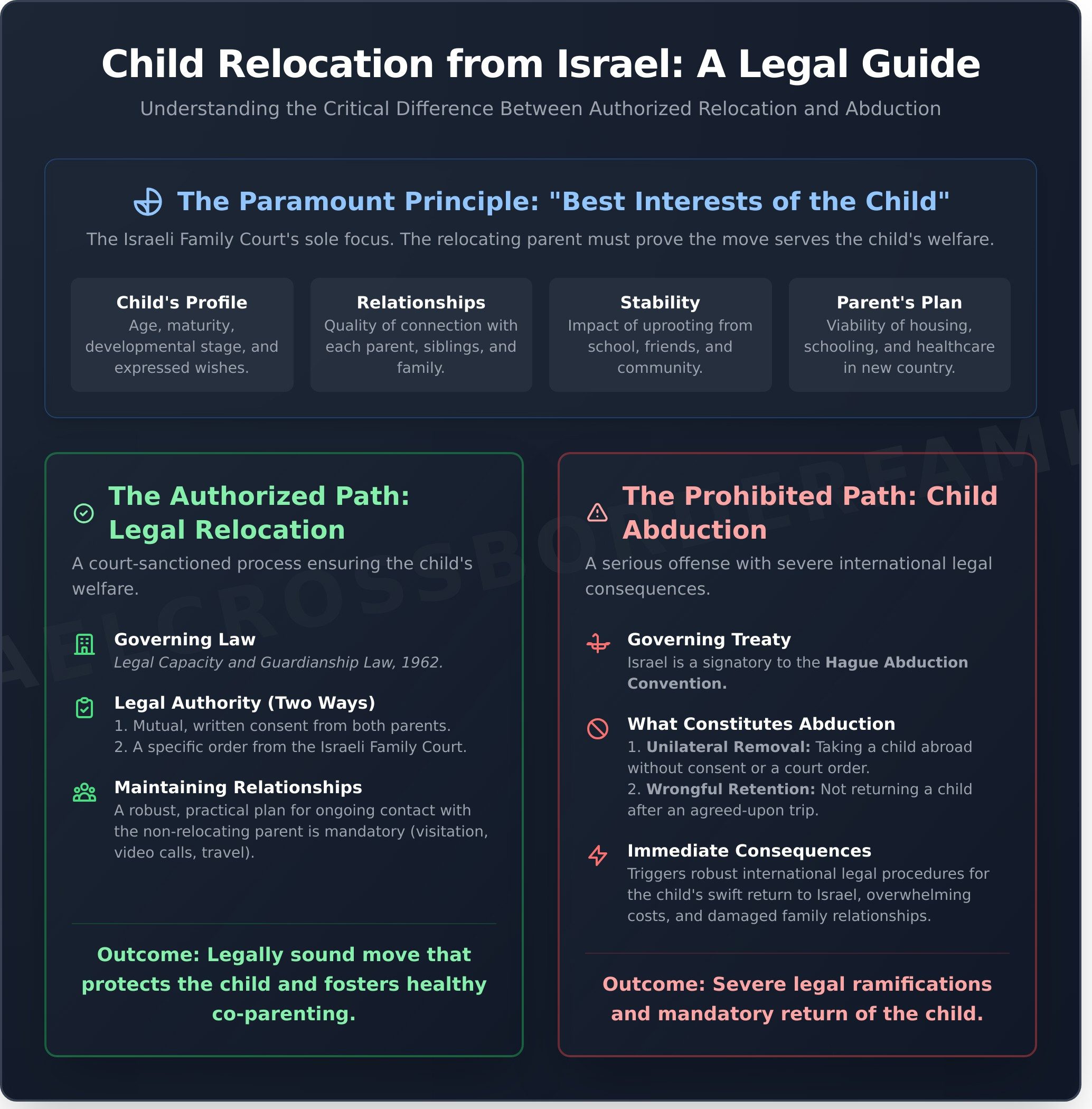
For any parent contemplating an international move with their child from Israel, understanding the fundamental legal distinction between relocation and abduction is the most critical starting point. In the eyes of Israeli and international law, these are not interchangeable terms; they represent two vastly different paths with profoundly different consequences. A legal relocation is a court-sanctioned process, whereas a unilateral removal is considered child abduction, a serious offense with severe legal ramifications.
To provide a clear overview of this complex topic, the following video explains the core concepts of obtaining legal permission.
The gravity of this distinction cannot be overstated. Israel is a signatory to the Hague Abduction Convention, an international treaty designed to ensure the prompt return of children wrongfully removed to or retained in another member country. Attempting to bypass the Israeli legal system by removing a child without consent or a court order will trigger immediate and robust international legal procedures aimed at the child’s swift return to Israel.
What Constitutes Child Abduction?
In the context of Israeli family law, child abduction, or “wrongful removal,” is not limited to clandestine actions. It includes any removal of a child from their habitual residence in Israel that breaches the other parent’s custody rights. Key examples include:
- Unilateral Removal: Taking a child to live in another country without the express written consent of the other parent or a valid court order.
- Wrongful Retention: Failing to return a child to Israel after an agreed-upon holiday or visit abroad, effectively turning a temporary trip into a permanent move.
Upon such an action, the ‘left-behind’ parent can immediately initiate legal proceedings under the Hague Convention, compelling foreign courts to order the child’s return.
The Legal Framework for Authorized Relocation
Securing legal permission to relocate with child from israel is a formal process governed by the Legal Capacity and Guardianship Law, 1962. This statute mandates that a child’s residence cannot be changed from Israel to a foreign country without legal authority. This authority can be obtained in one of two ways: by mutual, written consent from both parents, or by a specific order from the Israeli Family Court. The court’s paramount consideration in these sophisticated proceedings is always the “best interests of the child,” acting as the child’s ultimate guardian to ensure their welfare is protected above all else.
The Core Principle: The ‘Best Interests of the Child’ Doctrine
When a parent seeks permission to relocate with child from Israel, the Israeli Family Court operates under a single, paramount legal standard: the best interests of the child (tovat ha’yeled). This doctrine is not merely a guideline; it is the exclusive and decisive framework for the court’s determination. The personal desires, career aspirations, or new relationships of the parents are considered secondary to the child’s welfare. This principle is deeply embedded in Israeli law, reflecting international standards such as the UN Convention on the Rights of the Child. Consequently, the legal burden of proof rests squarely on the parent proposing the relocation to demonstrate, with clear and convincing evidence, that the move will serve the child’s best interests.
Factors the Court Examines for the Child’s Welfare
The court undertakes a comprehensive and multi-faceted inquiry into the child’s specific circumstances. This meticulous assessment is not based on a rigid formula but on a holistic view of the child’s world, including:
- The child’s age, developmental stage, maturity, and-where appropriate-their own expressed wishes.
- The nature and quality of the child’s existing relationship with each parent and with siblings or extended family in Israel.
- The potential psychological and emotional impact of uprooting the child from their familiar environment.
- The child’s current integration into their educational framework, social circles, and community life in Israel.
Assessing the Relocating Parent’s Plan
The court rigorously scrutinizes the viability and integrity of the relocating parent’s proposal. A mere desire to move is insufficient; a well-researched and concrete plan is required. The court will assess the parent’s good faith and capacity by examining the proposed arrangements for housing, schooling, and healthcare in the destination country. The underlying reason for the move-such as a significant career opportunity or proximity to a critical family support network-will also be evaluated for its potential to enhance the child’s quality of life.
Maintaining the Relationship with the Non-Relocating Parent
A central concern for the court is the preservation of a meaningful and continuous relationship between the child and the non-relocating parent. The proposed plan must include a robust, practical, and financially viable strategy for ongoing contact, including visitation schedules, travel arrangements, and regular communication (e.g., video calls). The court is acutely aware of the risk of parental alienation and will reject any relocation plan that appears designed to diminish the role of the other parent in the child’s life.
The Legal Process for Gaining Relocation Permission: A Step-by-Step Guide
Navigating the legal framework to secure permission to relocate with child from Israel involves one of two distinct pathways: achieving a comprehensive mutual agreement with the other parent or, failing that, pursuing a formal court application. While litigation is a necessary tool, Israeli Family Courts strongly favor and encourage amicable resolutions. Attempting good-faith negotiation before initiating court proceedings is not only cost-effective but also demonstrates a commitment to co-parenting, a factor the court will consider.
Path 1: Relocation by Mutual Agreement
The most efficient and least adversarial route is to negotiate a detailed relocation and custody agreement. This legally binding document must be meticulously drafted to address all future co-parenting logistics. Key terms should include:
- Visitation Schedule: A clear and comprehensive plan for the non-relocating parent’s contact, including school holidays, summer vacations, and special occasions.
- Travel Costs: A precise allocation of responsibility for the child’s international travel expenses.
- Communication: Stipulations for regular and meaningful remote contact, such as scheduled video calls.
Once signed, this agreement must be submitted to the Family Court for approval. This step is critical, as it converts the private contract into a legally enforceable court order, providing security and a clear mechanism for dispute resolution.
Path 2: Filing a Contested Application with the Family Court
When an agreement is unattainable, the parent seeking to move must file a formal ‘Statement of Claim’ (Ktav Tvi’a) with the Family Court. This document outlines the reasons for the proposed relocation and argues why it serves the child’s best interests. The other parent then has the opportunity to file a ‘Statement of Defense’ (Ktav Hagana) to present their objections.
The court will typically appoint an independent expert, such as a child psychologist, or request a report from the Social Services Department to provide a professional assessment. During the court hearings, both parties will present evidence, including testimonies and expert opinions, to support their position. The final decision rests solely with the judge, based on the principle of the child’s welfare.
The timeline for this process varies significantly. An agreed-upon relocation can be finalized within 2-4 months. In contrast, a contested case is a far more complex and lengthy process, often taking 12 to 24 months, or even longer, to reach a final judgment.
Building a Compelling Case: Evidence and Strategy for Success
Securing permission to relocate with child from Israel is a complex legal undertaking that hinges entirely on the court’s assessment of the child’s best interests. Success is not determined by a parent’s desire to move, but by the strength and credibility of a meticulously prepared, evidence-based application. A compelling case demonstrates forethought, stability, and a genuine commitment to fostering the child’s relationship with the parent remaining in Israel. It must proactively address the court’s concerns and anticipate the other parent’s objections with clear, strategic counter-arguments.
The Detailed Relocation Plan
An abstract desire to move is insufficient; the court requires a concrete and viable plan. Your application must present a clear picture of the child’s future life, supported by tangible evidence. This includes:
- Housing and Education: Specific details of the proposed residence, including lease agreements or property details, and confirmation of school enrollment or acceptance letters with information about the curriculum.
- Healthcare and Activities: A clear plan for the child’s medical care, including identified pediatricians and specialists, alongside a well-researched outline of available extracurricular and social opportunities.
- Support Network: Evidence of a strong support system, such as letters from family members or friends in the new location who are prepared to assist with the child’s integration and well-being.
The Co-Parenting and Visitation Plan
The court will heavily scrutinize your commitment to preserving the child’s bond with the other parent. A relocation application must be accompanied by a generous, practical, and detailed visitation proposal. This plan should clearly address who will cover the substantial international travel expenses, which can amount to thousands of shekels per trip, and outline a schedule for frequent and consistent communication, such as daily or weekly video calls, to maintain a strong parental connection across borders.
Expert and Third-Party Evidence
Objective, third-party assessments provide the court with crucial, unbiased insights into the potential impact of the move. Compiling robust supporting evidence is a critical component of your strategy. This often involves commissioning a report from an independent child psychologist or court-appointed social worker to evaluate the child’s needs and the proposed relocation. Furthermore, gathering sworn affidavits from teachers, family members, and friends, along with financial documents proving your professional and economic stability in the new country, will substantially strengthen your case. Navigating these evidentiary requirements demands a sophisticated legal approach. Expert legal strategy is crucial. Schedule a consultation to discuss your case.
International Considerations for a US-Israel Relocation
Securing a court’s approval for an international move is a significant legal achievement, but it represents the beginning, not the end, of the cross-border legal process. A relocation from Israel to the United States introduces a sophisticated layer of multi-jurisdictional complexities that demand meticulous planning and strategic legal foresight. The primary objective shifts from obtaining permission to relocate with child from israel to creating a durable, practical, and legally enforceable framework that protects the child’s welfare and the rights of both parents across international borders. This requires a deep understanding of how Israeli court orders are treated under U.S. law and the proactive establishment of clear logistical protocols.
Ensuring an Enforceable Visitation Order
An Israeli custody and visitation order, while binding in Israel, is not automatically enforceable by U.S. authorities. To bridge this jurisdictional gap, the most effective legal tool is a ‘mirror order.’ This involves petitioning a U.S. court in the child’s new home state to issue a domestic order that reflects and ratifies the exact terms of the Israeli judgment. This mechanism, often facilitated by the Uniform Child Custody Jurisdiction and Enforcement Act (UCCJEA), provides the non-relocating parent with a direct and efficient path to enforce their visitation rights within the American legal system, ensuring stability and continuity for the child.
Navigating Practical and Financial Logistics
The practical realities of a trans-Atlantic co-parenting relationship must be addressed with granular detail in the relocation agreement. These complex financial and logistical arrangements require careful negotiation and codification to prevent future disputes. Key considerations include:
- Child Support: Calculating support payments when one parent earns in Israeli Shekel (₪) and expenses are incurred in US Dollars. The agreement must specify the currency of payment, a clear methodology for currency conversion, and how cost-of-living adjustments will be handled between two vastly different economies.
- Legal Documentation: Establishing clear protocols for the renewal of the child’s Israeli and/or U.S. passports, as well as cooperation on any necessary visa or citizenship applications.
- Travel and Holiday Planning: Creating a detailed schedule for major holidays, summer vacations, and significant family events. The agreement must explicitly define how international travel costs are apportioned and establish reliable communication schedules across time zones.
Successfully managing these sophisticated international family law matters requires counsel with proven expertise in both Israeli and U.S. legal frameworks. Navigating the complexities of obtaining permission to relocate with child from israel and structuring an enforceable international agreement is paramount. For comprehensive guidance, contact our team of cross-border legal specialists who act as a seamless bridge between jurisdictions.
Navigating Complex Child Relocation: A Strategic Conclusion
Securing permission to relocate with child from Israel is a multi-faceted legal endeavor, demanding a sophisticated understanding of Israeli family law. As this guide has detailed, the entire process hinges on the paramount principle of the child’s best interests and requires a meticulously constructed case to differentiate a lawful move from an illegal abduction. Success is contingent upon presenting compelling, strategic evidence that demonstrates how the proposed relocation will positively serve the child’s long-term welfare.
These complex, multi-jurisdictional matters require counsel with specific, proven experience. Our firm offers specialized expertise in US-Israel family law, supported by a proven track record in the most challenging international custody cases. With bilingual attorneys adept at navigating both legal systems, we provide the authoritative guidance necessary to protect your family’s future. Facing a complex relocation case? Contact our expert cross-border family law team for a confidential consultation.
While the path may seem daunting, with the right strategic legal partner, a successful outcome is achievable.
Frequently Asked Questions
What are my chances of the court granting permission to relocate?
The probability of a court granting permission to relocate with a child from Israel is determined on a case-by-case basis, with the child’s best interests as the paramount consideration. The court meticulously evaluates the genuineness of the relocation motive, the viability of the proposed arrangements for the child’s welfare abroad, and crucially, the plan to preserve a meaningful relationship with the non-relocating parent. A well-prepared, comprehensive relocation plan significantly enhances the prospects of a favourable ruling.
How long does the relocation court process typically take in Israel?
Child relocation cases are complex legal proceedings that require thorough examination by the court. In Israel, the process typically spans from 12 to 24 months, contingent upon the specific circumstances of the case. Factors influencing this timeline include the court’s docket, the necessity for expert opinions from child psychologists or social workers, and the level of dispute between the parties. Expedited proceedings are rare and reserved for exceptionally urgent and clear-cut situations.
Can my child’s opinion influence the court’s decision?
Yes, the court will consider the child’s opinion, with the weight of this preference depending on the child’s age, maturity, and level of understanding. For older children, their expressed wishes can be highly influential. The court often appoints a professional, such as a social worker or psychologist, to interview the child. This ensures the child’s views are ascertained in a neutral environment, free from parental pressure, and presented to the court as part of the overall evidence.
What happens if I want to relocate to a country that is not a Hague Convention signatory?
Relocating to a non-signatory country of the Hague Convention on the Civil Aspects of International Child Abduction presents a formidable legal challenge. The court will apply a heightened level of scrutiny due to the significant difficulties in enforcing visitation orders and securing the child’s return if wrongfully retained. The relocating parent must present an exceptionally robust and legally enforceable plan to guarantee the non-relocating parent’s access and visitation rights, a standard that is often difficult to meet.
How can I prevent the other parent from relocating with our child?
To prevent an unauthorized relocation, you must act decisively by filing an immediate application with the Israeli Family Court for a “stay of exit” order (Tzav Ikuv Yetzia Min Ha’aretz). This legal instrument, often granted ex parte in urgent cases, formally prohibits the child from leaving Israel’s borders. Subsequently, you must present a compelling case arguing that the proposed relocation is not in the child’s best interests, focusing on the potential harm to the child’s stability and relationship with you.
If I get permission to relocate, can the other parent still see the child?
Absolutely. Any court order granting permission to relocate with a child from Israel will include a detailed and legally binding visitation schedule designed to preserve the child’s relationship with the non-relocating parent. This comprehensive plan typically outlines specific periods for in-person visits during school holidays and summer breaks, often stipulating that the relocating parent bears a significant portion of the associated travel costs. It also mandates regular virtual contact through video and phone calls.

Article by
Gabriel Lior
A Personal Journey That Became a Mission
The advisory was founded by an American father Gabriel Lior, LLB, MBA , global entrepreneur, and cross-border advisor who spent more than a decade navigating the Israeli family court system firsthand and now lives in Singapore with his son.
As a divorced parent in a cross-border family, Gabriel faced nearly every legal challenge a foreign parent can encounter in Israel — including child custody disputes, child support proceedings, property matters in Israel and abroad, false accusations, and complex immigration and relocation proceedings.
Over the years, he learned the hard way how difficult it is for non-Israeli parents to understand the system, identify the right legal strategy, and choose the right legal representation — especially when language, culture, and jurisdictional differences are involved. He also witnessed how foreign parents and new immigrants are often disadvantaged or taken advantage of by service providers and institutions simply because they lack local knowledge or fluency.
From Client to Advisor
To truly understand — and survive — the system, Gabriel pursued formal legal education in Israel, completing two Israeli law degrees, alongside a BA and MBA earned in the United States. This was never about becoming a practicing attorney, but about gaining a deep, structural understanding of how the system works — and where it breaks down for foreign parents.
This rare combination of:
Firsthand client experience
Israeli legal and US business education
International business and negotiation training
Decades of commercial execution
created a unique perspective – one that understands both sides of the table.
After years of litigation, persistence, and at times self-representation, he ultimately succeeded in securing custody of his son and relocating abroad through a rare legal victory in the Israeli Supreme Court — becoming one of the first fathers in Israel to do so under these circumstances.
Disclaimer
Important Disclaimer:
The information provided on this website and in its content is for general informational and educational purposes only and does not constitute legal advice, legal opinion, or legal representation.
Gabriel Lior is not licensed to practice law in Israel (nor is he interested in doing so) and does not provide legal services, despite having completed 2 Law Degrees. The services offered are advisory in nature and are intended to provide general guidance, strategic insight, and information regarding cross-border family law considerations.
No attorney-client relationship is formed by accessing this website, reading its content, or communicating with us.
Any decisions made based on this information are at your own discretion and risk. For legal advice specific to your situation, you should consult a licensed attorney in the relevant jurisdiction.
Where appropriate, we may refer clients to independent, licensed attorneys or professionals. Such referrals do not constitute legal representation and no liability is assumed for services provided by third parties.