This article is published on an independent advisory platform and does not constitute legal representation or an attorney-client relationship. Legal services are only provided by licensed attorneys under a separate engagement.
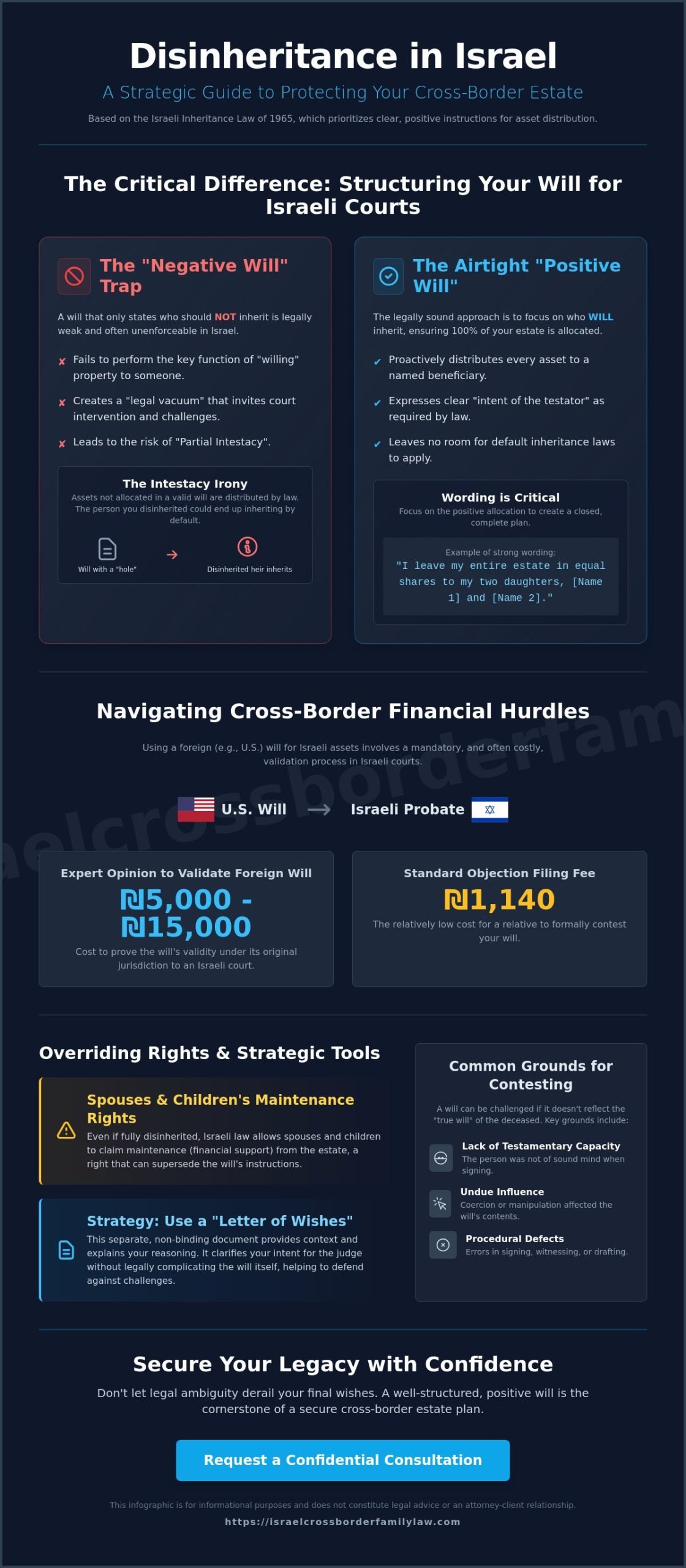
Writing a “negative will” that focuses solely on who should not inherit is one of the most certain ways to ensure your estate ends up in a protracted legal battle. You might assume your final wishes are absolute, but disinheritance laws in israel operate on a logic that often surprises international families. While the Inheritance Law of 1965 grants you testamentary freedom, the Israeli courts maintain a high standard for clarity and intent. If you have assets in both the US and Israel, relying on a single foreign document can lead to expensive complications. An expert opinion to validate a foreign will in an Israeli court can cost between ₪5,000 and ₪15,000, adding significant weight to an already stressful time.
It’s natural to want to protect your legacy from “black sheep” relatives or ensure your assets support the people who truly matter to you. This guide will show you how to build a legally airtight strategy that respects Israeli norms while securing your final wishes. We’ll explore the specific requirements for explicit disinheritance, the risks of “negative” clauses, and the strategic steps to avoid a ₪1,140 objection filing from derailing your estate plan. Get clarity before you commit. Request a confidential consultation.
Key Takeaways
- Understand the specific requirements of disinheritance laws in israel to ensure your final wishes are not overturned by the court for technical or procedural errors.
- Learn why a “negative will” is often insufficient and how to structure a positive distribution strategy that satisfies the Israeli Inheritance Law of 1965.
- Identify the unique rights of spouses and children to claim maintenance from the estate, which can occur regardless of the specific instructions left in your will.
- Navigate the complex cross-border process required to have a US-based will recognized and enforced by the Israeli Registrar of Inheritance.
- Discover how to use a “Letter of Wishes” to provide clarity and context for your decisions while protecting the legal integrity of your estate plan.
This article is published on an independent advisory platform (not a law firm) and does not imply an attorney-client relationship. Legal services are only provided by licensed attorneys under a separate engagement.
Understanding Disinheritance and “Negative Wills” in Israel
In IL, the Inheritance Law of 1965 establishes a robust foundation for testamentary freedom. This principle suggests that you have the legal right to decide exactly how your assets are distributed after your passing. However, disinheritance laws in israel are built on the premise that a will must be a proactive instrument of distribution. It’s not enough to simply list who you wish to exclude. If your document focuses entirely on who should not receive your assets without naming who should, you may inadvertently create a legal vacuum that invites court intervention.
Israeli courts prioritize the “intent of the testator,” but they require that intent to be expressed through “positive instructions.” This means you must explicitly name the individuals or organizations that will receive your property. When a will lacks these positive directions, it fails to meet the technical requirements of a valid testamentary document. The court cannot guess your wishes or invent a distribution plan on your behalf. Without a clear recipient, your attempt to control your legacy may be disregarded entirely.
The Legal Status of Negative Instructions
A document that only contains exclusions is often referred to as a “negative will.” Under the current legal framework in IL, such a document is technically not a will because it doesn’t perform the essential function of “willing” property to someone. A Negative Will is a document containing only exclusionary instructions, which is generally unenforceable in IL courts.
The primary risk here is “partial intestacy.” If you successfully disinherit one relative but fail to properly allocate 100% of your estate to others, a “hole” is created in the distribution. According to the Inheritance Law, any assets not specifically covered by a valid will are distributed according to the rules of intestate succession. Ironically, this often means the very person you intended to exclude could inherit a portion of the estate by default. To avoid this, your strategy must ensure every Shekel and property title is accounted for through a named beneficiary.
The Difference Between Exclusion and Total Disinheritance
It’s helpful to distinguish between simple exclusion and total disinheritance. Exclusion occurs when you leave an heir out of a specific asset, such as an apartment in Tel Aviv or a specific bank account. Total disinheritance is the explicit choice to ensure a relative receives nothing from the entire estate.
The wording you choose is critical for risk management. Phrases like “I leave nothing to my son” are far more vulnerable to legal challenge than “I leave my entire estate in equal shares to my two daughters.” By focusing on the positive allocation to your chosen heirs, you create a complete and closed distribution plan. This leaves no room for the court to apply default inheritance laws. For international families, ensuring this wording aligns with both Israeli and foreign expectations is a vital step in protecting the family legacy.
Get clarity before you commit. Request a confidential consultation.
This article is published on an independent advisory platform (not a law firm) and does not imply an attorney-client relationship. Legal services are only provided by licensed attorneys under a separate engagement.
Grounds for Contesting a Disinheritance in Israeli Court
While the principle of testamentary freedom is central to disinheritance laws in israel, it is not an absolute shield. When a family member is excluded from a will, the Israeli Family Court becomes the arbiter of whether the document reflects the “true will” of the deceased. It is important to understand that the court does not overturn a will simply because it seems “unfair” or “unkind.” Instead, legal challenges must be rooted in specific statutory grounds. The most common hurdles include lack of testamentary capacity, undue influence, or procedural defects that cast doubt on the document’s authenticity.
For international families, the risk of a contest is often higher due to the physical distance between relatives. An objection to a probate order requires a filing fee of ₪1,140 and must typically be submitted within 14 days of the probate application’s publication. If a will is successfully contested, the estate may revert to the default rules of the Inheritance Law, potentially granting assets to the very individuals you intended to exclude. Understanding these risks early allows you to evaluate your strategy before the document is ever signed.
Undue Influence and the “Anglo” Expat
Expats and elderly immigrants in IL are often more vulnerable to claims of undue influence. This legal concept involves pressure that overpowers the testator’s free will, making the document a reflection of someone else’s desires. In many cases, an “Anglo” parent may become dependent on one local child or a specific caregiver while other siblings live abroad. This isolation is a major “red flag” in Israeli courts.
To mitigate this, it’s common practice for testators over a certain age to obtain a medical opinion on the day the will is signed. This contemporaneous evidence proves mental clarity and capacity. While many US wills include “no-contest” clauses to deter litigation, these have limited effectiveness in IL. Israeli courts may still hear a contest if the challenger is acting in “good faith,” making procedural perfection even more vital.
The Deshet v. Eliyahu Precedent
The Israeli Supreme Court has established clear boundaries regarding “bad faith” in inheritance matters. In cases like Deshet v. Eliyahu, the court examined how heirs might attempt to manipulate the distribution of assets to bypass the deceased’s specific intent. This is particularly relevant when beneficiaries try to “collude” with a disinherited party through private side agreements.
If the court perceives that heirs are renouncing their shares in bad faith; for example, to shield assets from creditors or to redistribute them to a disinherited sibling against the testator’s wishes; it may intervene. Protecting your estate requires more than just a signature. It requires a strategic framework that anticipates these family dynamics and ensures your intent cannot be easily bargained away by those you leave behind.
Get clarity before you commit. Request a confidential consultation.
This article is published on an independent advisory platform (not a law firm) and does not imply an attorney-client relationship. Legal services are only provided by licensed attorneys under a separate engagement.
Disinheriting Spouses and Children: Special Considerations
International families often arrive in IL with assumptions based on their home jurisdictions. In many European countries, “forced heirship” laws mandate that a specific percentage of an estate must go to children or a surviving spouse. However, disinheritance laws in israel take a different approach. While you generally have the freedom to distribute your assets as you see fit, the legal system includes specific protections designed to prevent immediate family members from being left destitute. These protections don’t grant a right to a specific share of the property, but they do allow for a claim of ongoing financial support.
Another critical factor is the “Spousal Property Presumption,” known in Hebrew as Chilshat Shituf. Even if a will explicitly leaves a family home to a third party, a surviving spouse may already own 50% of that asset by virtue of the marriage itself. In such cases, the will only governs the deceased’s half of the property. This intersection of family law and inheritance law makes it essential to understand how your marital status affects your estate plan, particularly for those navigating divorce and separation for international families.
Maintenance from the Estate (Mezonot Min Ha’izavon)
Even if you explicitly disinherit a spouse or child, they may still be eligible for “Maintenance from the Estate.” This is not an inheritance. Instead, it’s a monthly payment or lump sum intended to cover basic living needs. The court evaluates several criteria before granting maintenance, including the claimant’s independent income, their standard of living during the deceased’s lifetime, and the total value of the estate. If a child is a minor or has special needs, the court is significantly more likely to approve such a claim. You can mitigate this risk through strategic financial planning, such as setting up specific trusts or life insurance policies that provide for these individuals outside of the probate process.
Disinheriting an Ex-Spouse or Separated Partner
Separation doesn’t automatically end inheritance rights in IL. If a spouse dies during an ongoing divorce process but before a final decree is issued, the surviving partner may still be considered a legal heir under the Inheritance Law of 1965. This can lead to the very outcome you were trying to avoid.
The most effective defense against a spouse’s claim is a court-validated “Financial Agreement,” such as a prenup or postnup. These documents allow couples to waive their rights to each other’s estates in advance. For more context on how these agreements function within the Israeli system, you can watch the video on Financial Agreements. Relying on a will alone is rarely enough when marital property rights are at stake. Strategy and early documentation are the only ways to ensure your assets are protected from unintended claims.
Get clarity before you commit. Request a confidential consultation.
This article is published on an independent advisory platform (not a law firm) and does not imply an attorney-client relationship. Legal services are only provided by licensed attorneys under a separate engagement.
The Cross-Border Dilemma: US Wills vs. Israeli Probate
For international families with assets in both the US and IL, the legal path to disinheritance is rarely a straight line. You might have a “self-proving” will from New York or California, but the Israeli Registrar of Inheritance Matters operates under a separate set of procedural rules. Even with a valid US document, the process in IL requires specific steps to ensure your wishes are honored. The reality is that disinheritance laws in israel don’t automatically recognize foreign probate orders without a formal validation process. This often leads to significant costs and delays if the original document isn’t prepared with cross-border complexities in mind.
One of the most common pitfalls is the use of boilerplate US language. Terms like “per stirpes” or “residuary estate” are standard in the US but don’t always have a direct equivalent in the Israeli Inheritance Law of 1965. If the wording is ambiguous, it creates an opportunity for a disinherited heir to claim that the testator’s intent wasn’t clear. This is particularly relevant for those seeking inheritance and estate planning for expats who need their documents to stand up in two different legal cultures simultaneously.
Step 1: Drafting for Jurisdictional Clarity
The first step in a robust strategy is deciding between separate wills or a single “global” document. While a global will sounds simpler, it often requires a notarized translation into Hebrew, which can cost between ₪250 and ₪400 per page. A better approach for many is to have a dedicated Israeli will that specifically mentions assets in IL. This ensures that your disinheritance instructions are written in a way that local judges understand. It’s also vital to avoid US-specific jargon that doesn’t translate. Clear, descriptive language is your best defense against a future contest in the Israeli Family Court.
Step 2: Formal Execution and Witnessing
Even a perfectly drafted will can fail if it isn’t executed correctly. Israeli law has strict requirements for witnesses, who must be present and sign the document in a specific manner. If the will was signed in the US, it must usually bear an “Apostille” seal to be recognized in IL. The Israeli court will likely require an expert opinion on foreign law to validate that the will is legal in its home jurisdiction. This expert opinion can cost between ₪5,000 and ₪15,000, making it one of the most expensive parts of the probate process. You should speak with an advisor about your cross-border plan to ensure these technicalities don’t derail your final wishes.
Get clarity before you commit. Request a confidential consultation.
This article is published on an independent advisory platform (not a law firm) and does not imply an attorney-client relationship. Legal services are only provided by licensed attorneys under a separate engagement.
Strategic Risk Management for Your Estate Plan
Effective estate planning for international families isn’t just about drafting a document. It’s about anticipating the friction that often follows a death. When navigating disinheritance laws in israel, your primary objective is to make the will as difficult to contest as possible. This starts with the language you use. While it’s tempting to list the grievances that led to excluding a relative, aggressive or insulting language often backfires. In an IL family court, such wording can be used as evidence of “lack of capacity” or “undue influence,” suggesting the testator was acting out of irrational malice rather than a reasoned strategy.
A more sophisticated approach involves using a “Letter of Wishes.” This is a separate document that provides the context for your choices without cluttering the will itself. It keeps the primary testamentary document focused on positive distribution, which is a key requirement under the Inheritance Law of 1965. Since a probate order for a foreign will can involve significant costs; such as the ₪5,000 to ₪15,000 fee for an expert opinion on foreign law; minimizing the grounds for a contest is a financial necessity. You can begin assessing these risks by requesting a Confidential Case Review to evaluate your current plan.
Documenting the “Why” Safely
To defeat future claims of mental incapacity, you should create a trail of evidence at the time the will is signed. This might include a video recording where you clearly state your intentions or contemporaneous notes shared with a neutral third party. These steps are particularly important for “Anglo” expats whose families are spread across different continents. Balancing transparency with privacy is a delicate task. You don’t necessarily need to inform disinherited heirs of your plans today, but you must ensure the evidence of your sound mind is preserved and accessible if a ₪1,140 objection is filed against your estate later.
The Role of an International Advisory
Cross-border situations are inherently complex because they involve two sets of rules that don’t always align. A local IL lawyer might understand the Succession Law but overlook the US tax implications of disinheriting a US citizen. Conversely, a US attorney may not realize that a “negative will” is generally unenforceable in IL courts. There’s also a significant cultural gap in how “fairness” is perceived. While US courts often prioritize the individual’s absolute right to dispose of property, Israeli courts may look more closely at the family unit’s maintenance needs.
Navigating these differences requires a bridge between both legal systems. Early strategy is the only way to ensure your legacy remains intact and your final wishes are honored without years of litigation. Get clarity before you commit. Request a confidential consultation.
This article is published on an independent advisory platform (not a law firm) and does not imply an attorney-client relationship. Legal services are only provided by licensed attorneys under a separate engagement.
Securing Your Legacy Across Borders
Protecting your estate requires more than just a signed document; it demands a strategy that bridges the gap between US expectations and Israeli legal reality. We’ve explored how the Inheritance Law of 1965 mandates positive distribution and why a “negative will” often fails to prevent a ₪1,140 objection from stalling the probate process. You now understand that even with explicit instructions, maintenance claims from the estate can arise if financial planning isn’t proactive. Navigating disinheritance laws in israel involves managing these risks while ensuring your cross-border assets are governed by clear, enforceable language.
Our advisory specialized in US-Israel cross-border family law provides the expertise needed to guide the international expat community through these complexities. By addressing technical requirements like Apostilles and expert opinions early, you prevent the stress of future litigation for your chosen heirs. Get clarity before you commit. Request a confidential consultation. With a well-structured plan, you can rest assured that your final wishes will be honored exactly as you intended.
This article is published on an independent advisory platform (not a law firm) and does not imply an attorney-client relationship. Legal services are only provided by licensed attorneys under a separate engagement.
Frequently Asked Questions
Can I completely disinherit my children in Israel?
Yes, you have the legal right to disinherit your children, but they may still be eligible for financial support. Under disinheritance laws in israel, children who are minors or have specific needs can claim “Maintenance from the Estate” if they lack the means to support themselves. This claim is based on necessity rather than a right to a specific percentage of the assets.
Is a US will that disinherits a child valid in Israel?
A US will can be valid in IL if it meets the formal legal requirements of the state where it was executed. To have it recognized, you must provide an Apostille and often an expert legal opinion on foreign law, which typically costs between ₪5,000 and ₪15,000. It’s often more efficient for international families to maintain a separate Israeli will for their local assets.
What is a “Negative Will” and why is it risky in IL?
A Negative Will is a document that only specifies who should not inherit without naming who should receive the assets. This is highly risky because it leaves a “hole” in the estate distribution. If there’s no named beneficiary, the Israeli court will apply the default rules of intestate succession, which often results in the excluded person inheriting anyway.
Can a disinherited spouse still claim money from my estate?
Yes, a spouse can claim maintenance or assert their rights under the Spousal Property Presumption. Even if you leave them nothing in your will, they may already legally own 50% of the marital property. They can also file for monthly support from the estate if they can prove financial need to the Family Court.
How much does it cost to contest a will in Israel?
The mandatory fee to file an objection to an inheritance order is ₪1,140. However, the total cost of a contest is much higher when you factor in legal fees and the cost of notarized translations, which range from ₪250 to ₪400 per page. If the court requires an expert opinion on the testator’s mental capacity, expenses will increase further.
What happens if I disinherit everyone and don’t name a new beneficiary?
Your estate will be distributed according to the default provisions of the Inheritance Law of 1965. In this scenario, the law prioritizes your spouse and children as the primary heirs. Without a positive instruction naming a specific person or organization to receive the assets, your attempt to exclude everyone will be disregarded by the Registrar.
Does Israel have a “forced heirship” law like France or Italy?
No, IL does not have forced heirship laws that mandate a fixed percentage of the estate for specific relatives. You enjoy broad testamentary freedom to choose your beneficiaries. The only significant restriction is the “maintenance” safety net, which ensures that dependent family members aren’t left entirely without financial resources.
How long does the probate process take in Israel for a foreign will?
The probate process for a foreign will generally takes between 6 and 12 months to complete. This timeline accounts for the time needed to obtain notarized translations, expert legal opinions, and the mandatory 14-day publication period for objections. If the will is contested, the process can extend for several years in the Family Court.

Article by
Gabriel Lior
A Personal Journey That Became a Mission
The advisory was founded by an American father Gabriel Lior, LLB, MBA , global entrepreneur, and cross-border advisor who spent more than a decade navigating the Israeli family court system firsthand and now lives in Singapore with his son.
As a divorced parent in a cross-border family, Gabriel faced nearly every legal challenge a foreign parent can encounter in Israel — including child custody disputes, child support proceedings, property matters in Israel and abroad, false accusations, and complex immigration and relocation proceedings.
Over the years, he learned the hard way how difficult it is for non-Israeli parents to understand the system, identify the right legal strategy, and choose the right legal representation — especially when language, culture, and jurisdictional differences are involved. He also witnessed how foreign parents and new immigrants are often disadvantaged or taken advantage of by service providers and institutions simply because they lack local knowledge or fluency.
From Client to Advisor
To truly understand — and survive — the system, Gabriel pursued formal legal education in Israel, completing two Israeli law degrees, alongside a BA and MBA earned in the United States. This was never about becoming a practicing attorney, but about gaining a deep, structural understanding of how the system works — and where it breaks down for foreign parents.
This rare combination of:
Firsthand client experience
Israeli legal and US business education
International business and negotiation training
Decades of commercial execution
created a unique perspective – one that understands both sides of the table.
After years of litigation, persistence, and at times self-representation, he ultimately succeeded in securing custody of his son and relocating abroad through a rare legal victory in the Israeli Supreme Court — becoming one of the first fathers in Israel to do so under these circumstances.
Disclaimer
Important Disclaimer:
The information provided on this website and in its content is for general informational and educational purposes only and does not constitute legal advice, legal opinion, or legal representation.
Gabriel Lior is not licensed to practice law in Israel (nor is he interested in doing so) and does not provide legal services, despite having completed 2 Law Degrees. The services offered are advisory in nature and are intended to provide general guidance, strategic insight, and information regarding cross-border family law considerations.
No attorney-client relationship is formed by accessing this website, reading its content, or communicating with us.
Any decisions made based on this information are at your own discretion and risk. For legal advice specific to your situation, you should consult a licensed attorney in the relevant jurisdiction.
Where appropriate, we may refer clients to independent, licensed attorneys or professionals. Such referrals do not constitute legal representation and no liability is assumed for services provided by third parties.