
This article is published on an independent advisory platform (not a law firm) and does not imply an attorney-client relationship. Legal services are only provided by licensed attorneys under a separate engagement.
What if the court that decides your divorce is determined not by the law, but by who reaches the courthouse doors first? For many expats and international families, the intersection of civil and religious systems creates a landscape that feels unpredictable. You likely chose Israel for its innovation and culture, but finding yourself in the middle of a dispute involving israel family law for foreigners can quickly become a jurisdictional puzzle. It’s common to feel concerned that religious laws might apply to your secular life or that your overseas assets are at risk during a separation.
We’re here to help you move from confusion to a clear, risk-based strategy. You’ll learn how the “Race for Jurisdiction” works, understand the updated 2026 child support minimums, and see how the courts treat international property. By the end of this guide, you’ll have a professional framework to make informed decisions about your family’s future. For more visual insights, you can also explore our guides at https://www.youtube.com/@IsraelFamilyLaw. Get clarity before you commit. Request a confidential consultation.
This article is published on an independent advisory platform (not a law firm) and does not imply an attorney-client relationship. Legal services are only provided by licensed attorneys under a separate engagement.
- Analyze the parallel jurisdictions of civil Family Courts and religious courts to understand how they govern your legal status in Israel.
- Evaluate the “Dissolution of Marriage” process required for couples who married in civil ceremonies abroad or who share different religious backgrounds.
- Understand the “Race for Jurisdiction” and why the timing of your initial filing is a critical factor in determining the legal outcome of your case.
- Review the 2026 child support minimums and the specific legal restrictions that apply to international child relocation.
- Establish a risk-based framework for managing israel family law for foreigners to protect your assets and parental rights through informed strategy.
For additional guidance, you can view our strategic briefings at https://www.youtube.com/@IsraelFamilyLaw. Get clarity before you commit. Request a confidential consultation.
This article is published on an independent advisory platform (not a law firm) and does not imply an attorney-client relationship. Legal services are only provided by licensed attorneys under a separate engagement.
Understanding the Dual Court System in Israel for Foreigners
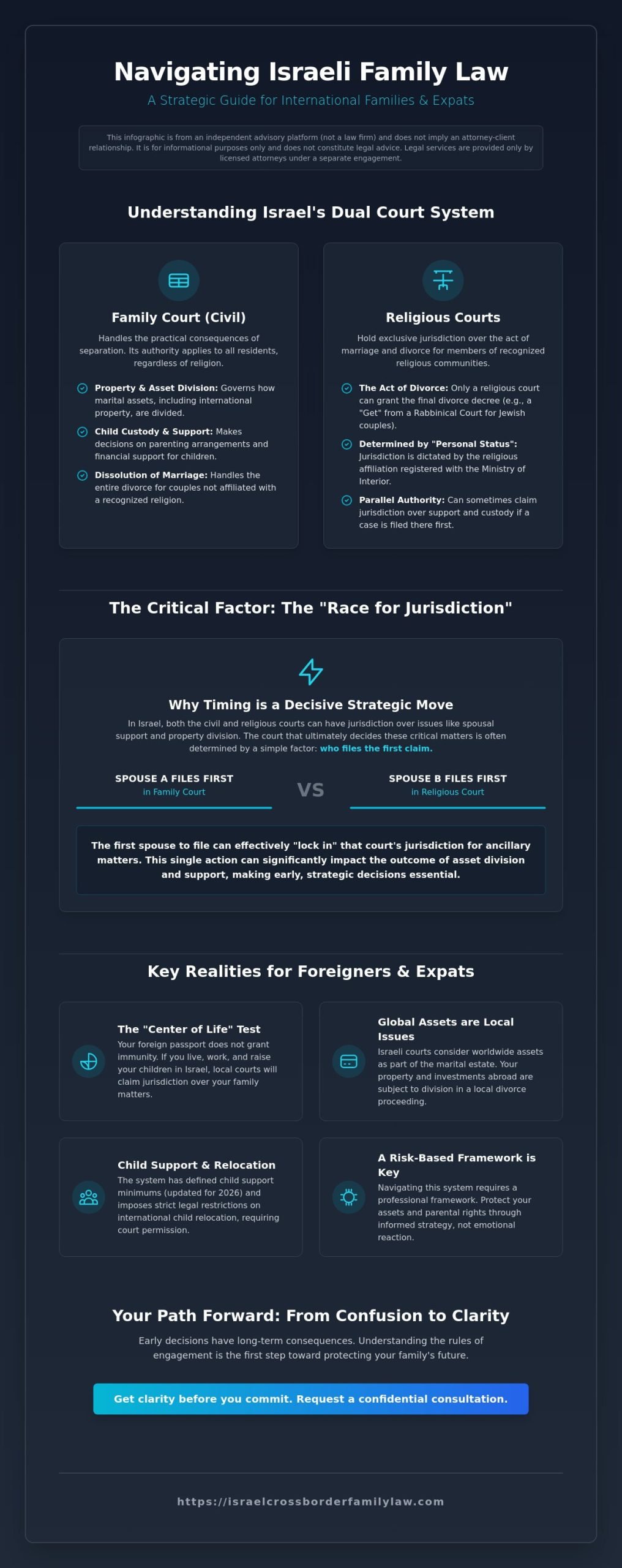
Unlike many Western nations where a single civil court handles all domestic matters, the Israeli system is built on a “millet” structure inherited from the Ottoman era. This means that Marriage and divorce in Israel are governed by religious authorities rather than a central civil registry. For those trying to understand israel family law for foreigners, this dual court system often presents the first major hurdle. Your “personal status,” which is your religious affiliation as registered by the Ministry of Interior (Misrad HaPnim), dictates which court holds the power to end your marriage.
The Ministry of Interior plays a gatekeeper role in this process. When you enter the country or apply for residency, your documents are reviewed to determine your religious community. If the Ministry registers you as a member of a recognized group, such as the Jewish, Muslim, or Druze communities, you fall under the jurisdiction of that group’s religious court for the actual act of divorce. If you aren’t registered with any recognized religious community, your case follows a different civil path. This registration is a critical piece of data that determines your legal reality before a dispute even begins.
To better understand how your legal status in Israel is established, watch this helpful video:
The Family Court vs. Religious Courts
The Family Court is a civil institution that handles the practical outcomes of a separation. This includes property division, child custody, and financial support. In contrast, Religious Courts have exclusive authority over the “act” of the divorce itself. For Jewish couples, only the Rabbinical Court can issue or authorize a “Get,” which is the religious divorce document. If you aren’t registered as a member of a recognized religious community, you’re often considered “without religion” for legal purposes. In these cases, the Family Court may handle the entire process through a civil dissolution rather than a religious ceremony.
How Israeli Law Applies to Non-Citizens
Many people mistakenly believe that carrying a foreign passport exempts them from local regulations. This isn’t the case. Israeli courts use the “center of life” test to determine jurisdiction. If you live, work, and raise your children in the country, the local courts will likely claim authority over your family matters regardless of your citizenship. Understanding the specific risks for expats and foreign nationals is essential because early decisions have long term consequences. Strategy is your best tool when navigating a system that may be vastly different from your home country’s legal culture. Get clarity before you commit. Request a confidential consultation.
This article is published on an independent advisory platform (not a law firm) and does not imply an attorney-client relationship. Legal services are only provided by licensed attorneys under a separate engagement.
Marriage and Divorce for International Families in Israel
Israel does not offer a secular civil marriage option within its borders. For many foreigners, this means traveling to jurisdictions like Cyprus, Prague, or the United States to formalize their union. As of 2026, the Ministry of Interior also recognizes civil marriages conducted online through platforms like Utah County, USA. While these marriages are valid for residency and registration, the process of ending them in Israel requires a strategic approach that accounts for your specific religious status. When a marriage involves two different faiths or individuals with no religious affiliation, the process is known as “Dissolution of Marriage” rather than a traditional religious divorce.
For Jewish foreigners, the Rabbinical court maintains authority over the “act” of divorce, even if the marriage took place in a civil ceremony abroad. This means a “Get” (religious divorce document) may still be required to ensure your status is clear for future personal matters. Navigating israel family law for foreigners becomes particularly complex when international prenuptial agreements are involved. Israeli courts generally respect foreign contracts; however, they must be validated to ensure they don’t conflict with local public policy. It’s often helpful to get clarity on your specific situation before making any legal commitments.
Ending a Foreign Marriage in Israel
Even if both parties agree to separate, an “uncontested” divorce for foreigners isn’t a simple administrative task. It requires a specific legal pathway through Israel’s Family Courts to ensure the foreign marriage is legally dissolved and the records are updated with the Ministry of Interior. This process involves proving that the court has jurisdiction over your “center of life,” which is typically established if you’ve resided in Israel for the majority of the preceding year.
Property Division and Cross-Border Assets
The Israeli “Spousal Property Relations Law” typically mandates an equal division of assets acquired during the marriage. This doesn’t just apply to local bank accounts or apartments in Tel Aviv; it can extend to retirement funds, real estate, and business interests held in the US, Europe, or elsewhere. This creates a risk of “forum shopping,” where one spouse may try to file for divorce in a country with more favorable property laws. Understanding the risks of divorce and separation for international families is the first step in protecting your financial interests. The court’s primary goal is a fair distribution, but the complexity of valuing cross-border assets often requires a detailed risk-based strategy.
This article is published on an independent advisory platform (not a law firm) and does not imply an attorney-client relationship. Legal services are only provided by licensed attorneys under a separate engagement.
The Strategic “Race for Jurisdiction”: Why Timing Matters
In the context of israel family law for foreigners, the concept of the “Race for Jurisdiction” (Merotz HaSamchuyot) is perhaps the most significant tactical reality. Because both civil Family Courts and religious courts share authority over many aspects of a separation, the court that receives the initial filing typically claims jurisdiction over the entire case. This isn’t merely an administrative detail; it determines which legal philosophy will govern your financial future and parental rights. For an international family, the difference between these two systems can lead to vastly different outcomes regarding property division and spousal maintenance.
Strategic timing is essential because once a case is opened in one system, it’s difficult and often impossible to move it to the other. This creates a high-stakes environment where the first spouse to act sets the legal stage for the entire process. Decisions made in the first 48 hours after a conflict arises often carry more weight than months of subsequent litigation. Understanding these dynamics allows you to move from a reactive position to a strategy-based approach that protects your interests across borders.
Filing First: The Civil vs. Religious Choice
Foreigners often find the civil Family Court more aligned with their expectations, as it adheres to standard civil evidence rules and a predictable legal framework. However, if one spouse files for divorce in the Rabbinical court, they may attempt to “bind” related issues to that suit. Kricha is the legal mechanism that attaches civil matters to a religious divorce suit, effectively moving those issues from the civil court’s jurisdiction to the religious court’s authority. This can be a significant risk if the religious court’s approach to assets or support differs from the civil standards you anticipated. Choosing the right venue requires an objective assessment of your specific assets and family goals.
Risks of Delay for International Families
For families with ties to multiple countries, delay introduces the risk of parallel proceedings in different nations. If one spouse files in Israel while the other initiates a case in a US state court, the legal landscape becomes exponentially more complex. Courts often apply the principle of “lis alibi pendens,” or suit pending elsewhere, to decide which country should proceed. This multi-jurisdictional friction can lead to conflicting orders and increased costs. To avoid these pitfalls, it’s vital to understand how it works and seek clarity before making any public commitments. Early strategy is the only way to manage the inherent complexity of cross-border family law. Get clarity before you commit. Request a confidential consultation.
This article is published on an independent advisory platform (not a law firm) and does not imply an attorney-client relationship. Legal services are only provided by licensed attorneys under a separate engagement.
International Child Custody and Support: Cross-Border Realities
When children are involved in a cross-border dispute, the legal stakes shift from financial assets to the fundamental structure of the family. A primary consideration in israel family law for foreigners is the “Tender Years Doctrine.” This legal presumption suggests that children under the age of six should remain in the custody of their mother. While recent legal trends and the landmark 2017 Supreme Court ruling (919/15) have moved toward more egalitarian shared parenting for children aged 6 to 18, the doctrine still heavily influences initial custody arrangements for toddlers and infants. Understanding how these local presumptions interact with your international parenting goals is a vital part of your legal strategy.
Financial support for children has also undergone significant changes. As of January 2026, the generally accepted minimum for a child’s essential needs is between ₪1,400 and ₪1,600 per month. This figure serves as a baseline before accounting for housing, education, and extracurricular costs. For children over six, the court now calculates support based on the proportional income of both parents and the actual time the child spends in each household. This shift from a father-only obligation to a shared responsibility requires careful financial documentation, especially when income is earned in foreign currencies or held in offshore accounts.
Relocation and the Risk of Abduction
One of the most critical risks for international families is the restriction on movement. You cannot simply leave Israel with your children without the other parent’s written consent or a court order. Moving children across borders without this authorization is legally classified as abduction under the Hague Convention on the Civil Aspects of International Child Abduction. Israel is an active signatory to this treaty and enforces it strictly. If you are facing a situation where relocation is necessary for your career or well-being, you must seek a formal relocation order. The court will evaluate the “best interests of the child” rather than the parent’s desire to return home. If you are currently in a high-conflict situation regarding travel, review our guidance on the Hague Convention and child abduction.
Enforcing Support Across Borders
For parents living abroad with a support order against a resident of Israel, or vice versa, enforcement is managed through a specific international framework. A bilateral agreement between the United States and Israel facilitates the enforcement of US child support in Israel through the Israeli Central Authority. This process allows for the collection of funds via the Directorate of Enforcement and Collection. Foreigners should also be aware of “stay of exit” orders (Tzav Ikur Yetzia Min HaAretz). These orders can prevent a parent from leaving the country until child support debts are paid or guaranteed by third-party lienholders. This is a significant risk for expats who travel frequently for business. To ensure your rights are protected during these complex proceedings, request a confidential case review to discuss your specific cross-border needs.
This article is published on an independent advisory platform (not a law firm) and does not imply an attorney-client relationship. Legal services are only provided by licensed attorneys under a separate engagement.
Protecting Your Interests: Strategy-Based Decision Making
Successfully managing israel family law for foreigners requires a shift from emotional reaction to calculated strategy. The first step in this process is achieving absolute clarity in plain English. Hebrew legal terms often carry cultural nuances that don’t have direct equivalents in American or British law. For example, the way Israeli courts value “reputation” or “career assets” during a divorce may differ significantly from your home jurisdiction. Without a clear translation of these concepts, you’re making decisions in the dark. Professional strategy bridges this gap by ensuring you understand the legal reality in your own language before you sign any documents.
A risk-based assessment is the cornerstone of professional decision-making. Before you engage in litigation, you must understand the probable outcomes versus the potential costs. As of January 2026, filing a property claim in the Family Court for a non-fixed sum between spouses involves a fee of 596 NIS. While these initial filing costs are manageable, the long term expense of a multi-year cross-border battle is not. Strategic practitioners look at your assets spanning both the US and Israel to determine which court system offers the most secure path for your financial future. This objective approach helps you avoid the “Race for Jurisdiction” pitfalls we discussed earlier.
Choosing an Advisory Path
Choosing the right path means looking for a bridge between legal cultures. You need guidance that understands both the Israeli Rabbinical system and the nuances of international finance. You can learn more about the advisory and our philosophy of prioritizing strategic planning over raw litigation. Early strategy often prevents years of costly cross-border litigation by identifying settlement opportunities before the conflict escalates and consumes your marital resources.
Taking the First Step Toward Clarity
The mantra “Get clarity before you commit” is your best protection against irreversible legal errors. A confidential review helps identify jurisdictional risks before they become a matter of public record. This allow you to evaluate your position regarding child support, which currently carries a 2026 minimum of ₪1,400 to ₪1,600 per month, without the pressure of an active court case. Understanding your rights and obligations in advance allows for a more stable transition for your family. Get clarity before you commit. Request a confidential consultation.
This article is published on an independent advisory platform (not a law firm) and does not imply an attorney-client relationship. Legal services are only provided by licensed attorneys under a separate engagement.
Securing Your Family’s Future Through Strategic Planning
Navigating the dual court system requires a deep understanding of how local religious and civil structures intersect with international obligations. We’ve explored how the “Race for Jurisdiction” and the Hague Convention create a high-stakes environment where early decisions determine long term outcomes. Managing israel family law for foreigners isn’t just about filing paperwork; it’s about building a bridge between two distinct legal cultures to protect your children and your global assets. By prioritizing strategy over raw litigation, you can manage risks like “stay of exit” orders and the complexities of cross-border property division with confidence.
Our advisory provides a calm, strategy-based framework led by practitioners who understand both the US and Israeli legal systems. This established expertise ensures that your interests are defended with professional formality and cross-cultural nuance. You don’t have to face these complexities alone. With the right strategy in place, you can find a clear and secure path forward for your family. Get clarity before you commit. Request a confidential consultation.
This article is published on an independent advisory platform (not a law firm) and does not imply an attorney-client relationship. Legal services are only provided by licensed attorneys under a separate engagement.
Frequently Asked Questions
Can a foreigner get divorced in Israel if they were married in the US?
Foreigners residing in Israel can dissolve a marriage performed in the US if the country has become their center of life. The court’s authority is based on your current residency rather than the location of your wedding ceremony. If you’ve lived in Israel for the majority of the year, the Family Court typically has jurisdiction to hear your case. This applies even if you only hold foreign citizenship.
Is a US prenuptial agreement valid in the Israeli Family Court?
Israeli Family Courts generally recognize US prenuptial agreements provided they meet specific procedural requirements and were signed with informed consent. The agreement must be validated by the court to ensure it doesn’t conflict with local public policy or fundamental rights. It’s essential to present these documents early in the process to secure your assets. Without professional validation, the court may apply local property laws instead.
How does the “Race for Jurisdiction” affect my property in the US?
The court that first receives a filing may claim authority over your global assets, including real estate or retirement accounts held in the US. This is why the “Race for Jurisdiction” is a critical element of israel family law for foreigners. One spouse might attempt to “bind” these foreign assets to a religious court proceeding to seek a more favorable outcome. Early strategy is vital to keep your international property within the civil court system.
What is the Hague Convention, and how does it protect my children in Israel?
The Hague Convention is an international treaty that prevents parents from unilaterally moving children across borders without the other parent’s consent. It ensures that custody disputes are heard in the child’s “habitual residence” rather than a country chosen by one parent. Israel strictly enforces this treaty to protect the stability of international families. If a child is removed without authorization, the treaty provides a mechanism for their immediate return.
Can I be prevented from leaving Israel if my spouse files for divorce?
A spouse can request a “stay of exit” order (Tzav Ikur Yetzia) to prevent you from leaving the country during a divorce. These orders are frequently used to ensure that child support obligations are met or to prevent a parent from relocating with children. You may need to provide financial guarantees or liens to have such an order lifted for travel. This is a common risk for expats who travel frequently for business.
How is child support calculated for expats with international income?
Courts calculate support by reviewing total global income, including salaries earned in foreign currencies and overseas business interests. Since January 2026, the baseline for essential needs is ₪1,400 to ₪1,600 per child. For expats, the court will also consider the proportional income of both parents and the actual time each child spends in their care. This ensures that the support reflects the true financial capacity of both parties.
Do I need a religious divorce (Get) if I am a secular foreigner?
If the Ministry of Interior registers you as Jewish, you will likely need a religious divorce (Get) even if you consider yourself secular. While the Family Court handles the financial side of israel family law for foreigners, the Rabbinical court maintains exclusive authority over the actual status change for Jewish residents. Failing to obtain a Get can lead to significant legal and personal complications if you choose to remarry in the future.
Is child custody always awarded to the mother in Israel?
Custody is not automatically awarded to the mother, though the “Tender Years Doctrine” creates a presumption for children under six. For children aged 6 to 18, the courts follow a 2017 ruling that encourages shared parental responsibility and proportional financial support. The final decision is always based on the “best interests of the child” rather than a fixed gender preference. Courts increasingly favor arrangements that maintain the child’s connection to both parents.

Article by
Gabriel Lior
A Personal Journey That Became a Mission
The advisory was founded by an American father Gabriel Lior, LLB, MBA , global entrepreneur, and cross-border advisor who spent more than a decade navigating the Israeli family court system firsthand and now lives in Singapore with his son.
As a divorced parent in a cross-border family, Gabriel faced nearly every legal challenge a foreign parent can encounter in Israel — including child custody disputes, child support proceedings, property matters in Israel and abroad, false accusations, and complex immigration and relocation proceedings.
Over the years, he learned the hard way how difficult it is for non-Israeli parents to understand the system, identify the right legal strategy, and choose the right legal representation — especially when language, culture, and jurisdictional differences are involved. He also witnessed how foreign parents and new immigrants are often disadvantaged or taken advantage of by service providers and institutions simply because they lack local knowledge or fluency.
From Client to Advisor
To truly understand — and survive — the system, Gabriel pursued formal legal education in Israel, completing two Israeli law degrees, alongside a BA and MBA earned in the United States. This was never about becoming a practicing attorney, but about gaining a deep, structural understanding of how the system works — and where it breaks down for foreign parents.
This rare combination of:
Firsthand client experience
Israeli legal and US business education
International business and negotiation training
Decades of commercial execution
created a unique perspective – one that understands both sides of the table.
After years of litigation, persistence, and at times self-representation, he ultimately succeeded in securing custody of his son and relocating abroad through a rare legal victory in the Israeli Supreme Court — becoming one of the first fathers in Israel to do so under these circumstances.
Disclaimer
Important Disclaimer:
The information provided on this website and in its content is for general informational and educational purposes only and does not constitute legal advice, legal opinion, or legal representation.
Gabriel Lior is not licensed to practice law in Israel (nor is he interested in doing so) and does not provide legal services, despite having completed 2 Law Degrees. The services offered are advisory in nature and are intended to provide general guidance, strategic insight, and information regarding cross-border family law considerations.
No attorney-client relationship is formed by accessing this website, reading its content, or communicating with us.
Any decisions made based on this information are at your own discretion and risk. For legal advice specific to your situation, you should consult a licensed attorney in the relevant jurisdiction.
Where appropriate, we may refer clients to independent, licensed attorneys or professionals. Such referrals do not constitute legal representation and no liability is assumed for services provided by third parties.
Related Insights & Resources

The Hague Convention on Child Abduction: A Guide for Parents in Israel & US Cases
The discovery that your child has been wrongfully removed to or from another country is...Read More →
Is My US Trust Enforceable in Israel? A Guide for Expats and Families
This article is published on an independent advisory platform and does not constitute a law...Read More →
Family Lawyer in Jerusalem: A Guide for International Families and Expats
This article is published on an independent advisory platform and does not constitute legal representation...Read More →