This article is published on an independent advisory platform (not a law firm) and does not constitute legal representation or legal advice. Legal services are only provided by licensed attorneys under a separate engagement. This publication does not imply an attorney-client relationship.
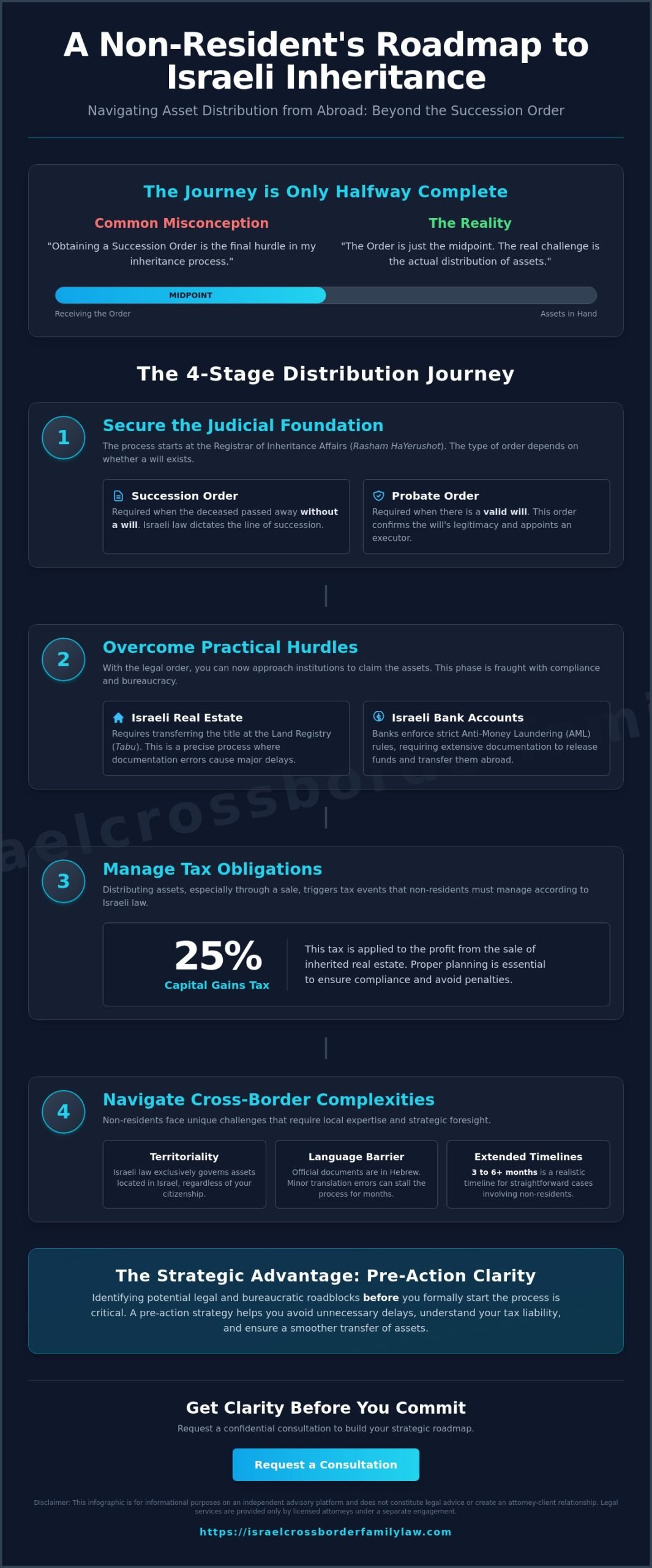
Most heirs believe that obtaining a succession order is the final hurdle, but distributing inherited assets in israel as a non-resident involves much more than just a court ruling. In reality, that legal document is merely the midpoint of a complex journey. You’ve likely spent months navigating the bureaucracy of the Registrar, perhaps feeling overwhelmed by Hebrew documents and unfamiliar procedures. It’s natural to feel that the hard part is over once the order is in hand, but the actual distribution of property and funds brings its own set of challenges.
We understand the difficulty of managing Israeli bank compliance from abroad and the fear of hidden legal traps. This guide provides a clear roadmap for transferring funds to your home country and managing the 25% capital gains tax on property sales. You’ll learn how to move from a court order to the actual possession of your inheritance through a strategic, risk-based approach. For more detailed insights, you can also view our guidance on the Israel Family Law YouTube channel. Get clarity before you commit. Request a confidential consultation.
Key Takeaways
- Distinguish between a Succession Order and a Probate Order to establish the correct judicial foundation for your inheritance claim in Israel.
- Handle the rigorous anti-money laundering (AML) documentation required by Israeli banks. This is essential for successfully transferring inheritance funds to your home country.
- Understand the tax implications of distributing inherited assets in israel as a non-resident, specifically the 25% capital gains tax applied to property sales.
- Identify potential legal or bureaucratic roadblocks through a pre-action strategy. This helps you avoid unnecessary delays before committing to the probate process.
This article is published on an independent advisory platform (not a law firm) and does not constitute legal representation or legal advice. Legal services are only provided by licensed attorneys under a separate engagement. This publication does not imply an attorney-client relationship.
The Reality of Distributing Inherited Assets in Israel for Non-Residents
If you’ve inherited property or funds in Israel, you might assume your local lawyer in New York or London can handle the distribution. That’s a common misconception. The Israeli legal system operates on the principle of territoriality. This means that if the asset is physically located within the borders of Israel, the process for distributing inherited assets in israel as a non-resident must follow Israeli law exclusively. Your citizenship or the deceased’s last place of residence doesn’t change this fundamental requirement.
To understand how assets are divided when there is no will, watch this helpful video:
The Israeli Succession Law of 1965 serves as the primary governing framework for all estates. Many foreign residents are surprised to find that simple “letters of administration” or probate orders from their home country are usually insufficient. Israeli authorities require a local order to transfer title or release funds. This reality makes early strategic decisions vital. You must decide how to approach the Registrar of Inheritance Affairs before submitting any paperwork, as early procedural choices can impact your tax liability and the speed of the transfer.
Why Cross-Border Inheritance is Inherently Complex
Navigating the intersection of two different legal systems often creates friction. For example, the probate process in common law jurisdictions differs significantly from the Israeli system. You’ll encounter Hebrew-only documentation at government offices, where even a small translation error can stall your application for months. While the official goal for issuing a Succession Order is 40 days, non-residents should expect a timeline of 3 to 6 months for straightforward cases. If the case involves a foreign will, the process often extends longer due to the need for expert legal opinions on foreign law.
Identifying Assets Within the Israeli Jurisdiction
It’s vital to categorize assets early to avoid logistical hurdles. Real estate remains a primary focus for many families. In late 2025, the average property price in Tel Aviv reached approximately 4.36 million NIS, making these high-value assets that require precise title management. Beyond property, you must account for bank accounts and digital assets. Israeli banks have rigorous compliance standards. Having a team on the ground is often the only way to locate dormant accounts or verify property titles at the Land Registry. You can find more context for expats and foreign nationals to see how these rules apply to your specific situation.
Get clarity before you commit. Request a confidential consultation.
This article is published on an independent advisory platform (not a law firm) and does not constitute legal representation or legal advice. Legal services are only provided by licensed attorneys under a separate engagement. This publication does not imply an attorney-client relationship.
Securing the Judicial Foundation: Succession and Probate Orders
The first formal step in distributing inherited assets in israel as a non-resident is obtaining a judicial order from the Registrar of Inheritance Affairs (Rasham HaYerushot). This government body verifies the legal heirs and the validity of any existing instructions left by the deceased. If your loved one passed away without a will, you must apply for a Succession Order, known in Hebrew as a Tsav Yerusha. This document does not list specific assets but identifies the legal beneficiaries and their respective percentages of the estate according to law.
When a valid will exists, the process shifts to obtaining a Probate Order (Tsav Kiyum Tsava’a). This order gives the will the force of a court judgment, allowing the executor or heirs to act. A mandatory requirement for both types of applications is the public notification. As of May 2026, a fee of 215 NIS is required for the mandatory publication of the probate application in a daily newspaper. This step ensures that any creditors or unknown heirs have the opportunity to come forward before the estate is settled.
The Process for Validating a Foreign Will in Israel
Validating a will drafted outside of Israel involves additional layers of scrutiny. You must provide the original document or a certified copy, often requiring an Apostille stamp from your home jurisdiction to prove its authenticity. All foreign documents must be translated into Hebrew by a recognized professional. Because the deceased was a foreign resident, the Registrar requires a legal opinion on the foreign law of their last place of residence. This expert opinion, which generally costs between 3,000 and 7,000 ILS, confirms that the will is valid under the laws of the country where it was signed. While Israel respects testamentary freedom, cases involving foreign residents are frequently transferred to the Family Court if complexities arise, potentially extending the timeline beyond the typical 6-month window.
Intestate Succession: Who Inherits When There is No Will?
If there is no will, the Succession Law of 1965 dictates the distribution. The hierarchy is clear: the surviving spouse usually receives the deceased’s movable property, including cars, and half of the remaining estate. The children share the other half equally. If the deceased had no children, the spouse’s share may increase to two-thirds, with the remainder going to parents or siblings. Israeli law provides significant protection for the surviving spouse, often allowing them to continue living in the family residence even if they only own a portion of the title. Understanding these defaults is essential for managing expectations during the distribution process. Get clarity before you commit. Request a confidential case review.
This article is published on an independent advisory platform (not a law firm) and does not constitute legal representation or legal advice. Legal services are only provided by licensed attorneys under a separate engagement. This publication does not imply an attorney-client relationship.
The Practical Hurdle: Transferring Israeli Bank Accounts and Real Estate
Securing a court order from the Registrar is a significant milestone, but it doesn’t automatically trigger the release of funds or the transfer of property. For non-residents, the transition from legal heir to asset owner is often where the most frustrating delays occur. When distributing inherited assets in israel as a non-resident, you must move from the judicial sphere into the rigorous world of Israeli banking compliance and land registration. These institutions operate under their own sets of rules that often feel disconnected from the probate court’s decision.
One of the most persistent challenges is the requirement for an Israeli bank account to hold estate funds during the interim period. Most Israeli banks won’t wire inheritance directly from a deceased person’s account to a foreign jurisdiction. They typically require the heirs to open a local estate account or a personal non-resident account first. This step ensures all local debts and taxes are settled before the capital leaves the country. It also provides a transparent record for the bank’s compliance department.
Navigating the Israeli Banking System from Abroad
Israeli financial institutions are increasingly hesitant to work with foreign residents due to strict global Anti-Money Laundering (AML) and Know Your Customer (KYC) regulations. To liquidate an account, you must provide a comprehensive paper trail. This includes certified copies of your passport, proof of tax residency in your home country, and often a detailed explanation of the deceased’s original source of wealth. Banks may also request a foreign law expert opinion even after the probate court has already accepted one. Success depends on presenting a clean file that satisfies the bank’s compliance department; this often requires a representative who understands the specific internal culture of Israeli finance.
Real Estate Title Transfers and Management
Transferring an apartment or plot of land requires formal registration with the Land Registry, known as the Tabu. This process involves submitting the digital Succession Order along with specific application forms and proof of fee payment. Once the title is in your name, you face a strategic choice: sell the property or manage it as a rental. Selling triggers the 25% Mas Shevach capital gains tax, calculated from the deceased’s original purchase date. If you choose to keep the property, you’ll need local management to handle municipal taxes (Arnona), utilities, and tenant relations. You can review our pricing page to understand the costs associated with professional estate management and strategic planning. Get clarity before you commit. Request a confidential consultation.
This article is published on an independent advisory platform (not a law firm) and does not constitute legal representation or legal advice. Legal services are only provided by licensed attorneys under a separate engagement. This publication does not imply an attorney-client relationship.
Cross-Border Tax and Regulatory Compliance for Non-Residents
One of the most common misconceptions about distributing inherited assets in israel as a non-resident is that the process is entirely tax-free. While it’s true that Israel abolished its formal estate and inheritance tax on April 1, 1981, this only describes one side of the equation. As a foreign resident, you’re operating within a multi-jurisdictional framework. Your tax obligations are determined not just by where the asset is located, but by where you live and how the asset is eventually liquidated.
The primary tax concern within Israel involves real estate. If you inherit an apartment and decide to sell it, you’ll encounter the Capital Gains Tax, known as Mas Shevach. This tax is currently set at 25% of the real gain. Crucially, Israel uses a “step-in-the-shoes” principle. This means the gain is calculated from the deceased’s original purchase price, not the value at the time of their death. If the property was purchased decades ago for a small fraction of its current value, the tax liability can be substantial. Coordinating with a professional who understands the specific treaties between Israel and your home country is the only way to identify these liabilities early.
Reporting Inherited Foreign Assets to the IRS
For US citizens and green card holders, the challenge extends to the Internal Revenue Service. You must navigate the Foreign Bank Account Report (FBAR) and FATCA requirements. If the total value of your foreign financial accounts exceeds specific thresholds at any point during the year, you must disclose them. Failure to do so can result in significant penalties that often outweigh the value of the inheritance itself. You may also be required to file Form 3520 to report the receipt of large bequests from a foreign estate. These reporting rules apply even if the assets are not yet liquidated. The US-Israel Tax Treaty provides some guidance on how pension funds or life insurance payouts are handled, but these rules are complex and require a nuanced strategy.
Compliance Risks and How to Mitigate Them
Dormant or “silent” accounts pose a significant risk to international families. If an Israeli bank account remains inactive for an extended period, the funds may be transferred to the Administrator General, making recovery much more difficult. Early disclosure to your home country’s tax authorities is almost always safer than attempting to hide a foreign inheritance. Transparency simplifies the banking compliance process we discussed in the previous section. For a broader look at how to structure your affairs, refer to our US-Israel Wills & Estate Planning Guide. Get clarity before you commit. Speak with a cross-border professional.
This article is published on an independent advisory platform (not a law firm) and does not constitute legal representation or legal advice. Legal services are only provided by licensed attorneys under a separate engagement. This publication does not imply an attorney-client relationship.
Strategic Next Steps: Securing Clarity Before You Commit
The process of distributing inherited assets in israel as a non-resident involves far more than just filling out government forms. Because you are managing an estate from a different country, a “pre-action” strategy is the most effective way to identify potential roadblocks before they become expensive delays. This strategy involves reviewing the deceased’s assets, verifying the chain of title, and anticipating the specific compliance demands of Israeli banks. By addressing these issues before you submit your application to the Registrar, you reduce the risk of your case being transferred to the Family Court, which can significantly extend the timeline.
Choosing a representative who understands both Israeli and Western business cultures is a critical differentiator. A bicultural approach ensures that you aren’t just getting a translation of the law, but a strategic explanation of how that law interacts with your home country’s regulations. Bilingual guidance allows you to navigate Hebrew-only documentation at the Land Registry while maintaining a clear, plain-English understanding of every step. This bridge between legal systems is what ultimately provides peace of mind during a complex cross-border transition.
Risk-Based Decision Making in Inheritance
Before committing to the probate process, it is helpful to evaluate the estate’s value against the inherent legal complexity. For example, if you are inheriting a property in Tel Aviv with an average value of 4.36 million NIS, the investment in professional guidance is easily justified. However, for smaller bank accounts, you must weigh the costs of foreign law expert opinions and mandatory publication fees against the final distribution amount. Early decisions regarding whether to sell or keep real estate will also dictate your tax strategy and the speed at which funds can be transferred to your home country.
Moving Forward with Confidence
Success in these matters requires a “team on the ground” in Tel Aviv who can physically visit government offices and negotiate with bank compliance departments. Remote management often leads to stalled applications and unanswered inquiries. To help you assess your specific situation and identify the most efficient path forward, you can request a confidential case review. This initial step allows you to move forward with a clear roadmap rather than reacting to bureaucratic hurdles as they arise.
Final Checklist: Documents to Gather Before Starting
- Original Death Certificate: This must be authenticated with an Apostille stamp.
- The Original Will: If one exists, it must be the physical original or a court-certified copy.
- Passport Copies: Certified copies of the passports for all named heirs.
- Proof of Residency: Documentation confirming the deceased’s last place of residence for the foreign law opinion.
- Asset Documentation: Property deeds (Tabu extracts) or recent bank statements from the Israeli institution.
Get clarity before you commit. Request a confidential consultation.
This article is published on an independent advisory platform (not a law firm) and does not constitute legal representation or legal advice. Legal services are only provided by licensed attorneys under a separate engagement. This publication does not imply an attorney-client relationship.
Securing Your Legacy Across Borders
Successfully distributing inherited assets in israel as a non-resident requires a proactive strategy that bridges two distinct legal cultures. As we’ve discussed, the initial Succession Order is merely the foundation for the more complex tasks of banking compliance and tax reporting. Whether you’re managing high-value real estate in Tel Aviv or liquidating accounts, the path to a successful transfer is paved with early, informed decisions.
We provide the bicultural and bilingual expertise needed to navigate these multi-jurisdictional challenges. With decades of cross-border experience and a strategic team on the ground in both Israel and the US, we help you avoid common pitfalls. You don’t have to face the Israeli bureaucracy alone. Get clarity before you commit. Request a confidential consultation today. Taking the right steps now ensures a seamless transition for your family’s future.
This article is published on an independent advisory platform (not a law firm) and does not constitute legal representation or legal advice. Legal services are only provided by licensed attorneys under a separate engagement. This publication does not imply an attorney-client relationship.
Frequently Asked Questions
Does Israel have an inheritance or estate tax for foreign residents?
Israel does not levy an inheritance or estate tax on assets passed to beneficiaries. This tax was abolished on April 1, 1981, and there are currently no plans to reintroduce it. However, while the transfer itself is tax-free, you may still face capital gains tax (Mas Shevach) if you choose to sell inherited real estate rather than keeping it.
Can I handle the Israeli probate process without traveling to Israel?
You can manage the entire process of distributing inherited assets in israel as a non-resident without physically visiting the country. As of May 2026, all petitions to the Registrar of Inheritance Affairs must be submitted through a mandatory digital portal. A local representative with a power of attorney can handle the necessary filings, bank communications, and land registry updates on your behalf.
How long does it typically take to obtain a Succession Order in Israel?
For straightforward cases involving foreign residents, the process generally takes between 3 and 6 months. The Registrar’s official goal is to issue an order within 40 days of receiving a completed application. However, the requirement for expert legal opinions on foreign law and the mandatory newspaper publication period usually extends the timeline for international families.
Will my US-based Will be recognized by the Israeli courts?
Israeli courts generally recognize Wills drafted in the US, provided they meet basic legal formalities such as the presence of two witnesses at the time of signing. To validate the document, you must provide an expert legal opinion confirming that the Will is valid under the laws of the deceased’s last place of residence. This is a standard requirement for distributing inherited assets in israel as a non-resident when a foreign Will is involved.
What happens if the deceased had assets in both the US and Israel?
Assets are governed by the laws of the jurisdiction where they are physically located. You’ll need to conduct two separate legal processes: probate in the US for American assets and a separate probate or succession application in Israel for Israeli assets. Israeli authorities do not automatically recognize foreign probate orders; you must obtain a local decree to manage Israeli bank accounts or real estate.
How do I transfer money from an inherited Israeli bank account to my US account?
Transferring funds requires you to satisfy the specific Anti-Money Laundering (AML) and Know Your Customer (KYC) protocols of the Israeli bank. You typically need to provide a certified chain of documents, including the Succession Order and proof of your tax residency. Most banks require the funds to be moved into a local estate account before they can be wired internationally to your US bank.
Is a religious court (Rabbinical Court) involved in the distribution of assets?
A religious court only has jurisdiction over an inheritance if all legal heirs provide their express written consent. If even one heir does not agree, the case must be handled by the civil Succession Registrar or the Family Court. Most international families choose the civil track to ensure the process follows the standard Succession Law of 1965.
What documents are required to start the inheritance process in Israel?
You must gather several key documents, including the original death certificate with an Apostille stamp and the original Will if one exists. You’ll also need certified copies of the heirs’ passports and a legal opinion on the foreign law of the deceased’s last residence. All documents issued in English or other foreign languages must be accompanied by a professional Hebrew translation to be accepted by the Registrar.

Article by
Gabriel Lior
A Personal Journey That Became a Mission
The advisory was founded by an American father Gabriel Lior, LLB, MBA , global entrepreneur, and cross-border advisor who spent more than a decade navigating the Israeli family court system firsthand and now lives in Singapore with his son.
As a divorced parent in a cross-border family, Gabriel faced nearly every legal challenge a foreign parent can encounter in Israel — including child custody disputes, child support proceedings, property matters in Israel and abroad, false accusations, and complex immigration and relocation proceedings.
Over the years, he learned the hard way how difficult it is for non-Israeli parents to understand the system, identify the right legal strategy, and choose the right legal representation — especially when language, culture, and jurisdictional differences are involved. He also witnessed how foreign parents and new immigrants are often disadvantaged or taken advantage of by service providers and institutions simply because they lack local knowledge or fluency.
From Client to Advisor
To truly understand — and survive — the system, Gabriel pursued formal legal education in Israel, completing two Israeli law degrees, alongside a BA and MBA earned in the United States. This was never about becoming a practicing attorney, but about gaining a deep, structural understanding of how the system works — and where it breaks down for foreign parents.
This rare combination of:
Firsthand client experience
Israeli legal and US business education
International business and negotiation training
Decades of commercial execution
created a unique perspective – one that understands both sides of the table.
After years of litigation, persistence, and at times self-representation, he ultimately succeeded in securing custody of his son and relocating abroad through a rare legal victory in the Israeli Supreme Court — becoming one of the first fathers in Israel to do so under these circumstances.
Disclaimer
Important Disclaimer:
The information provided on this website and in its content is for general informational and educational purposes only and does not constitute legal advice, legal opinion, or legal representation.
Gabriel Lior is not licensed to practice law in Israel (nor is he interested in doing so) and does not provide legal services, despite having completed 2 Law Degrees. The services offered are advisory in nature and are intended to provide general guidance, strategic insight, and information regarding cross-border family law considerations.
No attorney-client relationship is formed by accessing this website, reading its content, or communicating with us.
Any decisions made based on this information are at your own discretion and risk. For legal advice specific to your situation, you should consult a licensed attorney in the relevant jurisdiction.
Where appropriate, we may refer clients to independent, licensed attorneys or professionals. Such referrals do not constitute legal representation and no liability is assumed for services provided by third parties.