This article is published on an independent advisory platform. It is not a law firm, and the information provided does not constitute legal representation or an attorney-client relationship.
What if the Israeli court order you just signed is completely ignored by your bank in New York or your pension provider in California? For many expats and international families, dividing us assets in israeli divorce creates a unique set of challenges where local rulings don’t always translate into American action. It’s natural to feel anxious about whether an Israeli judge’s decision regarding a 401(k) or a US business interest will actually be recognized across the ocean. You are likely concerned about the 50/50 split mandated by the Spouses’ Property Relations Law of 1973 and how it interacts with assets held thousands of miles away.
We understand that the complexity of cross-border financial laws can be overwhelming, especially with the new 2026 reporting requirements for residents in Israel. This guide will help you understand how Israeli courts treat American property to ensure your settlement is both fair and enforceable. We will examine the strategic use of Qualified Domestic Relations Orders, the impact of US tax brackets for 2026, and ways to minimize your exposure to double taxation. To help you visualize these legal hurdles, you can view our detailed discussions here: https://www.youtube.com/@IsraelFamilyLaw. Get clarity before you commit. Request a confidential consultation.
Key Takeaways
- Learn how the principle of ‘Equitable Balancing’ applies to your global estate and which US-based assets may be classified as separate property.
- Understand the impact of USD/ILS exchange rates on your ‘cut-off date’ and the logistical challenges of appraising American real estate from Israel.
- Discover why the ‘race to the courthouse’ is a critical factor when dividing us assets in israeli divorce and how it influences your choice of jurisdiction.
- Identify potential tax traps like IRS Section 1041 to protect your settlement from unexpected liabilities during cross-border asset transfers.
- Gain a strategy for coordinating between Israeli and American legal teams to ensure your local court orders are recognized by US financial institutions.
The Complexity of US-Israel Asset Division
This article is published on an independent advisory platform. It is not a law firm, and the information provided does not constitute legal representation or an attorney-client relationship. Legal services are only provided by licensed attorneys under a separate engagement.
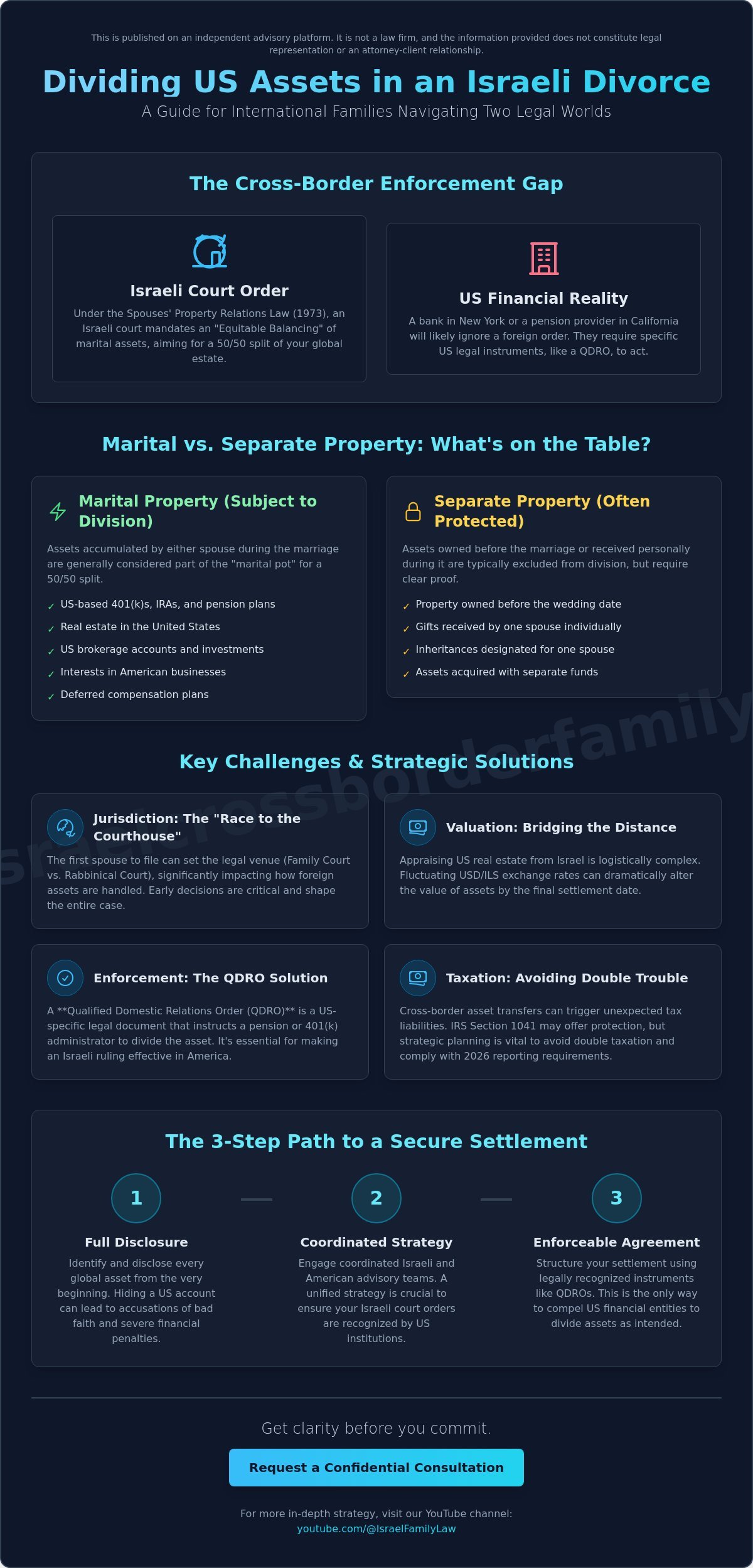
The process of dividing us assets in israeli divorce is governed by the Spouses’ Property Relations Law of 1973. This legislation establishes the principle of “Equitable Balancing” (Izun Mashabim), which presumes that assets accumulated by a couple during their marriage should be shared equally. While the law is straightforward in a local context, it becomes significantly more complex when one or both spouses hold property, retirement accounts, or business interests in the United States. Under Israeli law, these foreign holdings are technically part of the “marital pot” and are subject to division, even if they are located thousands of miles away. Understanding how international divorce laws create friction between these two jurisdictions is the first step toward a stable settlement.
To better understand the strategy behind where and when to file for a cross-border case, watch this helpful explanation:
There is an inherent tension between the authority of an Israeli judge and American property rights. While an IL court can order a spouse to transfer funds, it cannot directly seize a house in New York or force a US bank to split a 401(k) without specific American legal instruments. This makes it vital to identify every global asset before the very first hearing in IL. Failing to disclose a US brokerage account or a deferred compensation plan early on can lead to accusations of bad faith and may result in heavy financial penalties during the final balancing process.
Jurisdiction: Can an Israeli Court Rule on US Property?
Israeli Family Courts exercise “In Personam” jurisdiction, meaning they have authority over the people appearing before them. Even if the court can’t physically reach into a US bank account, it can order a spouse to pay a specific sum to balance the value of that account. Often, the court uses “offsetting assets” located within IL to achieve a 50/50 split. For example, if one spouse keeps a house in Tel Aviv, the other might receive a larger share of a US-based investment portfolio. You should also consider whether the Rabbinical Court or the Family Court is the better venue for your specific financial structure, as their procedural approaches to foreign discovery can differ.
The Impact of Early Decisions
Early choices often dictate the entire trajectory of a divorce for international families. The “race to the courthouse” is a real phenomenon in IL, where the first person to file may determine which court system handles the asset division. Ignoring US assets during the initial disclosure phase is a high-risk move that can lead to unenforceable agreements. It’s much safer to seek total clarity on your global net worth before signing any preliminary documents. Get clarity before you commit. Request a confidential consultation.
This article is published on an independent advisory platform. It is not a law firm, and the information provided does not constitute legal representation or an attorney-client relationship. Legal services are only provided by licensed attorneys under a separate engagement.
Classification of Cross-Border Assets: Marital vs. Separate
The classification of property is a foundational step when dividing us assets in israeli divorce. Under the Spouses’ Property Relations Law of 1973, marital property includes almost everything earned or acquired by either spouse during the marriage. However, assets owned before the wedding, or those received as gifts or inheritances, are typically classified as separate property. While this distinction sounds simple, the international nature of your holdings adds layers of risk that require careful management.
While US-based inheritances are generally exempt from division, their status is fragile. If you deposit an American inheritance into a joint Israeli bank account, it may be viewed as “co-mingled.” Once funds are used to pay for a family home in Israel or shared living expenses, the court often presumes the owner intended to share the asset. This “intent to share” can transform a protected US inheritance into a marital asset subject to a 50/50 split. It’s vital to maintain clear boundaries between separate US funds and joint Israeli life to protect your pre-marital wealth.
Digital assets also face new scrutiny. As of January 1, 2026, new reporting rules in Israel require residents to disclose worldwide income and foreign assets, including digital holdings on US-based crypto platforms. This increased transparency means that offshore digital wallets and US-based brokerage accounts are now more likely to be identified and valued during the balancing process. You can no longer assume that assets held in American digital platforms will remain invisible to the Israeli Tax Authority or the family court.
US Retirement Accounts: 401(k)s, IRAs, and Pensions
An Israeli court order cannot directly divide a US-based 401(k) or IRA. American plan administrators require a Qualified Domestic Relations Order (QDRO), which must be issued by a US court. This creates a procedural hurdle where an Israeli settlement must be “mirrored” in a US jurisdiction. Valuation is equally complex; you must decide whether to value the account based on its current balance or projected future benefits. Financial institutions like Vanguard or Fidelity may also charge a QDRO fee of up to $1,200 or more for processing these divisions.
Business Interests and RSUs
Equity in American startups or publicly traded companies presents unique valuation challenges. Israeli courts frequently use forensic accountants to determine the marital portion of Restricted Stock Units (RSUs), particularly those that haven’t yet vested. The court may apply the “time rule” to calculate how much of the equity was earned during the marriage. To ensure your strategy accounts for these complexities, it’s wise to review your specific asset list with an expert. Get clarity before you commit. Request a confidential consultation.
This article is published on an independent advisory platform. It is not a law firm, and the information provided does not constitute legal representation or an attorney-client relationship. Legal services are only provided by licensed attorneys under a separate engagement.
Practical Hurdles: Valuation and Enforcement
Valuing and enforcing financial orders across two continents requires a high degree of technical precision. When dividing us assets in israeli divorce, the “cut-off date” serves as the anchor for all financial calculations. This is the specific date, usually the day the divorce petition was filed, when the marital partnership is legally deemed to have ended. Because the Israeli court will likely issue its final ruling in New Israeli Shekels (ILS), the exchange rate on that precise cut-off date is critical. A sudden shift in the USD/ILS rate can significantly alter the actual value received by either party. It’s essential to lock in these figures early in the negotiation process to avoid disputes over currency fluctuations years later.
Enforcement becomes a primary concern when one party refuses to comply with the court’s instructions. If a spouse holds funds in a US brokerage account and refuses to transfer the agreed-upon share, the Israeli court may lack the direct power to freeze those American funds. In such cases, strategy often shifts toward “Equitable Balancing.” The court may award the compliant spouse a larger share of assets located within IL to compensate for the withheld US funds. This approach provides a practical solution without the need for lengthy international litigation.
Real Estate in the United States
American real estate is governed by the “Lex Situs” rule. This legal principle dictates that the laws of the specific US state where the land is located have the final authority over its title and transfer. An Israeli judge cannot sign a deed for a house in Florida or California. Instead, the court typically uses “offsetting” to balance the estate. One spouse might retain the family home in IL, while the other keeps the equity in the US property. To ensure these transfers are recognized by US title companies, every step must be documented to meet American regulatory standards. This often requires a coordinated effort to ensure the Israeli settlement language is acceptable to a US recorder of deeds.
Enforcing Financial Orders Across Borders
Enforcing an Israeli order in the United States relies on the principle of “comity.” This is a voluntary recognition where US courts respect foreign rulings, provided the legal process was fair and transparent. If you must reach assets in a US bank that refuses to follow an Israeli subpoena, you may need to “domesticate” the Israeli judgment in a US state court. This process involves asking an American judge to adopt the Israeli order as their own. For more on these complexities, see our guide on divorce and separation for international families. Get clarity before you commit. Request a confidential consultation.
This article is published on an independent advisory platform. It is not a law firm, and the information provided does not constitute legal representation or an attorney-client relationship. Legal services are only provided by licensed attorneys under a separate engagement.
Strategic Considerations: Tax and Jurisdictional Tactics
The decision of where to initiate proceedings is often referred to as the “Race to the Courthouse.” This isn’t just a matter of convenience; it’s a strategic move that can dictate which legal standards apply to dividing us assets in israeli divorce. If one spouse files in an Israeli Family Court while the other files in a US state court, a jurisdictional battle may follow. Israeli courts generally offer a predictable 50/50 split under the 1973 law, but a US court might have broader powers to compel the discovery of hidden financial accounts. You must weigh the speed and lower costs of the Israeli system against the robust investigative tools available in the American legal system.
Taxation is perhaps the most overlooked risk in cross-border cases. While IRS Section 1041 typically allows for tax-free asset transfers between spouses, these protections are often limited when one party is a non-resident alien. Without careful planning, a court-ordered transfer of US stocks or real estate could trigger an immediate capital gains tax event. Additionally, Israeli residents must navigate the impact of the US-Israel Tax Treaty to avoid double taxation on alimony or liquidated retirement funds. Understanding how these rules interact is essential to prevent “phantom income,” where you owe taxes on money you haven’t actually received in cash.
A Financial Agreement, known in Israel as a Heskem Mamon, is the most effective preventative tool for international couples. This document can be signed before or during the marriage to define exactly how global assets will be split, bypassing the default rules of both countries. Without such an agreement, you may face Israeli exit taxes or unexpected US liabilities during large asset liquidations. It’s much simpler to define these terms while the relationship is stable than to litigate them during a separation.
Tax Implications of Asset Transfers
Selling US property during a divorce can lead to significant capital gains liabilities. For 2026, US federal income tax brackets for single filers reach up to 37% for income over $640,600. If an Israeli court orders the sale of a US home, you must account for these federal rates plus potential state taxes. A well-structured settlement should specify who bears the tax burden to ensure the net distribution remains equitable. You should also consider the 2026 reporting rules in Israel, which now require new immigrants and returning residents to disclose worldwide income and foreign assets to the Israel Tax Authority, even if those assets are exempt from taxation.
Choosing the Right Venue
Filing in Israel often results in lower maintenance costs and a more streamlined process for families already living in the country. However, the US may be the better venue if the majority of the marital wealth is tied up in complex American business interests or trusts that an Israeli court cannot easily reach. To understand how we help you evaluate these options, you can learn more about how the advisory process works. Get clarity before you commit. Request a confidential consultation to discuss your jurisdictional strategy.
This article is published on an independent advisory platform. It is not a law firm, and the information provided does not constitute legal representation or an attorney-client relationship. Legal services are only provided by licensed attorneys under a separate engagement.
Achieving Clarity: The Cross-Border Advisory Approach
Successfully dividing us assets in israeli divorce requires more than just a standard legal approach. Many individuals assume that a local family lawyer in Tel Aviv or Jerusalem can naturally handle the intricacies of American financial instruments. However, local practitioners often miss the technical nuances of US-based assets, such as the specific tax triggers of a 401(k) withdrawal or the vesting schedules of Restricted Stock Units. Without a coordinated strategy between counsel in both jurisdictions, you risk signing an agreement that is perfectly valid in Israel but completely ignored by a US bank or pension provider. The goal is to create a “global” settlement that remains bulletproof regardless of which country’s soil you are standing on.
A coordinated approach ensures that the language used in your Israeli court order is compatible with American regulatory requirements. For example, ensuring that an Israeli “Izun Mashabim” (balancing of resources) order is drafted in a way that a US court can easily “domesticate” it prevents years of secondary litigation. This strategic coordination allows you to identify potential conflicts early, such as the tension between Israeli disclosure rules and US privacy laws. By aligning your legal teams, you move from a reactive stance to a proactive, strategy-based model that prioritizes your long-term financial security.
Strategy Over Litigation
Blindly litigating in two different legal systems is a recipe for financial exhaustion. The costs can escalate quickly, especially when you consider that a property claim in an Israeli Family Court carries a filing fee of 3,447 NIS as of January 2026. Instead of “blind” litigation, we advocate for risk-based decision making. This involves calculating when it is more cost-effective to settle for an asset offset in IL rather than fighting for a direct transfer of US funds. Mediation often serves as a superior tool for international families, as it allows you to create a custom cross-border framework that a judge might not have the authority to design. To gain a deeper understanding of these tactics, you can watch our guide on International Family Law Strategy.
Next Steps for International Families
Your first step toward clarity is gathering your US tax returns and account statements from the last three to five years. Under the reporting rules that went into effect on January 1, 2026, new immigrants and returning residents in Israel are now required to report their worldwide income and foreign assets to the Israel Tax Authority. This transparency makes early documentation essential. Consulting with a cross-border expert before making any formal offers ensures you aren’t walking into a tax trap or a jurisdictional dead end. You can find more details about our philosophy by visiting About the Advisory. Get clarity before you commit. Request a confidential consultation.
This article is published on an independent advisory platform. It is not a law firm, and the information provided does not constitute legal representation or an attorney-client relationship.
Securing Your Financial Future Across Borders
Managing a global estate during a separation requires a steady hand and a clear strategy. Successfully dividing us assets in israeli divorce depends on your ability to classify property correctly and anticipate enforcement hurdles before they arise. You’ve learned that Israeli courts use equitable balancing to split global holdings, but they often lack the direct power to reach into American accounts without specific US legal instruments. Early decisions regarding jurisdiction and tax planning are the most significant factors in protecting your long-term interests.
Our advisory focuses on a risk-based strategy specifically designed for international families. We offer specialized expertise in US-Israel financial structures and work with practitioners licensed in multiple jurisdictions to ensure your settlement is enforceable on both sides of the Atlantic. You don’t have to face these multi-jurisdictional complexities alone. Get clarity before you commit. Request a confidential consultation to begin building a stable path forward for your family.
This article is published on an independent advisory platform. It is not a law firm, and the information provided does not constitute legal representation or an attorney-client relationship. Legal services are only provided by licensed attorneys under a separate engagement.
Frequently Asked Questions
Can an Israeli court force the sale of my house in the US?
An Israeli court cannot directly order the sale of real estate located in the United States because it lacks jurisdiction over American land. Instead, the court typically uses a method called “offsetting” to achieve a fair split. One spouse might receive a larger share of Israeli bank accounts or the family home in Israel to balance out the value of the US property. This ensures an equal division without the need for an unenforceable foreign sale order.
What happens to my US Social Security benefits in an Israeli divorce?
US Social Security benefits are governed by federal law and are not considered marital assets that an Israeli court can divide. However, if you were married for at least 10 years, you may be eligible to collect benefits based on your ex-spouse’s earnings record once you reach retirement age. These rights are handled entirely by the US Social Security Administration and remain unaffected by the terms of your Israeli divorce settlement.
How are 401(k) accounts valued by Israeli family court experts?
Israeli court-appointed experts value 401(k) accounts by looking at the balance on the “cut-off date” and subtracting the portion earned before the marriage. When dividing us assets in israeli divorce, experts must also account for deferred tax liabilities. Since a 401(k) is funded with pre-tax dollars, its gross balance is higher than its actual “spendable” value. Experts apply a discount to account for the taxes you will eventually owe the IRS.
Do I need a separate lawyer in the US and Israel for my assets?
It is usually necessary to have a coordinated strategy involving professionals familiar with both legal systems. An Israeli lawyer cannot draft a Qualified Domestic Relations Order (QDRO) or handle title transfers in a US county recorder’s office. While the Israeli court sets the terms of the split, you will often need a US-based professional to ensure those terms are executed correctly within the American financial and legal infrastructure.
Will I have to pay US taxes on assets I receive in an Israeli divorce settlement?
Most transfers between spouses during a divorce are tax-free under IRS Section 1041, but this protection doesn’t always apply to international transfers. If one spouse is not a US citizen or resident, the transfer could trigger capital gains taxes. You must also consider the 2026 Israeli reporting requirements, which require you to disclose the receipt of foreign assets. Always verify the tax status of an asset before you agree to the transfer.
What is the ‘cut-off date’ and why is it critical for US stock options?
The cut-off date is the specific day the marital partnership is legally deemed to have ended, usually when the divorce petition is filed. It is critical for US stock options because it determines which grants are marital property and which are separate. Because American tech stocks can be volatile, the difference of even a few weeks in the cut-off date can change the value of your settlement by thousands of dollars.
Can a US Prenuptial Agreement protect my assets in an Israeli court?
A US prenuptial agreement can provide protection, but it isn’t automatically binding in Israel unless it meets local legal standards. To be fully recognized, the agreement should ideally be approved by an Israeli court or a notary under the Spouses’ Property Relations Law. If you didn’t take this step when you moved to Israel, a spouse might challenge the agreement, arguing that Israeli law should govern the division of your global assets.
How do I ensure my Israeli divorce decree is recognized by the IRS?
The IRS generally recognizes a foreign divorce decree if it is valid and final in the country where it was issued. You should obtain a certified English translation of your Israeli decree to provide as evidence of your change in marital status. This documentation is essential when you begin filing your US tax returns as “Single” or “Head of Household” and when you transfer US-based assets according to the court’s instructions.

Article by
Gabriel Lior
A Personal Journey That Became a Mission
The advisory was founded by an American father Gabriel Lior, LLB, MBA , global entrepreneur, and cross-border advisor who spent more than a decade navigating the Israeli family court system firsthand and now lives in Singapore with his son.
As a divorced parent in a cross-border family, Gabriel faced nearly every legal challenge a foreign parent can encounter in Israel — including child custody disputes, child support proceedings, property matters in Israel and abroad, false accusations, and complex immigration and relocation proceedings.
Over the years, he learned the hard way how difficult it is for non-Israeli parents to understand the system, identify the right legal strategy, and choose the right legal representation — especially when language, culture, and jurisdictional differences are involved. He also witnessed how foreign parents and new immigrants are often disadvantaged or taken advantage of by service providers and institutions simply because they lack local knowledge or fluency.
From Client to Advisor
To truly understand — and survive — the system, Gabriel pursued formal legal education in Israel, completing two Israeli law degrees, alongside a BA and MBA earned in the United States. This was never about becoming a practicing attorney, but about gaining a deep, structural understanding of how the system works — and where it breaks down for foreign parents.
This rare combination of:
Firsthand client experience
Israeli legal and US business education
International business and negotiation training
Decades of commercial execution
created a unique perspective – one that understands both sides of the table.
After years of litigation, persistence, and at times self-representation, he ultimately succeeded in securing custody of his son and relocating abroad through a rare legal victory in the Israeli Supreme Court — becoming one of the first fathers in Israel to do so under these circumstances.
Disclaimer
Important Disclaimer:
The information provided on this website and in its content is for general informational and educational purposes only and does not constitute legal advice, legal opinion, or legal representation.
Gabriel Lior is not licensed to practice law in Israel (nor is he interested in doing so) and does not provide legal services, despite having completed 2 Law Degrees. The services offered are advisory in nature and are intended to provide general guidance, strategic insight, and information regarding cross-border family law considerations.
No attorney-client relationship is formed by accessing this website, reading its content, or communicating with us.
Any decisions made based on this information are at your own discretion and risk. For legal advice specific to your situation, you should consult a licensed attorney in the relevant jurisdiction.
Where appropriate, we may refer clients to independent, licensed attorneys or professionals. Such referrals do not constitute legal representation and no liability is assumed for services provided by third parties.