What if the final divorce decree you signed in a Tel Aviv court is completely ignored by your 401(k) administrator in the United States? For many international families, the complexity of dividing US retirement assets in Israeli divorce isn’t just a hypothetical worry; it’s a looming financial risk. You likely understand that the Israeli principle of “Balancing of Resources” usually mandates a 50/50 split of marital property, but applying that rule to foreign accounts is rarely straightforward. The fear of triggering a 10% early withdrawal penalty or facing double taxation is enough to keep anyone awake at night.
At Israel Cross Border Law Firm, we understand that the cross-border legal gap feels vast. This comprehensive guide provides the strategic insights you need to protect your financial future while avoiding common tax traps. You’ll learn why a standard Israeli court order isn’t enough to satisfy US plan administrators and how a Qualified Domestic Relations Order (QDRO), issued by a US court, serves as the necessary bridge. We also look at the impact of 2026 currency volatility on your final settlement and the logistics of the ₪568 divorce filing fee. This article is provided by Israel Cross Border Law Firm to help you make informed decisions before you commit to a legal path.
Key Takeaways
- Understand why an Israeli court decree alone is insufficient for 401(k) plans and how a US-issued QDRO serves as the mandatory bridge for dividing US retirement assets in Israeli divorce.
- Identify the specific regulatory traps that trigger the 10% early withdrawal penalty and learn how to structure distributions to maintain tax-deferred status.
- Discover how the Israeli “Balancing of Resources” principle applies to foreign-held IRAs and why these accounts are often simpler to divide than employer-sponsored plans.
- Learn to mitigate the risks of currency volatility between the Shekel (₪) and the Dollar, which can significantly alter the actual value of your settlement during the transfer process.
- Gain clarity on the strategic importance of cross-border expertise to ensure your Israeli settlement is fully enforceable by US plan administrators and the IRS.
Understanding the Legal Framework for US Assets in IL Divorce
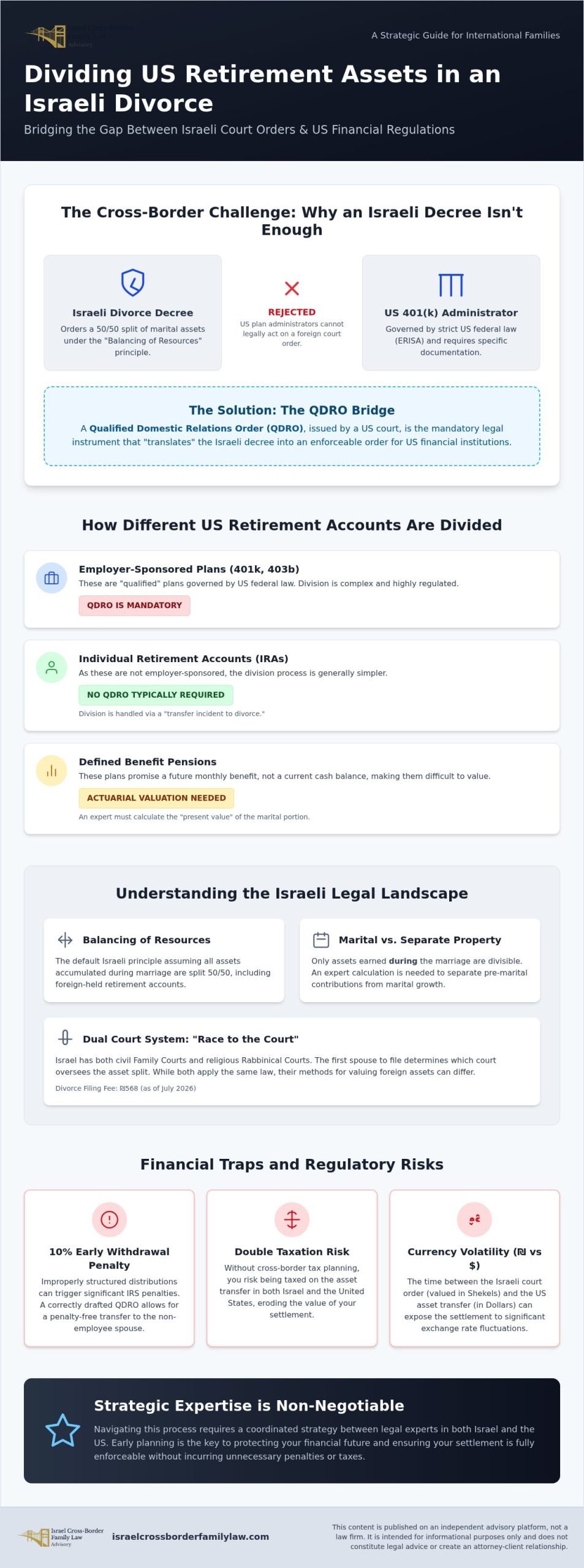
Israeli law operates under the “Balancing of Resources” (Izun Mashabim) principle. It’s a default legal framework that assumes all assets accumulated during a marriage should be split equally. This includes tangible property like a home in Israel and intangible assets like a 401(k) or IRA held in the United States. While the accounts are physically located abroad, Israeli courts claim jurisdiction over the marital portion of these funds if the couple resides in Israel. This intersection of local law and foreign financial instruments is a core challenge in international matrimonial law.
To better understand how these accounts are valued and split, watch this helpful video:
Israeli judges view US-based retirement accounts as deferred compensation. If the work was performed while the couple was married and living in Israel, the resulting pension or 401(k) contribution is considered a joint resource. However, dividing US retirement assets in Israeli divorce requires more than just a standard Israeli court order. You must first establish a clear valuation of what was earned before the marriage versus what was contributed during the union to avoid over-splitting your personal property.
Marital Property vs. Separate Property in IL
The distinction between pre-marital and marital property is vital. In Israel, the “start date” for asset accumulation is usually the wedding day, while the “end date” is the day the divorce petition is filed. An actuary is often appointed to calculate the marital portion of a US pension. If you have a Heskem Mamon (prenuptial agreement), it may protect your US assets, but only if it’s been properly validated by an Israeli court. Without this validation, your US retirement funds might be pulled into the general pool for division.
The Role of the Israeli Family Court vs. Rabbinical Court
Israel has a dual legal system where civil Family Courts and religious Rabbinical Courts share jurisdiction. This creates a “race to the court,” where the first spouse to file determines which system oversees the asset split. Both courts follow the Balancing of Resources law, but their valuation methods for foreign assets can vary significantly. You can learn more about how it works on our advisory platform. As of July 2026, the standard divorce filing fee in Israel is ₪568, regardless of which court you choose.
Types of US Retirement Assets Subject to Division
When you begin the process of dividing US retirement assets in Israeli divorce, it’s essential to categorize each account accurately. Not all US financial vehicles are treated the same by Israeli courts or US plan administrators. Employer-sponsored plans, such as 401(k) and 403(b) accounts, are among the most common assets for expats and international families. These are “qualified” plans under US law, meaning they are governed by federal regulations that require a specific legal instrument called a Qualified Domestic Relations Order (QDRO) for any distribution. Without this, an Israeli court order will not be recognized by the US financial institution.
Individual Retirement Accounts (IRAs) offer a slightly different path. Because IRAs are not employer-sponsored, they are generally easier to split. They don’t typically require a formal QDRO; instead, they are often divided through a “transfer incident to divorce.” For couples with defined benefit pensions, the challenge is valuation. Since these plans promise a future monthly benefit rather than a current cash balance, an Israeli actuary must calculate the “present value” of the marital portion to determine a fair Shekel (₪) equivalent for the final settlement.
Social Security benefits represent a unique exception in cross-border cases. Under US federal law, Social Security is not divisible in a divorce settlement, and Israeli courts generally respect this limitation. While the court may consider the existence of these benefits when looking at the overall financial picture, they cannot order a direct split of the future Social Security payments themselves. Gaining about the advisory insights early on can help you identify which assets are truly on the table.
Valuation Challenges for US Accounts
Currency fluctuations between the US Dollar and the Israeli Shekel (₪) introduce a layer of risk. In early 2026, the Bank of Israel reported an actual volatility of 8.4% for shekel/dollar changes, meaning a valuation done at the start of a case could be significantly different by the time of execution. You must also account for deferred tax liabilities. A ₪365,000 balance in a 401(k) is not equal to ₪365,000 in an Israeli bank account because the retirement funds are subject to future US income tax upon withdrawal. Failing to discount the value for these taxes can result in an inequitable distribution.
Stock Options and RSUs
For those in the tech sector, unvested stock options and Restricted Stock Units (RSUs) are often the most valuable marital assets. Israeli courts typically use a “co-ownership” approach, where the non-employee spouse receives their share only when the options actually vest and are sold. Alternatively, an “immediate payout” approach may be used, where the employee spouse “buys out” the other’s interest based on a current valuation. If you are unsure how to value these complex instruments, you may want to request a strategy session to review your specific portfolio.
The QDRO Dilemma: Making Israeli Orders Enforceable in the US
A common misconception among expats is that an Israeli court order is a universal key. It isn’t. When you are dividing US retirement assets in Israeli divorce, you will likely encounter a significant legal wall known as the “QDRO Gap.” While an Israeli Family Court judge has the authority to order the division of a 401(k) or a pension, US plan administrators are not legally bound to follow foreign decrees. These administrators operate under a US federal law called ERISA, which requires a specific document: a Qualified Domestic Relations Order (QDRO). Without a QDRO issued by a US court, your Israeli settlement is essentially unenforceable against the financial institution holding the funds.
The process of bridging this gap involves “mirroring” or domesticating the Israeli order in a US state court. This requires a practitioner who understands the nuances of both systems. The language used in your Israeli settlement must be precise enough to satisfy the Israeli judge while remaining flexible enough to be converted into a US-compliant QDRO. If the technical wording is off by even a few phrases, the US plan administrator may reject the transfer, forcing you back into a costly and time consuming legal cycle.
Steps to Secure a Valid Cross-Border Transfer
Success begins with preparation. You should contact the US plan administrator early in the divorce process to obtain their specific QDRO procedures and model language. This information is then integrated into the Israeli “Financial Agreement” (Heskem Mamon). By aligning the Israeli decree with US requirements from the start, you minimize the risk of rejection. If a decree has already been issued and is later rejected by the US, you may need to seek a “nunc pro tunc” order from the Israeli court, which acts as a retroactive correction to satisfy the administrator’s demands.
- Request the “Summary Plan Description” from the US employer to identify specific distribution rules.
- Ensure the Israeli court order explicitly names the “Alternate Payee” and the specific percentage or Shekel (₪) amount to be transferred.
- Coordinate with a US-based QDRO drafter to review the Israeli settlement before it is signed.
Common Pitfalls in International QDROs
One of the most frequent errors involves survivor benefits. If the “Plan Participant” spouse passes away before the funds are transferred, the “Alternate Payee” spouse may lose their entire share if the order didn’t explicitly include survivor protections. There is also the risk of account liquidation. Without a temporary restraining order or a clear “Stay of Exit” on the assets, a spouse could potentially withdraw funds before the QDRO is served. Mediation is often an effective tool for resolving these technical drafting disputes, allowing both parties to agree on the logistical mechanics of the transfer without the need for a contested hearing in the Family Court.
For those navigating these complexities, our advisory for expats and foreign nationals provides the strategic clarity needed to ensure your cross-border assets are protected through every stage of the legal process.
Tax Implications and Regulatory Risks in 2026
Dividing US retirement assets in Israeli divorce is not just a legal hurdle; it’s a major tax event that can significantly deplete your marital pool if handled incorrectly. The most immediate threat is the 10% early withdrawal penalty. Usually, taking money out of a 401(k) before age 59.5 triggers this penalty. However, US tax law provides a specific exception for transfers made “incident to divorce” under Internal Revenue Code Section 1041. To qualify for this protection, the movement of funds must be handled as a direct trustee-to-trustee transfer. If you cash out the account in the US with the intention of wiring the Shekel (₪) equivalent to a spouse in Israel, the IRS will likely view this as a taxable distribution. This mistake can lead to a 10% penalty plus standard income tax on the total amount.
Another layer of complexity involves tax withholding for non-resident aliens (NRAs). If the spouse receiving the share is not a US citizen or green card holder, the US financial institution may be required to withhold 30% of the distribution for taxes. While the US-Israel Tax Treaty can sometimes reduce this rate, it is not an automatic benefit. You must proactively claim treaty benefits and provide the correct documentation. Failing to do so can result in a permanent loss of funds that could have been preserved for your future in Israel. It is essential to get these details right during the drafting of your settlement to ensure a truly equitable outcome.
Avoiding the 10% Early Distribution Penalty
The key to protecting your assets is technical precision in the transfer method. A direct transfer ensures that the funds move from one retirement vehicle to another without being “received” by either spouse. This maintains the tax-deferred status of the account. In 2026, the IRS continues to scrutinize international transfers very closely. Cashing out assets to pay an Israeli settlement is a high-risk strategy that often results in double taxation: once in the US as a penalty and again as income in Israel. You should always aim for a solution that keeps the funds within a qualified retirement structure until the actual retirement age.
Ongoing Compliance for Expats in IL
Once the assets are divided, your reporting obligations don’t end. If your share of a US retirement account is moved into an Israeli financial instrument or bank account, you must comply with FBAR and FATCA reporting requirements. The weight of these early decisions on your long-term tax liability is immense. Managing these risks is a core part of our for expats foreign nationals advisory services. If you are concerned about how these rules apply to your specific portfolio, you should consult with a cross-border professional to ensure full compliance with both legal systems.
Strategic Considerations: The Importance of Cross-Border Expertise
The technical challenges of dividing US retirement assets in Israeli divorce often exceed the scope of standard family law practice. While a local Israeli lawyer might be highly skilled in domestic property division, they may overlook the deferred tax liabilities or the specific US plan requirements that can diminish the actual value of your settlement. Relying on a practitioner who doesn’t understand the “bridge” between the Israeli Family Court and the US financial system can result in assets that remain “locked” for years or distributions that are heavily taxed before they ever reach your Israeli bank account.
Strategic success in these cases requires an integrated approach. This involves calculating the marital portion of the 401(k) or IRA while simultaneously accounting for the future US tax burden to ensure the “equitable balance” is truly fair in Shekel (₪) terms. Advocate Anastasia Fux, with over 21 years of experience in Tel Aviv, has spent decades navigating these transnational complexities. Her expertise in cross-border mediation provides a critical advantage for international families who need to resolve asset disputes without the high costs and delays of contested litigation in multiple countries.
To prepare for a strategic consultation, you should gather the following documentation:
- The most recent statements for all 401(k), IRA, and pension accounts.
- The “Summary Plan Description” (SPD) for any employer-sponsored retirement plans.
- A copy of any Heskem Mamon (prenuptial agreement) you signed in Israel or the US.
- Historical records showing the account balances on the date of your marriage.
Questions to Ask Your Representative
When selecting a professional to guide you through this process, it’s vital to vet their specific experience with foreign assets. You should ask:
- Do you have direct experience communicating with US plan administrators regarding QDRO requirements?
- How do you account for US tax liabilities and potential IRS penalties in the final Israeli equitable balance?
- Can you coordinate effectively with my US-based CPA or financial advisor to ensure my annual filings remain compliant?
Seeking Clarity Before You Commit
The decisions you make during the initial filing stages in Israel will carry weight for years to come. Early strategic planning is the only way to avoid the procedural traps that lead to double taxation or unenforceable court orders. This guide is published on an independent advisory platform to provide educational insights into the risks and strategies involved in cross-border divorce; it doesn’t constitute formal legal representation or attorney-client advice.
Get clarity before you commit. Request a confidential consultation to review the specifics of your cross-border portfolio.
Securing Your Cross-Border Financial Future
The intersection of Israeli family law and US federal regulations requires a deliberate, dual-system strategy. You now understand that a standard Israeli decree is only the first step. To avoid the 10% early withdrawal penalty and ensure your 401(k) or IRA is actually transferable, a US-compliant QDRO is essential. This independent advisory platform specializes in bridging these legal gaps, helping you manage the currency risks and tax liabilities that often catch international families off guard.
Our practitioners bring over 21 years of experience to the process, focusing specifically on the jurisdictional conflicts inherent in dividing US retirement assets in Israeli divorce. By addressing the technical requirements of US plan administrators during the initial settlement phase, you protect your financial interests from being depleted by avoidable fees. You don’t have to face these cross-border complexities without a guide.
Get clarity before you commit. Request a confidential consultation. Taking the time to secure your assets through both legal systems today will provide the financial stability you need for your future in Israel.
Frequently Asked Questions
Can an Israeli court order the division of my US-based 401(k)?
Yes, an Israeli court has the authority to order the division of a US-based 401(k) if the couple resides in Israel. Under the Balancing of Resources principle, the court views the marital portion of these funds as joint property. However, the Israeli order itself isn’t enough to move the money. You must follow this up with a US legal process to ensure the plan administrator actually releases the funds.
What is a QDRO and do I need one for an Israeli divorce?
A Qualified Domestic Relations Order (QDRO) is a US legal document required to split employer-sponsored plans like a 401(k). You definitely need one when dividing US retirement assets in Israeli divorce. While an IRA can often be split with just a decree, a 401(k) administrator will reject any transfer that isn’t backed by a QDRO issued by a US court. This serves as the necessary bridge between the two legal systems.
Will I have to pay a 10% penalty to the IRS if I split my IRA in Israel?
You can avoid the 10% early withdrawal penalty if the transfer is executed correctly as a direct trustee-to-trustee transfer. The IRS provides an exception for distributions made incident to divorce under Section 1041. However, if you withdraw the money as cash to pay an Israeli spouse in Shekels (₪), the IRS will likely view it as a taxable event. This mistake triggers both income tax and the 10% penalty.
How does the Israeli court value a US pension in shekels?
Israeli courts typically appoint an actuary to determine the value of a US pension. The actuary calculates the “present value” of the portion earned during the years of the marriage. This Dollar amount is then converted into Shekels (₪) based on the exchange rate from the official “date of separation.” Because currency volatility in early 2026 reached 8.4%, the timing of this valuation can significantly impact the final payout.
Can I use a US prenuptial agreement to protect my retirement assets in Israel?
A US prenuptial agreement can protect your assets, but only if it’s been validated by an Israeli court. In Israel, foreign agreements aren’t automatically enforceable. You must undergo a “validation of agreement” process to ensure the Israeli court recognizes the separate property status of your US retirement funds. Without this step, the court may apply the default 50/50 split to all assets accumulated during the marriage.
What happens if my US plan administrator refuses to honor an Israeli court order?
If a US plan administrator rejects an Israeli order, you must domesticate or “mirror” that order in a US state court. Most administrators refuse foreign decrees because they don’t meet the strict technical requirements of US federal law. By obtaining a mirrored order in the US, you can generate a compliant QDRO. This ensures the administrator has a legally binding US document that they are required to honor.
Are Social Security benefits considered marital property in an Israeli divorce?
No, Social Security benefits are not considered divisible marital property. US federal law explicitly prohibits the transfer or division of these benefits in a divorce settlement. Israeli courts generally respect this federal limitation and exclude Social Security from the “Balancing of Resources” calculation. While the court may acknowledge these future payments as part of your overall financial standing, they cannot order a direct split of the benefit itself.
How long does the cross-border asset division process typically take?
The timeline for dividing US retirement assets in Israeli divorce typically ranges from six to eighteen months. This includes the time spent in Israeli mediation or litigation to reach a financial agreement. Once the Israeli decree is final, the US QDRO process adds several more months for drafting, court approval, and administrator review. Early coordination with a cross-border professional is the most effective way to prevent unnecessary procedural delays.

Article by
Gabriel Lior
A Personal Journey That Became a Mission
The advisory was founded by an American father Gabriel Lior, LLB, MBA , global entrepreneur, and cross-border advisor who spent more than a decade navigating the Israeli family court system firsthand and now lives in Singapore with his son.
As a divorced parent in a cross-border family, Gabriel faced nearly every legal challenge a foreign parent can encounter in Israel — including child custody disputes, child support proceedings, property matters in Israel and abroad, false accusations, and complex immigration and relocation proceedings.
Over the years, he learned the hard way how difficult it is for non-Israeli parents to understand the system, identify the right legal strategy, and choose the right legal representation — especially when language, culture, and jurisdictional differences are involved. He also witnessed how foreign parents and new immigrants are often disadvantaged or taken advantage of by service providers and institutions simply because they lack local knowledge or fluency.
From Client to Advisor
To truly understand — and survive — the system, Gabriel pursued formal legal education in Israel, completing two Israeli law degrees, alongside a BA and MBA earned in the United States. This was never about becoming a practicing attorney, but about gaining a deep, structural understanding of how the system works — and where it breaks down for foreign parents.
This rare combination of:
Firsthand client experience
Israeli legal and US business education
International business and negotiation training
Decades of commercial execution
created a unique perspective – one that understands both sides of the table.
After years of litigation, persistence, and at times self-representation, he ultimately succeeded in securing custody of his son and relocating abroad through a rare legal victory in the Israeli Supreme Court — becoming one of the first fathers in Israel to do so under these circumstances.
Disclaimer
Important Disclaimer:
The information provided on this website and in its content is for general informational and educational purposes only and does not constitute legal advice, legal opinion, or legal representation.
Gabriel Lior is not licensed to practice law in Israel (nor is he interested in doing so) and does not provide legal services, despite having completed 2 Law Degrees. The services offered are advisory in nature and are intended to provide general guidance, strategic insight, and information regarding cross-border family law considerations.
No attorney-client relationship is formed by accessing this website, reading its content, or communicating with us.
Any decisions made based on this information are at your own discretion and risk. For legal advice specific to your situation, you should consult a licensed attorney in the relevant jurisdiction.
Where appropriate, we may refer clients to independent, licensed attorneys or professionals. Such referrals do not constitute legal representation and no liability is assumed for services provided by third parties.