If you hold a 401(k) in the United States and a tech startup in the Diamond District, the court that hears your case first could determine the financial trajectory of your next decade. Many international families in Israel find that the most significant risks aren’t just emotional; they’re rooted in the complex overlap of two different legal and tax systems. It’s natural to feel concerned about the “Race of Jurisdiction” between Family and Rabbinical courts, especially with the 2026 updates to Israeli tax reporting requirements for expats and olim. Effective divorce financial planning Ramat Gan requires more than just a list of assets; it demands a strategy that respects both Israeli law and your ongoing obligations to the IRS.
We understand the pressure of making high-stakes decisions while navigating unfamiliar territory. This article provides a clear roadmap to help you gain strategic clarity before any litigation begins. You’ll learn which documents are essential to gather right now, how the US-Israel tax treaty impacts your asset transfers, and the best ways to value property across borders. By the end of this guide, you’ll have the framework needed to protect your financial future while managing the unique complexities of a cross-border life in Israel.
Key Takeaways
- Learn why the “Race for Jurisdiction” between the Family and Rabbinical courts is a critical first step in determining the division of your global assets.
- Access a structured checklist for divorce financial planning Ramat Gan that includes the specific documentation required for US retirement accounts, such as 401ks and IRAs.
- Gain clarity on valuing high-stakes assets, including local startup equity and residential property affected by 2026 tax adjustments.
- Understand how to apply the US-Israel Tax Treaty to your settlement to avoid double taxation on asset transfers and international property sales.
- Discover how to draft a financial agreement that remains enforceable across both legal systems by coordinating with professionals in both Israel and the United States.
The Landscape of Divorce Financial Planning in Ramat Gan
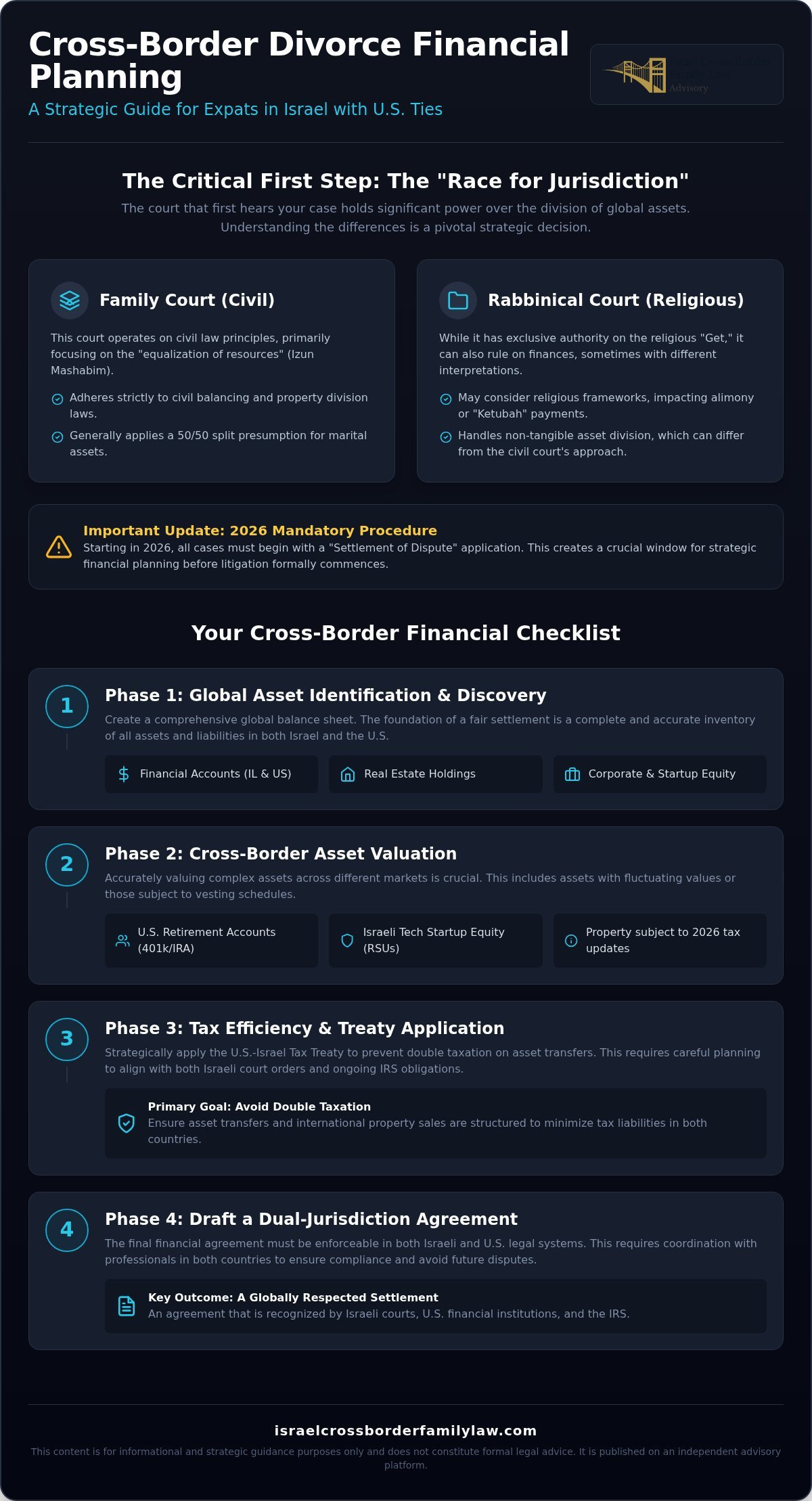
For residents of the Ramat Gan district, the financial path of a divorce is rarely a straight line. It’s often defined by the dual jurisdiction of the civil Family Court and the religious Rabbinical Court. Marriage and divorce laws in Israel dictate that while the Rabbinical Court has exclusive authority over the “Get” (the religious divorce document), both courts can handle financial matters. The court that receives a comprehensive claim first typically gains the authority to decide on property division and spousal support. This creates what is known as the “Race for Jurisdiction,” a pivotal moment where early decisions carry immense weight for your future financial stability.
In 2026, every case must begin with the “Settlement of Dispute” application. This mandatory procedure involves a cooling-off period and sessions with the court’s assistance unit to explore mediation. The application fee is 119 NIS as of January 2026. While this process aims for efficiency, it also triggers a stay on litigation, making it the ideal window for comprehensive divorce financial planning Ramat Gan. During this time, you must assess how local rules like “equalization of resources” (Izun Mashabim) will apply to international assets. Israeli law generally assumes a 50/50 split of marital assets, but applying this to a US-based 401(k) or a Delaware-registered startup requires specialized oversight.
Family Court vs. Rabbinical Court: The Financial Stakes
The two courts often differ in their interpretation of spousal support and the division of non-tangible assets. The Family Court generally adheres strictly to civil balancing principles. In contrast, the Rabbinical Court may consider traditional religious frameworks that can influence alimony or “Ketubah” payments. For those with high-value international profiles, the choice of jurisdiction isn’t just procedural; it’s a strategic financial decision. International assets require specific disclosure protocols, and failing to present them correctly in the initial filing can lead to complications in valuing your global portfolio. This is why divorce financial planning Ramat Gan must account for both local and foreign disclosure requirements from day one.
The Advisory Approach to Strategy
Successful outcomes depend on moving beyond reactive litigation toward a proactive financial strategy. It’s vital to identify “hidden” risks, such as how an Israeli court order might be viewed by a US financial institution or the IRS. Before making any formal commitments or filing documents that could lock you into a specific jurisdiction, consider a confidential case review. This allows you to evaluate your position through a cross-border lens, ensuring that your local Ramat Gan settlement doesn’t inadvertently trigger tax penalties or enforcement issues in the United States. Taking an advisory approach helps you achieve clarity before you commit to a path that may be difficult to reverse.
Your Cross-Border Financial Checklist: Essential Steps
The foundation of effective divorce financial planning Ramat Gan is the creation of a comprehensive global balance sheet. For international families, this goes beyond listing local bank accounts; it requires a deep dive into assets held in both “IL” and the United States. Without a clear inventory, the “equalization of resources” process used by Israeli courts can become skewed, potentially leading to an inequitable distribution of marital wealth. Identifying which assets are separate property (owned before the marriage or inherited) and which are marital property is the first step toward protecting your financial interests.
Phase 1: Asset Identification and Discovery
You must compile a detailed list of all liquid and illiquid holdings across both jurisdictions. This discovery phase should include:
- Financial Accounts: Current balances for all checking, savings, and brokerage accounts in IL and the US, including any cryptocurrency wallets or digital assets.
- Real Estate: Current valuations for primary residences in the Ramat Gan district and any investment properties or vacation homes located in US states.
- Corporate Interests: Documentation for business ownership, startup equity, and executive compensation packages such as Restricted Stock Units (RSUs) or stock options.
Tracing the source of funds for these assets is vital. If a down payment on a Ramat Gan apartment came from a US inheritance, that portion may be excluded from the 50/50 split, provided you have the documentation to prove it. Gathering these records early prevents delays during the mandatory dispute resolution period.
Phase 2: Retirement and Pension Valuation
Retirement accounts present a unique challenge because Israeli courts view them as marital assets, but US plan administrators require specific legal instruments to divide them. For US-based accounts like a 401(k) or IRA, you’ll need the latest summary plan descriptions and benefit statements. While an Israeli court can include the value of these accounts in a settlement, a Qualified Domestic Relations Order (QDRO) is typically required to actually move funds within a US employer-sponsored plan without triggering immediate tax penalties.
Conversely, Israeli assets such as “Keren Hishtalmut” (study funds) and local pension schemes must be valued for the cross-border balance sheet. Understanding the interplay between these systems is essential, especially since the U.S.-Israel tax treaty influences how these distributions are taxed. It’s also important to note that the US and IL do not currently have a Social Security totalization agreement. This means your planning must account for potential double taxation on social security credits, though 2026 rules may offer some relief for new US olim regarding Bituach Leumi payments. To ensure your asset list is exhaustive and legally sound, you can request a review of your financial profile.
Valuing Real Estate and Business Assets in Ramat Gan
Ramat Gan serves as a primary hub for Israel’s high-tech and diamond industries, which means marital estates in this district often include sophisticated business interests alongside local real estate. Accurate valuation is the cornerstone of divorce financial planning Ramat Gan. When you’re dividing these assets, the goal is to achieve an equitable balance that accounts for future liquidity and tax liabilities. It’s common for one spouse to retain the family home while the other keeps liquid investments, but this trade-off requires careful calculation of the “real” value after accounting for potential costs.
In the Ramat Gan district, residential property values are influenced by local factors, such as the municipal property tax increase requested for 2027. This includes a 6.95% exceptional increase plus a 3.05% nationwide adjustment. When you balance an Israeli home against US-based liquid assets, you must consider the 25% capital gains tax (Mas Shevach) on the real gain of Israeli real estate. Liquidating a US brokerage account to “buy out” a spouse from a Ramat Gan apartment might seem simple, but it can lead to disparate long-term financial outcomes if the hidden costs of future sales aren’t factored into the present-day valuation.
The Role of the Court-Appointed Actuary
In many contested cases, the Family Court appoints an external expert, usually an actuary or an accountant, to value the couple’s global finances. This expert’s report carries significant weight in the final judgment. It’s crucial to understand how it works when an expert reviews your US-based holdings. These reports often focus on local standards and might overlook the nuances of US equity vesting schedules or the specific provisions of the U.S.-Israel Tax Treaty. You have the right to challenge these findings or provide a private forensic accounting report, which typically costs between ₪18,000 and ₪50,000 in 2026, to ensure your international interests are accurately represented.
Business Asset Protection Strategies
For tech entrepreneurs and executives in Ramat Gan, distinguishing between pre-marital equity and growth achieved during the marriage is vital. Izun Mashabim is the default Israeli regime for property division, which assumes an equal split of the resources accumulated by either spouse during the marriage. However, professional reputation and “goodwill” are also considered assets under Israeli law. Protecting a professional practice requires demonstrating which portions of the value are personal to the practitioner and which are corporate. Effective divorce financial planning Ramat Gan involves isolating these variables early to prevent an over-valuation of your business interests. This proactive approach helps maintain the integrity of your professional life while ensuring a fair division of the marital estate.
Tax Efficiency and the US-Israel Treaty
Divorce financial planning Ramat Gan involves more than just splitting bank accounts; it requires a sophisticated understanding of how the US-Israel Tax Treaty governs the movement of marital wealth. For expats, the risk of double taxation is a constant variable that can erode the value of a settlement if not addressed during the negotiation phase. In 2026, the landscape has shifted for new immigrants and veteran returning residents, who now face full reporting obligations on worldwide assets to the Israel Tax Authority. These changes make it essential to align your Israeli settlement with US tax code requirements to prevent unintended liabilities.
Avoiding the Double Taxation Trap
The IRS generally views asset transfers between spouses “incidental to divorce” as non-taxable events under Section 1041. However, the Israeli Tax Authority may not always mirror this treatment, particularly regarding the transfer of Israeli-sourced assets or business interests. When dividing a US brokerage account, tracking the original tax basis is critical. If you receive an asset with a low basis, you’re effectively inheriting a future tax bill. Strategies for cross-border equalization must account for these “embedded” taxes. For example, selling an Israeli property involves a 25% capital gains tax on the real gain as of early 2026, whereas a US property sale might trigger different federal and state obligations depending on your residency status.
Reporting and Compliance Post-Divorce
Post-divorce compliance requires a rigorous update of your filing status in both countries. You must continue to meet FBAR and FATCA reporting requirements for any “IL” accounts that exceed the designated thresholds. Handling joint tax liabilities from previous years is another common pitfall; a well-drafted financial agreement should clearly define who is responsible for past audits or unpaid balances. To ensure your divorce financial planning Ramat Gan remains compliant with both jurisdictions, you must address these reporting duties early in the settlement process. You can find more information on international compliance by visiting our Israeli Family Law channel. To ensure your tax strategy is robust, you should consult with a professional who understands the intersection of these two systems.
Under current US law, alimony is typically not deductible for the payer nor taxable for the recipient for federal purposes, which differs from historical treatments. Israeli courts may view child support differently, especially with the 2026 minimum child support levels for a child’s essential needs ranging between ₪1,400 and ₪1,600 per month. Coordinating these payments across borders requires a strategy that minimizes the friction of currency exchange and transnational banking fees while ensuring that the support meets the best interests of the children in both legal cultures.
Disclaimer: This content is published on an independent advisory platform, not a law firm. The information provided focuses on strategy, risks, and decision-making guidance. It does not constitute formal legal advice or an attorney-client relationship. Legal services are only provided by licensed attorneys under a separate engagement.
Strategic Implementation: From Planning to Settlement
The transition from valuation to settlement is the most critical phase of divorce financial planning Ramat Gan. Once you have identified and valued your global assets, you must translate those numbers into a binding “Financial Agreement,” known in Israel as a Heskem Mamon. For international families, this document serves as the primary tool for ensuring that the division of assets is recognized and enforceable in both “IL” and the United States. Without careful drafting, a settlement reached in a Ramat Gan court might be ignored by US financial institutions or tax authorities, leading to costly delays and secondary litigation.
Execution requires a coordinated effort between your Israeli advisors and US-based professionals. While an Israeli court can order the division of a 401(k) or an IRA, the actual transfer of funds within an employer-sponsored plan usually requires a Qualified Domestic Relations Order (QDRO) drafted according to US state and federal laws. Strategic implementation ensures that these domestic orders are prepared in tandem with the Israeli agreement. This proactive approach prevents a situation where you’ve finalized your divorce in Israel but remain financially entangled with your former spouse in the US for years to come.
Crafting an Enforceable Divorce Agreement
Standard Israeli templates often lack the specificity needed to protect your US-based interests. For expats and foreign nationals, the agreement must include clear “choice of law” clauses and detailed instructions for the transfer of foreign assets. It’s also vital to ensure that child support provisions meet cross-border enforcement standards. If the agreement doesn’t account for US cost-of-living adjustments or specific educational expenses, it may be difficult to modify or enforce later through international conventions or US state courts.
Closing the Financial Chapter
Finalizing the financial chapter also involves the Rabbinical system. While the Family Court handles the property division, the Rabbinical Court oversees the “Get.” There are often financial prerequisites to this process, such as settling the Ketubah (marriage contract) or confirming that all financial obligations from the Heskem Mamon have been initiated. Once the divorce is granted, your work isn’t finished. You must execute the transfer of titles for Ramat Gan real estate and update your wills and estate plans to reflect your new status. Neglecting to update a US-based will or beneficiary designation can lead to unintended inheritance issues under both legal systems. Get clarity before you commit. Request a confidential consultation.
Securing Your Cross-Border Financial Future
Disclaimer: This content is published on an independent advisory platform, not a law firm. The information provided focuses on strategy, risks, and decision-making guidance. It does not constitute formal legal advice.
Managing a divorce between the Ramat Gan Family Court and the United States demands a strategy that looks beyond local borders. You now have a roadmap for gathering global asset data, valuing complex business interests, and navigating the US-Israel Tax Treaty. Decisions made during the initial cooling-off period often dictate the financial trajectory of your next decade. Success requires a meticulous alignment of two distinct legal and tax cultures to ensure your settlement is recognized and enforceable in both jurisdictions.
Effective divorce financial planning Ramat Gan is about mitigating risks like double taxation and ensuring that US retirement accounts are divided without triggering immediate penalties. Our advisory provides licensed expertise in cross-border family law strategy with a specialized focus on Anglo expats and international families in IL. We help you bridge the gap between Israeli court rulings and US financial compliance, providing the steady guidance needed during this challenging transition. Protecting your assets starts with understanding the risks before they become permanent liabilities. Get clarity before you commit. Request a confidential consultation.
Frequently Asked Questions
Is my US-based 401k subject to division in an Israeli divorce?
Yes, your US-based 401(k) is typically considered a marital asset subject to division under Israeli “equalization of resources” rules. While a Ramat Gan court can include this value in your settlement, actually transferring funds requires a Qualified Domestic Relations Order (QDRO) recognized by US plan administrators. It’s vital to coordinate with US counsel to ensure these orders are drafted correctly to avoid immediate tax penalties or the rejection of the transfer by the plan provider.
How does the Ramat Gan Family Court value a house in the US?
The Ramat Gan Family Court usually appoints an expert, such as an actuary or appraiser, to determine the fair market value of international real estate. This expert often relies on professional appraisals from the US and current market data. You have the right to supplement this report with your own cross-border data. Accurate valuation is a cornerstone of divorce financial planning Ramat Gan, as it prevents one spouse from retaining an overvalued or undervalued asset.
Can I be forced to pay alimony in Israel if I already pay child support?
Yes, spousal support (alimony) and child support are distinct legal obligations in Israel. While child support covers the essential needs of the children, alimony may be awarded to maintain a spouse’s standard of living or provide temporary support during a transition. The Rabbinical Court and Family Court may view these obligations differently. It’s essential to gain clarity on your specific financial profile before committing to a settlement that includes both types of payments across two jurisdictions.
What happens if my spouse hides assets in a US bank account?
If a spouse hides assets in a US bank account, the Israeli court can order full disclosure or appoint a forensic accountant to trace global funds. Forensic reports in 2026 typically cost between ₪18,000 and ₪50,000. Failure to disclose assets can lead to sanctions for contempt of court or a larger share of the known marital estate being awarded to the other spouse. Strategic discovery is necessary to ensure every single account is accounted for accurately.
Do I need a separate financial planner and lawyer for a cross-border divorce?
You don’t necessarily need two separate teams, but you do need an integrated approach that addresses both legal strategy and financial risk. A specialized advisor bridges the gap between the Israeli legal system and US financial reporting. This ensures your divorce financial planning Ramat Gan accounts for IRS compliance, tax treaty benefits, and the division of complex assets like startup equity. Coordinating these disciplines early prevents conflicting advice and reduces the risk of long-term financial errors.
How long does the financial discovery process take in Israel?
The financial discovery process in Israel typically takes between six and twelve months, depending on the complexity of your global portfolio. It begins with the mandatory dispute resolution period and continues through the exchange of financial statements and the work of court-appointed experts. Cases involving US-based assets or professional practices in Ramat Gan may take longer due to the need for international documentation and notarized translations, which currently cost approximately ₪250 to ₪480 per page.
Will the Israeli court recognize my US prenuptial agreement?
Israeli courts generally recognize foreign prenuptial agreements, provided they don’t contradict local public policy and were executed fairly. However, for a US agreement to be enforceable in IL, it should ideally be validated by an Israeli court or a notary. The court will examine whether both parties understood the terms and entered the agreement voluntarily. It’s wise to have your US document reviewed by an advisor familiar with both legal cultures to identify any potential enforcement gaps.
Are there specific tax benefits for divorcees in the US-Israel tax treaty?
The U.S.-Israel tax treaty provides several protections, primarily aimed at preventing double taxation on income and capital gains. For divorcees, the treaty helps clarify how asset transfers and pension distributions are taxed across borders. One significant benefit is the ability to use foreign tax credits to offset liabilities in the other country. Understanding these provisions allows you to structure your settlement more efficiently, ensuring you don’t lose a substantial portion of your marital assets to unnecessary tax bills.

Article by
Gabriel Lior
A Personal Journey That Became a Mission
The advisory was founded by an American father Gabriel Lior, LLB, MBA , global entrepreneur, and cross-border advisor who spent more than a decade navigating the Israeli family court system firsthand and now lives in Singapore with his son.
As a divorced parent in a cross-border family, Gabriel faced nearly every legal challenge a foreign parent can encounter in Israel — including child custody disputes, child support proceedings, property matters in Israel and abroad, false accusations, and complex immigration and relocation proceedings.
Over the years, he learned the hard way how difficult it is for non-Israeli parents to understand the system, identify the right legal strategy, and choose the right legal representation — especially when language, culture, and jurisdictional differences are involved. He also witnessed how foreign parents and new immigrants are often disadvantaged or taken advantage of by service providers and institutions simply because they lack local knowledge or fluency.
From Client to Advisor
To truly understand — and survive — the system, Gabriel pursued formal legal education in Israel, completing two Israeli law degrees, alongside a BA and MBA earned in the United States. This was never about becoming a practicing attorney, but about gaining a deep, structural understanding of how the system works — and where it breaks down for foreign parents.
This rare combination of:
Firsthand client experience
Israeli legal and US business education
International business and negotiation training
Decades of commercial execution
created a unique perspective – one that understands both sides of the table.
After years of litigation, persistence, and at times self-representation, he ultimately succeeded in securing custody of his son and relocating abroad through a rare legal victory in the Israeli Supreme Court — becoming one of the first fathers in Israel to do so under these circumstances.
Disclaimer
Important Disclaimer:
The information provided on this website and in its content is for general informational and educational purposes only and does not constitute legal advice, legal opinion, or legal representation.
Gabriel Lior is not licensed to practice law in Israel (nor is he interested in doing so) and does not provide legal services, despite having completed 2 Law Degrees. The services offered are advisory in nature and are intended to provide general guidance, strategic insight, and information regarding cross-border family law considerations.
No attorney-client relationship is formed by accessing this website, reading its content, or communicating with us.
Any decisions made based on this information are at your own discretion and risk. For legal advice specific to your situation, you should consult a licensed attorney in the relevant jurisdiction.
Where appropriate, we may refer clients to independent, licensed attorneys or professionals. Such referrals do not constitute legal representation and no liability is assumed for services provided by third parties.