This article is published on an independent advisory platform and does not constitute legal representation or an attorney-client relationship. Legal services are provided only by licensed attorneys under a separate engagement.
What if the first court you walk into actually costs you half of your retirement savings before a single motion is even heard? You’re likely feeling overwhelmed by the conflicting advice surrounding the “race to the court” between the United States and Israel. It’s natural to worry that unfamiliarity with the Rabbinical court system, or Beit Din, might put your assets or custody rights at risk. Many expats and international families share this anxiety when they realize that Israeli law treats property and alimony differently than US state courts.
This guide will show you how to conduct effective legal research for my us-israel divorce case so you can map out these jurisdictional risks before you commit to a filing strategy. We’ll examine the interaction between US state laws and the Israeli dual-court system. You’ll gain clarity on the 2026 filing fee structures, such as the 3,447 NIS fee for Israeli property claims, and the latest US Department of State findings on Hague Convention compliance. By understanding these systemic differences, you can protect your future with a strategy built on data rather than anxiety.
Key Takeaways
- Learn why standard research is insufficient for dual-jurisdiction families and how to map the interaction between two different legal systems.
- Identify the specific “Significant Ties” required for Israeli courts to accept jurisdiction over your international case.
- Conduct effective legal research for my us-israel divorce case to contrast US equitable distribution with the Israeli balancing of resources.
- Understand how the Hague Convention defines “Habitual Residence” to protect child custody rights during a cross-border move.
- Discover how to transform your research into a cohesive strategy that ensures clarity before you commit to any legal filing.
This article is published on an independent advisory platform and does not constitute legal representation or an attorney-client relationship. Legal services are only provided by licensed attorneys under a separate engagement.
Why US-Israel Divorce Cases Require Specialized Legal Research
A cross-border divorce isn’t just a standard legal proceeding; it’s a complex collision of two different sovereign systems. When your life involves assets in the United States, residency in Israel, or children moving between both, you’re dealing with a transnational case. Standard legal research for my us-israel divorce case often fails because it focuses on a single jurisdiction while ignoring how the second country will react. For example, a strategy that works perfectly in a New York court might trigger an immediate, unfavorable response in an Israeli Family Court.
To better understand this concept, watch this helpful video:
The phenomenon known as the “Race to the Court” remains a critical reality in 2026. Because Israel and the US have vastly different rules for property division and custody, the spouse who files first often locks in the venue. This early decision can dictate whether your US-based 401(k) is subject to Israeli balancing rules or whether a Rabbinical Court gains authority over your financial future. Without specialized research, you might inadvertently surrender rights to assets or custody simply by waiting too long to act.
The Role of an Independent Advisory Platform
This information is hosted on an independent advisory platform, not a law firm. The distinction is vital for your strategy. The goal here is to provide educational research and risk management before you commit to hiring a specific litigator. You can explore how this advisory process works to help you gain clarity. By focusing on strategy first, you avoid the common mistake of entering a “legal battle” without a clear map of the potential outcomes in both countries.
Understanding the “Cross-Border” Complexity
US state laws, such as those in California or Florida, differ significantly from the national laws of Israel (IL). In this context, IL always refers to Israel, never Illinois. While a US court might focus on “equitable distribution,” Israeli courts generally apply a “balancing of resources” approach. This complexity is even higher when children are involved, necessitating a deep understanding of the Hague Convention on the Civil Aspects of International Child Abduction. Cultural differences also play a role, as the Israeli system integrates religious courts that can impact everything from your ability to remarry to your long-term financial obligations.
This article is published on an independent advisory platform and does not constitute legal representation or an attorney-client relationship. Legal services are provided only by licensed attorneys under a separate engagement.
Determining Jurisdiction: The Research Behind Where to File
Effective legal research for my us-israel divorce case begins with a “Conflict of Laws” analysis. This is the technical process of evaluating which legal system has the primary authority to adjudicate your marriage, assets, and children. It isn’t as simple as choosing the country where you currently reside. Jurisdictional authority is often a contested issue that requires a deep dive into the specific residency history and physical presence of both spouses.
Israeli courts require what is known as “Dizika” or significant ties to the state to accept a case. These ties might include holding an Israeli ID, owning a primary residence in Israel, or having children enrolled in the local school system. If your ties to Israel are considered weak by a judge, the court may decline jurisdiction, even if you’ve already filed. This can result in significant delays and the loss of your “first-to-file” advantage. Conversely, to maintain a US filing option, you must research the specific residency requirements of your home state. Most US states require a residency period of six months to one year before a court will accept a divorce petition.
Strategic filing, sometimes called “forum shopping,” is a common element of cross-border cases. However, courts in both the US and Israel are increasingly wary of transparent attempts to disadvantage a spouse through venue selection. If a court determines that a filing was made in “bad faith” or lacks a legitimate connection to the jurisdiction, it may stay the proceedings. This makes early research into the “Significant Ties” standard essential for protecting your strategic position. If you’re unsure where your case stands, request a strategic advisory call to clarify your jurisdictional options.
Researching the Israeli Court System
Israel operates a unique dual-court system that requires careful navigation. Jewish couples face parallel jurisdiction between the civil Family Court and the Rabbinical Court, or Beit Din. While both courts can rule on property and custody, their procedural approaches differ. The Rabbinical Court holds exclusive authority over the “Gett” (the religious divorce decree), but it can also adjudicate financial matters if they are “anchored” to the divorce claim. Your research must determine which venue is more likely to provide a fair outcome for your specific asset structure.
US State Court Jurisdiction for Expats
For expats living in Israel, a US court can only rule on property or support if it maintains “Minimum Contacts” with the parties. This is a constitutional standard that evaluates your ongoing ties to a US state, such as maintaining a driver’s license, voting record, or bank accounts. Furthermore, custody research must account for the Uniform Child Custody Jurisdiction and Enforcement Act (UCCJEA). This act determines the child’s “home state,” which is usually where they have lived for the six months prior to filing. If your children have been in Israel longer than six months, a US court may lack the authority to issue custody orders.
This article is published on an independent advisory platform and does not constitute legal representation or an attorney-client relationship. Legal services are only provided by licensed attorneys under a separate engagement.
Comparing Legal Outcomes: Israeli Courts vs. US State Courts
The primary objective of legal research for my us-israel divorce case is to project the likely financial results in each jurisdiction. While many US states follow the principle of “Equitable Distribution,” which grants judges the discretion to divide property fairly but not always equally, Israel (IL) generally applies the “Balancing of Resources.” This Israeli standard creates a strong presumption of an equal 50/50 split of all assets accumulated during the marriage. Selecting between a US city like New York and an Israeli city like Tel Aviv can lead to significantly different results, especially for individuals with complex business interests or high-value separate property.
One critical area for research is the enforceability of US prenuptial agreements within the Israeli legal landscape. If an agreement wasn’t ratified by an Israeli court or a specialized notary, its validity may be questioned during the resource balancing process. Gaining clarity on these risks before you commit to a specific filing location is a vital step in protecting your financial future.
Property and Asset Division Research
Israeli courts typically assert the authority to divide assets regardless of where they’re physically located. This means a family home in California or a retirement account in New Jersey is usually subject to the Israeli balancing process. As of 2026, there’s a growing trend in Israel toward the rigorous valuation of digital assets and cryptocurrency. Israeli courts often appoint technical experts to track and value crypto holdings across global exchanges to ensure an accurate division. You must also research the potential tax consequences of asset transfers. For example, moving property to satisfy an Israeli court order might trigger US capital gains taxes if the transfer isn’t handled correctly under US tax law.
Support and Alimony Comparisons
Spousal support concepts differ fundamentally between the two nations. In many US jurisdictions, alimony can be long-term or even permanent. In contrast, Israeli “Mezonot Isha” (spousal support) is traditionally linked to the religious status of the marriage and usually terminates once the religious divorce, or Gett, is finalized. However, Israeli civil courts are moving toward a “rehabilitative alimony” approach, providing time-limited support to help a spouse reach financial independence. It’s also important to research the “Lifestyle” standard used in Israel; courts often attempt to ensure the spouse can maintain the standard of living established during the marriage. If your case moves to a Rabbinical court, you’ll need to investigate how “fault” or religious conduct might influence support rulings, which is a factor largely absent in US “no-fault” divorce systems.
This article is published on an independent advisory platform and does not constitute legal representation or an attorney-client relationship. Legal services are provided only by licensed attorneys under a separate engagement.
High-Stakes Research: Assets, Alimony, and the Hague Convention
Moving beyond financial calculations, legal research for my us-israel divorce case must address the protection of children and the prevention of jurisdictional deadlock. The stakes are exceptionally high when a case involves the potential movement of children across international borders. As of May 2026, the FBI reports working on 145 international parental kidnapping cases since 2024, highlighting the reality of these risks. Central to this research is the Hague Convention on the Civil Aspects of International Child Abduction, a treaty designed to ensure the prompt return of children wrongfully removed from their “Habitual Residence.”
Determining a child’s habitual residence is a fact-intensive process. Generally, if a child has lived in Israel (IL) for more than six months, Israeli courts may claim jurisdiction over custody matters. Your research should focus on documenting the child’s “center of life,” including school enrollment, medical records, and social ties. If you’re concerned about the potential for unauthorized relocation, you must understand how both US and Israeli authorities monitor compliance with the Hague Convention, as detailed in the U.S. Department of State’s April 2026 Annual Report.
Enforcement of child support also requires specialized strategy. While a US court might issue a support order, enforcing it against a parent living in Israel involves the Reciprocal Enforcement of Support Orders. You should research how the Israeli Ministry of Justice handles these requests to ensure financial stability isn’t lost in translation between systems. To evaluate your specific situation, schedule a confidential strategic session before you take any formal legal steps.
International Custody and Relocation
In Israeli law, relocation is never a unilateral decision. The court applies the “Best Interests of the Child” standard, which is often evaluated by court-appointed social workers or psychologists. These experts hold significant influence over the final ruling. Furthermore, your research must account for “Stay of Exit” orders (Tzav Ikur Yetzia Min Haaretz), which are common in Israeli divorce cases. These orders can prevent a child from leaving the country until the legal proceedings are finalized or a significant financial bond is posted. Understanding these international custody and relocation risks is essential for any parent living between the US and Israel.
Cross-Border Asset Protection
Protecting marital property requires a dual-track approach to discovery and asset freezing. In the US, the discovery process is broad, allowing for extensive requests for documents and depositions. Israeli courts, however, typically operate with more limited disclosure rules. You must research how to effectively “freeze” assets, such as US bank accounts or Israeli real estate, while a case is pending to prevent the dissipation of the marital estate. This includes investigating the validity of trusts, as Israeli courts may “pierce” a trust if it’s determined to be an attempt to shield assets from the balancing of resources.
This article is published on an independent advisory platform and does not constitute legal representation or an attorney-client relationship. Legal services are provided only by licensed attorneys under a separate engagement.
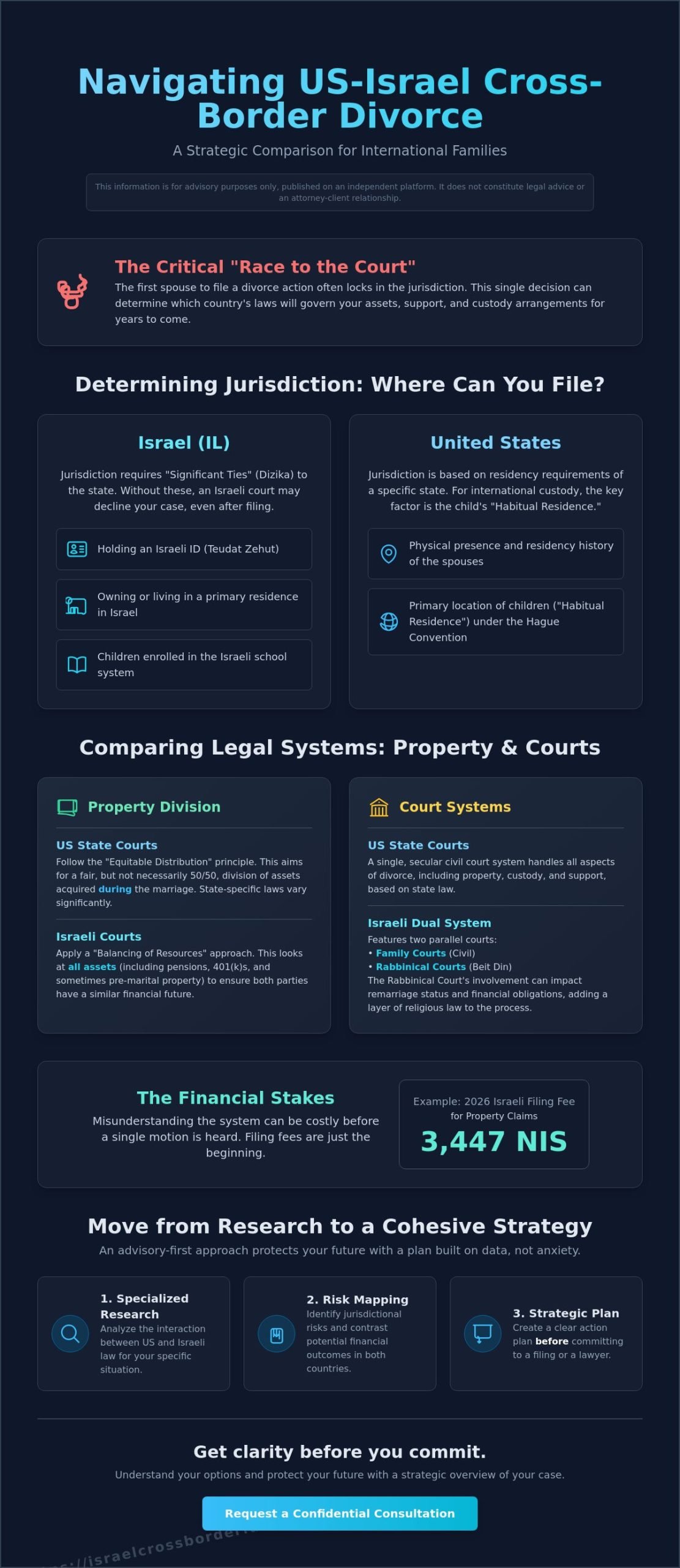
Moving from Research to Strategy: How an Advisory Approach Protects You
Research is the foundation of any successful cross-border case, but it’s only the beginning. The information you gather through legal research for my us-israel divorce case must be translated into a cohesive strategy before you take formal action. A common mistake is hiring a litigator in one country without considering how their actions will ripple across the other jurisdiction. Strategy acts as the bridge between raw legal facts and your actual goals, ensuring that every move is calculated to protect your assets and custody rights.
We advocate for a “Clarity Before Commitment” approach. This means understanding the full scope of your risks before you sign a retainer or file a petition. Decisions made in the first 30 days of a case often dictate the final outcome three years later. For example, filing a property claim in an Israeli Family Court requires a fee of 3,447 NIS as of 2026. If that filing was strategically unnecessary or done in the wrong venue, you’ve lost both money and tactical advantage. A confidential case review allows you to synthesize your research findings and identify the most favorable path forward.
Building Your Legal Team
Your research should inform how you vet and select your legal representation. An international divorce often requires a team that understands both the US state laws and the Israeli system. When interviewing potential counsel, ask if they maintain a physical presence in both markets or if they are dually qualified to practice in multiple jurisdictions. This is a critical differentiator. You should ask specific questions based on your research, such as how they plan to handle the conflict of laws regarding your specific assets. Your US and Israeli attorneys must work as partners to prevent conflicting orders that can lead to legal deadlock.
Next Steps for Your Case
To move forward, start by organizing your documentation. Create a comprehensive checklist that includes residency history, financial statements for all global assets, and any existing agreements. You can find more educational resources and specific guidance on our YouTube channel. Once you have a basic understanding of the landscape, the next step is to seek a professional review. This allows you to move from general information to a strategy tailored to your family’s unique needs. Get clarity before you commit. Request a confidential advisory call to discuss your strategic options.
This article is published on an independent advisory platform and does not constitute legal representation or an attorney-client relationship. Legal services are provided only by licensed attorneys under a separate engagement.
Securing Your Future Through Strategic Clarity
Mapping the complexities of a cross-border separation requires more than just looking up statutes. It demands a deep understanding of how the Israeli dual-court system and US state regulations collide in practice. By prioritizing comprehensive legal research for my us-israel divorce case, you gain the ability to anticipate risks before they become expensive legal mistakes. You now understand the critical importance of the first-to-file rule and the high stakes involved in Hague Convention compliance for international families.
Our team provides a bridge between these two legal cultures. We offer decades of experience in US-Israel cross-border matters and maintain a specialized focus on the unique needs of international families and expats. Practitioners are licensed in multiple jurisdictions, ensuring your strategy is built on authoritative expertise and a nuanced understanding of both systems. This advisory approach is designed to help you navigate the process with confidence and steady guidance.
Get clarity before you commit. Request a confidential consultation.
This article is published on an independent advisory platform and does not constitute legal representation or an attorney-client relationship. Legal services are provided only by licensed attorneys under a separate engagement.
Frequently Asked Questions
Can I get divorced in Israel if I was married in the US?
Yes, you can get divorced in Israel even if your marriage ceremony took place in the United States. Israeli courts accept jurisdiction if you or your spouse meet the “Significant Ties” (Dizika) standard, such as having your center of life in the country. For Jewish couples, the process will involve both the civil Family Court and the Rabbinical Court to ensure the divorce is recognized both civilly and religiously.
What is the “Race to the Court” in US-Israel divorce cases?
The “Race to the Court” refers to the strategic advantage gained by the spouse who files first in their preferred jurisdiction. In US-Israel cases, the first valid filing often determines whether the case is heard in an Israeli Family Court, a Rabbinical Court, or a US state court. This decision significantly impacts property division and custody, making early legal research for my us-israel divorce case essential.
How does the Hague Convention affect my US-Israel custody case?
The Hague Convention protects children from being wrongfully removed from their country of “Habitual Residence.” If a parent moves a child from the US to Israel (IL) or vice versa without consent, the convention provides a legal framework for the child’s prompt return. Courts focus on where the child was settled before the move rather than the parents’ preferences or citizenship status.
Will an Israeli court enforce my US prenuptial agreement?
An Israeli court may not automatically enforce a US prenuptial agreement. To be fully recognized during the “Balancing of Resources,” these agreements often require ratification by an Israeli court or a specialized notary. If your agreement was only signed in the US, it’s vital to research its validity under Israeli law before you file for divorce to protect your separate assets.
Can I sue for child support in Israel if the father lives in the US?
Yes, you can sue for child support in Israel even if the other parent resides in the US. Israel maintains reciprocal enforcement agreements with most US states through the Ministry of Justice. This allows Israeli support orders to be enforced by US authorities, ensuring that financial obligations are met across international borders despite the geographic distance between the parents.
What is a “Gett” and do I need one if I am a US citizen?
A “Gett” is a religious divorce decree required for Jewish couples to end their marriage according to Jewish law. Even if you’re a US citizen with a civil divorce decree from a US court, you still need a Gett to remarry within the Jewish community or in Israel. The Rabbinical Court (Beit Din) holds exclusive jurisdiction over granting the religious decree.
How long does a cross-border divorce between the US and Israel typically take?
The duration depends on whether the divorce is contested. An amicable, agreed-upon divorce in Israel typically takes 3 to 6 months to finalize. However, a contested cross-border case involving complex assets or custody disputes can last 2 to 4 years. The timeline is often extended by the need to coordinate between two different legal systems and jurisdictions.
Do I need two different lawyers for a US-Israel divorce case?
You typically need legal experts who are proficient in both legal systems. While you might hire separate attorneys in the US and Israel, working with a dually qualified practitioner can streamline the process. This ensures your strategy is cohesive and prevents conflicting orders. Effective legal research for my us-israel divorce case helps you determine the best structure for your international legal team.

Article by
Gabriel Lior
A Personal Journey That Became a Mission
The advisory was founded by an American father Gabriel Lior, LLB, MBA , global entrepreneur, and cross-border advisor who spent more than a decade navigating the Israeli family court system firsthand and now lives in Singapore with his son.
As a divorced parent in a cross-border family, Gabriel faced nearly every legal challenge a foreign parent can encounter in Israel — including child custody disputes, child support proceedings, property matters in Israel and abroad, false accusations, and complex immigration and relocation proceedings.
Over the years, he learned the hard way how difficult it is for non-Israeli parents to understand the system, identify the right legal strategy, and choose the right legal representation — especially when language, culture, and jurisdictional differences are involved. He also witnessed how foreign parents and new immigrants are often disadvantaged or taken advantage of by service providers and institutions simply because they lack local knowledge or fluency.
From Client to Advisor
To truly understand — and survive — the system, Gabriel pursued formal legal education in Israel, completing two Israeli law degrees, alongside a BA and MBA earned in the United States. This was never about becoming a practicing attorney, but about gaining a deep, structural understanding of how the system works — and where it breaks down for foreign parents.
This rare combination of:
Firsthand client experience
Israeli legal and US business education
International business and negotiation training
Decades of commercial execution
created a unique perspective – one that understands both sides of the table.
After years of litigation, persistence, and at times self-representation, he ultimately succeeded in securing custody of his son and relocating abroad through a rare legal victory in the Israeli Supreme Court — becoming one of the first fathers in Israel to do so under these circumstances.
Disclaimer
Important Disclaimer:
The information provided on this website and in its content is for general informational and educational purposes only and does not constitute legal advice, legal opinion, or legal representation.
Gabriel Lior is not licensed to practice law in Israel (nor is he interested in doing so) and does not provide legal services, despite having completed 2 Law Degrees. The services offered are advisory in nature and are intended to provide general guidance, strategic insight, and information regarding cross-border family law considerations.
No attorney-client relationship is formed by accessing this website, reading its content, or communicating with us.
Any decisions made based on this information are at your own discretion and risk. For legal advice specific to your situation, you should consult a licensed attorney in the relevant jurisdiction.
Where appropriate, we may refer clients to independent, licensed attorneys or professionals. Such referrals do not constitute legal representation and no liability is assumed for services provided by third parties.