This article is published on an independent advisory platform, not a law firm. The information provided is for educational purposes and does not constitute legal representation or an attorney-client relationship.
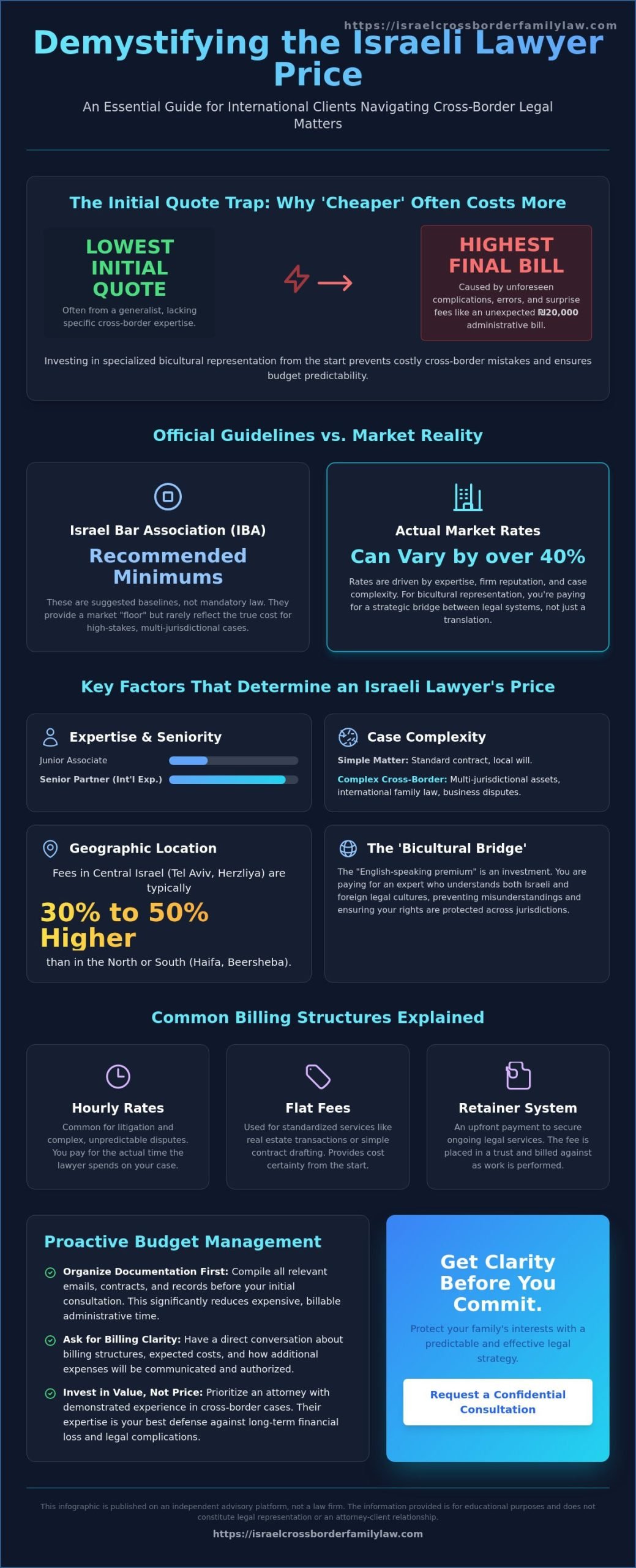
Choosing the professional with the lowest initial quote often results in the highest total invoice when managing a complex cross-border estate or business dispute. It’s natural to feel uneasy about the lack of transparency regarding an israeli lawyer price when you’re used to the predictable billing cycles of the U.S. or U.K. legal markets. You deserve to protect your family’s interests without the constant fear of a surprise ₪20,000 bill for administrative tasks you didn’t authorize. While the Israel Bar Association publishes recommended minimum tariffs, actual market rates for bicultural representation can vary by over 40 percent depending on the firm’s specific expertise.
This guide provides the clarity you need to understand how Israeli legal fees are structured, from flat-fee real estate transactions to hourly litigation rates. You’ll learn how to distinguish between “cheap” services and genuine value, ensuring your budget accounts for the specific demands of international cases. We’ll examine the factors that drive costs in the Israeli market and provide a strategy for managing expenses between jurisdictions effectively. For more visual guidance, you can also explore the resources on the Israel Family Law YouTube channel. Get clarity before you commit. Request a confidential consultation.
Key Takeaways
- Understand the distinction between the Israeli Bar Association’s recommended minimum fees and the actual market rates for specialized legal counsel in Tel Aviv.
- Learn how attorney seniority and the complexity of multi-jurisdictional issues directly influence the israeli lawyer price and your overall project budget.
- Gain clarity on common billing structures, such as hourly rates and the Israeli retainer system, to ensure your legal costs remain predictable and manageable.
- Identify the long-term financial risks of hiring a local generalist for complex cross-border matters involving international assets or family law.
- Discover practical strategies to reduce billable time, including how to organize your documentation effectively before your initial consultation.
This article is published on an independent advisory platform, not a law firm. The information provided is for educational purposes and does not constitute legal advice or an attorney-client relationship. Legal services are only provided by licensed attorneys under a separate engagement.
The Landscape of Legal Fees in Israel: An Overview
Navigating the legal system in a new country is a daunting task for any international family. When you begin researching the israeli lawyer price for various services, you’ll find a wide range of figures that can be confusing. Prices change based on the lawyer’s experience, the city where they practice, and the specific complexity of your case. International clients often face different cost structures because their matters involve navigating two or more legal jurisdictions simultaneously.
To better understand the financial side of legal transactions in Israel, watch this helpful video:
The Role of the Israeli Bar Association (IBA)
The Israel Bar Association (IBA) sets a baseline for the profession through its published list of recommended minimum fees. These recommendations cover common tasks like drafting a will, handling a real estate transaction, or managing a divorce. It’s vital to understand that these IBA minimums aren’t mandatory law; they’re suggestions. Most experienced firms, especially those handling sophisticated cross-border matters, charge significantly above these minimums. You should use the IBA list as a tool for basic price anchoring. It helps you understand the absolute floor of the market, but it rarely reflects the total cost for high-stakes litigation or complex family law cases in 2024.
Market Realities for Expats and Foreign Nationals
If you live in Tel Aviv or Herzliya, expect to pay more than you would in peripheral cities like Haifa or Beersheba. The “English-speaking premium” is a real factor in the israeli lawyer price. Bilingual attorneys who understand both Israeli law and foreign legal cultures provide a specialized service that prevents costly cross-border mistakes. You aren’t just paying for a translation. You’re paying for a bridge between two distinct legal systems. For many, seeking legal guidance for expats and foreign nationals is a strategic investment. It reduces the risk of long-term financial loss and ensures that your rights are protected in both Israel and your home country. Get clarity before you commit. Request a confidential consultation.
- Geographic Variance: Fees in the center of the country are typically 30% to 50% higher than in the north or south.
- Expertise Levels: Junior associates cost less, but senior partners with international experience command premium rates.
- Service Scope: Hourly rates are common for litigation, while flat fees are often used for standard contracts.
This article is published on an independent advisory platform (not a law firm) and does not imply an attorney-client relationship.
Key Factors Determining an Israeli Lawyer’s Price
The israeli lawyer price is rarely a flat rate because legal needs vary significantly in scope and risk. While a simple residential lease review might follow a standard percentage-based fee, complex family law matters are typically billed by the hour or through staged retainers. A foundational element of legal pricing in Israel is the Israel Bar Association Law. Under Section 81 of this statute, the National Council of the Bar is authorized to set recommended minimum fee tariffs. These tariffs provide a baseline, but seasoned practitioners often adjust their rates based on the specific demands of cross-border litigation.
Urgency plays a critical role in cost structures. Cases involving the Hague Convention or emergency stay-of-exit orders require immediate, intensive labor to meet strict court deadlines. When an attorney must prioritize a case to prevent a child from being moved across borders, the time-sensitivity often reflects in the initial retainer. Strategizing early helps manage these costs before they escalate during a crisis.
Seniority vs. Value in the Israeli Market
Choosing between a junior associate and a senior partner involves more than just comparing hourly rates. A partner charging ₪1,300 per hour may possess the specific expertise to resolve a multi-jurisdictional dispute in five hours, whereas a junior charging ₪650 might take fifteen hours to reach the same conclusion. In the IL market, value is found in a firm’s “team on the ground.” Having bicultural attorneys who understand both the Israeli Rabbinical courts and U.S. civil procedures reduces the risk of costly procedural errors. A firm with a proven track record in US-Israel family law disputes can often anticipate jurisdictional challenges before they become expensive roadblocks.
The Complexity of Cross-Border Family Law
International asset division naturally increases the scope of work. When a couple owns property in Tel Aviv and retirement accounts in New York, the legal process must account for different tax implications and valuation methods. This complexity is why specialized knowledge is vital. For those seeking visual explanations of these intricate topics, the Israel Family Law YouTube channel offers helpful breakdowns of how these systems interact. Specific challenges also arise when enforcing child support orders across borders, as this requires knowledge of international treaties and local execution office (Hotsaa La’Poal) regulations. Managing these multi-jurisdictional factors requires a strategic approach rather than a reactive one.
Understanding the variables behind the israeli lawyer price allows you to make an informed decision based on your specific financial and legal goals. Get clarity before you commit. Request a confidential consultation.
Common Billing Structures in Israeli Law Firms
Understanding the israeli lawyer price requires a look at the three primary billing methods used by firms in the country. Most firms utilize hourly billing, flat fees, or hybrid success-based models. In complex cross-border family law, the hourly model is the most prevalent because international cases often involve multiple jurisdictions and unpredictable timelines. Some civil or commercial matters might use a success fee, where the lawyer receives a percentage of the final settlement. These percentages typically range from 10% to 25% plus the mandatory value-added tax.
Hourly Rates vs. Flat Fees
Flat fees offer predictability for standardized tasks. Drafting a simple Israeli Will or a standard prenuptial agreement often falls into this category. These fees usually range between ₪5,000 and ₪15,000 depending on the complexity of the assets involved. However, litigation and divorce proceedings are almost always billed hourly. The uncertainty of court schedules and the opposing party’s actions make a flat fee impractical for the firm and potentially unfair for the client. For instance, a contested custody case involving international relocation requires a high volume of billable hours due to the need for expert witnesses and extensive cross-examinations.
Regulatory shifts and legislative changes are also factors influencing legal costs across the professional landscape. You should always ask if the quote includes expenses like travel time to courts in different districts or administrative filing fees. These costs can accumulate quickly in multi-jurisdictional cases.
Managing the Retainer and Invoicing
The retainer system is the standard for most Israeli firms. You provide an initial deposit which the firm holds in a client account. As work is performed, the firm draws from this fund. You should expect a detailed billing statement monthly or bi-monthly to maintain Transparency in our pricing model. Once the retainer drops below a certain threshold, you’ll be asked to replenish it. This ensures that the firm can continue working on your case without interruption.
A critical component of the israeli lawyer price is “Ma’am” (Value Added Tax). The current VAT rate in Israel is 17%. This tax applies to all legal services provided within the country. While some “export of services” to non-residents can occasionally qualify for a 0% VAT rate, this is rare in family law if the legal matter involves residents of Israel or assets located here. You’ll need to confirm if a quoted price includes or excludes this 17% tax to avoid surprises on your first invoice. For more visual guides on managing these expectations and understanding the Israeli system, you can visit the Israel Family Law YouTube channel.
This article is published on an independent advisory platform and does not constitute a law firm or an attorney-client relationship. Legal services are only provided by licensed attorneys under a separate engagement.
The Risks of Under-Budgeting for Cross-Border Cases
The “Cheap Lawyer” trap is a common pitfall for those moving between legal systems. While a lower initial israeli lawyer price might look better on a balance sheet today, it often reflects a lack of experience in multi-jurisdictional complexities. Local generalists who don’t specialize in cross-border law frequently miss how a decision in an Israeli court impacts assets or residency status in another country. This lack of foresight leads to “legal debt” where you pay significantly more later to fix avoidable mistakes.
Under-budgeting leads to reactive legal work. When a lawyer isn’t equipped to handle the intersection of Israeli and foreign statutes, they focus only on the immediate local issue. This narrow focus creates a high risk of long-term financial loss. For instance, correcting a single error in a US-Israel probate or tax filing can cost upwards of ₪25,000 in additional fees. This cost is often higher than the original filing fee because it requires undoing official records in two different government systems.
The Cost of Legal Errors in International Divorce
A poorly drafted clause in a cross-border prenuptial or divorce agreement can trigger years of litigation in two different countries. If an agreement isn’t enforceable in both jurisdictions, one party might sue in Israel while the other files in the US. This “forum shopping” can cause legal bills to skyrocket into the hundreds of thousands of shekels. Families facing these challenges should review divorce and separation for international families to understand the stakes. A failed Hague Convention defense, often the result of inexperienced counsel, can lead to legal costs exceeding ₪150,000 in a single year.
Why Specialized Strategy Saves Money Long-Term
Early strategic decisions prevent expensive court battles. A lawyer who understands the nuances of the Israeli Rabbinical Court alongside the procedures of US Civil Courts can identify conflicts before they become crises. This is particularly vital for individuals with business assets who need their legal team to act as a bridge between cultures. Strategic planning ensures that an israeli lawyer price covers not just the paperwork, but the protection of your global financial interests.
Choosing a legal partner based on risk management rather than the lowest quote is the most effective way to control costs. A specialized strategy might involve a higher upfront investment, but it eliminates the “double-billing” that occurs when you have to hire a second firm to fix a first firm’s errors. Get clarity before you commit. Request a confidential consultation.
This article is published on an independent advisory platform and does not constitute an attorney-client relationship. Legal services are only provided by licensed attorneys under a separate engagement.
How to Manage Your Legal Budget and Next Steps
Controlling the total israeli lawyer price you pay depends heavily on how you manage the relationship from day one. Legal fees in Israel can escalate quickly if the scope of work isn’t clearly defined or if the client relies on the attorney for non-legal tasks. By treating your legal matter as a strategic project, you can minimize waste and focus your budget on high-value advocacy rather than administrative overhead.
Organizing your documentation before the first meeting is the most effective way to save billable time. Attorneys often spend hours sorting through disorganized emails, WhatsApp messages, or bank statements. If you provide a clean, indexed digital folder, you’re paying for legal analysis rather than data entry. It’s also vital to set clear communication boundaries. Establish a frequency for updates and use email for non-urgent questions to avoid the 15-minute minimum billing increments common in Israeli practice.
Preparing for Your Initial Consultation
Your first meeting sets the trajectory for your case. Arrive with a detailed, chronological timeline of events and a comprehensive list of international assets. Values should be noted in Israeli Shekel (₪) to help the lawyer understand the local economic impact. You must distinguish between legal strategy and emotional support. While cross-border family law is inherently stressful, using your lawyer as a primary emotional outlet is an expensive choice that doesn’t improve your legal outcome.
When reviewing a legal engagement agreement in Israel, pay close attention to the specifics. These contracts, known as Schar Tircha, should clearly state whether the 17% VAT is included in the quoted price. They should also outline how “extraordinary” expenses like expert witnesses, translation fees, or court filing costs are handled. Don’t sign until you understand how the israeli lawyer price might change if the case moves from mediation into active litigation.
Taking an Informed First Step
Commitment to full representation is a significant financial decision that shouldn’t be rushed. Many international families benefit from using an advisory platform to gain clarity before hiring a firm for the long term. You can learn more about how the advisory process works to determine if your case requires a full-scale legal team or a more targeted intervention. Early clarity is the best way to control legal spend and avoid the trap of a poorly planned strategy.
The Confidential Case Review is designed as a diagnostic first step. It allows you to identify jurisdictional risks and cultural nuances that affect your budget before you sign a large retainer. This informed approach ensures that every ₪ spent is a deliberate investment in your future. Get clarity before you commit. Request a confidential consultation.
Moving Forward with Financial Clarity
Securing legal representation across borders involves more than comparing hourly rates. It requires a deep understanding of how Israeli court procedures and international treaty obligations interact. When you consider an israeli lawyer price, you aren’t just paying for time; you’re investing in a strategic roadmap that protects your interests in both jurisdictions.
Choosing the right billing structure and accounting for translation or expert witness costs in ₪ (ILS) ensures your budget remains resilient. Our independent advisory focuses on providing bicultural and bilingual legal guidance to help you navigate these complexities. We prioritize risk assessment and long-term strategy so you can make informed decisions without the stress of unexpected financial hurdles.
Get clarity before you commit. Request a confidential consultation.
Taking the time to plan your legal budget now will provide peace of mind as your case progresses.
This article is published on an independent advisory platform (not a law firm) and does not imply an attorney-client relationship. Legal services are only provided by licensed attorneys under a separate engagement. Get clarity before you commit. Request a confidential consultation.
Frequently Asked Questions
How much does a divorce lawyer in Israel cost on average?
Average fees for a divorce case in Israel typically range from ₪30,000 to ₪70,000 for standard proceedings, though complex litigation involving high-net-worth assets can exceed ₪150,000. These figures depend on the scope of the case and the attorney’s experience. The Israel Bar Association provides a Recommended Minimum Tariff which serves as a baseline for many practitioners across the country.
Do Israeli lawyers charge for the initial consultation?
Most experienced Israeli lawyers charge a fee for the initial consultation, which generally ranges between ₪600 and ₪1,500 plus VAT. While some firms offer brief introductory calls, a formal strategy session involves a detailed review of your cross-border situation. Paying for this time ensures you receive professional, unbiased guidance rather than a sales pitch, allowing you to make an informed decision.
Is there a difference in price between the Rabbinical Court and Civil Family Court?
Filing fees are generally lower in the Rabbinical Court, but the total legal cost depends on the complexity of the strategy rather than the venue itself. For example, opening a divorce file in the Rabbinical Court costs approximately ₪402, whereas property division claims in the Family Court are often calculated based on the claim value. Navigating both systems simultaneously can increase your israeli lawyer price due to the dual-track litigation required.
Can I pay an Israeli lawyer in US Dollars?
You can often pay in US Dollars, but the lawyer must convert the amount to Israeli Shekels for tax reporting and VAT purposes. Israeli law requires all invoices to be issued in ILS based on the representative exchange rate of the Bank of Israel on the day of payment. It’s important to clarify if the quoted price includes the mandatory 17% Value Added Tax, which applies to all services provided within Israel.
What are the standard court filing fees in Israel for 2026?
Court filing fees are updated every January 1st based on the Consumer Price Index, so 2026 rates will be finalized in early 2026. Current 2024 benchmarks for family law matters include ₪515 for child custody claims and ₪402 for divorce applications. You should budget for a 2% to 3% annual inflationary increase when planning for future litigation costs or multi-year cross-border cases. For more information on legal procedures, you can view resources on the Israel Family Law YouTube channel.
How can I check if an Israeli lawyer’s price is fair?
You can check the fairness of an israeli lawyer price by comparing it to the Israel Bar Association’s Recommended Minimum Tariff, also known as the Rules of the Bar Association 5760-2000. While top-tier firms specializing in international law charge significantly more than the minimum, this document provides a baseline for standard tasks. Requesting a detailed fee agreement that breaks down hourly rates versus flat fees helps ensure transparency from the start.
Are legal fees in Israel tax-deductible for US citizens?
Legal fees for personal matters like divorce are generally not tax-deductible for US citizens under current IRS regulations. However, portions of the fee related to tax planning or the production of taxable income, such as alimony collection, might be deductible if documented correctly. You should consult a qualified US tax professional to review your specific invoice for potential deductions related to your international legal expenses.
What happens if I cannot afford my legal fees mid-case?
If you cannot afford fees mid-case, you may apply for state-funded legal aid through the Ministry of Justice if you meet specific income and merit criteria. Your lawyer cannot simply abandon the case without court permission once proceedings have started. If a conflict over fees arises, the court must approve the attorney’s withdrawal to ensure your legal rights aren’t prejudiced during the transition to new representation.

Article by
Gabriel Lior
A Personal Journey That Became a Mission
The advisory was founded by an American father Gabriel Lior, LLB, MBA , global entrepreneur, and cross-border advisor who spent more than a decade navigating the Israeli family court system firsthand and now lives in Singapore with his son.
As a divorced parent in a cross-border family, Gabriel faced nearly every legal challenge a foreign parent can encounter in Israel — including child custody disputes, child support proceedings, property matters in Israel and abroad, false accusations, and complex immigration and relocation proceedings.
Over the years, he learned the hard way how difficult it is for non-Israeli parents to understand the system, identify the right legal strategy, and choose the right legal representation — especially when language, culture, and jurisdictional differences are involved. He also witnessed how foreign parents and new immigrants are often disadvantaged or taken advantage of by service providers and institutions simply because they lack local knowledge or fluency.
From Client to Advisor
To truly understand — and survive — the system, Gabriel pursued formal legal education in Israel, completing two Israeli law degrees, alongside a BA and MBA earned in the United States. This was never about becoming a practicing attorney, but about gaining a deep, structural understanding of how the system works — and where it breaks down for foreign parents.
This rare combination of:
Firsthand client experience
Israeli legal and US business education
International business and negotiation training
Decades of commercial execution
created a unique perspective – one that understands both sides of the table.
After years of litigation, persistence, and at times self-representation, he ultimately succeeded in securing custody of his son and relocating abroad through a rare legal victory in the Israeli Supreme Court — becoming one of the first fathers in Israel to do so under these circumstances.
Disclaimer
Important Disclaimer:
The information provided on this website and in its content is for general informational and educational purposes only and does not constitute legal advice, legal opinion, or legal representation.
Gabriel Lior is not licensed to practice law in Israel (nor is he interested in doing so) and does not provide legal services, despite having completed 2 Law Degrees. The services offered are advisory in nature and are intended to provide general guidance, strategic insight, and information regarding cross-border family law considerations.
No attorney-client relationship is formed by accessing this website, reading its content, or communicating with us.
Any decisions made based on this information are at your own discretion and risk. For legal advice specific to your situation, you should consult a licensed attorney in the relevant jurisdiction.
Where appropriate, we may refer clients to independent, licensed attorneys or professionals. Such referrals do not constitute legal representation and no liability is assumed for services provided by third parties.