Imagine you’ve finalized your divorce in New York or California, only to discover that your former spouse has moved to Tel Aviv and stopped making payments. You might assume your US court order follows them automatically, but the reality of Enforcing Divorce Judgments Across Borders is far more complex. It’s natural to feel a sense of uncertainty when you realize a foreign support order might be ignored or that assets located in Israel aren’t easily accessible. The confusion caused by conflicting legal systems can make an already difficult transition feel overwhelming.
You deserve a clear, strategic path forward. This guide explains the legal requirements for domesticating and enforcing international divorce decrees between the United States and Israel. We’ll examine the strict five-year statute of limitations for filing enforcement motions and the specific jurisdictional thresholds, such as the ₪2.5 million limit for the Magistrates’ Court. You’ll learn about the essential four-part test Israeli courts use to recognize foreign judgments. This overview ensures you understand the risks and procedural steps required to protect your rights under Israeli law before you commit to a specific legal strategy.
Key Takeaways
- Learn why a US divorce decree requires formal domestication before it can be legally recognized and executed by Israeli authorities.
- Understand the mandatory conditions under the Foreign Judgments Enforcement Law to ensure your international order meets local statutory standards.
- Discover how Enforcing Divorce Judgments Across Borders depends on state-specific reciprocity and alignment with Israeli public policy.
- Identify the technical documentation required, including apostilles and notarized Hebrew translations, to navigate the Israeli court system efficiently.
- Gain strategic clarity on the cultural and legal differences between US and Israeli courts to protect your assets and family interests.
The Reality of Enforcing Divorce Judgments Across Borders
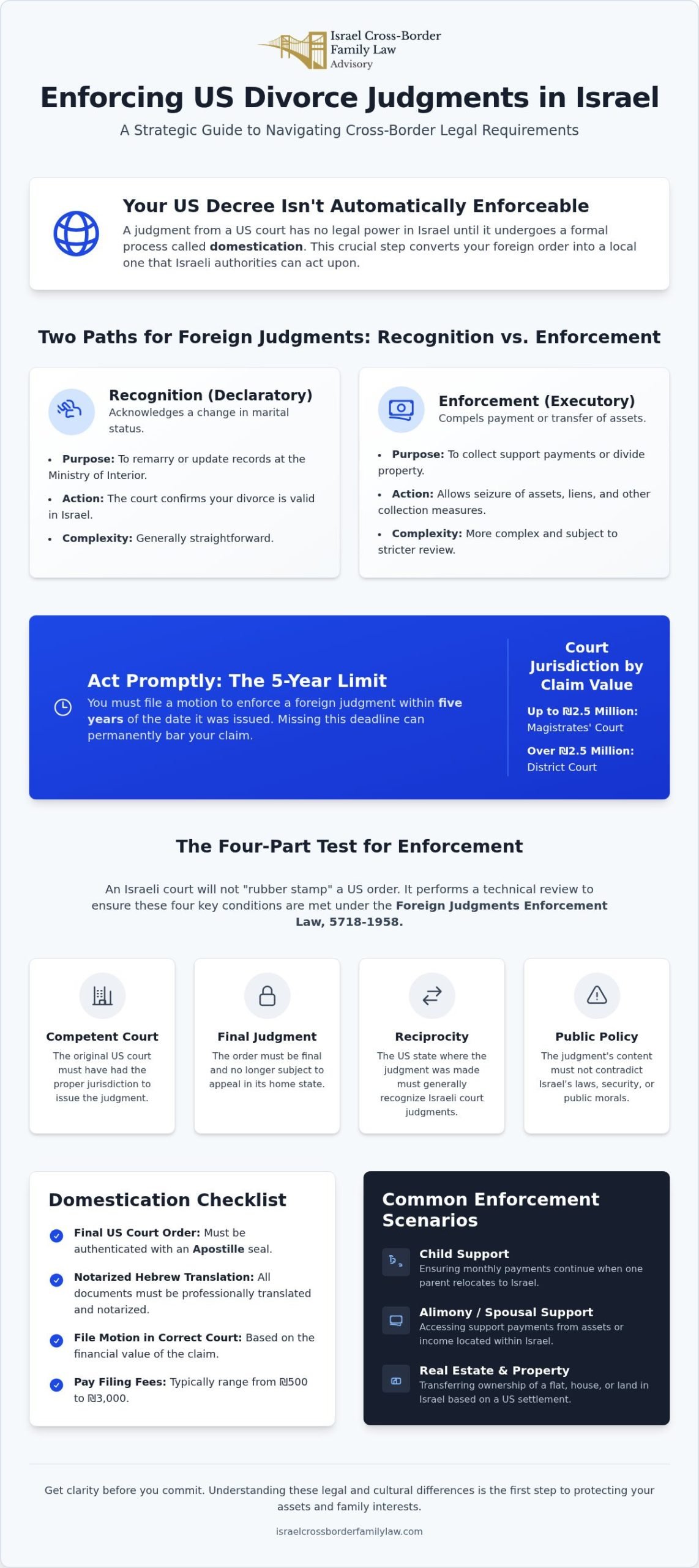
Many families assume that a final decree from a US court carries immediate weight in Israel. This is a common misconception. While your US judgment is legally binding in its home state, it doesn’t cross the border automatically. To make it effective here, you must undergo a process called domestication. This procedure turns a foreign piece of paper into a local court order that Israeli authorities can actually act upon. Without this step, your US decree remains a foreign document with no power to compel action within the Israeli legal system.
The process of Enforcing Divorce Judgments Across Borders is not just a formality; it’s a strategic necessity for anyone with assets or family obligations in both countries. Whether you’re dealing with unpaid support or property distribution, understanding the distinction between simply recognizing a divorce and actually enforcing its terms is the first step toward security.
Recognition vs. Enforcement: What is the Difference?
Israeli law distinguishes between two types of judicial actions regarding foreign orders. Declaratory recognition is the process of acknowledging that your marital status has changed. If you intend to update your status at the Ministry of Interior or remarry in Israel, you need the court to recognize your foreign divorce. This is often straightforward if the proper documentation is provided.
Executory enforcement is more complex. It involves the enforcement of foreign judgments to move money or property. If your former spouse refuses to pay child support or won’t sign over a flat in Jerusalem, recognition alone won’t help you. You need an executory order that the Israeli Collection and Enforcement Bureau can use to seize assets or place liens. This is particularly vital in cases involving child support cross-border enforcement, where monthly payments are at stake.
The Role of International Comity
Israeli courts operate on the principle of international comity. This concept means they generally respect the decisions of foreign courts to ensure global legal stability and finality. However, they aren’t “rubber stamps.” A critical requirement for Enforcing Divorce Judgments Across Borders is “finality.” The US order must be final and no longer subject to appeal in the state where it was issued. If the case is still active or being challenged in a US court, the Israeli judge will likely wait until the matter is settled. This ensures that the Israeli legal system doesn’t conflict with ongoing litigation abroad, protecting the integrity of both jurisdictions.
Common scenarios requiring this domestication include:
- Child Support: Ensuring monthly payments continue when a parent relocates to Tel Aviv or Haifa.
- Alimony: Domesticating spousal support orders to reach assets held in Israeli banks.
- Real Estate: Transferring ownership of property in Israel based on a US settlement agreement.
The Legal Framework for Domesticating Foreign Judgments in Israel
The primary statute governing the recognition of international orders is the Enforcement of Foreign Judgments Law, 5718-1958. This legislation serves as the definitive roadmap for anyone seeking to validate a US decree within the Israeli system. It’s a structured process designed to ensure that while Israel respects international decisions, it only adopts those that meet strict local standards. Successfully Enforcing Divorce Judgments Across Borders depends entirely on demonstrating that your specific decree satisfies every requirement of this law.
When you file a motion to enforce, the court doesn’t reopen the divorce case to look at the facts again. Instead, it performs a technical review to confirm the judgment is “domesticated.” This involves verifying the authority of the original court and the finality of its decision. For instance, the Israeli court will check if the value of the claim fits within the correct jurisdiction; claims up to ₪2,500,000 are typically handled by the Magistrates’ Court, while larger matters move to the District Court. Filing fees for these motions generally range from ₪500 to ₪3,000, depending on the complexity and the court tier involved.
The Statutory Requirements for Enforcement
For a US judgment to be enforceable in Israel, it must meet several mandatory conditions. First, the judgment must have been rendered by a court that was competent to do so under the laws of its own country. This means the US court needed proper jurisdiction over both the parties and the subject matter. Second, the judgment must be final. If the order is temporary or still subject to an active appeal in the US, the Israeli court will not enforce it. Finally, the obligation itself must be enforceable under Israeli law and must not contradict local public policy. When dealing with parental obligations, these Practical Steps for Enforcing Child Support Orders demonstrate how US and Israeli authorities coordinate to meet these statutory goals.
Due Process and Fair Notice
Israeli courts are deeply committed to the principle of “natural justice.” This means they’ll refuse to enforce a judgment if the defendant didn’t receive a fair chance to defend themselves. You must prove that the other party was properly served with the legal papers in the US according to that state’s laws. According to Israeli standards, proper service means the defendant was provided with the legal documents in a way that granted them a genuine opportunity to present their case before a decision was made. If a spouse was never notified of the proceedings, the resulting judgment is often considered “voidable” in Israel.
Because these requirements are technical and strict, it’s helpful to speak with a professional who understands the interplay between these two legal systems. Getting clarity on these statutory hurdles early can prevent significant delays in your enforcement efforts. You can also request a confidential case review to determine if your current US order meets the criteria for Enforcing Divorce Judgments Across Borders before you begin the formal filing process in Israel.
Common Obstacles to Recognition and Enforcement
Even when you’ve met the basic statutory requirements, several significant hurdles can stall the process of Enforcing Divorce Judgments Across Borders. Israeli courts aren’t simply administrative offices; they act as gatekeepers of the local legal system. A US judgment that appears valid on its face might still be rejected if it triggers specific legal defenses. Understanding these obstacles before you file is essential to avoid costly delays and unexpected setbacks in the Israeli family court system.
Beyond technical documentation, the court examines the substance of the order. If the original proceedings were tainted by fraud or if the judgment contradicts a ruling already issued by an Israeli court, the domestication process will likely fail. These complexities highlight why strategy must always precede litigation in cross-border matters.
The Public Policy Hurdle
The most significant discretionary tool available to an Israeli judge is the “Public Policy” exception, known in Hebrew as Takanat HaZibur. This principle allows a court to refuse enforcement if the foreign judgment contradicts the fundamental values or moral standards of the State of Israel. In the context of family law, this doesn’t mean the court will reject an order just because it’s different from Israeli law. Instead, it targets orders that are seen as inherently unjust or predatory.
For example, US judgments that include punitive damages or “penalty clauses” for late support payments are often scrutinized. Israeli family law is generally compensatory rather than punitive. If your US decree contains aggressive financial penalties that don’t exist in the Israeli system, the court might strip those sections away while enforcing the core support obligation. It’s often necessary to frame your enforcement request carefully to ensure the primary financial protections remain intact while acknowledging these local policy boundaries.
The Reciprocity Rule Between the US and Israel
Israel’s enforcement law includes a reciprocity requirement. This means the court must be satisfied that the foreign country (or specific US state) would similarly enforce an Israeli judgment. Since family law in the US is handled at the state level, the Israeli court looks at the specific rules in places like New York, California, or Florida. Fortunately, this condition is flexible. You don’t always need a formal treaty; evidence that the US state has a history of recognizing foreign orders is often sufficient.
There’s also a “safety valve” involving the Attorney General. If the Attorney General requests enforcement even in the absence of clear reciprocity, the court has the power to grant it. This often happens in child support cases where the welfare of the child is the primary concern. Navigating these state-specific nuances requires a nuanced understanding of how Enforcing Divorce Judgments Across Borders works in practice, as the “reciprocity” status of a specific US jurisdiction can impact the speed and success of your petition.
Finally, the court will check for conflicting judgments. If an Israeli Family Court or Rabbinical Court has already issued a ruling on the same matter, the domestic ruling almost always takes precedence over the foreign one. This makes the timing of your filing a critical strategic decision.
Practical Steps for Enforcing Your International Decree
Transitioning from understanding the legal framework to the actual process of Enforcing Divorce Judgments Across Borders requires meticulous attention to detail. The Israeli court system relies heavily on procedural correctness. Any error in documentation can result in a petition being dismissed before the merits are even considered. While the law provides a pathway for domestication, the burden of proof rests entirely on the petitioner to provide authenticated evidence that meets Israeli standards.
The logistics of this process involve more than just filing paperwork. You must bridge the gap between two different bureaucratic systems. This requires a structured approach to gathering evidence, authenticating records, and presenting them in a format that the Israeli Family Court can accept under the Foreign Judgments Enforcement Law.
Document Preparation and Authentication
Your first priority is gathering the correct version of your US judgment. A standard photocopy or even a court-stamped copy is usually insufficient for international purposes. You must obtain an authenticated copy of the judgment accompanied by an Apostille. An Apostille is a specialized certificate issued by the Secretary of State in the US state where the judgment was rendered. It verifies the signature and seal of the court official, making the document legally recognizable in Israel under international treaties.
Once you have the authenticated documents, you must secure a notarized Hebrew translation. Precision is vital here; a poor translation of legal terms like “custody” or “alimony” can lead to significant misinterpretation by an Israeli judge. The translation must be performed by a professional who understands both legal systems to ensure accuracy. You can learn more about how we facilitate these complex transitions by reviewing how our advisory works.
Navigating the Israeli Family Court System
After your documents are prepared, you file a formal Petition for Enforcement in the appropriate Family Court. Selecting the correct venue is a strategic decision based on where the other party resides or where the assets are located, such as Tel Aviv, Jerusalem, or Haifa. Once the petition is filed, the court serves the documents to the other party, who then has a legal right to submit a “Response.” This stage is where many of the obstacles discussed earlier, such as public policy or reciprocity arguments, are typically raised.
The timeline for these proceedings varies based on the complexity of the case and the level of opposition. In cases where the enforcement is not contested, the recognition process in Israel can be completed in approximately six months. However, if the other party contests the motion, the process can extend from two to three years, particularly if the court requires expert evidence on the specific laws of the US state involved. Because the weight of early decisions is so significant, you should request a consultation to ensure your documentation is handled correctly from the outset.
Strategic Guidance for Global Families
Navigating the intersection of two distinct legal systems requires more than just reactive filing. It demands a forward-looking strategy that anticipates how an Israeli judge will interpret a US decree. Many families make the mistake of assuming that a favorable outcome in a US court is the end of the journey. In reality, Enforcing Divorce Judgments Across Borders often presents unique challenges that can’t be resolved through litigation alone. You must consider the long-term implications of every clause in your US agreement before it’s finalized.
The weight of early decisions cannot be overstated. Choosing how to phrase a settlement agreement in New York or California can determine whether that document remains enforceable in Tel Aviv years later. If an agreement is drafted without considering Israeli public policy or the specific requirements of the Enforcement of Foreign Judgments Law, you may find yourself with a “victory” that holds no weight in the jurisdiction where your assets or former spouse are located. Protecting your financial interests requires a nuanced understanding of both legal cultures.
Clarity Before Commitment
Winning a case in the US is only half the battle if the resulting order is deemed unenforceable in Israel. Before you invest significant resources into litigation or enforcement, it’s vital to evaluate the cost-benefit ratio of your approach. This means looking beyond the immediate legal dispute to assess whether the eventual judgment can actually be domesticated. A Confidential Case Review provides the necessary framework to identify these risks before they become insurmountable obstacles. This proactive step helps you understand if your US support order or property division is likely to meet the four-part test for enforcement or if it will be blocked by the local policy exceptions discussed earlier.
A Bridge Between Legal Systems
Successful outcomes in cross-border family law depend on seamless coordination between your US counsel and your Israeli advisory team. These two systems operate on different cultural and legal foundations. While US courts focus on state-specific statutes and common law precedents, Israeli courts navigate a complex landscape of civil family law and religious Rabbinical oversight. Strategic relationships with local professionals in Tel Aviv and Jerusalem are essential for executing a global plan.
Working with practitioners who understand both environments serves as a critical differentiator. This multi-qualified approach ensures that your legal strategy isn’t lost in translation. For those who prefer visual guides on these complex topics, you can explore more detailed explanations on our YouTube channel. By building a bridge between these divergent legal cultures, you can manage the process of Enforcing Divorce Judgments Across Borders with confidence. Get clarity before you commit to a course of action that might not yield the results you expect.
Securing Your Cross-Border Interests
Successfully domesticating a US court order in Israel is a deliberate process that requires more than just administrative filing. The Enforcement of Foreign Judgments Law serves as a strict gatekeeper, ensuring that every decree meets local standards of finality and public policy. Whether you’re securing child support or distributing real estate in Tel Aviv, the complexity of Enforcing Divorce Judgments Across Borders means that your strategy must be established long before you enter a courtroom.
Early decisions regarding document authentication and the timing of your petition can significantly impact your success. This independent advisory platform provides the strategic guidance international families need, drawing on decades of cross-border legal experience to navigate these challenges. By coordinating between US and Israeli legal cultures, you can protect your family’s financial future and achieve legal finality across jurisdictions.
Get clarity before you commit. Request a confidential consultation to assess your case’s enforceability. You don’t have to face these multi-jurisdictional complexities alone; professional support is available to help you build a secure bridge between legal systems.
Frequently Asked Questions
Is a US divorce decree automatically valid in Israel?
A US divorce decree is not automatically valid in Israel and must be formally recognized through the domestication process. Under the Foreign Judgments Enforcement Law of 1958, an Israeli court must declare the judgment enforceable before it carries legal weight locally. This procedure ensures the foreign order meets specific statutory requirements, such as finality and jurisdictional competence. Without this step, you cannot update your marital status or enforce financial obligations within the Israeli system.
Can I enforce US child support orders if my ex-spouse moved to Israel?
Yes, you can enforce US child support orders in Israel by filing a petition in the appropriate Family Court. The court will review the order to ensure it doesn’t violate local public policy. For claims under ₪2,500,000, the Magistrates’ Court typically has jurisdiction. Successfully Enforcing Divorce Judgments Across Borders ensures that monthly support obligations remain active even after a parent relocates to cities like Tel Aviv or Jerusalem.
What is an Apostille and why do I need one for my divorce papers?
An Apostille is an international authentication certificate that verifies the signature and seal of the US official who issued your divorce papers. You need one because Israeli courts won’t accept a standard notary or simple court copy as authentic for cross-border use. It serves as a standardized proof of legitimacy between countries that are members of the Hague Convention, allowing the Israeli legal system to trust the document’s origin without further investigation.
How long does it take to domesticate a foreign judgment in Israel?
The timeline for domesticating a foreign judgment varies based on whether the other party contests the motion. If the enforcement is uncontested, the process usually takes about six months to complete. However, if your former spouse challenges the petition, the duration can extend to two or three years. This is especially true if the court requires expert testimony regarding the specific laws of the US state where the original judgment was rendered.
Will an Israeli court enforce a US judgment regarding Israeli real estate?
An Israeli court can enforce US judgments concerning Israeli real estate, but the process requires careful alignment with local property laws. While the court respects international comity, it must ensure the order is final and non-appealable in the US. If the judgment involves transferring ownership of a flat in Haifa or Tel Aviv, you’ll need the domesticated order to update the Israel Land Registry (Tabu). Strategy is essential here to avoid public policy conflicts.
What happens if the US judgment contradicts an Israeli Rabbinical Court ruling?
If a US judgment contradicts an existing Israeli Rabbinical Court ruling, the Israeli ruling almost always takes precedence. Israeli courts prioritize local decisions to maintain the integrity of their own judicial system. This conflict highlights why the timing of your filing is a critical strategic decision. If you anticipate a dispute, it’s vital to seek clarity on which jurisdiction’s ruling will carry the most weight before you commit to a specific legal path.
Do I need to be physically present in Israel to enforce my judgment?
You generally don’t need to be physically present in Israel to initiate the process of Enforcing Divorce Judgments Across Borders. Your legal representative can file the petition and manage the procedural requirements on your behalf. While a judge might request your testimony in contested cases, many preliminary stages are handled through written submissions and affidavits. This allows expats and international families to manage their legal affairs in Israel while residing in the United States.
Can I enforce an Israeli divorce judgment in the United States?
Yes, Israeli divorce judgments can be enforced in the United States, though the process depends on the laws of the specific US state. US courts generally recognize foreign judgments based on the principle of comity, provided there was due process and the Israeli court had proper jurisdiction. Each state, such as New York or California, has its own rules for domesticating foreign orders, making it essential to coordinate between your US counsel and Israeli advisory team.

Article by
Gabriel Lior
A Personal Journey That Became a Mission
The advisory was founded by an American father Gabriel Lior, LLB, MBA , global entrepreneur, and cross-border advisor who spent more than a decade navigating the Israeli family court system firsthand and now lives in Singapore with his son.
As a divorced parent in a cross-border family, Gabriel faced nearly every legal challenge a foreign parent can encounter in Israel — including child custody disputes, child support proceedings, property matters in Israel and abroad, false accusations, and complex immigration and relocation proceedings.
Over the years, he learned the hard way how difficult it is for non-Israeli parents to understand the system, identify the right legal strategy, and choose the right legal representation — especially when language, culture, and jurisdictional differences are involved. He also witnessed how foreign parents and new immigrants are often disadvantaged or taken advantage of by service providers and institutions simply because they lack local knowledge or fluency.
From Client to Advisor
To truly understand — and survive — the system, Gabriel pursued formal legal education in Israel, completing two Israeli law degrees, alongside a BA and MBA earned in the United States. This was never about becoming a practicing attorney, but about gaining a deep, structural understanding of how the system works — and where it breaks down for foreign parents.
This rare combination of:
Firsthand client experience
Israeli legal and US business education
International business and negotiation training
Decades of commercial execution
created a unique perspective – one that understands both sides of the table.
After years of litigation, persistence, and at times self-representation, he ultimately succeeded in securing custody of his son and relocating abroad through a rare legal victory in the Israeli Supreme Court — becoming one of the first fathers in Israel to do so under these circumstances.
Disclaimer
Important Disclaimer:
The information provided on this website and in its content is for general informational and educational purposes only and does not constitute legal advice, legal opinion, or legal representation.
Gabriel Lior is not licensed to practice law in Israel (nor is he interested in doing so) and does not provide legal services, despite having completed 2 Law Degrees. The services offered are advisory in nature and are intended to provide general guidance, strategic insight, and information regarding cross-border family law considerations.
No attorney-client relationship is formed by accessing this website, reading its content, or communicating with us.
Any decisions made based on this information are at your own discretion and risk. For legal advice specific to your situation, you should consult a licensed attorney in the relevant jurisdiction.
Where appropriate, we may refer clients to independent, licensed attorneys or professionals. Such referrals do not constitute legal representation and no liability is assumed for services provided by third parties.