This article is published on an independent advisory platform and is not a law firm. The content is for informational and advisory purposes only; it is not legal representation or legal advice. An attorney-client relationship is only established through a separate engagement with a licensed attorney.
The strategic race for jurisdiction in Israel means that the simple act of filing first often dictates the entire financial and personal trajectory of your future. If you’re an expat or have assets in multiple countries, you’re likely overwhelmed by the friction between the Rabbinical and Family court systems. You want to protect your children and your wealth, but the language barrier and unfamiliar procedures make the process feel unpredictable. Finding the right israeli divorce lawyer is the first step in regaining control over a complex situation.
You deserve a process that’s both calm and predictable, even when dealing with cross-border complexities. This guide will help you understand the unique risks of the Israeli system, including the 2026 updates to court fees and child support thresholds. We’ll preview how to choose a strategy that protects your international interests and ensures your parental rights remain secure. Get clarity before you commit. Request a confidential consultation.
Key Takeaways
- Learn how the dual-court system between Civil Family Courts and Rabbinical Courts creates unique strategic risks for international families.
- Understand the “Race for Jurisdiction” and why the timing of your initial filing is often the most critical decision in an Israeli divorce.
- Discover how to protect cross-border assets and manage child support expectations when dealing with multiple legal jurisdictions.
- Gain insights into the mandatory “Settlement of Dispute” process and why a specialized israeli divorce lawyer is essential for navigating these early stages.
- Identify the key traits of an effective international advocate, including multi-jurisdictional licensing and the ability to bridge cultural legal gaps.
This article is published on an independent advisory platform (not a law firm) and must not imply an attorney-client relationship. The content provided here is informational and advisory only; it does not constitute legal representation or legal advice. Legal services are only provided by licensed attorneys under a separate, formal engagement.
Understanding the Landscape: Why Israeli Divorce is Unique for Expats
Expats and international families often arrive in Israel with a Western understanding of family law, assuming that divorce is a strictly civil matter handled by a unified court system. However, the legal environment in IL is built on a dual-court structure that can feel alien to those from the US or Europe. In Israel, family law is governed by both secular Civil Family Courts and religious Rabbinical Courts. This overlap creates a unique set of strategic risks for international families who may not realize how much their religious affiliation or the simple act of filing first impacts their future.
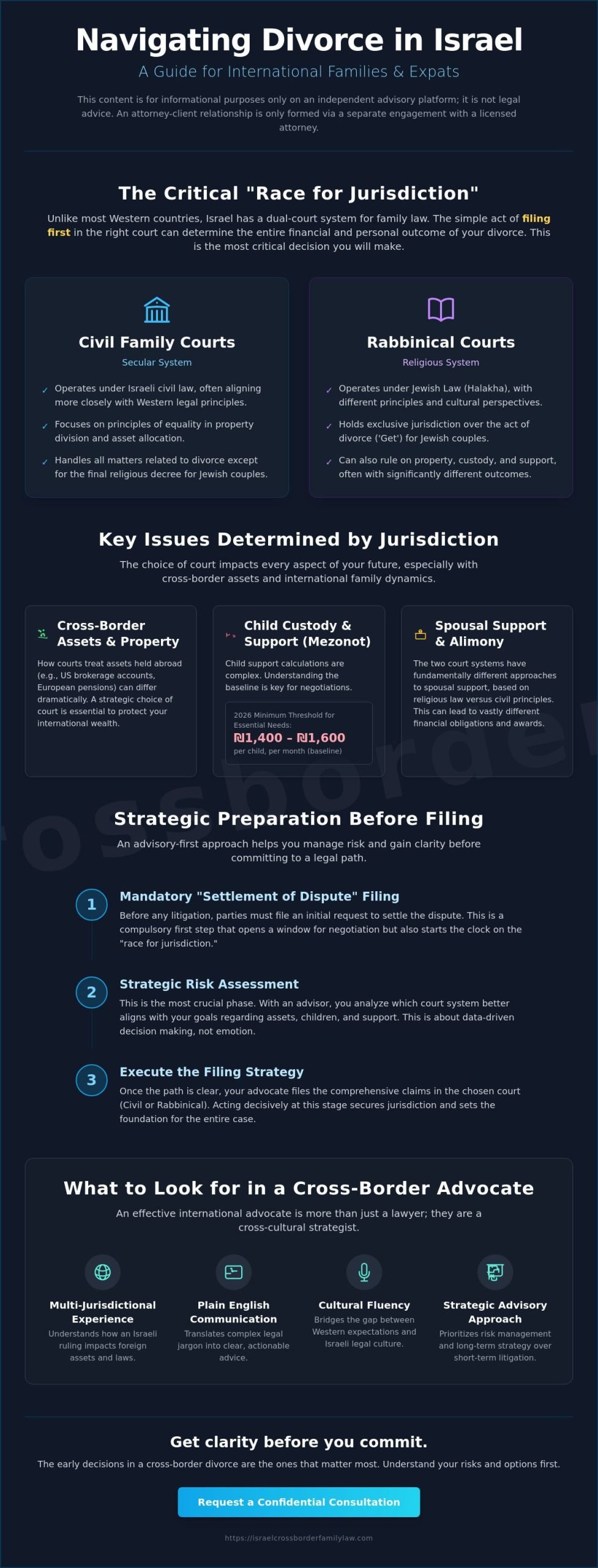
The Divorce Process in Israel involves navigating these two systems simultaneously. While the Rabbinical Court has exclusive jurisdiction over the act of divorce itself for Jewish couples, both courts can hear matters related to property division, child custody, and support. Because each court applies different principles and cultural perspectives, the outcomes can vary significantly. This complexity is why many individuals seek a specialized israeli divorce lawyer to help them understand which venue best protects their specific cross-border interests. Early decisions in this system carry immense weight, often setting the tone for years of litigation or negotiation.
To better understand how these religious courts function and their specific role in your proceedings, watch this helpful video:
The Advisory vs. Advocacy Approach
In a high-stakes international divorce, strategy must always precede action. We advocate for an advisory approach where you gain total clarity on your risks before making any formal commitments to the court. A strategic advisor looks beyond the immediate conflict to see how a ruling in a Jerusalem court might impact assets held in a US brokerage account or a European pension fund. This phase is about risk management rather than just litigation. By understanding the 2026 updates to court fees and the evolving standards for child support, you can make decisions based on data rather than emotion. Remember, this guidance is educational; formal legal representation requires a separate agreement with a practitioner.
Plain English for Complex Systems
Israel operates under “personal status” law, which means your religious identity dictates the laws applied to your marriage and its dissolution. This is a sharp departure from the secular, state-based laws US citizens are accustomed to. You cannot simply rely on the laws of your home state if you are living in IL. An israeli divorce lawyer with cross-cultural fluency is essential because they act as a bridge between these divergent legal cultures. They help translate complex concepts like “Mezonot” (child support) into terms that make sense within your broader financial reality. This is particularly important now that the 2026 minimum threshold for a child’s essential needs has been clarified at ₪1,400 to ₪1,600 per month, a baseline that must be understood before entering any negotiations.
Get clarity before you commit. Request a confidential consultation.
This article is published on an independent advisory platform and must not imply an attorney-client relationship. The content provided here is informational and advisory only; it does not constitute legal representation or legal advice. Legal services are only provided by licensed attorneys under a separate, formal engagement.
The Race for Jurisdiction: Rabbinical Courts vs. Family Courts
In the Israeli legal system, the outcome of a divorce often depends on who reaches the courthouse first. This strategic competition is known as the Race for Jurisdiction, or Merotz HaSamchuyot. It occurs because both the Rabbinical Courts and the Civil Family Courts have the authority to hear matters such as property division, alimony, and child custody. The spouse who initiates the process can choose the venue, provided they follow specific procedural rules. This decision is not merely administrative; it is a high-stakes strategic move that can alter the financial and personal landscape of your future.
A common misconception among expats is that the Rabbinical Court is only relevant for the ultra-religious. In reality, any Jewish couple seeking a divorce in IL must interact with this system to obtain a religious decree. Even if you consider yourself entirely secular, the Rabbinical Court may gain jurisdiction over your financial assets if your spouse “binds” those issues to their initial divorce claim. Because the two court systems apply different legal philosophies, an israeli divorce lawyer must evaluate which venue offers a more predictable path for your specific cross-border situation.
When the Rabbinical Court Takes Authority
The Rabbinical Court has exclusive jurisdiction over the “Get,” which is the formal Jewish divorce decree. Without this document, the state does not recognize the end of the marriage. Beyond the divorce itself, a party can “bind” related matters to the claim, effectively forcing property or support issues into the religious system. This can be risky for international families, as the Rabbinical Court may view spousal support or pre-marital assets through a lens that differs from Western secular standards. Understanding the implications of the “Get” and the potential for sanctions in cases of refusal is a critical part of your initial strategy.
The Role of the Civil Family Court
For many international couples, the Civil Family Court offers a more modern and structured environment. These courts apply secular law and are often viewed as more predictable when handling complex financial portfolios or interfaith matters. If you are part of a non-Jewish or interfaith couple, the Family Court is typically your primary venue. It is also the court that most frequently deals with divorce and separation for international families, particularly when assets are located in multiple countries. Choosing the right court requires a calm assessment of your goals and the specific risks associated with each system. To better understand how these choices impact your specific case, you may want to request a confidential review of your situation.
Get clarity before you commit. Request a confidential consultation.
This article is published on an independent advisory platform (not a law firm) and must not imply an attorney-client relationship. The content provided here is informational and advisory only; it does not constitute legal representation or legal advice. Legal services are only provided by licensed attorneys under a separate, formal engagement.
Cross-Border Complications: Assets, Alimony, and Children
When a family’s life spans multiple countries, the legal friction increases exponentially during a separation. Assets located in the United States or Europe aren’t invisible to Israeli courts. In fact, an israeli divorce lawyer must often navigate how local rulings will interact with foreign financial institutions and international treaties. One of the most challenging areas involves child support cross-border enforcement. US child support orders aren’t automatically recognized in IL; they require a formal process of registration and recognition through the Israeli court system, which can be technically demanding for those unfamiliar with the local bureaucracy.
Israeli courts generally claim jurisdiction over global assets if the couple’s center of life is in Israel. This means your US brokerage accounts, properties in London, or tech company equity are all on the table. The complexity arises when a court in Jerusalem issues an order for an asset held by a bank in New York. Without a strategy that accounts for both legal systems, you may end up with a judgment that’s impossible to enforce abroad. This is why understanding the interaction between these jurisdictions is more important than simply knowing the local law.
International Child Custody and Relocation
The Israeli legal standard is always “the best interests of the child.” While this sounds universal, its application in IL involves specific cultural nuances regarding parental roles. Moving a child across international borders without the explicit, written consent of the other parent or a court order is considered a grave legal violation. Such actions often trigger the Hague Convention on the Civil Aspects of International Child Abduction. Legal experts in 2026 note an evolving global application of these principles, with an increased focus on the child’s “habitual residence” in international custody cases. For a deeper understanding of these high-stakes situations, you should review our resources on Hague Convention child abduction.
Protecting Global Assets and Pensions
Israel follows a principle called “balancing of resources,” which generally means that assets acquired during the marriage are divided equally. However, applying this to US-based 401(k)s, IRAs, or restricted stock units (RSUs) is difficult because Israeli courts lack the direct authority to split a US retirement account. Parties often have to find creative offsetting solutions using local assets or real estate. Full disclosure is vital during this phase. Hiding foreign accounts often leads to future litigation that can reopen a case years after the divorce is finalized. A strategic israeli divorce lawyer works to ensure that the final agreement is enforceable in both jurisdictions, preventing a “hollow” judgment that looks good on paper but cannot be executed in practice.
Get clarity before you commit. Request a confidential consultation.
This article is published on an independent advisory platform (not a law firm) and must not imply an attorney-client relationship. The content provided here is informational and advisory only; it does not constitute legal representation or legal advice. Legal services are only provided by licensed attorneys under a separate, formal engagement.
Strategic Preparation: Steps to Take Before Filing
Preparation is the defining factor between a controlled legal transition and a chaotic cross-border conflict. For international families, the first step is the meticulous collection of financial documentation from both IL and your country of origin. This includes tax returns, brokerage statements, pension valuations, and property deeds. Because Israeli courts use a “balancing of resources” approach, having a clear map of your global footprint allows for a more predictable division of assets. If you’re concerned about the safety of your children or the risk of unauthorized removal from the country, review the protocols of the Hague Convention immediately.
In the Israeli system, “doing nothing” is rarely a neutral choice; it is a high-risk strategy. Waiting for your spouse to act often means forfeiting your ability to choose the court venue. As we discussed regarding the Race for Jurisdiction, the party who files first sets the stage. An israeli divorce lawyer can help you evaluate your position before the clock starts ticking. Early preparation ensures that when the mandatory “Settlement of Dispute” (Ishuv Sichsuch) process begins, you’re operating from a position of data rather than reaction.
The Mandatory Mediation Period
Since 2016, Israel has required couples to participate in a mandatory dispute resolution process before any litigation can proceed. This is managed by court-affiliated “Social Units” (Yechidat HaSiyuah), which consist of social workers and legal professionals. Once a “Settlement of Dispute” application is filed, there’s a 60-day stay of proceedings where neither party can file further claims. This period is not just a formality; it’s a strategic window to build a long-term plan. Use this time to consult with a strategic advisor to ensure your cross-border interests are protected before the stay expires and the path to litigation opens.
Assessing Jurisdictional Advantages
Determining whether your case should be heard in Israel or another jurisdiction, such as a US state, depends heavily on your “center of life.” Residency alone isn’t always enough to establish court authority over international assets. Jurisdiction is the foundation of every cross-border result, and it dictates which laws will apply to your property and your parental rights. A qualified israeli divorce lawyer will analyze your ties to each country to determine where you have the strongest legal standing. If you’re unsure how your residency status impacts your rights, you can reach out for a strategic assessment of your situation.
Get clarity before you commit. Request a confidential consultation.
This article is published on an independent advisory platform (not a law firm) and must not imply an attorney-client relationship. The content provided here is informational and advisory only; it does not constitute legal representation or legal advice. Legal services are only provided by licensed attorneys under a separate, formal engagement.
Finding the Right Advocate: Beyond the Title of “Israeli Divorce Lawyer”
Many individuals believe that hiring the most aggressive israeli divorce lawyer is the best way to secure their future. In international cases, however, high-conflict litigation often backfires. It can lead to the freezing of global bank accounts, long delays in child visitation, and the triggering of expensive international treaties that could have been avoided with a more measured approach. Instead of a “shark,” you need a practitioner who prioritizes risk mitigation and strategic foresight. This is especially true when your assets are spread across different continents. You should look for an advocate who values cross-cultural fluency and understands the nuances of both the IL system and your home country’s laws. Reviewing pricing and advisory structures early on helps you understand how a firm manages complex, multi-jurisdictional files without unnecessary escalations.
The right advocate acts as a bridge between legal cultures. They don’t just know the law; they understand how a ruling in a Rabbinical Court might be perceived by a judge in New York or London. Strategy must always come first. By choosing a lawyer who prioritizes a calm, predictable process over a reactive one, you protect your children from the fallout of a protracted legal battle. This approach is not about being “soft” but about being commercially and strategically aware of the long-term impact of every court filing.
Questions to Ask During a Consultation
When you meet with a potential israeli divorce lawyer, you need to look past the general credentials. The goal is to determine if they have the specific expertise required for a cross-border family matter. Consider asking the following questions to gauge their fit:
- How many US-Israel or international cases have you handled specifically this year?
- How do you handle assets, such as 401(k)s or foreign real estate, that aren’t physically located in IL?
- What is your specific approach to managing the Rabbinical Court vs. Family Court race for jurisdiction?
- How do you coordinate with legal teams in other countries if a parallel proceeding is necessary?
The Importance of Confidential Review
Setting the correct trajectory at the very beginning is the most effective way to avoid a decade of litigation. A confidential review allows you to map out your “center of life” and jurisdictional advantages before any papers are filed. This proactive step prevents the accidental “binding” of assets to a court that may not favor your position. You can see how this structured advisory process simplifies the complexity on our how it works page. By focusing on strategy before action, you ensure that your legal team is working toward a sustainable outcome for your family and your wealth.
Get clarity before you commit. Request a confidential consultation.
This article is published on an independent advisory platform and must not imply an attorney-client relationship. The content provided here is informational and advisory only; it does not constitute legal representation or legal advice. Legal services are only provided by licensed attorneys under a separate engagement.
Securing Your Family’s Future Across Borders
Managing a divorce in IL requires more than just local knowledge; it demands a global strategy. You’ve seen how the strategic race for jurisdiction and the dual-court system can fundamentally shift your financial outcome. Protecting your international assets and ensuring the safety of your children under the Hague Convention are tasks that require foresight and data-driven decision-making. Early action is often the difference between a chaotic conflict and a controlled transition.
Choosing a specialized israeli divorce lawyer who understands the friction between US and Israeli law is your best defense against unpredictability. We specialize in these US-Israel cross-border matters, offering a calm, strategy-based advisory approach to help you navigate international custody and complex financial portfolios. Get clarity before you commit. Request a confidential consultation. You don’t have to face this complexity alone. With the right guidance, you can achieve a stable and predictable path forward for your family.
This article is published on an independent advisory platform and must not imply an attorney-client relationship. The content provided here is informational and advisory only; it does not constitute legal representation or legal advice. Legal services are only provided by licensed attorneys under a separate engagement.
Frequently Asked Questions
Can a US citizen get a divorce in Israel?
Yes, US citizens can divorce in Israel if they meet residency requirements or if their “center of life” is established in IL. For Jewish citizens, the Rabbinical Court holds exclusive jurisdiction over the religious divorce decree, while the Civil Family Court handles matters like property and custody. It’s essential to determine which court system is most appropriate for your international assets before you initiate any formal filings.
What is the “Race for Jurisdiction” in Israeli law?
The “Race for Jurisdiction” is a strategic competition where the first spouse to file a claim determines whether the Rabbinical Court or the Family Court hears the case. Because these two systems apply different legal philosophies to alimony and property division, filing first is often a decisive factor in the outcome. An israeli divorce lawyer can help you evaluate which venue offers a more predictable path for your specific cross-border situation.
Do I need an Israeli divorce lawyer if my spouse filed in the US?
You likely need legal guidance in both countries to ensure your rights are protected across different jurisdictions. If your spouse files in the US, an Israeli court may still claim authority over children or assets located in IL. Coordinating between two legal systems is a complex task; a strategic advisor ensures that a US ruling is actually enforceable in Israel and that your local interests remain secure.
How long does a divorce take in Israel for foreigners?
The timeline varies based on whether the parties reach a mutual agreement or enter contested litigation. A settled divorce can be finalized in a few months, while complex cases involving international assets can last two years or longer. Since 2016, all cases must begin with a mandatory 60-day dispute resolution period, which is a “cooling off” time designed to encourage mediation before any litigation can proceed in the courts.
Can I enforce a US divorce decree in Israel?
A US divorce decree is not automatically recognized in Israel and requires a formal process of registration and recognition. You must file a petition with the Family Court or Rabbinical Court to have the foreign judgment validated locally. This step is critical for child support enforcement or property transfers, as Israeli financial institutions and government agencies will not act on a foreign order without a corresponding Israeli judgment.
What happens to my US property in an Israeli divorce?
Israeli courts apply the “balancing of resources” principle to global assets, meaning property and pensions located in the US are generally included in the division. While an Israeli judge cannot directly order a US bank to transfer funds, they can offset the value of those foreign assets using property located within IL. Full disclosure of all international holdings is necessary to prevent future litigation that could reopen your case years later.
Is child support higher in Israel or the US?
Child support levels depend on the specific income of both parents and the time spent with the children. As of January 2026, the generally accepted minimum in Israel for a child’s essential needs is between ₪1,400 and ₪1,600 per month, excluding housing and extraordinary expenses. An israeli divorce lawyer can help you compare these local baselines against US state guidelines to understand which system provides a more equitable financial framework for your family.
Can I leave Israel with my children during the divorce process?
You cannot leave Israel with your children during a divorce without the explicit written consent of the other parent or a specific court order. Courts often issue an “Exit Delay Order” to prevent the unauthorized removal of children from the country while proceedings are active. Attempting to move children across borders without permission is a violation of the Hague Convention and can lead to severe legal consequences in both IL and the US.

Article by
Gabriel Lior
A Personal Journey That Became a Mission
The advisory was founded by an American father Gabriel Lior, LLB, MBA , global entrepreneur, and cross-border advisor who spent more than a decade navigating the Israeli family court system firsthand and now lives in Singapore with his son.
As a divorced parent in a cross-border family, Gabriel faced nearly every legal challenge a foreign parent can encounter in Israel — including child custody disputes, child support proceedings, property matters in Israel and abroad, false accusations, and complex immigration and relocation proceedings.
Over the years, he learned the hard way how difficult it is for non-Israeli parents to understand the system, identify the right legal strategy, and choose the right legal representation — especially when language, culture, and jurisdictional differences are involved. He also witnessed how foreign parents and new immigrants are often disadvantaged or taken advantage of by service providers and institutions simply because they lack local knowledge or fluency.
From Client to Advisor
To truly understand — and survive — the system, Gabriel pursued formal legal education in Israel, completing two Israeli law degrees, alongside a BA and MBA earned in the United States. This was never about becoming a practicing attorney, but about gaining a deep, structural understanding of how the system works — and where it breaks down for foreign parents.
This rare combination of:
Firsthand client experience
Israeli legal and US business education
International business and negotiation training
Decades of commercial execution
created a unique perspective – one that understands both sides of the table.
After years of litigation, persistence, and at times self-representation, he ultimately succeeded in securing custody of his son and relocating abroad through a rare legal victory in the Israeli Supreme Court — becoming one of the first fathers in Israel to do so under these circumstances.
Disclaimer
Important Disclaimer:
The information provided on this website and in its content is for general informational and educational purposes only and does not constitute legal advice, legal opinion, or legal representation.
Gabriel Lior is not licensed to practice law in Israel (nor is he interested in doing so) and does not provide legal services, despite having completed 2 Law Degrees. The services offered are advisory in nature and are intended to provide general guidance, strategic insight, and information regarding cross-border family law considerations.
No attorney-client relationship is formed by accessing this website, reading its content, or communicating with us.
Any decisions made based on this information are at your own discretion and risk. For legal advice specific to your situation, you should consult a licensed attorney in the relevant jurisdiction.
Where appropriate, we may refer clients to independent, licensed attorneys or professionals. Such referrals do not constitute legal representation and no liability is assumed for services provided by third parties.