This article is published on an independent advisory platform and is not a law firm. This content is for informational and advisory purposes only; it does not constitute legal representation or legal advice. Legal services are only provided by licensed attorneys under a separate, formal engagement.
Last year, an American expat living in Neve Tzedek realized that a single afternoon filing in the Rabbinical court had fundamentally shifted the trajectory of his divorce and his rights to property held in Florida. This situation isn’t an outlier. Many international residents find themselves caught between two competing court systems without a clear map of the risks involved. Securing a family law attorney tel aviv english speaking specialist who understands these bicultural nuances is often the first step toward regaining control over a chaotic situation.
You’ve likely worked hard to build a life in Israel, and it’s frustrating to feel like your assets and family stability are at the mercy of a language barrier or a legal “race to jurisdiction” you don’t fully understand. This guide provides the strategic clarity you need to bridge the gap between the Israeli system and your home country’s laws. We’ll explore the critical differences between Civil and Rabbinical courts, how to handle multi-jurisdictional assets, and the steps you can take to minimize conflict while living abroad. For more visual insights, you can also explore the resources available at the IsraelFamilyLaw YouTube channel.
Get clarity before you commit. Request a confidential consultation.
Key Takeaways
- Understand how the “race for jurisdiction” between Rabbinical and Civil courts can dictate the trajectory and final outcome of your legal proceedings.
- Identify the complexities of managing cross-border assets, such as Israeli tech options and foreign real estate, within the local legal framework.
- Learn how to properly vet a family law attorney tel aviv english speaking professional based on their mastery of legal English and international treaty knowledge.
- Discover why a strategic, risk-based approach to litigation is more effective for protecting international family interests than emotional decision-making.
- Gain clarity on the procedural requirements for enforcing international court orders and navigating the unique challenges faced by the Anglo expat community.
Navigating Family Law in Tel Aviv as an English Speaker
This article is published on an independent advisory platform and does not imply an attorney-client relationship. Legal services are only provided by licensed attorneys under a separate engagement.
Tel Aviv serves as the primary hub for Israel’s “Anglo” expat community, creating a unique legal micro-climate. While the city feels international, the legal reality remains firmly rooted in Hebrew statutes and local traditions. For an expat, finding a family law attorney tel aviv english speaking is a necessity, not a luxury. Simple translation isn’t enough when your life is split between two countries. Legal concepts don’t always have a direct equivalent in English; a word-for-word translation can lead to dangerous misunderstandings regarding your rights or obligations. This is especially true for families with US-Israel interests, where tax implications and jurisdictional overlaps require a nuanced strategy rather than a basic dictionary.
To better understand the practical side of this profession, watch this helpful video:
The Role of an English-Speaking Advisor
An advisory approach focuses on bridging the gap between your expectations and the Israeli reality. Traditional legal representation often focuses on the “what,” but an advisor explains the “why” in plain English. It’s about clarity. You might hear terms like “Get,” which refers to a religious divorce decree, or “Mazon,” which covers child support and maintenance. Without a clear explanation, these terms can feel alien. An advisor ensures you understand that “Mazon” in Israel can include specific costs like housing and extracurriculars that differ from standard US child support models. This guidance helps you manage the inherent complexity of cross-border situations without the stress of a language barrier.
Understanding the Tel Aviv Legal Environment
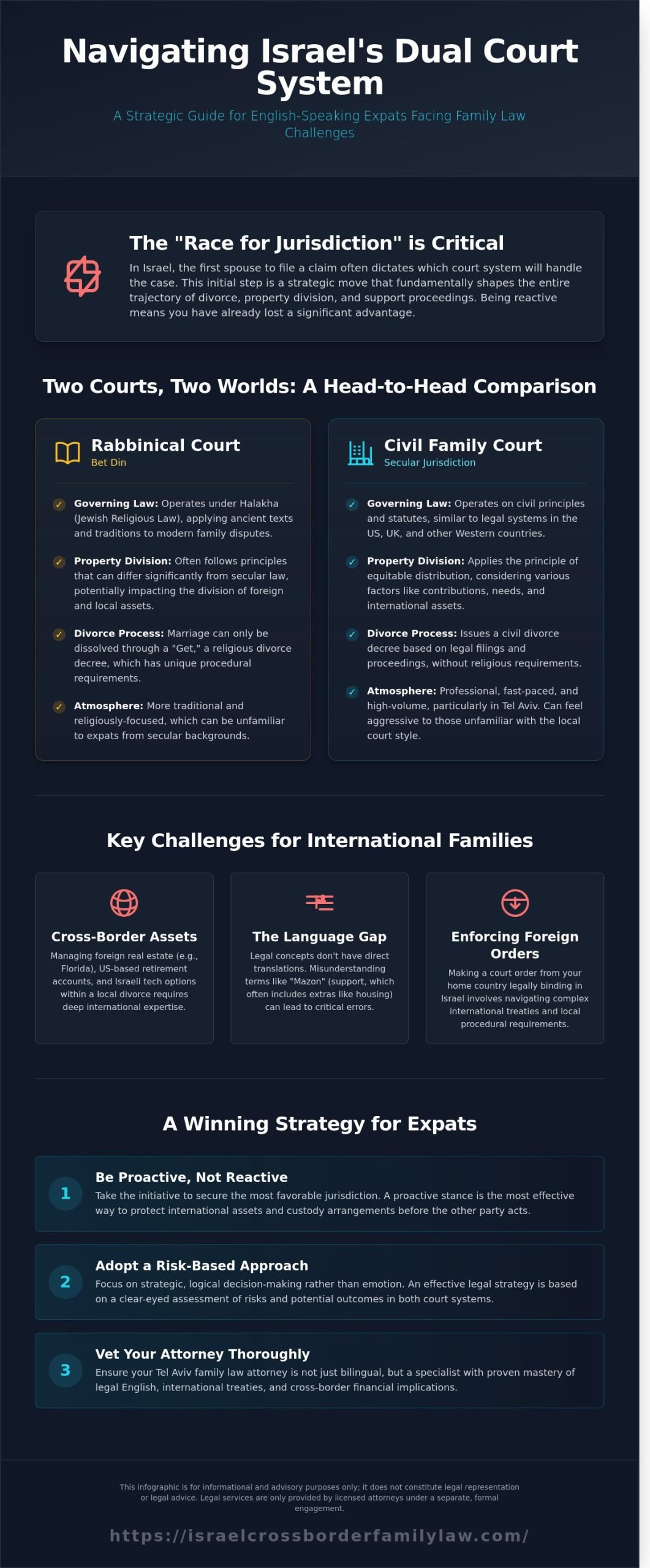
The Tel Aviv Family Courts are known for being fast-paced and high-volume. The atmosphere is professional but can feel aggressive to those used to a more reserved court style. In this environment, you must deal with The Dual Court System in Israel, where civil family courts and religious rabbinical courts often have concurrent jurisdiction. This creates a “race to the court” dynamic. If you’re reactive, you’ve already lost the advantage. For foreigners, a proactive stance is the only way to protect international assets or custody arrangements. It’s vital to take the right initial steps for expats to ensure your case is heard in the most favorable venue. Working with a family law attorney tel aviv english speaking allows you to navigate these cultural nuances with confidence.
Get clarity before you commit. Request a confidential consultation.
The Dual Court System: Rabbinical vs. Civil Jurisdictions
Israel operates under a unique legal structure where two distinct court systems hold power over family matters. The secular Family Court and the religious Rabbinical Court (Bet Din) possess parallel authority. For an expat, this duality is often the most confusing aspect of the legal journey. While the Family Court operates on civil principles similar to those in the UK or US, the Rabbinical Court applies Halakha, or Jewish law. Understanding how these systems interact requires the guidance of a family law attorney tel aviv english speaking who can bridge the cultural and linguistic gap.
The 2014 Law for the Settlement of Disputes in Family Matters mandates a stay of proceedings while parties attend mandatory mediation (Mahut) sessions, but the underlying jurisdictional conflict remains. International families are frequently caught off guard by the fact that religious courts have a say in their personal lives. This involvement is not optional; it’s a fundamental part of the Israeli legal fabric that applies to all Jewish residents, regardless of their level of religious observance.
The ‘Race for Jurisdiction’ Explained
The “Race for Jurisdiction” is a critical concept that dictates which court system will hear your case. The first party to validly file a claim in one of these courts generally determines which system oversees the majority of the dispute, including property division and spousal support. If one spouse files a comprehensive divorce claim in the Rabbinical Court first, that court may gain jurisdiction over the entire matter. Waiting even a few days to seek advice can result in your case being heard in a forum that doesn’t align with your strategic interests. You can learn more about how these early decisions impact international families and their long-term outcomes.
Religious vs. Secular Law in Family Matters
Religious courts hold exclusive jurisdiction over the act of marriage and divorce itself for Jewish citizens and residents. This means the “Get” (religious divorce decree) must pass through the Rabbinical system. Other matters, such as child custody or asset distribution, can be moved to the civil Family Court if both parties consent or if the civil file is opened first. For English speakers, navigating these sensitivities without a Hebrew-first background is daunting. The procedures are strict; the nuances of religious law can significantly affect alimony calculations or the division of cross-border assets.
Strategic implications vary significantly between the two systems. For instance, the Rabbinical Court may approach “rehabilitation alimony” differently than a secular judge who focuses on modern economic parity. Decisions made in the first 48 hours of a dispute often set the trajectory for years of litigation. A family law attorney tel aviv english speaking helps ensure that your rights are protected in both arenas while managing the complex paperwork required in Hebrew. Request a confidential consultation to get clarity before you commit to a specific legal path.
Evaluating Cross-Border Legal Needs: Israel vs. the United States
For families living between Tel Aviv and major US hubs like New York or California, legal issues don’t stop at the border. Assets often span multiple jurisdictions. You might own a condo in Brooklyn while your spouse holds vested stock options in a Herzliya “start-up nation” unicorn worth ₪2,500,000. Managing these complexities requires a family law attorney tel aviv english speaking professional who understands the friction between these two legal systems.
Enforcing US court orders within the Israeli system isn’t automatic. Under the Enforcement of Foreign Judgments Law of 1958, a foreign decree must meet specific criteria to be recognized by Israeli courts. This is particularly challenging when US orders use legal “shorthand” that doesn’t exist in Israel. An effective attorney must bridge this gap, translating concepts like “equitable distribution” or “QDROs” into terms the Israeli Family Court can implement. Without this bicultural expertise, your financial interests or parental rights can be compromised during the transition between countries.
International child custody remains the most sensitive cross-border issue. When a parent moves a child across borders without explicit consent, it may trigger the Hague Convention on Child Abduction. These cases are high-stakes and operate on strict timelines. Strategy matters from day one.
Asset Protection and Financial Agreements
In Israel, a “Financial Agreement” (Heskem Mamon) is the primary tool for asset protection, yet it differs significantly from a US prenuptial agreement. Under the Spouses (Property Relations) Law of 1973, these agreements must be validated by an Israeli court or a notary to be legally binding. For high-net-worth individuals, dual-jurisdiction drafting is essential. This ensures the document stands up to scrutiny in both a US state court and the Israeli Rabbinical or Family Court systems. Specific attention must be paid to pension funds and Social Security benefits, as their treatment in a divorce varies wildly between the two nations.
International Custody and Relocation
Israeli law prioritizes “The Best Interests of the Child,” a standard that is often interpreted through a different cultural lens than in the US. While US courts might favor a 50/50 physical custody split, Israeli courts traditionally leaned toward the “Tender Years Presumption,” though this is evolving. If you are facing a dispute regarding moving children between countries, you need specific guidance on international custody relocation. Israeli courts are often cautious about allowing relocation if it significantly diminishes the child’s connection to the parent remaining in Israel.
Get clarity before you commit. Request a confidential consultation.
How to Vet an English-Speaking Family Attorney in Tel Aviv
Selecting a family law attorney tel aviv english speaking requires looking past basic conversational fluency. Many practitioners in Israel claim to be proficient in English, yet few possess the specialized “Legal English” necessary to draft documents that satisfy both Israeli courts and foreign jurisdictions. It’s not just about speaking; it’s about the ability to translate complex Hebrew legal concepts like Isun Mashabim (balancing of resources) into terms an expat or a foreign court can actually understand.
You should prioritize an attorney who understands the 1975 US-Israel Income Tax Treaty. This document is vital when assets like 401(k) plans, Social Security benefits, or RSUs from the Tel Aviv high-tech sector are involved. If your spouse holds equity in a startup, the impact of a merger or acquisition on your divorce settlement is a technical matter, not just a legal one. Your counsel must be able to explain these financial intersections without losing the nuance in translation.
A Vetting Checklist for Expats
- Knowledge of US State Nuances: Does the attorney recognize the difference between California’s community property rules and New York’s equitable distribution? While they practice Israeli law, they must understand how their strategy affects your standing in your home state.
- Evidence Translation: Ask how they handle sensitive evidence like WhatsApp messages or bank statements. Professional, certified translation is mandatory to ensure the “voice” of the evidence isn’t lost when presented to an Israeli judge.
- Independent Collaboration: Are they willing to work with an outside expert to ensure your global interests are protected? You can learn more about how this coordination functions by reviewing how the advisory process works.
Communication and Transparency
Expats often find the Israeli legal culture to be more aggressive than what they are used to in London or New York. You should look for a “team on the ground” that favors a calm, advisory tone. This approach helps de-escalate conflict, which is often more cost-effective than a “litigation-first” mindset. Ensure the firm provides billing and reporting in English so you aren’t left guessing about costs or case progress. For a better visual understanding of these dynamics, you can view educational resources on the Israel Family Law YouTube channel.
Watch out for red flags. If a lawyer guarantees a specific outcome or uses high-pressure sales tactics, it’s a sign to walk away. The Israeli family court system is discretionary; no one can promise a win. Instead, look for an attorney who speaks in terms of risks, strategies, and probabilities. This transparency is the only way to make an informed decision when your family’s future and your global assets are at stake.
Get clarity before you commit. Request a confidential consultation.
This article is published on an independent advisory platform (not a law firm). The information provided is for informational and advisory purposes only and does not constitute legal representation or an attorney-client relationship. Legal services are only provided by licensed attorneys under a separate engagement.
Strategic Support for International Families in Israel
The Israel Cross Border Law Firm serves as a strategic bridge for families who find themselves caught between different legal cultures and expectations. For an expat, the Israeli legal system can feel opaque; the procedural norms in the Family Court or the Rabbinical Court often differ significantly from those in the U.S., UK, or Canada. Choosing a family law attorney tel aviv english speaking expats can rely on is about more than just translation. It is about finding a guide who understands the bicultural nuances of your situation.
Strategic decision-making must prioritize risk management over emotional litigation. While the impulse to “win” in court is natural during a separation, emotional litigation is frequently a losing financial strategy. In Israel, contested proceedings can easily cost upwards of ₪60,000 in initial legal fees alone, with costs climbing as cases drag on for years. We encourage families to look at the data and the long-term financial impact before filing aggressive motions. Seeking clarity before making any legal commitments in Israel is the most effective way to protect your assets and your children’s future.
The Advisory Advantage
Our approach focuses on strategy and risk management rather than simply reacting to court dates. We integrate your legal, financial, and personal goals into a single, cohesive plan. This is especially vital for international families with assets in multiple jurisdictions or complex residency statuses. By maintaining a neutral, educational stance, we help confused expats understand the “why” behind Israeli legal procedures. This advisory model removes the pressure of the “litigation trap,” where parties feel forced into conflict. Instead, we provide a clear map of your options, allowing you to move forward with confidence and a “team on the ground” that understands your specific cultural background.
Next Steps for Your Family
A proactive approach is always superior to a reactive one. This applies to divorce and separation, but it is equally critical for inheritance and estate planning. Early strategic intervention can drastically alter final settlements; for example, addressing jurisdictional issues within the first 30 days of a dispute can prevent years of cross-border litigation. A family law attorney tel aviv english speaking professionals trust will ensure you don’t sign documents you don’t fully understand. If you’re ready to move forward, we recommend starting with a confidential review of your situation to identify potential risks before they escalate.
You can learn more about how it works or begin the process by requesting a confidential case review. Get clarity before you commit. Request a confidential consultation.
Protecting Your Interests in a Cross-Border Environment
Navigating the Israeli legal landscape requires more than just a basic understanding of local statutes. It demands a strategic approach to the dual court system, where the choice between Rabbinical and Civil jurisdictions can significantly impact the final outcome of your case. For expats and international families, these decisions are often complicated by cross-border assets and multi-jurisdictional ties. You’ll need to weigh the risks of different legal strategies early in the process to avoid long-term complications.
Partnering with a family law attorney tel aviv english speaking professional ensures you have a guide who understands the cultural nuances of the Israeli marketplace while maintaining a deep connection to global legal standards. An advisory-first approach focuses on risk management and clear communication, helping you bridge the gap between complex legal systems. By prioritizing clarity and informed decision-making, you can protect your interests and your family’s well-being in a new environment.
Get clarity before you commit. Request a confidential consultation.
Taking the time to understand your options is the most effective way to manage the challenges of a cross-border life. You’re now better prepared to make choices that serve your family’s long-term interests.
This article is published on an independent advisory platform (not a law firm) and does not imply an attorney-client relationship. All legal services are only provided by licensed attorneys under a separate engagement. Get clarity before you commit. Request a confidential consultation.
Frequently Asked Questions
Is a US prenuptial agreement enforceable in a Tel Aviv court?
An American prenuptial agreement is generally enforceable in Israel if it meets the specific criteria outlined in the 1973 Spouses’ Financial Relations Law. You must have the document validated by an Israeli Family Court to ensure its terms don’t conflict with local public policy or mandatory statutes. Expats often find that while the contract is valid, certain clauses regarding real estate in Tel Aviv require specific local registration to be fully recognized. It’s essential to have a professional review your US agreement to confirm it aligns with Israeli legal standards.
Can I divorce in Israel if my spouse lives in the United States?
You can file for divorce in Israel even if your spouse resides in the US, provided the Israeli court establishes jurisdiction over the marriage. Under the Rabbinical Courts Jurisdiction Law of 1953, the court considers factors like your current residency status and whether Israel is the center of your life. Serving legal papers to a spouse in the US requires strict adherence to international treaties like the Hague Service Convention to ensure the Israeli ruling is recognized abroad. This process ensures that your global assets and parental rights are handled within a single, cohesive legal framework.
What is the ‘Race for Jurisdiction’ and how does it affect me?
The “Race for Jurisdiction” refers to the dual-court system in Israel where both the Family Court and the Rabbinical Court have authority over divorce matters. The court where the case is filed first usually gains the exclusive right to decide on related issues like alimony and asset division. Consulting a family law attorney tel aviv english speaking expert is vital because the legal outcomes can vary significantly depending on which court system takes the lead. Making an informed decision about where to file is one of the most critical steps in your international divorce strategy.
Do I need a separate lawyer for my assets in the US and my assets in Israel?
It’s highly recommended to have legal counsel in both jurisdictions to manage complex cross-border portfolios and ensure compliance with different tax codes. An Israeli lawyer handles the local litigation and property transfers, while a US-based attorney ensures compliance with IRS regulations and state-specific property laws. This collaborative approach prevents conflicting rulings that could lead to double taxation or the loss of retirement accounts like 401(k)s. Having a team on the ground in both locations provides a seamless professional home for your global interests.
How is child support calculated for international families in Israel?
Child support is calculated based on the 1959 Family Law Amendment (Maintenance), which evaluates the specific needs of the child and the income of both parents. For international families, the court may adjust these figures to account for the higher cost of living in cities like Tel Aviv compared to certain US regions. The system shifted significantly following Supreme Court Case 919/15, which established more gender-neutral guidelines for children over age six in joint custody. These calculations are complex and require a sophisticated understanding of both parents’ global financial standing.
Can an Israeli court order the return of a child to the US under the Hague Convention?
Israeli courts strictly enforce the 1980 Hague Convention on the Civil Aspects of International Child Abduction to prevent the wrongful removal of children across borders. Since Israel joined the convention in 1991, the courts aim to return children to their country of habitual residence within a target window of six weeks. Exceptions are rare and usually involve a proven “grave risk” to the child’s safety, as defined by international standards. Because these cases move rapidly through the system, immediate strategic planning is essential for any parent involved in a relocation dispute.
What are the costs associated with hiring a cross-border family law expert?
Costs include mandatory court filing fees, which often range from ₪500 to over ₪3,000 depending on the specific motion, and professional fees for multi-jurisdictional strategy. You should also budget for official translations and apostille certifications required for US documents to be accepted by Israeli authorities. Engaging a family law attorney tel aviv english speaking professional ensures that you avoid the financial drain of procedural errors that are common in international litigation. For more detailed explanations on managing these costs, you can view resources on our YouTube channel at https://www.youtube.com/@IsraelFamilyLaw.
How long does the average international divorce take in the Tel Aviv system?
A contested international divorce in the Tel Aviv Family Court typically takes between 12 and 24 months to reach a final judgment. Cases involving child custody disputes or assets located in multiple US states can extend this timeline due to the need for international evidence and expert testimony. It’s important to remember that early decisions regarding jurisdiction can either expedite or delay the process significantly. Getting clarity through a structured strategy early on helps you navigate the system efficiently and reduces the overall duration of the legal proceedings.

Article by
Gabriel Lior
A Personal Journey That Became a Mission
The advisory was founded by an American father Gabriel Lior, LLB, MBA , global entrepreneur, and cross-border advisor who spent more than a decade navigating the Israeli family court system firsthand and now lives in Singapore with his son.
As a divorced parent in a cross-border family, Gabriel faced nearly every legal challenge a foreign parent can encounter in Israel — including child custody disputes, child support proceedings, property matters in Israel and abroad, false accusations, and complex immigration and relocation proceedings.
Over the years, he learned the hard way how difficult it is for non-Israeli parents to understand the system, identify the right legal strategy, and choose the right legal representation — especially when language, culture, and jurisdictional differences are involved. He also witnessed how foreign parents and new immigrants are often disadvantaged or taken advantage of by service providers and institutions simply because they lack local knowledge or fluency.
From Client to Advisor
To truly understand — and survive — the system, Gabriel pursued formal legal education in Israel, completing two Israeli law degrees, alongside a BA and MBA earned in the United States. This was never about becoming a practicing attorney, but about gaining a deep, structural understanding of how the system works — and where it breaks down for foreign parents.
This rare combination of:
Firsthand client experience
Israeli legal and US business education
International business and negotiation training
Decades of commercial execution
created a unique perspective – one that understands both sides of the table.
After years of litigation, persistence, and at times self-representation, he ultimately succeeded in securing custody of his son and relocating abroad through a rare legal victory in the Israeli Supreme Court — becoming one of the first fathers in Israel to do so under these circumstances.
Disclaimer
Important Disclaimer:
The information provided on this website and in its content is for general informational and educational purposes only and does not constitute legal advice, legal opinion, or legal representation.
Gabriel Lior is not licensed to practice law in Israel (nor is he interested in doing so) and does not provide legal services, despite having completed 2 Law Degrees. The services offered are advisory in nature and are intended to provide general guidance, strategic insight, and information regarding cross-border family law considerations.
No attorney-client relationship is formed by accessing this website, reading its content, or communicating with us.
Any decisions made based on this information are at your own discretion and risk. For legal advice specific to your situation, you should consult a licensed attorney in the relevant jurisdiction.
Where appropriate, we may refer clients to independent, licensed attorneys or professionals. Such referrals do not constitute legal representation and no liability is assumed for services provided by third parties.