For an expatriate parent, the prospect of a child custody dispute within Israel’s legal system can be a source of significant anxiety. The fear of navigating unfamiliar court procedures, compounded by concerns over potential judicial bias and the complexities of international treaties, creates a formidable challenge. Securing expert guidance from a specialized child custody lawyer for expats in Israel is the foundational step toward safeguarding your parental rights and ensuring a stable future for your child. These multi-jurisdictional matters require a sophisticated legal strategy, one that anticipates issues from relocation rights to the application of the Hague Convention. This comprehensive guide is engineered to provide that strategic clarity. We will navigate the intricate landscape of Israeli family law for non-citizens, outlining the critical factors that influence court decisions and detailing the essential qualities of an effective cross-border legal advocate. Our objective is to equip you with the confidence and knowledge necessary to protect your relationship with your child and achieve a fair, favorable, and lasting custody arrangement.
Understanding Child Custody in Israel: Key Principles for Expats
Navigating child custody proceedings in Israel as an expatriate requires a foundational understanding of the legal principles that guide the Family Courts. The entire statutory framework is built upon one central, overriding doctrine designed to be neutral regarding a parent’s gender, religion, or nationality. An experienced child custody lawyer for expats in israel can provide critical guidance in interpreting how these principles apply to complex, cross-border family situations. To better understand these core concepts, the following video offers a valuable overview for expatriates:
The ‘Best Interests of the Child’ Doctrine
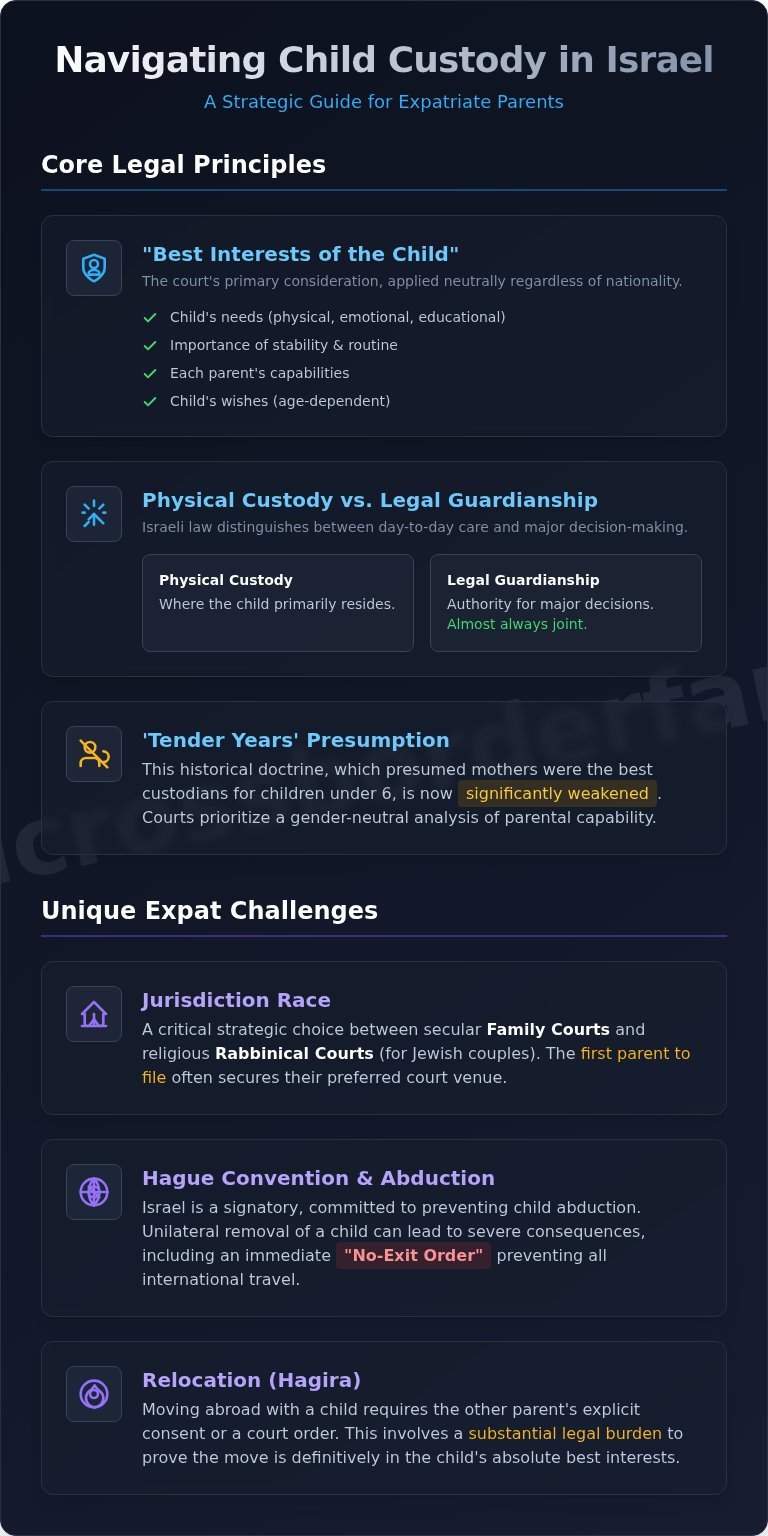
The paramount consideration in any custody determination by an Israeli court is the “best interests of the child” (Tovat HaYeled). This principle empowers judges with significant discretion to craft a custody arrangement that best serves a child’s welfare. The court undertakes a comprehensive evaluation of multiple factors, including:
- The child’s physical, emotional, and educational needs.
- The importance of maintaining stability and routine in the child’s life.
- Each parent’s demonstrated ability and capacity to provide for those needs.
- The child’s own wishes, depending on their age and maturity.
Crucially for expatriates, this assessment is applied regardless of a parent’s country of origin.
Physical Custody vs. Legal Guardianship (Apótropus)
It is essential to distinguish between two types of custody. Physical custody (mishmoret) refers to where the child primarily resides and the day-to-day parenting schedule. In contrast, legal guardianship (apótropus) is the authority to make major decisions concerning the child’s life, such as education, significant medical care, and international travel. Israeli law presumes that both parents are natural guardians, and courts almost universally grant joint legal guardianship, ensuring both parents retain their decision-making rights. This shared responsibility also relates to financial obligations, which are governed by specific Israeli Child Support Laws that can present unique challenges for expats.
The ‘Tender Years’ Presumption (Chazakat HaGil HaRach)
A common misconception, particularly among those familiar with older legal standards, is the continued relevance of the ‘Tender Years’ Presumption. This historical doctrine presumed that mothers were the most suitable primary custodians for children under the age of six. However, a series of landmark court rulings and legislative reforms have significantly weakened this presumption. While it has not been formally abolished, contemporary courts now prioritize a gender-neutral analysis of individual parental capability and the specific family dynamic, making it a far less decisive factor than it once was.
Unique Challenges Expats Face in Israeli Custody Cases
Navigating a child custody dispute is an inherently stressful experience, but for expatriates in Israel, this challenge is magnified by a complex legal system, cultural differences, and international laws. The stakes are exceptionally high when your connection to your home country and your relationship with your child hang in the balance. Understanding these unique obstacles is the first step toward building a successful legal strategy, underscoring the necessity of engaging a specialized child custody lawyer for expats in Israel who possesses deep, cross-border expertise.
Jurisdiction: Family Court vs. Rabbinical Court
Israel operates a dual legal system for family law, a critical factor that can determine the entire trajectory of your case. The secular Family Courts have broad jurisdiction over custody matters for all citizens and residents. However, for Jewish couples, the religious Rabbinical Courts hold concurrent jurisdiction over matters of marriage and divorce, which often includes custody. The “race to jurisdiction”-where the first to file in their preferred court often secures that venue-is a serious strategic consideration with profound implications for the outcome.
The Hague Convention and International Child Abduction
As a signatory to the Hague Convention on the Civil Aspects of International Child Abduction, Israel is legally committed to preventing the wrongful removal of a child from their country of habitual residence. This international treaty provides a powerful legal mechanism for the swift return of an abducted child. Consequently, any attempt by one parent to unilaterally remove a child from Israel can lead to severe legal repercussions, including the immediate issuance of a ‘no-exit’ order, which legally bars both the parent and child from leaving the country.
Relocation (Hagira): Moving Home With Your Child
For many expats, the ultimate goal is to return to their home country with their child. In Israel, this process, known as Hagira (relocation), is highly complex and contentious. A parent cannot legally leave Israel with their child without either the express written consent of the other parent or a specific court order granting permission. The legal burden on the parent wishing to relocate is substantial, as they must prove to the court that the move is definitively in the child’s best interests. The court meticulously considers numerous factors, including:
- The age of the child and their established connections in Israel.
- The viability of maintaining a meaningful relationship with the non-relocating parent.
- The reasons for the proposed move and the quality of life offered in the new country.
Facing a relocation issue? Consult with our experts immediately.
Why a Standard Israeli Family Lawyer Is Not Enough for Expats
While any qualified Israeli family lawyer can navigate domestic custody disputes, the legal landscape for expatriates is fundamentally different. Cross-border family law introduces layers of complexity that demand more than a general understanding of the Israeli legal system. Engaging a legal representative without specific international experience can lead to critical oversights and strategic disadvantages. The distinction lies in the ability to manage multi-jurisdictional issues, where a deep understanding of international treaties and foreign legal frameworks is not an advantage, but a necessity. A specialist provides a decisive edge by anticipating challenges unique to expats. This is why engaging a dedicated child custody lawyer for expats in Israel is a strategic imperative for protecting your parental rights and your child’s best interests across international borders.
Navigating Conflicting International Laws and Decrees
Expat custody cases frequently involve legal documents originating from outside Israel. A foreign prenuptial agreement, a U.S. custody order, or a European divorce decree may not be automatically enforceable. A specialist possesses the procedural knowledge required to have these foreign documents recognized and validated by Israeli courts. Furthermore, issues surrounding dual citizenship can create conflicting legal obligations, requiring sophisticated legal counsel to navigate which jurisdiction’s laws take precedence in matters of support, guardianship, and inheritance.
Experience with the Hague Convention and Relocation Cases
Cases involving international child relocation or abduction fall under the Hague Convention, a highly specialized and time-sensitive area of international law. These matters require a unique skill set that a standard family lawyer rarely possesses. An experienced child custody lawyer for expats in Israel will have a proven track record in:
- Presenting compelling evidence to the court about the child’s life and opportunities in your home country.
- Coordinating seamlessly with legal counsel in other jurisdictions to build a cohesive, multi-national legal strategy.
- Navigating the expedited and stringent procedural requirements of Hague Convention applications.
This expertise is crucial in securing permission to relocate with your child or in defending against an unlawful retention.
Bilingual and Bicultural Communication
Effective representation extends beyond legal filings. It requires clear, unambiguous communication. A lawyer who is fluent in English can explain the complex nuances of Israeli family law without simplification, ensuring you are fully informed at every stage. More importantly, a bicultural attorney understands the subtle cultural dynamics that can influence negotiations and court proceedings. This ensures that your position is articulated effectively and that nothing critical is ‘lost in translation’-either legally or culturally.
How a Specialized Expat Custody Lawyer Protects Your Rights
Navigating the Israeli family court system requires more than just legal knowledge; it demands a sophisticated understanding of the cross-border complexities inherent in expat life. When your children’s well-being is at stake, engaging a dedicated child custody lawyer for expats in Israel is the critical first step in transforming uncertainty into a clear, actionable strategy. Our firm provides the robust legal framework and strategic counsel necessary to protect your parental rights and secure your child’s future.
Developing a Strategic Case Plan
Our process begins with a comprehensive assessment of your unique international circumstances. We meticulously analyze factors such as dual citizenship, residency status, and the applicability of international treaties like the Hague Convention. This allows us to identify key legal arguments, anticipate potential challenges from the opposing party, and establish realistic, achievable goals for custody, visitation schedules (sidurei re’iya), and financial support.
Negotiating Parenting Plans and Visitation
The cornerstone of a successful outcome is a meticulously drafted parenting plan that addresses the practical realities of an expat family. We focus on negotiating comprehensive agreements that proactively resolve future conflicts. Key provisions often include:
- Detailed schedules for school terms, national holidays, and summer vacations.
- Clear protocols for international travel, including passport control and consent letters.
- Stipulations for virtual communication (e.g., video calls) to maintain strong parent-child bonds across distances.
Where possible, we leverage mediation to achieve amicable, durable solutions that prioritize the child’s stability and minimize courtroom conflict.
Litigation and Courtroom Representation
Should litigation become necessary, our firm offers formidable representation in Israel’s Family Courts. We manage the precise preparation and filing of all legal documents, ensuring full compliance with procedural requirements. In the courtroom, we articulate your case with clarity and conviction, presenting compelling evidence to the judge. When beneficial, we leverage a network of trusted expert witnesses, such as child psychologists, to provide authoritative testimony on the child’s best interests. Ultimately, our objective is to provide you with peace of mind. By entrusting your case to a specialist legal team, you gain a strategic partner dedicated to navigating every nuance on your behalf. We are committed to securing a stable and positive future for you and your children. Contact our firm to discuss how we can protect your rights.
The Process: What to Expect When Working With Our Firm
Navigating a cross-border child custody dispute in the Israeli legal system can be a complex and formidable challenge. The uncertainty of the process often adds significant stress to an already difficult situation. Our firm is committed to demystifying this journey by providing a structured, transparent, and strategic approach. As a leading child custody lawyer for expats in Israel, we have refined a four-step process designed to provide clarity, manage expectations, and vigorously pursue your objectives, whether through amicable negotiation or assertive litigation.
Step 1: The Confidential Consultation
Your engagement with our firm begins with a comprehensive and confidential consultation. This is a critical opportunity for you to discuss the specific circumstances of your case with an experienced attorney. We will actively listen to understand your concerns, assess the multi-jurisdictional elements involved, and provide an initial, candid evaluation of your legal standing and potential options under Israeli law. You will leave this meeting with a clear understanding of your rights and the pathways available to you.
Step 2: Strategy and Document Preparation
Following the initial consultation, we proceed to the strategic phase. This involves a meticulous process of information gathering, including financial records, communication logs, and the proper authentication of foreign documents for use in Israeli courts. Based on this evidence and your specific goals, we formulate a bespoke legal strategy. Our team then prepares all necessary initial court filings or negotiation proposals, ensuring every document is crafted to position your case for the strongest possible outcome.
Step 3: Negotiation, Mediation, or Litigation
With a clear strategy in place, we advance your case. Our primary objective is often to achieve a favourable resolution efficiently, exploring settlement through skilled negotiation or formal mediation. We will represent you in all communications, protecting your interests while seeking common ground. However, should an amicable agreement prove unattainable, our role as your child custody lawyer for expats in Israel is to advocate for you and your child’s best interests vigorously and tenaciously within the Family Court system.
Step 4: Finalizing Agreements and Court Orders
The final stage is dedicated to formalizing the resolution. Whether your case is settled through agreement or decided by a judge, we ensure the outcome is memorialized in a meticulously drafted, legally binding document. We will secure the final judgment from the court and advise you on the critical next steps for the implementation and enforcement of the court’s orders, providing you with the legal certainty required to move forward. If you are ready to take the first step, we invite you to contact our firm to schedule a consultation.
Secure Your Parental Rights with Specialized Cross-Border Counsel
Navigating the complexities of an international child custody dispute requires more than a general understanding of Israeli family law. As an expatriate, you face a distinct set of multi-jurisdictional challenges where issues of international relocation and the Hague Convention are paramount. Therefore, engaging the right child custody lawyer for expats in israel is not merely an option-it is a critical necessity for safeguarding your relationship with your child and ensuring your rights are vigorously defended across borders. Our firm is uniquely positioned to provide this sophisticated level of representation. With extensive experience in high-stakes US-Israel cross-border custody cases, our bilingual attorneys, fluent in both English and Hebrew, offer the nuanced guidance required to navigate these sensitive matters. We possess a deep, practical understanding of international relocation law and are prepared to advocate powerfully on your behalf. We invite you to Schedule a Confidential Consultation to Protect Your Parental Rights and take the first decisive step toward securing your family’s future with confidence.
Frequently Asked Questions: Navigating Expat Child Custody in Israel
Will the Israeli courts automatically favor the Israeli parent over an expat?
No. The guiding legal principle in all Israeli custody proceedings is the “best interests of the child.” The court is legally mandated to make a determination based on what is best for the child’s welfare, stability, and development, irrespective of the parents’ nationalities. However, practical considerations such as the child’s established life, language, and community ties within Israel are significant factors that the court will comprehensively evaluate when rendering its decision on custody and residency.
Can I leave Israel with my child for a vacation to my home country?
You cannot unilaterally leave Israel with your minor child, even for a short vacation, without the explicit, written consent of the other parent or a specific court order permitting the travel. Attempting to do so can have severe legal consequences, including the issuance of a “stop-exit” order preventing departure and potential allegations of parental abduction under the Hague Convention. It is imperative to formalize any travel agreements to avoid complex international legal disputes.
How is child support calculated in Israel, especially for expats with foreign income?
Israeli courts possess the jurisdiction to assess a parent’s global income when calculating child support obligations. You will be required to provide comprehensive financial disclosure, including tax returns and bank statements from your home country. This foreign income will be converted to Israeli Shekels (ILS) and evaluated alongside the Israeli parent’s income and the child’s established needs. Navigating these multi-jurisdictional financial assessments requires a sophisticated understanding of both Israeli and international law.
What happens to my visa or legal status in Israel if I separate from my Israeli spouse?
If your legal status in Israel is contingent upon your marriage to an Israeli citizen, a separation or divorce can jeopardize that status. It is not automatically revoked, but you must proactively petition the Ministry of Interior to adjust your visa basis. Being the parent of an Israeli child provides strong grounds for remaining in the country, but this requires a separate, and often complex, application process to secure a new visa independent of your former spouse.
My divorce and custody were decided in the US. Is that order valid in Israel?
A foreign judgment, including a custody order from the United States, is not automatically enforceable in Israel. The order must undergo a formal recognition and enforcement process, known as domestication, within the Israeli Family Court system. While Israel is a signatory to conventions that facilitate this, the court will still review the foreign order to ensure it aligns with Israeli public policy and the child’s best interests before it can be legally enforced within the country.
What is the difference between going to the Family Court and the Rabbinical Court?
The Rabbinical Court holds exclusive jurisdiction over marriage and divorce for Jewish citizens, while the Family Court handles these matters for non-Jews or mixed couples. For ancillary issues like custody and support, jurisdiction can be concurrent. The choice of forum is a critical strategic decision, as the first court to be seized with a matter often retains jurisdiction. A knowledgeable child custody lawyer for expats in Israel can provide essential guidance on which venue is more advantageous for your specific circumstances.

Article by
Gabriel Lior
A Personal Journey That Became a Mission The advisory was founded by an American father Gabriel Lior, LLB, MBA , global entrepreneur, and cross-border advisor who spent more than a decade navigating the Israeli family court system firsthand and now lives in Singapore with his son.
As a divorced parent in a cross-border family, Gabriel faced nearly every legal challenge a foreign parent can encounter in Israel — including child custody disputes, child support proceedings, property matters in Israel and abroad, false accusations, and complex immigration and relocation proceedings. Over the years, he learned the hard way how difficult it is for non-Israeli parents to understand the system, identify the right legal strategy, and choose the right legal representation — especially when language, culture, and jurisdictional differences are involved. He also witnessed how foreign parents and new immigrants are often disadvantaged or taken advantage of by service providers and institutions simply because they lack local knowledge or fluency. From Client to Advisor To truly understand — and survive — the system, Gabriel pursued formal legal education in Israel, completing two Israeli law degrees, alongside a BA and MBA earned in the United States. This was never about becoming a practicing attorney, but about gaining a deep, structural understanding of how the system works — and where it breaks down for foreign parents. This rare combination of: Firsthand client experience Israeli legal and US business education International business and negotiation training Decades of commercial execution created a unique perspective – one that understands both sides of the table. After years of litigation, persistence, and at times self-representation, he ultimately succeeded in securing custody of his son and relocating abroad through a rare legal victory in the Israeli Supreme Court — becoming one of the first fathers in Israel to do so under these circumstances.
Disclaimer
Important Disclaimer: The information provided on this website and in its content is for general informational and educational purposes only and does not constitute legal advice, legal opinion, or legal representation. Gabriel Lior is not licensed to practice law in Israel (nor is he interested in doing so) and does not provide legal services, despite having completed 2 Law Degrees. The services offered are advisory in nature and are intended to provide general guidance, strategic insight, and information regarding cross-border family law considerations. No attorney-client relationship is formed by accessing this website, reading its content, or communicating with us. Any decisions made based on this information are at your own discretion and risk. For legal advice specific to your situation, you should consult a licensed attorney in the relevant jurisdiction. Where appropriate, we may refer clients to independent, licensed attorneys or professionals. Such referrals do not constitute legal representation and no liability is assumed for services provided by third parties.