This article is published on an independent advisory platform (not a law firm) and does not imply an attorney-client relationship. Legal services are only provided by licensed attorneys under a separate engagement.
Waiting even a few months too long to enforce a court order can permanently erase years of financial support you are rightfully owed. It’s common to feel overwhelmed by the conflicting rules between your home state and Israel, especially when you fear a technicality might cost your family significant unpaid arrears. Understanding the statute of limitations for foreign support orders is the first step toward securing your family’s financial future.
You’ll gain clarity on the critical time limits and jurisdictional rules for enforcing international child and spousal support. This guide explains which country’s clock is ticking and how to navigate the Israeli court system effectively. We will look at the five-year recognition window in Israel, compare it to the longer enforcement periods in US states like New York or California, and outline a strategy for collecting long-term arrears. For more visual guidance, you can also explore our resources on the Israel Family Law YouTube channel at https://www.youtube.com/@IsraelFamilyLaw. Get clarity before you commit. Request a confidential consultation.
Key Takeaways
- Learn how Israel’s five-year window for recognizing judgments differs from the two-year limit for collecting retroactive arrears.
- Understand how the statute of limitations for foreign support orders often favors the longer time limit under the Uniform Interstate Family Support Act.
- Identify why informal payment arrangements made outside of court can jeopardize your legal ability to collect unpaid support later.
- Discover the essential steps for gathering certified documentation and managing currency fluctuations when enforcing an order in Israel.
This article is published on an independent advisory platform (not a law firm) and does not imply an attorney-client relationship. Legal services are only provided by licensed attorneys under a separate engagement.
Understanding Statutes of Limitations in Cross-Border Support Enforcement
A statute of limitations is essentially a legal expiration date. In the context of child and spousal support, these time limits dictate how long a person has to bring a claim before the court loses its authority to act. When families move between the United States and Israel, the statute of limitations for foreign support orders becomes a central strategic hurdle. The process of enforcement of foreign judgments is not automatic; it requires active legal steps that are governed by strict clocks.
To better understand this concept, watch this helpful video:
There is a critical distinction between enforcing an ongoing, current order and collecting past-due arrears. While an active order may remain valid for the child’s entire minority, the right to collect unpaid money from years ago can be “time-barred.” This means even if a debtor clearly owes thousands of dollars, a court may refuse to help you collect if you waited too long to file. Reciprocity agreements, such as the Memorandum of Understanding between the US and Israel, help facilitate these cases, but they do not override the specific deadlines set by local law.
The Conflict of Laws: Which Clock is Ticking?
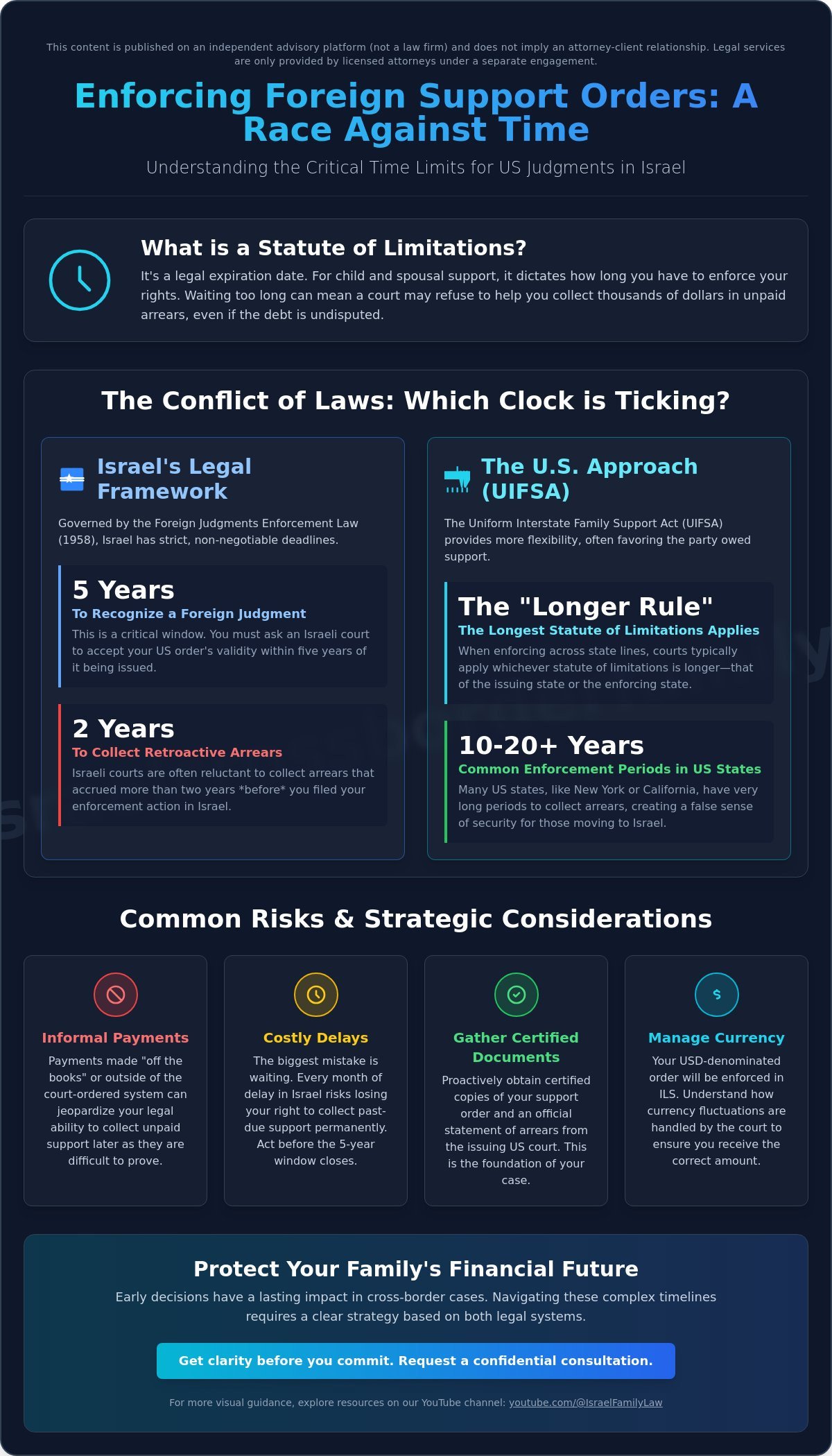
Determining which country’s law applies is often the most complex part of child support cross-border enforcement. Courts generally look at two principles: lex fori (the law of the forum where you are seeking enforcement) and lex loci (the law of the place where the order was originally issued). Under the Uniform Interstate Family Support Act (UIFSA) used in the US, courts often apply the longer of the two available statutes of limitations. However, in Israel, the Foreign Judgments Enforcement Law typically mandates a five-year window for recognition, creating a potential trap for those used to longer US deadlines.
Why International Support Orders are Different
International cases involve more than just different calendars. Moving across borders can sometimes “pause” a limitation period if the debtor is intentionally hiding, but this is difficult to prove. There is also a major difference between administrative enforcement through agencies and judicial enforcement through the family court. Relying on government agencies alone can be risky because they may not meet the strict judicial deadlines required to protect your rights. Early strategy is vital because a single late filing can result in the permanent loss of support. Get clarity before you commit. Request a confidential consultation.
This article is published on an independent advisory platform (not a law firm) and does not imply an attorney-client relationship. Legal services are only provided by licensed attorneys under a separate engagement.
The Israeli Legal Framework for Foreign Support Judgments
In Israel, the recognition and enforcement of foreign support orders are governed primarily by the Law for the Enforcement of Foreign Judgments (1958). This legislation provides a structured pathway for the Israeli Family Court to grant local validity to orders issued by US state courts. Because of the Memorandum of Understanding between the US and Israel, there’s a “Direct Enforcement” route that simplifies the administrative burden for many families. This reciprocity doesn’t waive the procedural requirements or the specific timeframes mandated by Israeli law, but it does create a more predictable environment for cross-border cases.
The Israeli Family Court plays a gatekeeper role in this process. It must verify that the foreign order is final, enforceable in its home country, and not contrary to Israeli public policy. A significant risk involves arrears that accrued before the order was registered in Israel. Israeli law is particularly strict here. Once an order is recognized, you generally have a two-year window to seek enforcement for past-due support. If you wait longer, the court may only allow collection retroactive to the date the enforcement request was filed. This makes the statute of limitations for foreign support orders a primary concern for anyone moving to Israel with an existing US order.
The 21-Year Rule in Israeli Law
Under the Law of Limitations, a judgment is generally valid for enforcement for up to 21 years. However, this long window is deceptive for international families. The statute of limitations for foreign support orders in Israel effectively starts with a five-year recognition limit. If the order isn’t brought before an Israeli court within those first five years of its issuance, the longer enforcement period may never apply. Exceptions exist if the debtor wasn’t available for service or if there was a stay of proceedings, but these are difficult to litigate without clear evidence.
Registration vs. Enforcement
Registering a US order in Israel is the first hurdle in beating the clock. Registration officially places the foreign judgment on the Israeli record, but it doesn’t automatically trigger collection. The Israeli Central Authority assists in these cases, yet the responsibility for timely filing remains with the individual. You must provide certified copies of the original order and transcripts of the proceedings to ensure the court has a complete record. Delaying this first step can lead to the “time-barring” mentioned previously, effectively making the debt uncollectible under Israeli jurisdiction. If you’re unsure about your current standing, it’s wise to request a confidential case review to assess your specific deadlines.
This article is published on an independent advisory platform (not a law firm) and does not imply an attorney-client relationship. Legal services are only provided by licensed attorneys under a separate engagement.
Conflict of Laws: US State Limits vs. Israeli Time Limits
Cross-border enforcement requires a delicate balancing act between the jurisdiction that issued the order and the one where the money is collected. In the United States, the Uniform Interstate Family Support Act (UIFSA) dictates that the statute of limitations for foreign support orders should be the longer of the two available periods. For example, New York maintains a 20-year statute of limitations for enforcing child support judgments. If a parent seeks to enforce a New York order in a state with a shorter window, the 20-year limit typically prevails. However, when the enforcement moves to Israel, this “longer of the two” rule faces practical challenges within the Israeli judicial framework.
The risk of a “dormant” judgment is a primary concern for international families. A US judgment that has sat without enforcement activity for a decade might be considered dormant but revivable in its home state. In Israel, the Family Court may view such a long delay with skepticism. Consider a case study of a 15-year-old New York support order. While the order is still valid under New York’s 20-year rule, an Israeli court might hesitate to recognize it if the parent failed to act within the five-year recognition window established by Israeli law. This creates a jurisdictional “conflict of laws” where the timing of your first filing in Israel determines whether the debt is collectible or permanently lost.
When US State Law Controls the Outcome
Generally, the law of the issuing state governs the duration of the support obligation itself. If a Florida court orders support until a child reaches 21, Israel will typically respect that duration even though Israeli law usually ends support at 18 or the end of military service. To succeed in child support cross-border enforcement, it is essential to obtain a “certified statement of arrears” from the US court. This document proves the current value of the debt and confirms that the order remains active under the issuing state’s laws.
When Israeli Law Overrides Foreign Limits
Israeli courts reserve the right to apply public policy exceptions to foreign judgments. Even if a US state has no statute of limitations, an Israeli judge might apply the principle of “laches,” which addresses unreasonable delays that prejudice the other party. If a parent waits 15 years to seek enforcement without a valid reason, the court may decide that the delay makes enforcement inequitable. This discretionary power means that simply having a valid US order isn’t always enough. Strategic timing and a clear explanation for any delays are necessary to protect your rights in the Israeli system. Get clarity before you commit. Request a confidential consultation.
This article is published on an independent advisory platform (not a law firm) and does not imply an attorney-client relationship. Legal services are only provided by licensed attorneys under a separate engagement.
Common Risks and Strategic Considerations for Expats
Expats often fall into the trap of making “informal” or handshake agreements regarding support payments. While these arrangements may seem practical during a transition to Israel, they carry immense legal risk. If a US court order exists, an unrecorded side deal doesn’t stop the legal clock. The statute of limitations for foreign support orders continues to run based on the original judgment. Without a formal court modification, the payer remains liable for the full amount, and the recipient risks losing the ability to enforce the original terms if they wait too long to register the order in the Israeli system.
Currency fluctuations add another layer of complexity to cross-border arrears. Support orders are typically issued in US Dollars, but enforcement in Israel occurs in New Israeli Shekels. Over a decade of unpaid support, the exchange rate can shift significantly, impacting the actual value of the recovery. Calculating these arrears requires precision to ensure the amount sought in the Israeli Family Court matches the true debt. It’s also common for an obligor to move to Israel specifically to avoid US enforcement, assuming the distance provides a shield. While the US-Israel reciprocity agreement bridges this gap, the burden is on the recipient to locate the payer and initiate the process before the local five-year recognition window closes.
A frequent objection from parents who have delayed filing is, “I waited because I didn’t know where they lived.” While this is a valid emotional reason, it’s rarely a successful legal defense against a time-barred claim. Israeli courts expect a degree of due diligence. If you didn’t take active steps to find the other parent, the court may rule that the delay was unreasonable. This makes early action a necessity rather than a choice.
Risk-Based Decision Making
Success in cross-border cases requires evaluating the cost of enforcement against the likelihood of recovery. Many families wait for a “better time” to file, hoping their financial situation or the payer’s location will become more stable. Unfortunately, this often leads to the legal expiration of the claim. Understanding the challenges for expats and foreign nationals is vital before committing to a long-term strategy. You should prioritize a confidential case review to assess whether your specific order is still within the enforceable window under both US and Israeli law.
The Role of Technology and Tracking
Modern enforcement relies heavily on technology. International skip-tracing can now identify assets and employment in Israel with high accuracy, even if the payer is attempting to remain off the grid. For those who need more visual context on these risks and the enforcement process, the Israel Family Law YouTube channel provides several guides tailored to international families. These resources can help you understand the landscape before you take formal legal steps. If you’re concerned about your timeline, contact us today to discuss your options.
This article is published on an independent advisory platform (not a law firm) and does not imply an attorney-client relationship. Legal services are only provided by licensed attorneys under a separate engagement.
Protecting Your Rights: Next Steps for International Enforcement
Moving from the theoretical understanding of time limits to the practical enforcement of an order requires a disciplined approach to documentation. Gathering the necessary records is the foundation of any successful cross-border action. You must obtain certified copies of the original support orders and complete transcripts from the issuing US court. Scanned copies or unofficial printouts are generally insufficient for the Israeli Family Court. Working with a practitioner who is multi-qualified and understands the procedural nuances of both jurisdictions is a critical differentiator. This dual perspective ensures that the specific requirements of the US issuing state are correctly translated into the Israeli framework.
The first move you make in the Israeli court system often dictates the trajectory of the entire case. If the initial petition for recognition is flawed or filed past a deadline, it can trigger a permanent bar on enforcement. This is particularly dangerous for “stale” orders that are approaching their legal limits. If your order is nearing the five-year mark since its issuance, or if the child is approaching adulthood, your window for action is closing rapidly. Addressing these orders requires a strategy that accounts for the statute of limitations for foreign support orders while simultaneously preparing for potential defenses from the obligor.
Seeking Clarity Before Commitment
Understanding the difference between an advisory platform and formal legal representation is essential before you take action. While we provide the strategic framework for managing the statute of limitations for foreign support orders, legal services are only provided by licensed attorneys under a separate engagement. You can learn more about how the advisory works to see how we help families identify risks before they commit to a litigation path. Obtaining a clear view of your child support cross-border enforcement options allows you to make decisions based on data rather than emotion.
Strategic Planning for International Families
Strategic planning for international families involves more than just a single court filing; it requires a long-term plan for support collection that accounts for the child’s entire minority. Early decisions regarding enforcement often dictate the financial resources available for your children’s future education and well-being. These cases are inherently complex and require a bespoke strategy that respects the cultural and legal differences between the US and Israel. Get clarity before you commit. Request a confidential consultation.
This article is published on an independent advisory platform (not a law firm) and does not imply an attorney-client relationship. Legal services are only provided by licensed attorneys under a separate engagement.
Securing Your Family’s Financial Future Across Borders
Navigating the intersection of US and Israeli law requires more than just knowing the rules; it demands a proactive strategy. You’ve seen how the mismatch between individual state laws and the Israeli five-year recognition window can create unexpected barriers for the unprepared. Delaying action or relying on informal agreements often leads to the permanent loss of support arrears. Protecting your rights depends on gathering certified documentation and understanding how the statute of limitations for foreign support orders applies to your specific jurisdictional needs.
As an advisory for international families with expertise in US-Israel cross-border law, we provide the authoritative guidance expats need to navigate these multi-jurisdictional complexities. We help you evaluate risks and develop a strategy that protects your family’s long-term interests. By taking strategic steps early, you ensure that the legal system works for you rather than against you. It’s vital to seek clarity before moving forward with enforcement in a foreign court. Get clarity before you commit. Request a confidential consultation.
This article is published on an independent advisory platform (not a law firm) and does not imply an attorney-client relationship. Legal services are only provided by licensed attorneys under a separate engagement.
Frequently Asked Questions
Does child support ever expire in Israel?
Child support obligations themselves typically last until the child is 18 or finishes military service. However, the legal right to collect unpaid arrears can expire if you don’t take action within specific timeframes. In Israel, the law generally limits the retroactive collection of arrears to two years from the date you begin enforcement proceedings. Waiting too long can result in the permanent loss of older debt.
Can I enforce a 10-year-old US child support order in Israel?
Enforcing a decade-old order is difficult but not always impossible. The primary hurdle is the five-year recognition rule found in Israeli law. If you didn’t seek recognition within five years of the order being issued, you must show the court a valid reason for the delay. Success often depends on whether the debtor was hiding or if the order remained active through ongoing US enforcement efforts.
What happens if my US state has no statute of limitations but Israel does?
Israeli courts typically apply their own procedural deadlines regardless of the rules in the issuing US state. Even if a state like California has no expiration date for support, you must still comply with the Israeli statute of limitations for foreign support orders. This means the five-year recognition window and the two-year arrears rule will likely dictate how much you can actually collect in an Israeli court.
How does the Israeli court calculate arrears for foreign orders?
The court calculates the debt by converting the original currency into New Israeli Shekels based on the exchange rate at the time each payment was due. These amounts are often adjusted for inflation using the Israeli Consumer Price Index. The court may also add legal interest. This complex calculation ensures the support maintains its intended value despite the passage of time and cross-border movement.
Do I need to be an Israeli citizen to enforce a support order in Israel?
You don’t need to be an Israeli citizen or resident to file for enforcement. The Israeli legal system allows any person with a valid foreign judgment to seek its recognition if the debtor or their assets are located within Israel. The court’s focus is on the validity of the order and its jurisdiction over the payer, not the nationality of the person receiving the support.
What is the “Law for Enforcement of Foreign Judgments”?
This 1958 law provides the legal foundation for recognizing and enforcing judgments from foreign courts. It establishes the criteria the Israeli Family Court uses to ensure a US order was issued fairly and by a competent authority. This framework is essential for managing the statute of limitations for foreign support orders, as it sets the five-year deadline for bringing these orders to Israel.
Can a foreign support order be modified in Israel if the time limit is nearing?
Modification and enforcement are two separate legal paths. While you can ask an Israeli court to modify a support amount due to a change in circumstances, this won’t reset the clock on old arrears. If a time limit is nearing, your priority should be the formal recognition of the existing order to prevent the debt from becoming legally unenforceable under the local statute of limitations.
What documents do I need to prove a foreign support order is still valid?
You must provide a certified copy of the original court order and a certificate of finality showing the order is no longer subject to appeal. A certified statement of arrears from a US child support agency is also vital to prove the exact amount owed. These documents must often be apostilled and translated into Hebrew to be accepted as evidence in the Israeli Family Court system.

Article by
Gabriel Lior
A Personal Journey That Became a Mission
The advisory was founded by an American father Gabriel Lior, LLB, MBA , global entrepreneur, and cross-border advisor who spent more than a decade navigating the Israeli family court system firsthand and now lives in Singapore with his son.
As a divorced parent in a cross-border family, Gabriel faced nearly every legal challenge a foreign parent can encounter in Israel — including child custody disputes, child support proceedings, property matters in Israel and abroad, false accusations, and complex immigration and relocation proceedings.
Over the years, he learned the hard way how difficult it is for non-Israeli parents to understand the system, identify the right legal strategy, and choose the right legal representation — especially when language, culture, and jurisdictional differences are involved. He also witnessed how foreign parents and new immigrants are often disadvantaged or taken advantage of by service providers and institutions simply because they lack local knowledge or fluency.
From Client to Advisor
To truly understand — and survive — the system, Gabriel pursued formal legal education in Israel, completing two Israeli law degrees, alongside a BA and MBA earned in the United States. This was never about becoming a practicing attorney, but about gaining a deep, structural understanding of how the system works — and where it breaks down for foreign parents.
This rare combination of:
Firsthand client experience
Israeli legal and US business education
International business and negotiation training
Decades of commercial execution
created a unique perspective – one that understands both sides of the table.
After years of litigation, persistence, and at times self-representation, he ultimately succeeded in securing custody of his son and relocating abroad through a rare legal victory in the Israeli Supreme Court — becoming one of the first fathers in Israel to do so under these circumstances.
Disclaimer
Important Disclaimer:
The information provided on this website and in its content is for general informational and educational purposes only and does not constitute legal advice, legal opinion, or legal representation.
Gabriel Lior is not licensed to practice law in Israel (nor is he interested in doing so) and does not provide legal services, despite having completed 2 Law Degrees. The services offered are advisory in nature and are intended to provide general guidance, strategic insight, and information regarding cross-border family law considerations.
No attorney-client relationship is formed by accessing this website, reading its content, or communicating with us.
Any decisions made based on this information are at your own discretion and risk. For legal advice specific to your situation, you should consult a licensed attorney in the relevant jurisdiction.
Where appropriate, we may refer clients to independent, licensed attorneys or professionals. Such referrals do not constitute legal representation and no liability is assumed for services provided by third parties.