This article is published on an independent advisory platform and does not constitute an attorney-client relationship. This content is for informational and advisory purposes only; legal services are only provided by licensed attorneys under a separate engagement.
What if the most expensive part of your separation isn’t the final settlement, but the lack of a clear cross-border financial strategy? For many expats and international families, budgeting for a US-Israel divorce feels like trying to hit a moving target while managing two entirely different legal cultures. You likely already realize that managing costs across two jurisdictions is inherently complex; the fear of legal fees spiraling out of control is a common concern for those caught between the Israeli Family Court and American state systems.
We’re here to provide an authoritative guide to help you regain control. This article outlines a strategic roadmap to understanding primary cost drivers, from Israeli filing fees to the hidden impact of jurisdictional choices. You’ll learn how to identify potential tax liabilities early and discover practical steps to minimize litigation through risk-based decision-making. We’ve also included helpful resources from our YouTube channel, @IsraelFamilyLaw, to explain these concepts in more detail. Get clarity before you commit. Request a confidential consultation.
Key Takeaways
- Understand why traditional domestic budgeting fails in international cases due to the unique cost structures of managing two distinct legal systems simultaneously.
- Learn how the initial decision of where to file impacts your total legal spend and how forum shopping significantly affects your long-term bottom line.
- Identify the non-attorney expenses that often surprise families when budgeting for a US-Israel divorce, such as multi-national forensic asset valuation and document certification.
- Discover a phased approach to financial planning that allows you to establish a realistic baseline instead of relying on a single, static estimate.
- Explore how early strategic consultation helps you avoid the most expensive litigation mistakes before you commit to a specific legal course of action.
This article is published on an independent advisory platform and does not constitute an attorney-client relationship. This content is for informational and advisory purposes only; legal services are only provided by licensed attorneys under a separate engagement.
The Financial Anatomy of a US-Israel Cross-Border Divorce
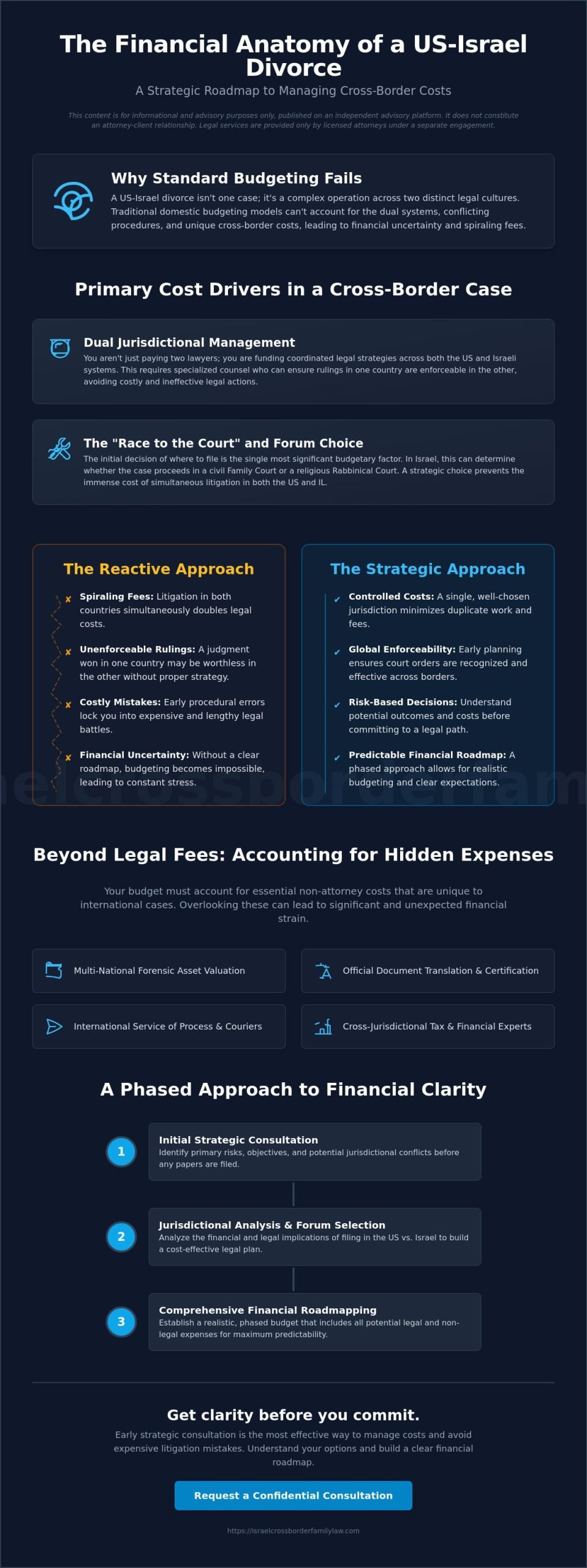
Budgeting for a US-Israel divorce requires a shift in perspective. Standard domestic models fail to account for the multi-jurisdictional complexity that arises when assets, children, and legal obligations span two continents. You aren’t just paying for two lawyers; you’re funding a sophisticated legal operation that requires constant coordination between the American and Israeli systems. This unique structure means that early strategic decisions don’t just influence the legal outcome; they dictate your entire financial trajectory.
The fundamental driver of cost is the structural difference in divorce law in Israel, where the interplay between civil Family Courts and religious Rabbinical Courts creates a landscape unlike anything in the United States. When you’re managing a divorce for an international family, the financial burden is often front-loaded. You must invest in clarity before making commitments to prevent costs from escalating during the later stages of litigation.
To better understand how these financial factors interact, watch this helpful video:
Why Cross-Border Cases Are More Expensive
International cases naturally incur higher costs due to the administrative burden of transnational operations. Serving legal process across borders involves specific international treaties and local regulations that can add significant time and expense to an initial budget. Additionally, your counsel must possess a nuanced understanding of both systems to ensure that a ruling in one country remains enforceable in the other. This prevents the nightmare scenario of paying for a judgment that carries no weight once you cross the border. The need for specialized knowledge across two jurisdictions is a primary reason why budgeting for a US-Israel divorce looks so different from a typical local case.
The Role of the “Race to the Court”
In the Israeli context, the “race to the court” is a critical budgetary factor. The first party to file can often determine whether the case is heard in the Rabbinical Court or the Family Court. This choice locks in specific procedural costs and can prevent the financial drain of “split” proceedings. When litigation is active in both the US and IL simultaneously, legal spend often doubles as attorneys in both jurisdictions must respond to every motion and hearing. Establishing a clear jurisdictional strategy early on is the most effective way to maintain a predictable financial roadmap. Get clarity before you commit. Request a confidential consultation.
This article is published on an independent advisory platform and does not constitute an attorney-client relationship. This content is for informational and advisory purposes only; legal services are only provided by licensed attorneys under a separate engagement.
Jurisdiction and Forum Shopping: The First Budgetary Decision
The strategic selection of a legal forum is the most significant variable when budgeting for a US-Israel divorce. This process, often called “forum shopping,” is not merely a matter of geographic convenience. It is a calculated financial decision that determines which procedural rules, filing fees, and discovery requirements will apply to your case. Selecting the wrong jurisdiction can lead to overlapping litigation in both countries, effectively doubling your legal spend before the substantive issues are even addressed.
For instance, filing for divorce in New York involves a mandatory court fee of $335 as of March 2026. In contrast, California petitions require a $435 base fee as of May 2026. While these filing fees are a small fraction of the total cost, the procedural rules behind them carry heavy financial weight. US courts typically allow for exhaustive discovery, including depositions and interrogatories, which can drive the average cost of a contested divorce in New York to approximately $27,000. Choosing to litigate in Israel may offer a more streamlined alternative for certain financial matters.
Cost Differences Between IL and US Courts
The Israeli legal system operates with a different fee structure and procedural rhythm. As of January 2026, a child custody claim in an Israeli Family Court carries a fee of 417 NIS. While attorney hourly rates in Israel typically range from 600 to 1,500 NIS, the lack of American-style discovery often results in lower overall billable hours. However, cases involving the Rabbinical Courts introduce unique complexities. The potential for “Get” refusal can lead to extended litigation and additional legal layers that are absent in purely civil US proceedings. You must weigh these procedural differences against the potential for a faster resolution in one system over the other.
Avoiding the Cost of Conflicting Orders
One of the most expensive mistakes international families make is failing to establish a clear jurisdictional path. Litigating a “dispute over where to litigate” is a common trap that drains resources without resolving the divorce itself. You can mitigate this risk by using a financial agreement to pre-set the desired forum. This proactive step helps prevent the high cost of enforcing foreign judgments or defending against non-recognition of court orders. Establishing a single, recognized jurisdiction early on is the most effective strategy for maintaining a predictable budget. You can request a confidential case review to explore which jurisdiction aligns with your financial and strategic goals. Get clarity before you commit.
This article is published on an independent advisory platform and does not constitute an attorney-client relationship. This content is for informational and advisory purposes only; legal services are only provided by licensed attorneys under a separate engagement.
Beyond Legal Fees: Accounting for Hidden Cross-Border Expenses
While attorney retainers are the most visible expense, they represent only a portion of the total financial commitment. Budgeting for a US-Israel divorce involves more than just paying for legal representation; it requires identifying the ancillary experts needed to validate cross-border claims. These “non-attorney” costs often surprise international families who expect a standard domestic fee structure. From document certification to expert testimony on foreign law, these hidden expenses can significantly impact your financial roadmap if they aren’t accounted for early in the process.
One primary driver of these costs is the need for court-admissible documentation. Every American financial statement or legal document must be translated and certified before it can be used in an Israeli court. As of 2026, the fee for an Apostille certification from the Israeli Ministry of Foreign Affairs is 41 NIS per document. In the United States, the Department of State fee for an Apostille is $20 per document. While these individual fees seem small, the cumulative cost of certifying years of bank records and property deeds adds up quickly. Additionally, Israeli courts often require a formal legal opinion on US law if assets are held abroad, which necessitates hiring a qualified expert to draft a brief for the judge.
Forensic Accounting and Asset Valuation
Managing assets across two continents requires specialized forensic accounting. You can’t simply apply US valuation methods to Israeli assets; a US-based 401(k) or IRA has a different tax treatment and liquidity profile than an Israeli pension fund or Keren Hishtalmut. Forensic accountants are essential for valuing real estate located in a different country and tracking assets across international banking systems. Their role is to ensure that “hidden” or complex assets are accurately identified, which is a critical step in achieving a fair division of property.
Compliance and Tax Costs
Cross-border splits often trigger tax events in both nations. US citizens living in Israel must maintain IRS compliance, and a divorce can complicate these filings. Specialized tax planning is necessary to avoid double taxation on transferred assets. Furthermore, child support enforcement across borders involves administrative expenses to ensure that orders are recognized and processed by international authorities. For a deeper look at these complexities, you should watch the video on international asset division. Get clarity before you commit. Request a confidential consultation.
This article is published on an independent advisory platform and does not constitute an attorney-client relationship. This content is for informational and advisory purposes only; legal services are only provided by licensed attorneys under a separate engagement.
A Step-by-Step Guide to Budgeting for Unpredictable Legal Fees
Managing a cross-border separation requires a shift from reactive spending to proactive financial planning. A realistic strategy for budgeting for a US-Israel divorce relies on a phased approach rather than a single, static estimate. This method allows you to adjust your financial roadmap as jurisdictional questions are resolved. By utilizing the pricing transparency of an independent advisory, you can establish a baseline of expectations before engaging local counsel in either country. Establishing a contingency fund for unexpected jurisdictional motions is also a prudent step to ensure your strategy remains uninterrupted.
Step 1: Conduct a Multi-Jurisdictional Asset Audit
Begin by cataloging every account, property, and debt held in both IL and the US. You must identify which assets are likely to be stipulated and which will be contested. For example, a shared residence in Tel Aviv might be straightforward, while the division of a US-based 401(k) requires more intensive legal work across systems. Determining the “value at risk” helps you justify your legal expenditure. If the cost of litigating a specific asset exceeds its potential value, it’s often more strategic to negotiate a settlement.
Step 2: Define Your Legal Objectives Clearly
You should differentiate between “must-have” outcomes and negotiable points early in the process. Clear objectives prevent “scope creep,” where legal billing expands into areas that don’t serve your primary goals. Mediation is often a highly effective tool for controlling costs before a case escalates. In IL, an application for settling a dispute costs only 119 NIS as of January 2026. Seeking early resolution through mediation can save tens of thousands compared to a contested case, which averages $27,000 in jurisdictions like New York.
Step 3: Request a Detailed Fee Arrangement
When hiring practitioners, you must understand their specific billing models and fee structures. Israeli hourly rates for divorce lawyers typically range from 600 to 1,500 NIS, while New York rates can reach $600 per hour. Request milestone-based estimates for each stage of the case, such as the initial filing, the discovery phase, and final hearings. Establish a communication protocol that requires notification if a specific task will exceed a pre-set number of hours. This structure ensures that your budget remains a tool for decision-making rather than a source of anxiety. Contact our advisory team to begin structuring your strategic roadmap. Get clarity before you commit.
This article is published on an independent advisory platform and does not constitute an attorney-client relationship. This content is for informational and advisory purposes only; legal services are only provided by licensed attorneys under a separate engagement.
Strategic Risk Management with Israel Cross Border Law Firm
The most effective way to control costs is to treat your separation as a high-stakes business transition rather than an emotional battle. In many cases, the financial drain of a split isn’t caused by the legal issues themselves, but by the lack of an overarching strategy to manage them. By focusing on risk-based decision making, you move from a position of confusion to one of informed strength. This strategic approach is essential when budgeting for a US-Israel divorce, as it allows you to anticipate jurisdictional friction before it becomes an expensive reality. A clear understanding of budgeting for a US-Israel divorce requires looking past the hourly rate and focusing on the total cost of the legal lifecycle. Working with the team at Israel Cross Border Law Firm ensures that every decision is evaluated through the lens of international risk management.
The Advisory vs. Litigation Model
Engaging an independent advisory platform provides a layer of strategic oversight that traditional law firms often lack. While a litigator’s primary role is to fight your case in court, an advisor helps you determine if that fight is financially viable in the first place. Understanding how our advisory works allows international families to build a bridge between the IL and US legal systems. This cross-cultural perspective is vital. It prevents you from applying American legal expectations to an Israeli Rabbinical Court or Family Court, a mistake that often leads to redundant work and wasted fees. An advisory perspective often saves significantly more than it costs by identifying the most efficient path through the multi-jurisdictional complexity. It acts as a shield against the procedural scope creep that often happens when lawyers in two different countries work without a unified plan.
Taking the First Step Toward Clarity
Early decisions carry the highest financial impact. The first motion filed or the first jurisdiction chosen sets the tone for the entire proceeding. If you prioritize long-term stability over short-term litigation wins, you can avoid the “race to the court” traps mentioned in previous sections. Protecting your future requires a roadmap that accounts for the differences in how assets are valued and how support is enforced across borders. A well-constructed plan ensures that your resources are preserved for your family’s next chapter rather than being consumed by avoidable legal disputes. This roadmap serves as a guide for your local counsel, ensuring they stay focused on your primary commercial and personal objectives. Get clarity before you commit. Request a confidential consultation to begin your strategic planning process.
This article is published on an independent advisory platform and does not constitute an attorney-client relationship. This content is for informational and advisory purposes only; legal services are only provided by licensed attorneys under a separate engagement.
Securing Your Financial Roadmap Across Borders
Managing the financial complexities of a cross-border separation requires moving beyond guesswork. As established throughout this guide, successful budgeting for a US-Israel divorce depends on early jurisdictional strategy and a clear-eyed assessment of multi-national assets. By auditing your global holdings and identifying non-attorney costs like forensic valuations and document certifications early, you prevent the most common financial pitfalls. A phased approach ensures that your resources are allocated toward your primary objectives rather than being consumed by avoidable procedural disputes.
Our strategy-first advisory model focuses on multi-jurisdictional asset protection and risk-based decision-making. We specialize in the unique intersection of the US and IL legal systems, helping international families build a bridge between disparate court cultures. This independent perspective ensures your local legal teams remain focused on your long-term commercial and personal stability. You have the power to transform a period of uncertainty into a structured transition toward your next chapter. Get clarity before you commit. Request a confidential consultation.
This article is published on an independent advisory platform and does not constitute an attorney-client relationship. This content is for informational and advisory purposes only; legal services are only provided by licensed attorneys under a separate engagement.
Frequently Asked Questions
How much does a typical US-Israel divorce cost?
Total costs vary significantly based on the level of conflict and the specific jurisdictions involved. In the United States, a contested case in New York can average $27,000, while Israeli representation for contested matters often starts at 15,000 NIS. Because you are managing two legal systems, your total budget must account for dual filing fees and specialized cross-border coordination. Establishing a clear strategy early is the most effective way to keep these figures within a predictable range.
Can I use one lawyer for both my US and Israel legal needs?
It is rare for a single attorney to be licensed and actively practicing in both jurisdictions with the depth required for complex litigation. Most families find success by hiring a local specialist in each country and using an independent advisory platform to coordinate the overall strategy. This collaborative approach ensures that a decision made in one court doesn’t inadvertently damage your standing in the other. It also prevents costly procedural errors across different legal cultures.
Who pays the legal fees in an Israeli divorce?
Each party typically pays their own legal fees in Israel, though the court has the discretion to award costs to the prevailing party in certain circumstances. Unlike some US jurisdictions where a higher-earning spouse might be ordered to pay the other’s interim fees, Israeli courts usually wait until the end of proceedings to decide on fee shifting. You should plan your initial budgeting for a US-Israel divorce assuming you will need to fund your own representation throughout the process.
How do I avoid paying for two sets of lawyers?
You can minimize dual representation by resolving jurisdictional questions as quickly as possible. If you can establish that one country is the primary forum for all matters, you may only need the second set of lawyers for specific enforcement tasks or document certification. A well-drafted financial agreement can also pre-emptively designate a single forum. This prevents the high cost of litigating in two places at once, which is the primary driver of runaway legal spend.
What are the most common hidden costs in an international divorce?
Hidden costs often include document translations, Apostille certifications, and expert testimony on foreign law. For example, the Israeli Ministry of Foreign Affairs charges 41 NIS per document for an Apostille as of 2026. You may also need forensic accountants to value assets like US-based 401(k) plans or Israeli pension funds. These ancillary expenses are essential for court-admissible evidence but are frequently overlooked in initial domestic-style budgets.
Does the Rabbinical court cost more than the Family court?
The filing fees themselves are relatively comparable, but the total cost depends on the complexity of the specific issues being litigated. An application for settling a dispute in the Family Court costs 119 NIS as of January 2026. However, Rabbinical Court proceedings can become more expensive if there is a refusal to grant a “Get,” which can lead to prolonged litigation. Your choice of forum should be based on strategic outcomes rather than just the initial filing fee.
Can I budget for child support enforcement costs in advance?
Yes, you can allocate funds for enforcement by identifying which international treaties, like the Hague Convention, will apply to your situation. Enforcement often requires specific administrative filings and the coordination of government agencies in both IL and the US. While these costs are predictable, they are distinct from the initial divorce litigation. Including these in your budgeting for a US-Israel divorce ensures that your support orders actually result in the transfer of funds across borders.
How do I stop my spouse from draining joint accounts to pay for their lawyer?
You can seek temporary orders or injunctions from the court to freeze joint assets and prevent the unauthorized depletion of marital funds. In Israel, this is a common step to maintain the status quo while the case is pending. Acting quickly is essential to protect your financial position. Once funds are spent on legal fees or moved across international borders, recovering them becomes significantly more difficult and expensive.

Article by
Gabriel Lior
A Personal Journey That Became a Mission
The advisory was founded by an American father Gabriel Lior, LLB, MBA , global entrepreneur, and cross-border advisor who spent more than a decade navigating the Israeli family court system firsthand and now lives in Singapore with his son.
As a divorced parent in a cross-border family, Gabriel faced nearly every legal challenge a foreign parent can encounter in Israel — including child custody disputes, child support proceedings, property matters in Israel and abroad, false accusations, and complex immigration and relocation proceedings.
Over the years, he learned the hard way how difficult it is for non-Israeli parents to understand the system, identify the right legal strategy, and choose the right legal representation — especially when language, culture, and jurisdictional differences are involved. He also witnessed how foreign parents and new immigrants are often disadvantaged or taken advantage of by service providers and institutions simply because they lack local knowledge or fluency.
From Client to Advisor
To truly understand — and survive — the system, Gabriel pursued formal legal education in Israel, completing two Israeli law degrees, alongside a BA and MBA earned in the United States. This was never about becoming a practicing attorney, but about gaining a deep, structural understanding of how the system works — and where it breaks down for foreign parents.
This rare combination of:
Firsthand client experience
Israeli legal and US business education
International business and negotiation training
Decades of commercial execution
created a unique perspective – one that understands both sides of the table.
After years of litigation, persistence, and at times self-representation, he ultimately succeeded in securing custody of his son and relocating abroad through a rare legal victory in the Israeli Supreme Court — becoming one of the first fathers in Israel to do so under these circumstances.
Disclaimer
Important Disclaimer:
The information provided on this website and in its content is for general informational and educational purposes only and does not constitute legal advice, legal opinion, or legal representation.
Gabriel Lior is not licensed to practice law in Israel (nor is he interested in doing so) and does not provide legal services, despite having completed 2 Law Degrees. The services offered are advisory in nature and are intended to provide general guidance, strategic insight, and information regarding cross-border family law considerations.
No attorney-client relationship is formed by accessing this website, reading its content, or communicating with us.
Any decisions made based on this information are at your own discretion and risk. For legal advice specific to your situation, you should consult a licensed attorney in the relevant jurisdiction.
Where appropriate, we may refer clients to independent, licensed attorneys or professionals. Such referrals do not constitute legal representation and no liability is assumed for services provided by third parties.