Navigating a cross-border family law matter is an inherently complex undertaking, made all the more daunting when it involves the unique intricacies of the Israeli legal system. For individuals residing abroad, the challenges are magnified by concerns over jurisdictional conflicts, the role of religious courts, and the potential for cultural misunderstandings to impact the protection of your most vital interests. The critical first step toward a successful resolution is knowing how to choose a family lawyer in Israel who possesses not only domestic legal acumen but also a sophisticated understanding of international private law. Selecting the right counsel is paramount to safeguarding your parental rights and matrimonial assets across multiple jurisdictions. This comprehensive guide is engineered to provide you with the essential criteria, critical questions, and a structured process for making this crucial decision. We will equip you with the knowledge to identify and appoint a legal representative who can confidently navigate both Israeli and international legal frameworks, ensuring your case is managed with the strategic, multi-jurisdictional expertise it demands. Our objective is to empower you to feel confident in the Israeli legal process and achieve a fair, efficient resolution to your family matter.
First, Understand Israel’s Unique Family Law System
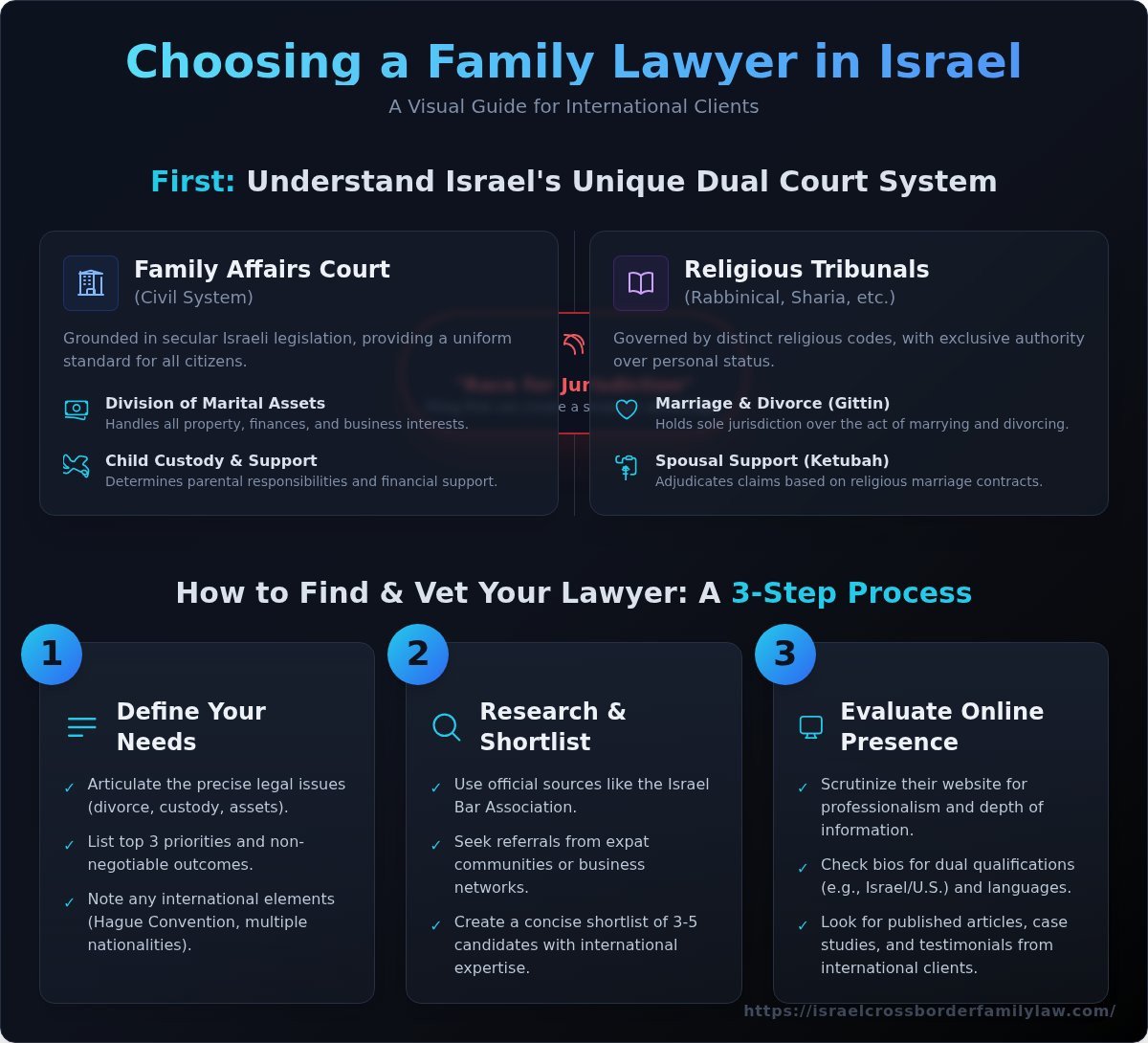
Navigating family law in Israel presents a unique set of challenges not found in the legal systems of the United States or Europe. The primary reason for this complexity is Israel’s dual legal framework, where secular civil courts operate in parallel with religious tribunals. Understanding this structure is the foundational first step in learning how to choose a family lawyer Israel can offer, as jurisdiction is often the first and most critical battleground in any family dispute. A lawyer’s ability to develop a sophisticated strategy within this framework is paramount to protecting your interests. To better understand how these courts approach specific issues like child custody, this overview provides valuable context:
The Family Affairs Court (Civil System)
Established to function as a specialized civil court, the Family Affairs Court has broad jurisdiction over most family-related matters for all Israeli citizens, regardless of religious affiliation. These courts handle critical issues including child support calculations, division of marital assets, and most aspects of child custody and visitation. Its decisions are grounded in secular Israeli legislation, providing a uniform legal standard for these complex financial and parental matters.
The Religious Tribunals (Rabbinical, Sharia, etc.)
Concurrently, matters of personal status are governed by religious law. For Jewish citizens, the Rabbinical Courts hold exclusive jurisdiction over the acts of marriage and divorce (Gittin). This authority profoundly impacts divorce proceedings, the validity of prenuptial agreements under religious law, and certain aspects of spousal support (Ketubah claims). Similar religious courts exist for Muslim (Sharia), Druze, and recognized Christian communities, each applying their own distinct religious legal codes.
Why This Duality Matters for Your Case
This parallel system creates a dynamic often referred to as the “race for jurisdiction,” where the party who files first in their preferred court can gain a significant strategic advantage. For instance, one spouse might seek relief in the civil court, which may have a more favorable approach to property division, while the other rushes to the Rabbinical Court. An adept lawyer’s ability to navigate the intricate rules of Israel’s court system is therefore not just a benefit-it is essential. For international families, cross-border jurisdictional questions add another layer of complexity, making the initial strategic decisions paramount. This is why the answer to how to choose a family lawyer in Israel begins with finding a professional who possesses deep, multi-jurisdictional expertise.
Step-by-Step: How to Find and Vet Your Lawyer
Selecting the right legal counsel is a strategic process that moves from broad discovery to a highly focused, informed decision. A methodical approach ensures that your chosen representative not only possesses the requisite legal expertise but also aligns with the specific, often complex, nuances of your case. For those navigating the multi-jurisdictional landscape, understanding how to choose a family lawyer israel requires a diligent vetting process that extends far beyond a preliminary online search.
Step 1: Define Your Specific Legal Needs
Before initiating contact, you must articulate the precise parameters of your legal requirements. A clear definition of your objectives is a foundational part of the process for how to choose a family lawyer israel. Consider the core issues: are you dealing with a complex divorce with cross-border assets, an international child custody dispute under the Hague Convention, or the drafting of a prenuptial agreement involving multiple nationalities? Understanding the specific jurisdiction of Israel’s Family Courts will help clarify the scope of your matter. We advise listing your top three priorities and any non-negotiable outcomes to create a clear brief for potential counsel.
Step 2: Conduct Initial Research and Create a Shortlist
Leverage credible resources to build a preliminary list of candidates. Official channels such as the Israel Bar Association provide a verified starting point. Supplement this with referrals from trusted sources within expat communities or international business networks, as they often have direct experience with sophisticated cross-border legal matters. Specifically seek out attorneys and firms whose public profiles emphasize experience in advising international clients. Your objective should be a concise shortlist of three to five candidates whose specializations directly correspond to the needs you defined in Step 1.
Step 3: Evaluate Online Presence and Published Content
A law firm’s digital footprint is a crucial piece of the puzzle when learning how to choose a family lawyer israel, serving as a preliminary indicator of its professionalism and expertise. Scrutinize each candidate’s website for clarity, depth of information, and professional presentation. Do their attorney bios highlight relevant experience, such as dual qualifications in Israel and the U.S. or fluency in multiple languages? Look for published articles, legal guides, or blog posts on topics pertinent to your situation. This content demonstrates a command of the subject matter and a commitment to client education. Testimonials or case studies from clients with similar international profiles can provide invaluable insight into the firm’s capabilities and client service approach.
Critical Questions to Ask a Family Lawyer in Your Consultation
The initial consultation is more than a simple introduction; it is a critical opportunity to evaluate a prospective lawyer’s expertise, strategic thinking, and compatibility with your specific needs. Approaching this meeting with a structured set of questions positions you as an informed client and is a fundamental step in learning how to choose a family lawyer in Israel. This preparation ensures you gather the necessary intelligence to make a confident, strategic decision for your family’s future.
Questions About Experience and Specialization
Your case involves sophisticated, cross-border legal challenges. The firm you select must possess demonstrable experience in navigating these complexities. Ask pointed questions to verify their qualifications:
- How many cases similar to mine, involving complex US-Israeli law, have you successfully handled? A strong answer will include specific, albeit confidential, examples of past cases, demonstrating a track record rather than theoretical knowledge.
- What is your firm’s experience level in both the Israeli Family Court and the Rabbinical Court (Beit Din)? An ideal family lawyer will be adept at navigating both secular and religious legal systems, understanding the strategic advantages and jurisdictional nuances of each.
- Are you or any partners in your firm licensed to practice in relevant US jurisdictions? Dual-licensed attorneys offer a seamless and integrated approach, providing a significant advantage in multi-jurisdictional asset division and custody matters.
- Who will be the primary attorney working on my case, and what is their direct experience? Ensure the experienced partner you meet with is not just a figurehead. You need clarity on who will manage the day-to-day progress of your file.
Questions About Legal Strategy and Approach
A lawyer’s initial assessment reveals their strategic acumen. You are not just hiring a legal technician; you are retaining a strategic advisor.
- Based on what I’ve shared, what is your initial assessment and proposed legal strategy? Look for a response that is measured, realistic, and tailored to your unique circumstances, not a generic, one-size-fits-all plan.
- Do you favor negotiation and mediation, or are you primarily a litigator? The most effective lawyers are strategically versatile, capable of vigorous litigation but preferring discreet, cost-effective resolutions through mediation when appropriate for the client’s objectives.
- How do you propose to handle evidence, discovery, and assets located in the United States? A competent cross-border lawyer will immediately outline a clear process for international discovery and collaboration with US-based counsel or experts.
Questions About Communication and Fees
Transparency in communication and billing is non-negotiable. These questions establish clear expectations from the outset.
- What is your fee structure (hourly, flat fee)? What is the estimated total cost, and what is the required retainer? A reputable lawyer will provide a clear fee agreement. Hourly rates for experienced family lawyers in Israel can range from ₪1,200 to ₪2,500+. They should be able to provide a realistic, albeit non-binding, estimate of total costs.
- How will I be kept informed, and what is your policy on returning calls or emails, especially across time zones? A good firm will have a clear communication protocol, ensuring you remain informed and connected, regardless of geographical distance.
- What other costs should I anticipate, such as court fees, expert witnesses (e.g., accountants, psychologists), or translation services? A transparent answer here prevents future financial surprises and demonstrates the lawyer’s thoroughness.
Red Flags to Watch For When Choosing a Lawyer
Navigating the complexities of family law requires not only identifying a capable advocate but also recognizing the warning signs of an unsuitable one. A critical component of knowing how to choose a family lawyer in Israel involves scrutinizing a candidate’s professionalism, communication style, and experience. An astute client can distinguish between a confident, strategic advisor and one whose approach may compromise the case’s integrity and outcome.
Guarantees of a Specific Outcome
Be wary of any attorney who guarantees a specific result. The Israeli family court system, like any judicial process, is subject to numerous variables. An ethical, experienced lawyer will provide a candid assessment of your case’s strengths and weaknesses, discuss potential outcomes, and outline a clear legal strategy. They offer confidence based on expertise, not unrealistic promises. A guarantee of victory is a significant red flag indicating a lack of professional integrity.
Poor Communication or Lack of Transparency
Effective representation is built on a foundation of clear, consistent communication. If an attorney is difficult to reach or consistently delayed in their responses during your initial consultation, this pattern is unlikely to improve. Further warning signs include:
- Vagueness regarding their fee structure, such as their hourly rate in Israeli Shekels (₪) or the total estimated legal fee (sh’char tircha).
- A reluctance to provide a clear, written retainer agreement.
- The use of excessive legal jargon without taking the time to explain complex concepts in understandable terms.
A top-tier professional prioritizes transparency, ensuring you are fully informed at every stage of the legal process.
Lack of Specific Cross-Border Experience
For cases involving US and Israeli jurisdictions, specialized knowledge is non-negotiable. A lawyer may have an excellent reputation in domestic Israeli family law but lack the critical experience required for international matters. Red flags include an attorney who seems unfamiliar with or dismissive of the complexities of enforcing foreign judgments, managing cross-border discovery, or interpreting international treaties like the Hague Convention. These are not minor details; they are central to the success of multi-jurisdictional cases. When evaluating how to choose a family lawyer in Israel for an international dispute, ensure their primary expertise aligns with your needs. Our firm specializes exclusively in complex US-Israel legal matters, providing the nuanced, dual-jurisdictional guidance these sensitive cases demand.
Why a Cross-Border Specialist is Your Greatest Asset
For individuals and families with connections to both Israel and the United States, family law matters involve a layer of complexity that far exceeds a standard domestic case. When your life, assets, and children span two distinct legal systems, the final question of how to choose a family lawyer in Israel becomes paramount. The answer lies in securing counsel with dedicated, multi-jurisdictional expertise. A general practitioner is simply not equipped to navigate the sophisticated challenges of international law.
Navigating Dual Jurisdictions Seamlessly
A true cross-border specialist firm provides strategic guidance on critical issues where Israeli and U.S. laws intersect. This includes advising on the validity and enforceability of a U.S. prenuptial agreement within an Israeli court, managing the complex process of domesticating American custody or child support orders, and ensuring the seamless coordination of legal strategy with your counsel in the United States. This integrated approach prevents critical missteps and protects your rights across borders.
Cultural and Linguistic Fluency
Effective representation demands more than a translation of legal statutes; it requires a deep, nuanced understanding of both Israeli and American cultures. A lawyer who is a native or fluent English speaker ensures nothing is lost in translation. This bicultural fluency is vital for explaining complex Israeli legal concepts-from the division of marital property to the authority of the Rabbinical Courts-in clear, unambiguous terms, empowering you to make fully informed decisions with confidence.
Protecting Your International Assets
When assets are located in both Israel and the U.S., their valuation and division become a formidable challenge. A cross-border specialist possesses the requisite financial and legal knowledge to address:
- The valuation and division of international assets, including U.S.-based retirement accounts (401ks, IRAs), real estate, and business interests.
- The significant international tax implications inherent in any proposed settlement agreement.
- The meticulous structuring of agreements to be legally robust and enforceable in both jurisdictions.
This proactive approach safeguards your financial future against unforeseen complications. Ultimately, when you need to choose a family lawyer in Israel for a case with international dimensions, engaging a specialist is not a luxury-it is a necessity for protecting your family and your future. If your family law matter involves both Israeli and U.S. jurisdictions, ensure your legal team has the proven experience to manage its complexities. Learn more about our dedicated cross-border family law practice.
Your Strategic Partner in Navigating Israeli Family Law
Navigating the complexities of a cross-border family law matter requires more than just legal representation; it demands strategic, multi-jurisdictional expertise. As this guide has demonstrated, the key to a successful outcome lies in understanding Israel’s unique legal framework and meticulously vetting potential counsel for specific international experience. Ultimately, the process of how to choose a family lawyer israel for a global case is about securing a partner who can act as a bridge between legal systems and cultures, safeguarding your interests at every turn. Our firm is uniquely positioned to serve as that bridge. With a team of dual-qualified attorneys experienced in both US and Israeli law, we possess a deep understanding of the challenges faced by expats and foreign nationals. We have a proven track record in high-stakes international divorce and custody cases, offering the sophisticated counsel required to protect your assets and family. When you are ready to move forward with confidence, we invite you to Schedule a Consultation with Our Cross-Border Family Law Experts and take the decisive first step toward protecting your future.
Frequently Asked Questions
What is the difference between the Family Court and the Rabbinical Court in Israel?
Navigating Israel’s dual-jurisdiction system is a critical aspect of family law. The Family Court is a secular, civil institution with broad authority over all family matters, including child custody, support, and property division for all citizens. In contrast, the Rabbinical Court (Beit Din) is a religious court. For Jewish citizens, it holds exclusive jurisdiction over marriage and divorce proceedings, while its authority over other matters like finances often depends on which party files first or mutual consent.
How much does a family lawyer cost in Israel?
Legal fees for family law representation in Israel are variable and reflect the complexity of the case. Attorneys may charge an hourly rate, typically ranging from ₪800 to over ₪2,000 for senior partners specializing in sophisticated, cross-border disputes. Alternatively, a fixed fee may be arranged for the entire case or for specific stages. A comprehensive retainer agreement outlining all potential costs and billing structures should be established at the outset of the engagement to ensure full transparency.
Do I need a lawyer who speaks fluent English?
For international clients, engaging an attorney with full professional fluency in English is not merely a convenience but a strategic imperative. When considering how to choose a family lawyer in Israel, clear and nuanced communication is essential for articulating case strategy, understanding complex legal documents, and providing testimony. A bilingual attorney provides a significant advantage, ensuring that nothing is lost in translation and that the cultural intricacies of your multi-jurisdictional case are expertly managed and represented.
Can a US prenuptial agreement be enforced in Israel?
A prenuptial agreement executed in the United States is not automatically enforceable within the Israeli legal system. An Israeli court will review the foreign agreement to ensure it aligns with Israeli public policy and was entered into fairly, with both parties having received independent legal counsel. To enhance its validity, the agreement should be formally ratified by an Israeli court or a notary, a process that effectively domesticates the agreement and strengthens its standing in any future proceedings within Israel.
What should I bring to my first consultation with a family lawyer?
To ensure a productive initial consultation, it is advisable to prepare a comprehensive file of relevant documents. This should include personal identification (passports or Teudat Zehut), marriage and birth certificates, any existing prenuptial or postnuptial agreements, and a summary of significant financial assets and liabilities. A concise, written timeline of key relationship events can also provide your legal counsel with the foundational information needed to conduct a thorough initial case assessment.
Is mediation a common practice for family disputes in Israel?
Mediation is a deeply integrated and highly encouraged component of the family dispute resolution process in Israel. In fact, current legislation mandates that parties attend an initial information and assessment meeting with a social worker at a Family Assistance Unit before they are permitted to file claims in court. This framework is designed to facilitate amicable, out-of-court settlements, positioning formal litigation as a secondary option for matters that cannot be resolved through collaborative means.

Article by
Gabriel Lior
A Personal Journey That Became a Mission The advisory was founded by an American father Gabriel Lior, LLB, MBA , global entrepreneur, and cross-border advisor who spent more than a decade navigating the Israeli family court system firsthand and now lives in Singapore with his son.
As a divorced parent in a cross-border family, Gabriel faced nearly every legal challenge a foreign parent can encounter in Israel — including child custody disputes, child support proceedings, property matters in Israel and abroad, false accusations, and complex immigration and relocation proceedings. Over the years, he learned the hard way how difficult it is for non-Israeli parents to understand the system, identify the right legal strategy, and choose the right legal representation — especially when language, culture, and jurisdictional differences are involved. He also witnessed how foreign parents and new immigrants are often disadvantaged or taken advantage of by service providers and institutions simply because they lack local knowledge or fluency. From Client to Advisor To truly understand — and survive — the system, Gabriel pursued formal legal education in Israel, completing two Israeli law degrees, alongside a BA and MBA earned in the United States. This was never about becoming a practicing attorney, but about gaining a deep, structural understanding of how the system works — and where it breaks down for foreign parents. This rare combination of: Firsthand client experience Israeli legal and US business education International business and negotiation training Decades of commercial execution created a unique perspective – one that understands both sides of the table. After years of litigation, persistence, and at times self-representation, he ultimately succeeded in securing custody of his son and relocating abroad through a rare legal victory in the Israeli Supreme Court — becoming one of the first fathers in Israel to do so under these circumstances.
Disclaimer
Important Disclaimer: The information provided on this website and in its content is for general informational and educational purposes only and does not constitute legal advice, legal opinion, or legal representation. Gabriel Lior is not licensed to practice law in Israel (nor is he interested in doing so) and does not provide legal services, despite having completed 2 Law Degrees. The services offered are advisory in nature and are intended to provide general guidance, strategic insight, and information regarding cross-border family law considerations. No attorney-client relationship is formed by accessing this website, reading its content, or communicating with us. Any decisions made based on this information are at your own discretion and risk. For legal advice specific to your situation, you should consult a licensed attorney in the relevant jurisdiction. Where appropriate, we may refer clients to independent, licensed attorneys or professionals. Such referrals do not constitute legal representation and no liability is assumed for services provided by third parties.