This article is published on an independent advisory platform and does not constitute legal representation or legal advice. Legal services are only provided by licensed attorneys under a separate engagement.
What if the most significant obstacle to receiving your inheritance isn’t a legal dispute, but the hidden friction between two different banking cultures and tax systems? You likely recognize that managing assets across borders is inherently complex, especially when faced with Hebrew documentation and the rigorous demands for apostilles. Learning how to inherit in israel under the Succession Law of 1965 requires more than just a basic understanding of a will; it demands a strategic approach to bridge the gap between US expectations and the Israeli Registrar of Inheritance Affairs.
This guide provides you with a clear, strategy-focused roadmap to handle everything from probate orders to cross-border tax liabilities without falling into common bureaucratic traps. We’ll examine the functional differences between succession and probate, the specific steps for transferring property or bank funds in Israeli Shekels (₪), and how to manage your tax obligations to avoid unnecessary penalties. Get clarity before you commit. Request a confidential consultation.
Key Takeaways
- Learn how the Inheritance Law of 1965 governs the distribution of assets and determines jurisdiction based on the deceased’s domicile or location of property.
- Understand the essential differences between a Succession Order and a Probate Order to determine the correct legal path for your specific situation.
- Gain clarity on how to inherit in israel by navigating the administrative requirements of the Inheritance Registrar, even while residing outside the country.
- Identify the cross-border tax implications and remote management strategies available to US-based heirs under current international treaties.
- Discover why early asset mapping and strategic planning are vital to preventing family disputes and ensuring Israeli assets do not remain frozen.
This article is published on an independent advisory platform (not a law firm) and is for informational purposes only. It does not constitute legal advice or imply an attorney-client relationship. Legal services are only provided by licensed attorneys under a separate engagement.
Understanding the Legal Framework of Israeli Inheritance Law
Understanding how to inherit in israel requires a foundational grasp of the Inheritance Law of 1965. This statute serves as the primary governing authority for all estates within IL borders. In this guide, “IL” refers exclusively to the State of Israel. The law establishes clear rules for both testate succession, where a will exists, and intestate succession, which occurs when a person dies without a valid will. Jurisdiction is typically triggered by two factors: the deceased’s primary domicile at the time of death or the physical presence of assets, such as real estate or bank accounts, within IL.
Israel applies a “unity of the estate” principle. This means the law of the deceased’s domicile generally governs the entire estate. However, the application of this principle becomes complex when cross-border assets are involved. Succession of real property is often the most intricate aspect of an estate, especially when considering the specific regulations found in Israeli land and property laws. While Israeli courts prioritize their own statutes, they may defer to foreign laws for specific distributions if the deceased was a foreign national.
To better understand this concept, watch this helpful video:
The Role of Domicile in Inheritance
The deceased’s domicile is the most significant factor in determining which country’s laws apply to the inheritance process. Domicile isn’t just where someone lived; it’s the place they considered their permanent home. For a US expat living in Tel Aviv, an Israeli court might determine they were domiciled in IL, meaning Israeli law governs their global assets. Conversely, if a US resident owns an apartment in Jerusalem, Israeli courts usually handle the property distribution but may look to the laws of the specific US state for guidance on who the legal heirs are. This distinction is vital for heirs learning how to inherit in israel while living abroad.
The Cultural Shift: Israeli vs. US Legal Systems
The Israeli legal system lacks certain structures common in the US. For instance, Israel doesn’t recognize “Joint Tenancy with Right of Survivorship” for bank accounts. In the US, a joint account holder often inherits the balance automatically. In IL, the account may be frozen until an inheritance order is issued. Furthermore, “probate” in Israel, known as Kiyum Tzava, isn’t the same as the court-supervised process in the US. It’s often more administrative but requires precise filings with the Registrar of Inheritance Affairs. For more detailed guidance, see this information for expats and foreign nationals.
Get clarity before you commit. Request a confidential consultation.
This article is published on an independent advisory platform and does not constitute legal advice or an attorney-client relationship.
Succession vs. Probate: Determining Your Legal Route
Choosing the right legal path is the first strategic hurdle for anyone learning how to inherit in israel. This choice depends entirely on whether the deceased left a valid, enforceable will. Early decisions regarding which order to seek can shorten the timeline for asset distribution by several months or even years. The Succession Order is the default legal mechanism used by the Israeli Inheritance Registrar when no valid will exists.
International families often find that the complexity of cross-border estates requires bridging the gap between two different legal cultures. While US probate often focuses on the executor’s role, the Israeli system centers on the issuance of a declarative order that establishes the heirs’ rights directly. This distinction is critical for beneficiaries who may be used to the broad powers granted to executors in the US. In Israel, the Registrar or the Family Court must first confirm the legal route before any assets, including real estate or bank accounts, can be accessed or transferred.
The Succession Order (Tzav Yerusha)
When a person dies without a will, the Inheritance Law of 1965 dictates how assets are distributed among heirs. Under these “Intestacy” rules, a surviving spouse typically receives the deceased’s vehicle and 50% of the remaining estate. The remaining 50% is divided equally among the children. If there are no children, the spouse’s share increases to 66% or 100%, depending on the survival of the deceased’s parents or siblings. For heirs located in the US, managing an estate in Israel requires a dedicated presence to handle local filings and ensure the Registrar recognizes foreign identification documents.
The Probate Order (Tzav Kiyum Tzava)
The Probate Order validates a will, whether it is handwritten, witnessed, or made before an authority. Cross-border estate planning often involves US-drafted wills that must be reconciled with Israeli standards. While the Israeli Inheritance Registrar can accept a US-drafted will, it must meet specific formal requirements or be supported by a legal opinion regarding the laws of the US state where it was signed. Heirs may challenge a will based on undue influence, lack of capacity, or formal defects, making early strategic advice essential for expats and foreign nationals.
If you are researching how to inherit in israel with a foreign will, be aware that the process usually requires a Hebrew translation and a formal declaration of foreign law. These procedural requirements are not mere formalities; they are substantive legal hurdles that can impact the validity of the inheritance claim. Strategy matters because an incorrect filing can lead to lengthy delays in the Israeli family courts. Get clarity before you commit. Request a confidential consultation.
Navigating the Israeli Inheritance Registrar (Rasham HaYerusha)
The Registrar of Inheritance Affairs (Rasham HaYerusha) serves as the primary administrative authority for estate matters. It manages the majority of undisputed cases where heirs seek a Succession Order or Probate Order. Understanding how to inherit in israel requires a clear grasp of this agency’s specific demands, particularly regarding the authentication of foreign records. While the system is largely digitized, international families often encounter friction because the Registrar maintains strict verification standards for documents originating outside of Israel.
Most applications move through an online portal designed for efficiency. However, US heirs often face delays when foreign documentation fails to meet Israeli evidentiary standards. Every application requires a mandatory public notice published in Israeli newspapers. This transparency measure allows a 14-day period for any creditors or undisclosed heirs to file objections. If a case involves a dispute, a challenge to the will, or a particularly intricate legal conflict, the Registrar transfers the matter to the Family Court for judicial review.
Step-by-Step Application Process
The path to obtaining an inheritance order involves three primary administrative phases. Accuracy during these steps prevents the Registrar from issuing a “deficiency notice” that can stall the process for months.
- Step 1: Authentication. You must secure an original death certificate from the relevant US state authority. This document requires a Hague Convention Apostille to be recognized by Israeli officials.
- Step 2: Translation. All foreign documents must be translated into Hebrew. An Israeli notary must certify these translations to ensure they meet the Registrar’s specific legal requirements.
- Step 3: Filing and Fees. The petition is filed electronically. As of 2024, the mandatory government fee for an online application is ₪506, while a manual filing costs ₪572.
Required Documentation for US Heirs
US-based heirs face a higher evidentiary burden than local residents. A central requirement for estates involving foreign decedents is the “Legal Opinion” (Havat Daat) regarding foreign law. Since the deceased lived in the US, the Registrar needs a qualified expert to explain how the laws of that specific state govern the distribution of assets. This document is essential because it bridges the gap between the two legal systems and confirms who the rightful heirs are under foreign law.
Heirs must also submit formal affidavits (Tatzhir) to confirm their identities and their relationship to the deceased. These must be signed before a consul at an Israeli consulate or a qualified attorney. Finally, you must provide proof that a “Notice to Heirs” was sent via registered mail to all parties named in the will or entitled to a share under the law. Managing these moving parts requires a strategic approach to ensure the application is processed without administrative rejection. You can learn more about the logistics of this process by reviewing how the advisory works.
Get clarity before you commit. Request a confidential consultation.
This article is published on an independent advisory platform and does not imply an attorney-client relationship. The content provided is for informational purposes only and does not constitute legal representation or legal advice.
Cross-Border Challenges for US-Based Heirs
Managing an inheritance from thousands of miles away often feels overwhelming, especially when dealing with a legal system that operates in a different language. The most common question US-based heirs ask is whether they must travel to Israel to secure their legacy. You don’t need to board a flight to Tel Aviv to manage this process. By utilizing a specific Power of Attorney, you can authorize a local representative to handle everything from filing the probate petition to liquidating assets. This allows you to stay home while your interests are protected on the ground in Israel.
The “Foreign Law Opinion” is a critical requirement for US-based decedents; it is a professional legal brief submitted to the Israeli court that explains how the laws of the decedent’s US state of residence apply to the inheritance. Because Israel follows the law of the decedent’s domicile at the time of death, this document bridges the gap between US state statutes and Israeli probate requirements. Without it, the Israeli Inheritance Registrar cannot issue a succession order for an American citizen.
Tax Implications and Reporting
One of the few advantages of the Israeli system is that the country currently has no estate or inheritance tax as of 2024. However, US heirs must remain vigilant about their domestic obligations. The US-Israel Tax Treaty helps prevent double taxation, but it doesn’t eliminate reporting requirements. If the inherited Israeli bank account exceeds $10,000 at any point, you must file an FBAR (FinCEN Form 114). Additionally, receiving an inheritance or gift from a foreign person that exceeds $100,000 requires the filing of IRS Form 3520.
Banking and Asset Transfer Hurdles
Bureaucracy in the Israeli banking sector is notoriously rigid. It’s common for an Israeli bank to refuse to release funds even after you present a valid court-issued succession order. Banks operate under strict Anti-Money Laundering (AML) protocols and “Know Your Customer” (KYC) requirements that are often more aggressive than those in the US. They will demand proof of the source of funds and confirmation that the assets have been reported to the IRS.
- Document Verification: Expect to provide certified copies of passports and proof of US tax residency.
- Account Maintenance: Closing an account from abroad is significantly harder than keeping one open; it’s often wiser to maintain the account until all assets are fully reconciled.
- Transfer Limits: Moving large sums, such as ₪500,000 or more, out of Israel requires specific bank clearances and often a tax clearance certificate.
Strategic coordination between your US tax tax preparer and Israeli legal counsel is the only way to ensure a smooth transfer of wealth across borders. Get clarity before you commit. Request a confidential consultation to discuss how to inherit in israel without unnecessary delays.
This article is published on an independent advisory platform and does not constitute legal representation or legal advice. Legal services are only provided by licensed attorneys under a separate engagement.
Strategy and Risk Management in Asset Distribution
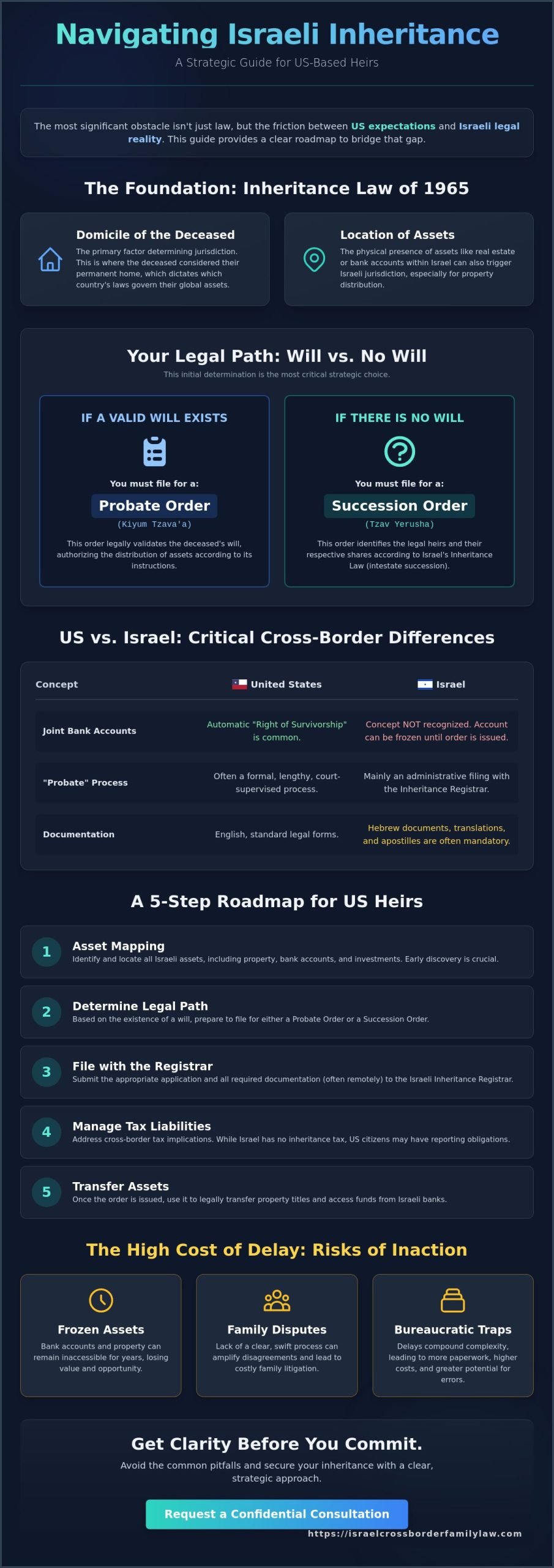
Understanding the mechanics of how to inherit in israel is only the first step. The transition from being a named heir to actually possessing an asset requires a proactive risk management strategy. Without this, assets such as a ₪3,500,000 property in Tel Aviv or a ₪600,000 investment account can remain frozen for months or years due to procedural errors. Early strategic planning prevents the Registrar of Inheritance Affairs from flagging a file, which often triggers a transfer to the Family Court for lengthy clarification.
Asset Mapping serves as the foundation of this strategy. Before any petitions are filed, heirs should conduct a comprehensive audit of the estate. This involves identifying potential claims from creditors or estranged family members who might emerge during the mandatory public notice period. In Israel, once a petition is published, any interested party has 14 days to file an objection. Mapping these risks allows for a controlled resolution, often through private mediation, rather than entering three to five years of high-conflict litigation in the Family Court.
The Importance of Early Clarity
Risk assessment is not a luxury; it’s a necessity for international families. Heirs often discover that Israeli banks require specific language in a Succession Order before they will release funds. If the order is drafted incorrectly, the process must start over, adding ₪15,000 to ₪25,000 in additional administrative costs and delays. Identifying these requirements early ensures the petition is tailored to meet the standards of both the Registrar and financial institutions.
A structured approach helps determine the most efficient path forward. Families dealing with cross-border estates must weigh the cost of immediate distribution against potential tax implications in the US. Seeking a Request a confidential case review provides the clarity needed to navigate these choices without making premature commitments that could complicate the estate’s tax status.
Seeking Professional Guidance
Generic legal advice often fails when applied to US-Israel situations because it ignores the bicultural nuances of the “Start-up Nation.” Israeli law, governed by the Succession Law of 1965, operates differently than the probate systems in New York or California. For example, Israel does not impose an estate tax, but US heirs may still face capital gains obligations or reporting requirements like the FBAR for Israeli bank accounts exceeding the ₪37,000 threshold (approximately $10,000).
The advisory role functions as a professional home for international families, bridging the gap between two distinct legal cultures. We provide a steady hand to help you understand how to inherit in israel while protecting your interests in the US. This bicultural expertise ensures that your strategy accounts for both the Israeli legal landscape and your domestic financial obligations.
Get clarity before you commit. Request a confidential consultation.
This article is published on an independent advisory platform, not a law firm. The information provided is for educational purposes only and does not constitute legal advice or an attorney-client relationship. Legal services are only provided by licensed attorneys under a separate engagement.
Secure Your Family Legacy With a Strategic Roadmap
Navigating international succession requires more than just filling out forms. You’ve seen how the Israeli Inheritance Registrar operates differently than US probate courts. Success depends on understanding these procedural nuances and managing the risks inherent in cross-border asset distribution. Early decisions regarding whether to follow a will or local succession laws often dictate the timeline and cost of the entire process.
Understanding how to inherit in israel involves bridging the gap between two distinct legal cultures. Our team brings decades of experience in US-Israel family law to help you navigate these complexities. We focus on providing specialized support for Anglo expats and international families through a bilingual and bicultural legal strategy. This approach ensures you have a clear roadmap before you take any formal legal steps.
Get clarity before you commit. Request a confidential consultation.
With the right strategic foundation, you can manage your family’s Israeli interests with confidence and peace of mind.
This article is published on an independent advisory platform, not a law firm. The information provided is for educational purposes and does not create an attorney-client relationship. Legal services are only provided by licensed attorneys under a separate engagement.
Frequently Asked Questions
Is there inheritance tax in Israel for US citizens?
Israel abolished inheritance and estate tax in 1981, so the state doesn’t tax the transfer of assets from the deceased to their heirs. However, it’s important to understand that US citizens are subject to US federal estate tax on their global assets. If the total value of the estate exceeds the 2024 federal exemption of approximately ₪50,000,000, you’ll need to account for US tax liabilities even if the assets are located in Tel Aviv or Jerusalem.
How long does the probate process take in Israel for foreigners?
The probate process for foreigners typically takes between 6 and 12 months to reach completion. This timeline includes the mandatory 14 day period for public objections and the administrative review by the Inheritance Registrar. If the deceased was not an Israeli resident, the court often requires an expert legal opinion regarding the laws of their last domicile, which can add 8 to 16 weeks to the total duration.
Can I inherit property in Israel if the deceased did not have a will?
You can inherit property without a will under the guidelines of the 1965 Succession Law. This statute defines a clear hierarchy of heirs, usually granting the spouse the movable assets and 50 percent of the estate, while the children share the remaining 50 percent. Establishing how to inherit in israel in these cases requires a Succession Order, which formally identifies the legal heirs based on their biological or marital relationship to the deceased.
What is an Apostille and why is it required for my documents?
An Apostille is an international certification established by the 1961 Hague Convention that verifies the authenticity of a public document. It’s required because Israeli government offices won’t accept foreign death certificates, marriage licenses, or powers of attorney without this specialized stamp. The Apostille ensures that your US-issued documents are recognized as legally valid by the Israeli Inheritance Registrar and other regulatory bodies.
Do I need to travel to Israel to claim my inheritance?
You don’t need to travel to Israel to claim your assets or manage the legal proceedings. Most international heirs utilize a notarized and Apostilled Power of Attorney to appoint a local representative who manages the filings and bank communications. This allows you to navigate the complex probate system from abroad while a team on the ground handles the administrative tasks. For more details on managing these processes remotely, you can view instructional guides at https://www.youtube.com/@IsraelFamilyLaw.
What happens if I discover assets in Israel years after a relative passed away?
There’s no statute of limitations on filing for a Succession Order or a Probate Order in Israel. You can still claim dormant bank accounts or real estate even if the relative passed away 20 or 30 years ago. You’ll need to provide the original death certificate and potentially reconstruct the family tree to prove your status as a legal heir under the 1965 Succession Law.
Can a US-made will be used to inherit assets in Israel?
A US-made will is generally valid in Israel if it meets the formal legal requirements of the state where it was signed. When determining how to inherit in israel with a foreign document, you must apply for a Probate Order and provide a translated copy of the will. The Israeli court will typically honor the testator’s wishes as long as the document doesn’t contradict fundamental Israeli public policy.
What is the role of the Israeli Inheritance Registrar?
The Israeli Inheritance Registrar is the government authority under the Ministry of Justice that oversees the distribution of estates. This office processes all applications for Succession and Probate Orders and maintains the national registry of wills. While the Registrar handles standard, uncontested cases, any matter involving a legal dispute or complex international litigation is transferred to the Family Court for a judicial decision.
Get clarity before you commit. Request a confidential consultation.

Article by
Gabriel Lior
A Personal Journey That Became a Mission
The advisory was founded by an American father Gabriel Lior, LLB, MBA , global entrepreneur, and cross-border advisor who spent more than a decade navigating the Israeli family court system firsthand and now lives in Singapore with his son.
As a divorced parent in a cross-border family, Gabriel faced nearly every legal challenge a foreign parent can encounter in Israel — including child custody disputes, child support proceedings, property matters in Israel and abroad, false accusations, and complex immigration and relocation proceedings.
Over the years, he learned the hard way how difficult it is for non-Israeli parents to understand the system, identify the right legal strategy, and choose the right legal representation — especially when language, culture, and jurisdictional differences are involved. He also witnessed how foreign parents and new immigrants are often disadvantaged or taken advantage of by service providers and institutions simply because they lack local knowledge or fluency.
From Client to Advisor
To truly understand — and survive — the system, Gabriel pursued formal legal education in Israel, completing two Israeli law degrees, alongside a BA and MBA earned in the United States. This was never about becoming a practicing attorney, but about gaining a deep, structural understanding of how the system works — and where it breaks down for foreign parents.
This rare combination of:
Firsthand client experience
Israeli legal and US business education
International business and negotiation training
Decades of commercial execution
created a unique perspective – one that understands both sides of the table.
After years of litigation, persistence, and at times self-representation, he ultimately succeeded in securing custody of his son and relocating abroad through a rare legal victory in the Israeli Supreme Court — becoming one of the first fathers in Israel to do so under these circumstances.
Disclaimer
Important Disclaimer:
The information provided on this website and in its content is for general informational and educational purposes only and does not constitute legal advice, legal opinion, or legal representation.
Gabriel Lior is not licensed to practice law in Israel (nor is he interested in doing so) and does not provide legal services, despite having completed 2 Law Degrees. The services offered are advisory in nature and are intended to provide general guidance, strategic insight, and information regarding cross-border family law considerations.
No attorney-client relationship is formed by accessing this website, reading its content, or communicating with us.
Any decisions made based on this information are at your own discretion and risk. For legal advice specific to your situation, you should consult a licensed attorney in the relevant jurisdiction.
Where appropriate, we may refer clients to independent, licensed attorneys or professionals. Such referrals do not constitute legal representation and no liability is assumed for services provided by third parties.