This article is published on an independent advisory platform and is not a law firm. The information provided is for educational purposes only and does not constitute legal representation or legal advice. Legal services are only provided by licensed attorneys under a separate engagement.
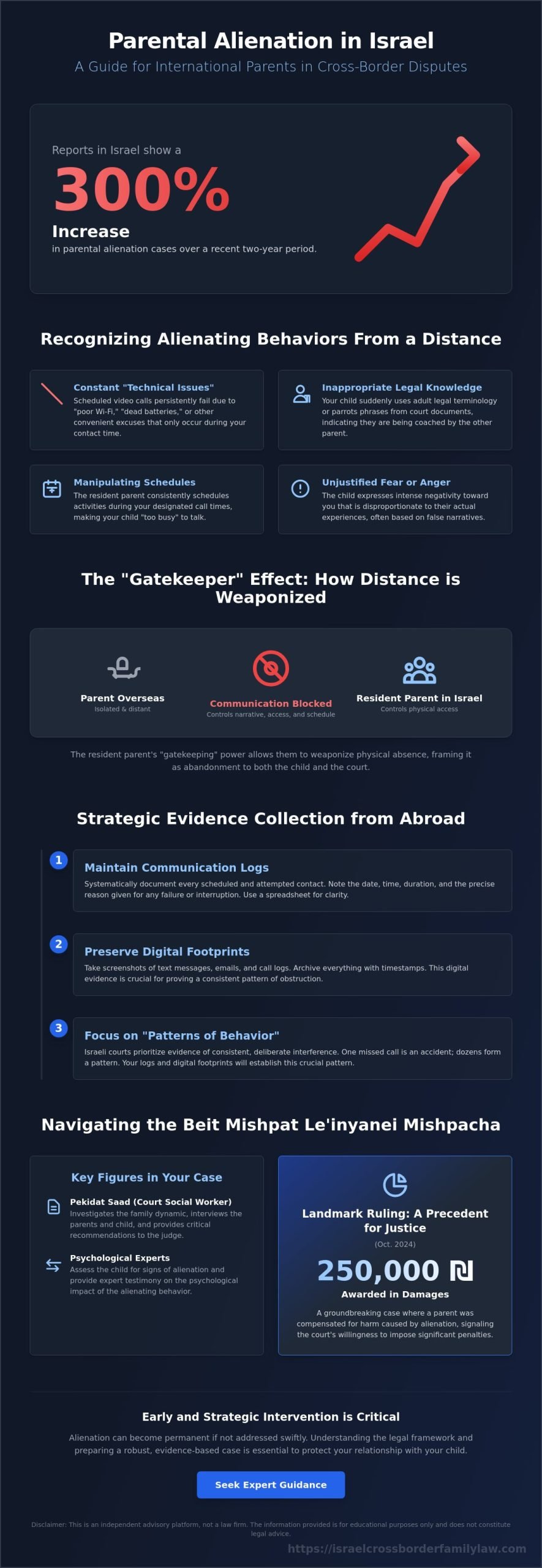
What if the thousands of miles between your home and Israel aren’t the primary reason your child has stopped answering your calls? It’s a haunting realization for many international parents that geographic distance is being weaponized to erode their parental bond. You likely feel a profound sense of helplessness as you try to interpret your child’s sudden coldness through a screen while struggling to understand a Hebrew speaking legal system that feels worlds away. You’re right to be concerned, as reports show a 300% increase in parental alienation cases in Israel over a recent two year period.
Proving parental alienation from overseas requires a transition from emotional reaction to the systematic collection of digital evidence within the specific framework of Israeli law. This article provides a clear strategy for identifying alienation and explains how the Israeli Family Court, or Beit Mishpat Le’inyanei Mishpacha, views these cross border disputes. We’ll explore recent trends, including the landmark October 2024 ruling where a parent was awarded 250,000 ₪ in damages, to help you build a framework for early intervention and protect your relationship with your child.
Key Takeaways
- Identify the subtle signs of alienating behavior, such as persistent “technical issues” during scheduled video calls or a child adopting adult legal terminology.
- Develop a systematic approach to proving parental alienation from overseas by maintaining comprehensive communication logs and preserving digital footprints of every contact attempt.
- Understand the critical role of the Pekidat Saad (court-appointed social worker) and psychological experts within the Israeli Family Court system.
- Learn why early intervention is essential to prevent alienation from becoming permanent and how to assess the risks of litigation before committing.
This article is published on an independent advisory platform and is not a law firm. The information provided is for educational purposes only and does not constitute legal representation or legal advice. Legal services are only provided by licensed attorneys under a separate engagement.
Understanding Parental Alienation in a Cross-Border Context
Parental alienation is defined as a psychological dynamic where one parent influences a child to reject the other parent without legitimate justification. In a cross-border environment, this often manifests as a deliberate pattern of behavior designed to undermine the child’s relationship with the parent living abroad. Modern international law increasingly prefers the term “alienating behavior” over the controversial “syndrome” label because it focuses on the observable actions of the parent rather than a medical diagnosis of the child. This distinction is critical when proving parental alienation from overseas, as Israeli courts prioritize evidence of specific behaviors that interfere with parental contact.
To better understand how these patterns of behavior influence legal proceedings, watch this helpful video:
The “CrossBorder” reality places the parent living in Israel in a position of significant “gatekeeping” power. A gatekeeper is a parent who controls the child’s access to the other parent, often using their physical proximity to manage communication and schedules. When a child is in Israel and the other parent is thousands of miles away, the resident parent can easily create barriers that are difficult to challenge without a team on the ground. This distance allows the alienating parent to frame technical glitches or “busy schedules” as the child’s own desire to avoid contact, making the task of proving parental alienation from overseas particularly complex.
The Distinction Between Alienation and Justifiable Estrangement
It’s vital to distinguish between alienation and justifiable estrangement. Estrangement occurs when a child pulls away because of a parent’s actual misconduct, such as abuse or neglect. In contrast, alienation involves a child who is manipulated into fearing or hating a parent who has done nothing to deserve such a reaction. Israeli Family Courts look for “unexplained” reluctance where a child’s intense negativity is disproportionate to their actual experience with the parent. Identifying these patterns early is essential for those navigating international custody and relocation issues before the bond is permanently severed.
Why Distance Makes Proving Alienation Challenging
Distance gives the resident parent total control over the narrative of the child’s daily life. They may tell the child that the parent abroad doesn’t care or has “moved on,” while simultaneously telling the court that the international parent’s absence constitutes abandonment. This creates a double-edged sword where your physical absence is weaponized against you. Success in these cases requires more than just emotional pleas; it requires a strategic approach to documenting every interaction and understanding how the Israeli legal system evaluates these multi-jurisdictional family dynamics.
Recognizing Alienating Behaviors from 6,000 Miles Away
Identifying the signs of alienation becomes a sophisticated exercise in observation when you are physically removed from your child’s daily environment. While parents living in Israel can witness behavioral shifts in person, international parents must rely on digital interactions to detect patterns of interference. One of the most prevalent tactics is the “technical difficulty” excuse. If Zoom calls or WhatsApp video chats consistently fail due to “poor Wi-Fi” or “dead batteries” only during your scheduled time, this is rarely accidental. These disruptions serve to frustrate the bond and make the child associate communication with you as a source of stress or failure. Over time, these small hurdles contribute to the “disposable parent” narrative, where the child is led to believe you have started a new life abroad and no longer prioritize their needs.
Exclusion from major life events is another hallmark of this dynamic. In Israel, schools and medical professionals frequently communicate through Hebrew language platforms like Mashov or localized WhatsApp groups. If the resident parent fails to include your contact information or translate critical updates, they are effectively gatekeeping your child’s reality. You might only learn about a significant medical issue or a school milestone weeks after it occurred. This lack of transparency is a critical component when proving parental alienation from overseas, as it demonstrates a deliberate effort to marginalize your role in the child’s life.
Digital Gatekeeping Tactics
Digital gatekeeping often involves the resident parent “hovering” just out of the camera’s view during your calls. You may notice your child frequently looking off-camera before answering simple questions, indicating they are checking for the other parent’s approval. Tactics also include scheduling conflicting extracurricular activities or social events exactly when you are supposed to call. This forces the child to choose between a “fun” activity in Israel and a “boring” phone call with the parent abroad, inevitably casting you as the person standing in the way of their happiness.
Psychological “Programming” Signs
A child who has been psychologically programmed often displays a startling lack of ambivalence. In healthy relationships, children recognize that parents have both strengths and flaws. In cases of alienation, the resident parent is viewed as “all good” while the overseas parent is “all bad.” The child may also act as a “messenger,” using complex legal terminology or reciting specific grievances about court filings they should not have access to. When the resident parent claims “it’s the child’s choice not to talk,” they are often using faux-empowerment to mask their own role in the alienation. Recognizing these “borrowed” grievances is essential for proving parental alienation from overseas in the Israeli Family Court system.
Get clarity before you commit to a legal path. Request a confidential consultation to discuss your specific situation.
A Step-by-Step Guide to Gathering Evidence from Overseas
Gathering evidence while living abroad requires a transition from emotional reaction to disciplined documentation. Because the Israeli Family Court relies heavily on objective proof of a parent’s efforts to maintain a bond, you must create a clear paper trail. A primary tool in this process is a detailed communication log. Every attempt to reach your child, whether through WhatsApp, Zoom, or phone calls, should be recorded with the date, time, duration, and specific outcome. If a call was “dropped” or went unanswered, note the context. These logs transform vague feelings of being “blocked” into a verifiable pattern of interference.
Preserve every digital footprint. This includes screenshots of denied requests for contact, text messages where the resident parent makes excuses, and recordings of video calls where the child appears coached or under duress. However, it’s vital to ensure any recording complies with Israeli privacy laws. Beyond communication, financial records serve as silent witnesses to your commitment. Evidence of consistent child support payments and receipts for attempted or completed visits to Israel counteract the “abandonment” narrative often used by alienating parents. This documentation is the first line of defense when proving parental alienation from overseas.
Documenting the “Pattern of Exclusion”
Documenting the pattern of exclusion often involves using a centralized parenting app to track all interactions. These platforms provide a court-admissible record of non-compliance and prevent the resident parent from deleting messages or altering history. Throughout this process, your tone must remain calm and persistent. Even if your child rejects your calls, you shouldn’t stop trying. Ceasing contact, even in the face of hostility, can be used against you in court as evidence of a lack of interest. Maintaining a steady, respectful presence in writing is crucial for proving parental alienation from overseas.
Working with Israeli Professionals
Working with Israeli professionals is the next step in building your case. You have rights to access your child’s records from institutions like Kupat Holim (health services) and the Ministry of Education. Often, these records reveal if the resident parent has excluded you from medical decisions or school updates. Gathering reports from schools or therapists in Israel follows specific international custody & relocation protocols that ensure the evidence is gathered legally. Because many of these documents will be in Hebrew, a bilingual liaison is essential to ensure no nuance is lost. You can learn more about how it works for expats who need to navigate these bureaucratic layers while living thousands of miles away.
Navigating the Israeli Legal System: The Role of Experts
In the Israeli legal landscape, the Family Court, known as Beit Mishpat Le’inyanei Mishpacha, operates under a “Therapeutic Jurisprudence” model. This approach moves away from purely adversarial litigation and instead relies heavily on a multidisciplinary team of experts to determine the child’s best interests. When you are proving parental alienation from overseas, your interactions with these court-appointed professionals are as critical as the evidence you present to the judge. The court frequently appoints child psychologists or specialized expert witnesses to evaluate the family dynamic and identify if the child’s rejection of the international parent is authentic or the result of psychological manipulation. These experts are trained to look for the “borrowed language” and lack of ambivalence discussed in previous sections.
There are instances where alienating behaviors overlap with international child abduction cases. If a child has been wrongfully retained in Israel, the alienating parent may use the legal delay to solidify the child’s resistance to returning. Israeli courts are increasingly sensitive to this tactic. Because the system is designed to be protective, the court’s reliance on neutral third-party evaluations is the primary mechanism for overcoming the “he said, she said” nature of cross-border disputes. Understanding how to navigate these expert evaluations is the cornerstone of a successful strategy.
The Social Worker Investigation
The Pekidat Saad is a court-appointed social worker who carries significant influence in Israeli family law. For an international parent, the investigation often begins with a remote interview. You should be prepared to present your communication logs and evidence of exclusion clearly during this session. The social worker will eventually submit a “Tazkir,” or official report, to the judge. This document contains specific recommendations regarding visitation and contact. Because the judge relies heavily on the Tazkir, ensuring the social worker understands the digital barriers you face is essential for proving parental alienation from overseas.
Legal Remedies in Israel
If the court confirms alienation, several legal remedies are available to restore the parent-child bond. These include court-ordered reunification therapy and, increasingly, financial sanctions against the alienating parent. A landmark ruling in October 2024 demonstrated this trend, as a father was awarded 250,000 ₪ in damages, calculated at 50,000 ₪ for every year of alienation. In extreme cases, the court may consider a transfer of custody, though this remains a “nuclear option” used only when all therapeutic interventions fail. These measures reflect a growing commitment within the Israeli judiciary to penalize those who interfere with a child’s right to both parents.
If you are facing these challenges, it’s vital to act before the child’s resistance becomes entrenched. Request a confidential case review to begin building your strategy.
Strategic Decision-Making: When to Act and How to Prepare
Deciding when to transition from private attempts at reconciliation to formal legal action is one of the most difficult choices an international parent faces. Many parents fall into the “Wait and See” trap, hoping that the child’s hostility is a temporary phase or that the resident parent will eventually cooperate. However, in the context of proving parental alienation from overseas, delay often works against the bond. Distance allows the alienating narrative to become the child’s only reality. Every month that passes without intervention can solidify the child’s rejection, making eventual reunification therapy significantly more difficult and complex.
A strategic approach requires balancing the risk of increased conflict against the risk of permanent bond loss. While legal action can temporarily escalate tensions, it also signals to the resident parent and the Israeli Family Court that you are committed to your parental role. Your strategy must consider the multi-jurisdictional nature of your life. This involves understanding how your home country’s orders might interact with Israeli law and ensuring your advisory team in Israel is synchronized with your international objectives. Get clarity before you commit. Request a confidential consultation to evaluate the specific risks of your situation.
Early Intervention vs. Crisis Management
Identifying the tipping point is essential. If you notice a consistent pattern of missed calls or the use of “scripted” language by your child, you’ve likely reached a stage where legal oversight is necessary. Early decisions made during divorce and separation often set the tone for future contact. As highlighted on the @IsraelFamilyLaw YouTube channel, strategic timing is everything. Crisis management is often reactive and more costly; early intervention allows you to establish court-monitored communication before the child is fully programmed to reject you.
Preparing for Your Consultation
When you are ready to seek professional advice, preparation is your most valuable asset. Start by summarizing your case using a “Who, What, When” framework that highlights the specific instances of interference you’ve documented in your evidence logs. Clearly define your goals, whether you’re seeking full reunification, increased digital contact, or legal protections against further alienation. Having this information organized ensures that your advisor can provide a realistic assessment of your chances of proving parental alienation from overseas. You can begin this process by requesting a Confidential Case Review to discuss the strategic steps required for your specific cross-border family dynamic.
Securing Your Parental Bond Across Borders
Managing a parent-child relationship across international borders is inherently complex, yet the challenge is significantly magnified when alienating behaviors are present. Successfully proving parental alienation from overseas requires a transition from emotional distress to a disciplined, evidence-based strategy. By maintaining meticulous communication logs and understanding the critical role of court-appointed experts like the Pekidat Saad, you can provide the Israeli Family Court with the objective data it needs to protect your child’s best interests.
Early intervention is the most effective way to prevent a temporary distance from becoming a permanent rift. This advisory platform specializes in US-Israel cross-border family law, providing authoritative guidance for the expat community on matters ranging from the Hague Convention to international custody disputes. We focus on helping families navigate the sophisticated Israeli legal system with clarity and foresight, ensuring you understand the risks before making significant legal commitments.
Get clarity before you commit. Request a confidential consultation to discuss your specific situation and develop a proactive roadmap for your family. Protecting your bond with your child is a journey that begins with an informed, strategic decision.
Frequently Asked Questions
Is parental alienation a crime in Israel?
Parental alienation isn’t a criminal offense under the Israeli Penal Code, but it’s treated with increasing severity in the Family Court system. Judges utilize civil remedies like financial sanctions and tort damages to penalize alienating behavior. A landmark decision in October 2024 saw a parent awarded 250,000 ₪ for the emotional damage caused by years of severed contact, illustrating the court’s willingness to impose significant penalties.
Can I use recorded Zoom calls as evidence in an Israeli court?
Recorded Zoom or WhatsApp calls are generally admissible in Israeli courts as long as the recording doesn’t violate privacy laws. Since you’re a party to the conversation, you can typically record the interaction to document signs of coaching or interference. These recordings are vital when proving parental alienation from overseas because they provide objective proof of the child’s behavior and the resident parent’s “hovering” during calls.
What happens if the resident parent in Israel refuses to follow a contact order?
If a resident parent ignores a contact order, the court can impose fines for non-compliance to encourage future cooperation. These fines are often set on a per-violation basis to provide immediate consequences for gatekeeping behavior. In persistent cases, the court might also order therapeutic interventions or appoint a specific coordinator to oversee all communications and ensure the child remains accessible to you.
How long does it take to prove parental alienation from overseas?
The timeline for proving parental alienation from overseas typically ranges from 6 to 18 months. This period allows for the appointment of a Pekidat Saad and the completion of necessary psychological evaluations. While the legal process is deliberate, seeking an expedited hearing in Tel Aviv or Jerusalem courts can sometimes shorten these timelines if the court determines the child’s welfare is at immediate risk.
Will the Israeli court listen to me if I cannot fly to Israel for the hearing?
Israeli Family Courts frequently allow international parents to testify via secure video link if travel is not feasible. While physical presence can be beneficial for building rapport with the judge, the court recognizes the logistical challenges of cross-border living. You’ll need to submit a formal request for remote testimony well in advance of your scheduled hearing date to ensure the technology is prepared.
Does the Pekidat Saad always favor the parent living in Israel?
The Pekidat Saad is a neutral court-appointed official whose mandate is to protect the child’s best interests. They don’t have an inherent bias toward the resident parent, but their reports are based on the evidence and interactions available to them. This is why providing them with a clear, translated log of your contact attempts is essential for ensuring your perspective is accurately represented in their final report.
What is reunification therapy, and does it work in cross-border cases?
Reunification therapy is a court-ordered process where a psychologist works with the parent and child to repair their relationship. In cross-border situations, this often involves a hybrid model of remote sessions followed by intensive, in-person meetings when the parent visits Israel. Success depends heavily on the court’s ability to enforce the alienating parent’s cooperation with the therapist’s specific recommendations and schedule.
Can parental alienation lead to a change in child support payments?
While child support and visitation are separate legal issues, extreme alienation can occasionally impact financial obligations. Israeli courts have, in rare circumstances, reduced child support when a child is deemed “rebellious” or when the resident parent actively sabotages the relationship. This is a complex legal area that requires a strategic assessment of the specific family dynamics and the court’s view on the resident parent’s behavior.

Article by
Gabriel Lior
A Personal Journey That Became a Mission
The advisory was founded by an American father Gabriel Lior, LLB, MBA , global entrepreneur, and cross-border advisor who spent more than a decade navigating the Israeli family court system firsthand and now lives in Singapore with his son.
As a divorced parent in a cross-border family, Gabriel faced nearly every legal challenge a foreign parent can encounter in Israel — including child custody disputes, child support proceedings, property matters in Israel and abroad, false accusations, and complex immigration and relocation proceedings.
Over the years, he learned the hard way how difficult it is for non-Israeli parents to understand the system, identify the right legal strategy, and choose the right legal representation — especially when language, culture, and jurisdictional differences are involved. He also witnessed how foreign parents and new immigrants are often disadvantaged or taken advantage of by service providers and institutions simply because they lack local knowledge or fluency.
From Client to Advisor
To truly understand — and survive — the system, Gabriel pursued formal legal education in Israel, completing two Israeli law degrees, alongside a BA and MBA earned in the United States. This was never about becoming a practicing attorney, but about gaining a deep, structural understanding of how the system works — and where it breaks down for foreign parents.
This rare combination of:
Firsthand client experience
Israeli legal and US business education
International business and negotiation training
Decades of commercial execution
created a unique perspective – one that understands both sides of the table.
After years of litigation, persistence, and at times self-representation, he ultimately succeeded in securing custody of his son and relocating abroad through a rare legal victory in the Israeli Supreme Court — becoming one of the first fathers in Israel to do so under these circumstances.
Disclaimer
Important Disclaimer:
The information provided on this website and in its content is for general informational and educational purposes only and does not constitute legal advice, legal opinion, or legal representation.
Gabriel Lior is not licensed to practice law in Israel (nor is he interested in doing so) and does not provide legal services, despite having completed 2 Law Degrees. The services offered are advisory in nature and are intended to provide general guidance, strategic insight, and information regarding cross-border family law considerations.
No attorney-client relationship is formed by accessing this website, reading its content, or communicating with us.
Any decisions made based on this information are at your own discretion and risk. For legal advice specific to your situation, you should consult a licensed attorney in the relevant jurisdiction.
Where appropriate, we may refer clients to independent, licensed attorneys or professionals. Such referrals do not constitute legal representation and no liability is assumed for services provided by third parties.