This article is published on an independent advisory platform (not a law firm) and does not imply an attorney-client relationship.
What if the simple act of delivering a document determines whether your future is decided by a religious or civil authority? In the complex world of international family law, knowing how to serve divorce papers in israel is often the most critical step in securing a favorable jurisdictional outcome. You likely already feel the pressure of the “race for jurisdiction,” where the first party to file and serve correctly can influence whether the case is heard in the Rabbinical Court or the Family Court. This dual system can be overwhelming, especially when you are dealing with Hebrew documents and cross-border logistics.
It is natural to feel concerned about making a procedural mistake that could delay your case or jeopardize your legal standing. This guide provides the clarity you need to understand the technical requirements and strategic importance of proper service to protect your interests during a separation. We will explore the mandatory steps for initiating service, the specific protocols for parties living in the US under the Hague Convention, and how to avoid common mistakes that can stall your proceedings for months.
Key Takeaways
- Learn how the timing of service directly impacts the “race for jurisdiction” between the Rabbinical and Family Court systems.
- Understand the specific legal protocols for how to serve divorce papers in israel when one party resides in the United States.
- Identify the mandatory first step involving the Application for the Settlement of Dispute and why it must precede formal litigation.
- Compare personal service and registered mail to determine the most secure method for ensuring your documents are legally recognized.
- Discover why strategic “quiet preparation” is often more effective than immediate service for protecting cross-border assets.
Understanding Service of Process in the Israeli Legal Landscape
Service of process is the formal mechanism by which a legal action is officially brought to a defendant’s attention. In the context of international family law, it represents much more than a simple delivery. It’s the foundational step that ensures the principle of due process is upheld, giving the other party a fair opportunity to respond to the claims filed against them. Within the Israeli legal framework, the distinction between filing a claim at the court registry and successfully completing service is profound. While filing initiates the case, it’s the valid service of documents that anchors the court’s authority over the matter.
The timing of this step is particularly sensitive because of the “Race for Jurisdiction.” This concept refers to the strategic advantage gained by being the first to properly file and serve a claim in either the Rabbinical Court or the Family Court. If you are exploring how to serve divorce papers in israel, you must recognize that an error in delivery isn’t just a minor delay. It can result in a total loss of jurisdictional control, potentially forcing your case into a court system that is less favorable to your specific financial or personal interests.
To better understand this concept, watch this helpful video:
The Dual Court System and Service
Israel operates under a unique dual-court system where religious and civil courts have parallel authority over certain aspects of divorce and separation for international families. The concept of “Linkage” allows a party to bind issues like property division and child custody to the divorce claim itself. However, this linkage only becomes effective once service is legally finalized. Many people mistakenly believe that an informal notification, such as a WhatsApp message or an email, satisfies the court’s requirements. It doesn’t. Without a formal acknowledgment of receipt or a verified affidavit from a process server, the court may refuse to move forward. For those dealing with spouses abroad, the Hague Service Convention provides the mandatory international framework that must be followed to ensure the Israeli court’s eventual ruling is recognized globally.
Anglo Expats and the Language Barrier
For English-speaking families, the language barrier presents a significant procedural risk. All official court documents in Israel are issued in Hebrew. To ensure valid service on a party who does not speak Hebrew, these documents must be translated by certified professionals. Using an uncertified translation can lead to the service being contested and eventually thrown out by a judge. Anglo families are often at a disadvantage because they may not realize that the technical accuracy of the translation is just as important as the delivery itself. Ensuring that every legal term is correctly interpreted is essential for maintaining the integrity of your strategy and avoiding costly procedural challenges that can stall your case for months.
The Mandatory First Step: Serving the Application for Dispute Resolution
In Israel, the path to divorce doesn’t begin with a traditional lawsuit. Under the 2016 Mandatory Dispute Resolution Law, parties must first file an “Application for the Settlement of Dispute,” known in Hebrew as Bakasha L’Yishuv Sichsach. This procedural requirement is designed to encourage mediation before litigation begins. However, the legal weight of this application depends entirely on successful delivery. If you are researching how to serve divorce papers in israel, you must understand that this initial document is the gatekeeper to the entire process. Without proof of service, the court won’t recognize the application as active, and you won’t secure your place in the jurisdictional race.
Serving this application triggers a mandatory “stay of proceedings,” which acts as a legal freeze on litigation for a standard duration of 60 days. During this window, neither spouse can file substantive claims regarding property, custody, or support in any court. For international families, navigating this phase requires precision, especially if one party is outside the country. You can find detailed U.S. Department of State guidance on service in Israel to help understand the formal channels required for cross-border delivery. Missing a step here can result in the court dismissing your application, allowing the other party to file first and gain the upper hand in choosing the court system.
The Role of the Assistance Unit
Once the application is served, the parties are invited to meetings with the court’s Assistance Unit, which is staffed by social workers and legal professionals. These meetings are not trials; they are diagnostic sessions intended to determine if the dispute can be resolved through mediation. You cannot serve substantive divorce claims during this stay period unless there is an extreme emergency. Strategically, being the first to serve this application is vital. The party who initiates this process generally earns the right to choose between the Rabbinical Court and the Family Court if mediation fails after the 60-day period ends. For those managing cases for expats and foreign nationals, this choice often determines the financial outcome of the entire separation.
Deadlines and Timeframes
The court mandates strict windows for completing service after the initial filing. Typically, you have 15 days to ensure the other party receives the documents and to provide the court with an acknowledgment of receipt. If you fail to meet this deadline, the court may close the file, effectively erasing your priority status. The stay of proceedings is a mandatory period, typically lasting 60 days, during which neither party may file substantive legal claims in any court. In urgent cases involving child abduction or the immediate hiding of assets, exceptions to these rules exist, but they require specific motions to bypass the standard stay. To ensure your application meets these strict procedural standards, you can request a consultation to discuss your specific circumstances.
Approved Methods for Delivering Divorce Papers in Israel
Once you’ve filed the initial application, the focus shifts to the physical delivery of the documents. In the Israeli legal system, the method you choose can be the difference between a smooth transition and a procedural nightmare. While the court offers a standard postal service, it’s rarely the best choice for complex international cases where a single day’s delay can alter the jurisdictional outcome. Proof of delivery is the only way to confirm the court’s authority to proceed.
If you’re wondering how to serve divorce papers in israel effectively, personal service is the gold standard. This method involves a physical hand-off of the documents, which provides the highest level of certainty. You’ll receive an Ishur Msira (acknowledgment of receipt), which is a vital piece of evidence for the court file. This document eliminates the common excuse that papers were lost in the mail or delivered to the wrong address, securing your position in the “race for jurisdiction.”
What happens if a spouse is intentionally avoiding delivery? In these scenarios, you can request “substituted service.” This allows you to deliver papers through alternative means, such as leaving them with a relative or at a place of work, provided you can prove the spouse will likely see them. The Israeli Judicial Authority outlines the specific criteria for these requests to ensure the respondent’s right to due process isn’t violated. Substituted service is a fallback, not a first resort, and requires clear evidence of evasion.
Using a Private Process Server
Hiring a licensed professional is often a strategic necessity for divorce and separation for international families. A private server handles the legwork and provides a sworn Affidavit of Service, known as a Tashtit. This document is essential for overcoming claims that the spouse was never notified. These servers are skilled at handling hostile environments or tracking down individuals who have moved without notice, which is common in cross-border disputes. They ensure the delivery meets all technical standards required by both the Family and Rabbinical Courts.
Digital Service: Email and WhatsApp
There’s a growing trend in Israeli courts toward accepting service via email or WhatsApp. However, this isn’t an automatic right. You must first obtain a court order by demonstrating that traditional methods have failed. The court will look for proof that the digital account is active and that the recipient has actually viewed the message. Without this prior permission, digital notification is legally insufficient. Relying on an unapproved email can jeopardize your entire case, especially if the other party later claims they never saw the notification.
Cross-Border Service: Serving Papers Between the US and Israel
When one spouse is in Israel and the other is in the United States, procedural requirements become significantly more rigid. You can’t simply mail documents across the ocean and expect an Israeli or American court to recognize the delivery as valid. Instead, you must follow the Hague Service Convention. This international treaty provides a standardized, legally binding method for delivering documents between member nations. If you are trying to figure out how to serve divorce papers in israel while residing in the US, understanding this treaty is your first priority to ensure any future judgment is enforceable.
International service is not just a logistical hurdle; it’s a strategic one. The Israeli court needs proof that the party in the US was notified according to international law. Conversely, if you’re serving a spouse in IL from the US, you must work through the Israeli Central Authority. Errors during this phase can lead to a US court refusing to recognize an Israeli divorce decree later. This complexity is why many families seek a strategy that accounts for both legal systems before they take the first step.
The Hague Convention Process
The process begins by submitting a formal request to the Central Authority of the country where the recipient resides. For a case initiated in Israel against a spouse in the US, the documents are sent to the US Department of Justice. As of June 2026, the standard fee for this service in the United States is $95.00 USD. The task is typically executed by a private contractor, ABC Legal, on behalf of the government. You should prepare for a timeline of one to six months for the process to be completed. Common pitfalls that lead to rejection include failing to provide certified Hebrew translations or using outdated forms. If the paperwork isn’t perfect, the Central Authority will return it, forcing you to restart the clock on your 60-day stay of proceedings.
Service on an Authorized Agent
In certain scenarios, you may be able to bypass the lengthy Hague process by serving an authorized agent within Israel. If your spouse has already hired an attorney in IL to handle other legal matters, the court may allow service on that attorney. Another option is the “business activity” rule. This applies if the spouse has a representative in Israel managing their business or financial affairs. Serving this representative can sometimes be legally sufficient to satisfy the court’s requirements. For more details on how these rules apply to your specific residency status, see our guide for expats and foreign nationals. To ensure you choose the most efficient path for your case, you can consult with an advisor on international service strategy.
This article is published on an independent advisory platform (not a law firm) and does not imply an attorney-client relationship.
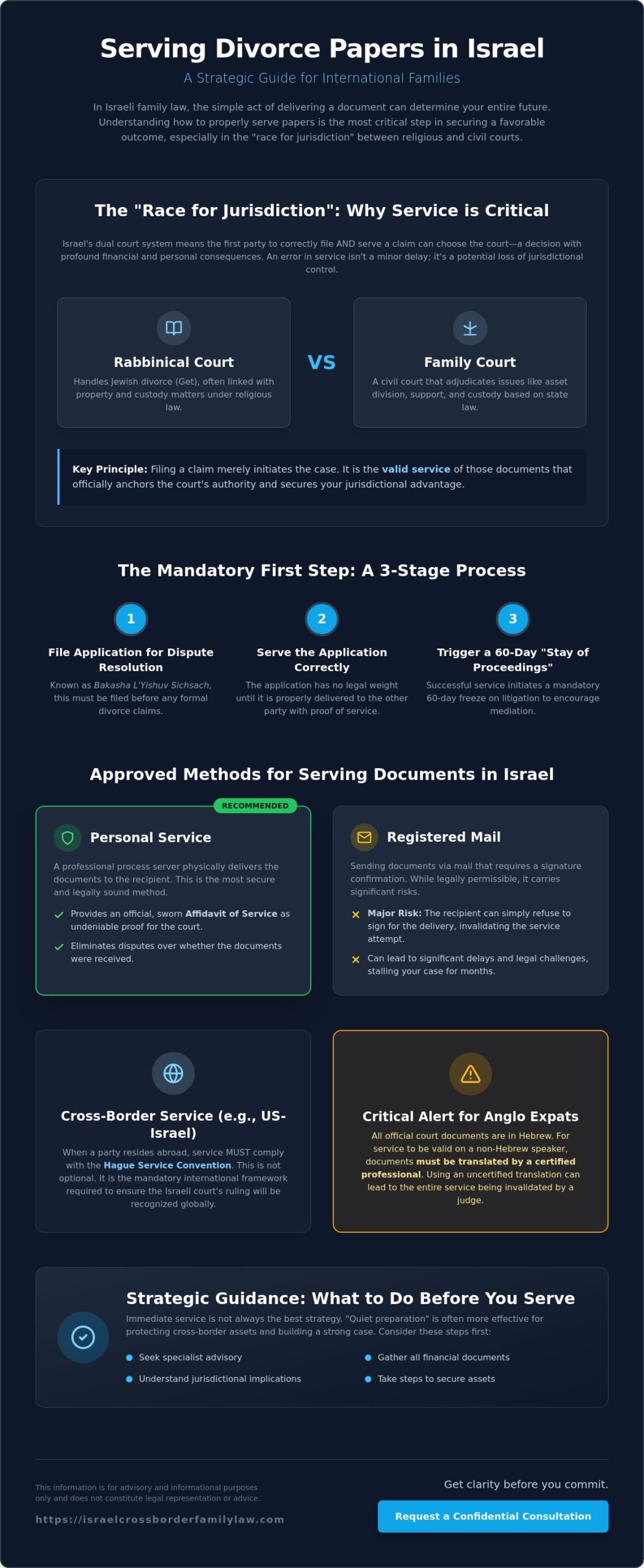
Strategic Guidance: What to Do Before You Serve
While the mechanics of how to serve divorce papers in israel are technical, the decision of when to initiate that service is purely strategic. Many individuals feel a sense of urgency to act immediately, yet a surprise service without adequate preparation can lead to unintended consequences. Once you serve the initial application, you trigger a 60-day stay of proceedings. This period is designed for mediation, but it also alerts the other party to your legal intentions. If you haven’t secured your financial records or property documentation beforehand, you may find yourself at a disadvantage when the freeze on litigation begins.
Before moving forward, it’s essential to assess the systemic differences between the Rabbinical Court and the Family Court. These two systems often view the division of assets through different lenses. For example, specific types of property or future earnings might be treated differently depending on which court gains jurisdiction. Quietly gathering evidence and assessing these risks allows you to choose the forum that best aligns with your long-term interests. Taking the time for an advisory review before you learn how to serve divorce papers in israel ensures that your first move isn’t just fast, but also calculated.
The Impact of Early Decisions
The location and timing of service can profoundly influence claims regarding international custody and relocation. In cross-border cases, the court that first handles the dispute resolution application often retains authority over where the children will live. If you serve papers while a spouse is temporarily in IL, you might inadvertently lock the case into the Israeli system, even if you intended for it to be heard in a US court. Timing your service is just as important as the method of delivery. You don’t want to initiate a process that you aren’t fully prepared to finish, especially when children and international borders are involved.
Seeking Strategy Over Litigation
There’s a significant difference between a litigation-first approach and a strategy-first approach. Most law firms focus on the technical execution of filing and serving. An advisory platform, however, focuses on the broader implications and the “what if” scenarios. By clarifying your risks before you engage a law firm, you can enter the process with a clear roadmap rather than reacting to events as they unfold. This strategic layer is particularly valuable for international families who must navigate the multi-jurisdictional complexity of both Israeli and foreign laws. Get clarity before you commit. Request a confidential consultation to discuss your strategy.
This article is published on an independent advisory platform (not a law firm) and does not imply an attorney-client relationship.
Securing Your Strategic Advantage Through Proper Service
Executing service is the definitive moment when abstract legal strategy becomes a concrete reality. By understanding how to serve divorce papers in israel, you protect yourself from the procedural pitfalls that often compromise international families. Proper service ensures that the correct court system handles your assets and custody matters while maintaining the integrity of your case across borders. It’s not just about delivery; it’s about anchoring your jurisdictional priority before the other party can act.
Our advisory platform provides specialized expertise in US-Israel cross-border family law. We focus on strategy and risk mitigation, drawing on extensive experience with Hague Convention service procedures to guide you through every technical step. Navigating these multi-jurisdictional complexities requires a steady hand and a clear roadmap. The choices you make now will define your legal standing for years to come, so it’s vital to act with precision. You don’t have to face these systemic differences alone.
Get clarity before you commit. Request a confidential strategy call to explore your options and mitigate your risks.
This article is published on an independent advisory platform (not a law firm) and does not imply an attorney-client relationship.
Frequently Asked Questions
Can I serve divorce papers in Israel myself?
Generally, no. While you might wonder if you can handle the delivery personally, knowing how to serve divorce papers in israel correctly usually requires a neutral third party or a licensed process server. If you perform the delivery yourself, the recipient can easily challenge the service by claiming they never received the documents. Using an independent party provides the court with an objective witness and a valid proof of delivery.
What happens if my spouse refuses to sign the service papers?
A refusal to sign does not necessarily invalidate the service. If a process server attempts delivery and the spouse refuses to accept the documents, the server can leave them at the spouse’s feet or at their residence. The server then documents the refusal in a sworn affidavit. This record allows the court to move forward with the case despite the lack of a physical signature from the respondent.
How long does it take to serve papers under the Hague Convention?
The process of serving documents from Israel to the US through the Hague Convention typically takes between one and six months to complete. This timeline depends heavily on the efficiency of the Central Authority in the country where the papers are being delivered. Because these delays can impact the “race for jurisdiction,” it’s vital to initiate the process as early as possible to avoid stalling your case in IL.
Is service via WhatsApp legal in Israel?
Service via WhatsApp is only legal if you first obtain specific permission from the court. You must demonstrate that traditional methods of service have failed or are impossible to execute despite your best efforts. The court will require proof that the recipient actually uses the phone number and has viewed the message before they will recognize digital delivery as a valid method of service.
Do I have to serve papers in Hebrew if my spouse only speaks English?
You must serve the original Hebrew documents issued by the court, but they must be accompanied by a certified English translation. Serving only Hebrew papers to an English speaker is often considered a violation of due process. Providing a professional translation ensures the recipient understands the legal claims and prevents them from successfully challenging the service based on a language barrier.
What is an ‘Affidavit of Service’ and why is it required?
An Affidavit of Service is a sworn legal document signed by the person who delivered the papers. It provides the court with formal proof that the spouse was notified of the proceedings. This document is essential because it details the date, time, and location of the delivery. Without a valid affidavit, the court cannot confirm that it has the authority to hear your family law case or issue rulings.
Can I serve divorce papers to my spouse at their workplace in Israel?
Yes, you can serve papers at a workplace if personal service at home is not possible. However, the delivery should be handled discreetly by a professional process server to avoid unnecessary conflict or public embarrassment. If the spouse is not present, you may sometimes leave the documents with a person in charge at the business, provided you follow the specific rules for substituted service in IL.
What happens if I cannot find my spouse to serve them?
If a spouse’s whereabouts are unknown, you must petition the court for “Service by Publication.” This involves demonstrating that you’ve made extensive, good-faith efforts to locate them through investigators or government registries. The court may then allow you to publish a notice in a newspaper or on a digital platform. Once the publication period ends, the court will treat the spouse as if they have been formally served.

Article by
Gabriel Lior
A Personal Journey That Became a Mission
The advisory was founded by an American father Gabriel Lior, LLB, MBA , global entrepreneur, and cross-border advisor who spent more than a decade navigating the Israeli family court system firsthand and now lives in Singapore with his son.
As a divorced parent in a cross-border family, Gabriel faced nearly every legal challenge a foreign parent can encounter in Israel — including child custody disputes, child support proceedings, property matters in Israel and abroad, false accusations, and complex immigration and relocation proceedings.
Over the years, he learned the hard way how difficult it is for non-Israeli parents to understand the system, identify the right legal strategy, and choose the right legal representation — especially when language, culture, and jurisdictional differences are involved. He also witnessed how foreign parents and new immigrants are often disadvantaged or taken advantage of by service providers and institutions simply because they lack local knowledge or fluency.
From Client to Advisor
To truly understand — and survive — the system, Gabriel pursued formal legal education in Israel, completing two Israeli law degrees, alongside a BA and MBA earned in the United States. This was never about becoming a practicing attorney, but about gaining a deep, structural understanding of how the system works — and where it breaks down for foreign parents.
This rare combination of:
Firsthand client experience
Israeli legal and US business education
International business and negotiation training
Decades of commercial execution
created a unique perspective – one that understands both sides of the table.
After years of litigation, persistence, and at times self-representation, he ultimately succeeded in securing custody of his son and relocating abroad through a rare legal victory in the Israeli Supreme Court — becoming one of the first fathers in Israel to do so under these circumstances.
Disclaimer
Important Disclaimer:
The information provided on this website and in its content is for general informational and educational purposes only and does not constitute legal advice, legal opinion, or legal representation.
Gabriel Lior is not licensed to practice law in Israel (nor is he interested in doing so) and does not provide legal services, despite having completed 2 Law Degrees. The services offered are advisory in nature and are intended to provide general guidance, strategic insight, and information regarding cross-border family law considerations.
No attorney-client relationship is formed by accessing this website, reading its content, or communicating with us.
Any decisions made based on this information are at your own discretion and risk. For legal advice specific to your situation, you should consult a licensed attorney in the relevant jurisdiction.
Where appropriate, we may refer clients to independent, licensed attorneys or professionals. Such referrals do not constitute legal representation and no liability is assumed for services provided by third parties.