This article is published on an independent advisory platform and does not constitute a law firm or an attorney-client relationship. All content is for informational purposes only. Legal services are provided solely by licensed attorneys under a separate engagement.
What if the assets your family spent a lifetime building in Israel remained frozen for years because of a single jurisdictional oversight? It’s natural to feel overwhelmed when you’re balancing the requirements of two different legal systems while managing the emotional weight of a loss. This guide clarifies the nuances of inheritance law in israel so you can approach cross-border estate management with the confidence of a seasoned professional. You’ll gain a clear roadmap of the probate process, from the initial filing of a Succession Order to the final distribution of assets. We’ll examine how to navigate the 1965 Succession Law, explain the critical differences between the Family Court and the Rabbinical Court, and outline strategies to protect Israeli assets from double taxation. In 2024, the standard fee for an online succession order application is ₪534, yet the hidden costs of procedural delays can be far higher for international families. By understanding these complexities now, you can avoid the disputes that often arise when heirs lack a strategic plan. Get clarity before you commit. Request a confidential consultation.
For more insights on protecting your family’s future, watch our detailed breakdown here: https://www.youtube.com/@IsraelFamilyLaw
Key Takeaways
- Gain a clear understanding of the Succession Law of 1965, the primary legal framework that governs how all estates and assets are distributed within Israel.
- Learn the four specific requirements for a valid will under inheritance law in israel to prevent the common risks associated with relying solely on foreign legal documents.
- Identify the legal hierarchy of heirs in cases of intestacy and how Israeli law prioritizes the protection of spouses and children when no valid will exists.
- Evaluate the benefits of a “Dual Will” strategy to seamlessly manage cross-border assets and address the unique legal complexities facing international families and “US Persons.”
- Navigate the practical steps of the Israeli probate process and learn how early strategic planning can prevent local banks from freezing essential family accounts.
This article is published on an independent advisory platform and does not constitute an attorney-client relationship. Legal services are only provided by licensed attorneys under a separate engagement.
Understanding the Framework of Israeli Succession Law
The Succession Law of 1965 provides the secular foundation for all estate matters in IL. This comprehensive statute serves as the primary legal “bible” for managing and distributing assets within the country. It doesn’t matter if you’re a lifelong citizen or an expat holding a single apartment in Netanya; if you own assets in Israel, this law governs their future. The framework applies to anyone who was a resident of Israel at the time of their passing or anyone who left behind property, bank accounts, or business interests within the country’s borders.
Understanding inheritance law in israel requires a clear distinction between “Succession by Will” and “Succession by Law.” When a person leaves a valid legal document, the state follows the instructions through a Probate Order. If no will exists, the estate is considered intestate, and the law dictates a fixed distribution hierarchy among surviving family members. While the modern system acknowledges the historical influence of Jewish inheritance laws, the 1965 statute ensures a uniform, secular process that protects the rights of all international families regardless of religious affiliation.
To better understand how these regulations impact property and estate planning, watch this helpful video:
Civil Family Courts vs. Rabbinical Courts
Israel operates a parallel jurisdiction system that often surprises expats and foreign nationals. While the secular Family Court is the default for most international families, Rabbinical courts also hold authority over inheritance matters. However, a Rabbinical court can only take jurisdiction if every legal heir provides written “mutual consent.” Many international clients prefer the Family Court system because it offers a high degree of predictability and strictly follows civil statutes, which is vital when dealing with complex cross-border tax or property issues.
The Role of the Registrar of Inheritance Affairs
The Registrar of Inheritance Affairs acts as the administrative gatekeeper for the estate process. It’s the first stop for all non-contentious applications, whether you’re seeking a Succession Order or a Probate Order. Since the digital transition in 2018, the Registrar has moved toward an online filing system to accelerate processing times for standard cases. If a family member files an objection or if the case involves a complex legal question that the Registrar cannot settle, the file is automatically transferred to the Family Court for a judge to review. This ensures that simple estates move quickly while disputed matters receive full judicial attention.
Get clarity before you commit. Request a confidential consultation.
This article is published on an independent advisory platform and does not constitute legal representation or an attorney-client relationship. Legal services are only provided by licensed attorneys under a separate engagement.
Valid Wills in Israel: Ensuring Your Wishes are Enforceable
Israel’s legal framework for successions, primarily governed by the Inheritance Law of 1965, grants individuals broad testamentary freedom to distribute their assets as they see fit. While this flexibility is a hallmark of inheritance law in israel, it doesn’t mean the process is without risk. Procedural errors and formal defects remain the most frequent reasons Israeli courts strike down wills or allow them to be successfully contested. For international families with assets in multiple jurisdictions, relying on a foreign-drafted document that ignores local formal requirements can lead to years of litigation and the freezing of Israeli bank accounts or real estate.
The Four Types of Wills Recognized in IL
- Handwritten Wills: To be valid, the entire document must be written by hand by the testator. It must include a clear date and a signature, both also handwritten. While simple, these are easily challenged if the handwriting is questioned.
- Wills in the Presence of Witnesses: This is the standard for most expats and foreign nationals. The testator signs the document before two witnesses who have no stake in the inheritance. The witnesses then sign to confirm the testator’s identity and capacity.
- Wills Before an Authority: A testator can state their wishes orally or submit a written document to a judge, a member of the Rabbinical Court, or the Registrar of Inheritance Affairs. Using The Guardian General and Director of Inheritance Affairs as a resource for filing ensures the document is officially recorded and less prone to claims of forgery.
- Oral Wills (Deathbed Wills): These are reserved for emergency situations where the testator believes they are facing imminent death. The instructions must be given to two witnesses who record them immediately. Crucially, if the testator survives for 30 days after making the oral will, the document automatically expires.
Common Pitfalls for International Wills
Cross-border estates often run into trouble with “Mutual Wills” between spouses. Under Section 8a of the Inheritance Law, mutual wills are legal but require very specific language regarding the right to revoke. If a couple signs a mutual will in the U.S. that doesn’t account for Israeli revocation rules, the surviving spouse might find themselves legally barred from changing the will later, even if circumstances change significantly.
Another complex area is the “Heir-After-Heir” rule. Section 42 of the law allows you to name a primary heir and a secondary heir who inherits after the first one passes. However, you can’t extend this chain indefinitely; the law generally limits this to two generations. Vague clauses or “precatory language” where you “hope” or “suggest” how an heir uses money are often struck down by Israeli courts, who prefer clear, binding instructions. Clear drafting is essential to prevent assets from leaving the family line due to unintended interpretations. Get clarity before you commit. Request a confidential consultation.
Intestate Succession: Who Inherits When There is No Will?
When an individual passes away without leaving a valid legal will, the distribution of their estate is governed by the Succession Law of 1965. This legislation creates a structured, non-negotiable framework for how assets are passed to survivors. It’s a common misconception that family members can decide among themselves how to split assets; in reality, the state applies a fixed hierarchy that prioritizes biological and legal ties above all else. The Israeli legal system follows a rigid formula for distribution regardless of any verbal promises or informal intentions expressed by the deceased during their lifetime.
The Israeli Law of Succession ensures that the estate remains within the closest family circles. If you haven’t drafted a will, your assets won’t necessarily go where you expect, especially in complex cross-border family structures. For those navigating inheritance law in israel, understanding these default rules is the first step in determining if your current estate plan (or lack thereof) exposes your heirs to conflict or unintended financial outcomes.
The Rights of the Surviving Spouse
The law provides specific protections for a surviving spouse to ensure they aren’t left without resources. First, the spouse is entitled to the family car and all “moveable” household goods, such as furniture and appliances. When it comes to the remaining estate, including bank accounts and real estate, the standard division is 50% to the spouse and 50% to the children of the deceased.
The family home often presents the most significant challenge. While the spouse receives half of the property, the children receive the other half. This shared ownership can lead to friction if the children wish to sell the asset while the spouse still resides there. If the deceased had no children but left behind parents or siblings, the spouse’s share may increase to two-thirds of the estate, depending on which relatives are still living.
The Hierarchy of Heirs (The “Parental” System)
Israel utilizes a “parental” system to categorize heirs into three distinct circles. The law only moves to the next circle if no heirs exist in the previous one:
- First Circle: The children of the deceased and their descendants (grandchildren). If a child has passed away, their share goes to their own children.
- Second Circle: The parents of the deceased and their descendants, which includes the deceased’s siblings, nephews, and nieces.
- Third Circle: The grandparents of the deceased and their descendants, such as uncles, aunts, and cousins.
This hierarchy is particularly relevant for expats and foreign nationals who may have relatives scattered across different continents. If no heirs are found within these three circles, the estate eventually reverts to the State of Israel. Because inheritance law in israel is so specific about these circles, international families often find that distant relatives they haven’t spoken to in years are legally entitled to a portion of their Israeli assets.
Get clarity before you commit. Request a confidential consultation.
This article is published on an independent advisory platform and does not constitute a law firm or an attorney-client relationship. Legal services are only provided by licensed attorneys under a separate engagement.
Navigating Cross-Border Challenges: US Assets and Israeli Law
Being a “US Person” while holding assets in Israel creates a unique set of legal pressures. US citizens are taxed on their global income and estates, regardless of where they live. Conversely, inheritance law in israel focuses primarily on the deceased’s last place of residence or the physical location of their property. This overlap often leads to administrative gridlock if not managed with a clear strategy.
A “Dual Will” strategy serves as the most stable foundation for international families. You shouldn’t rely on a single document to cover both jurisdictions. An Israeli will, drafted in Hebrew and compliant with the 1965 Inheritance Law, handles local assets like apartments in Tel Aviv or bank accounts in Haifa. A separate US will or trust manages stateside interests. This approach prevents one country’s probate process from stalling the other for years.
The US-Israel tax treaty offers some protection against double taxation, but it doesn’t simplify the probate process. Families often find that while they won’t pay the same tax twice, the legal fees to prove their status in two different languages can be staggering. You need to seek clarity on how your specific assets are classified under both systems before you commit to a single-jurisdiction estate plan.
Inheritance Tax vs. Capital Gains Tax
Israel currently imposes no inheritance or estate tax. This changed in 1981 when the state abolished these levies to encourage investment. However, heirs must understand the “Step-up in Basis” discrepancy. While the US system often resets the value of an asset to its market price at the time of death, Israel’s Mas Shevach (Real Estate Appreciation Tax) functions differently. Heirs essentially “step into the shoes” of the deceased regarding the original purchase price. When you sell inherited real estate, the tax is calculated from the date the deceased originally bought it, which often results in a 25% tax on the appreciation.
Managing Multi-Jurisdictional Probate
Validating a US probate order in an Israeli court is a process known as “resealing.” It’s rarely a quick fix. Israeli banks are notoriously difficult with foreign inheritance orders. They frequently demand specific Israeli court declarations even if a US court has already ruled on the matter. This caution stems from strict compliance with international anti-money laundering regulations and FATCA reporting. If the estate involves corporate holdings or private equity, you may need specialized strategies for Navigating US-Israel M&A to ensure business continuity during the transition.
Get clarity before you commit. Request a confidential consultation.
This article is published on an independent advisory platform and is not a law firm. The content provided is for informational and advisory purposes only and does not constitute legal representation or an attorney-client relationship. Legal services are only provided by licensed attorneys under a separate engagement.
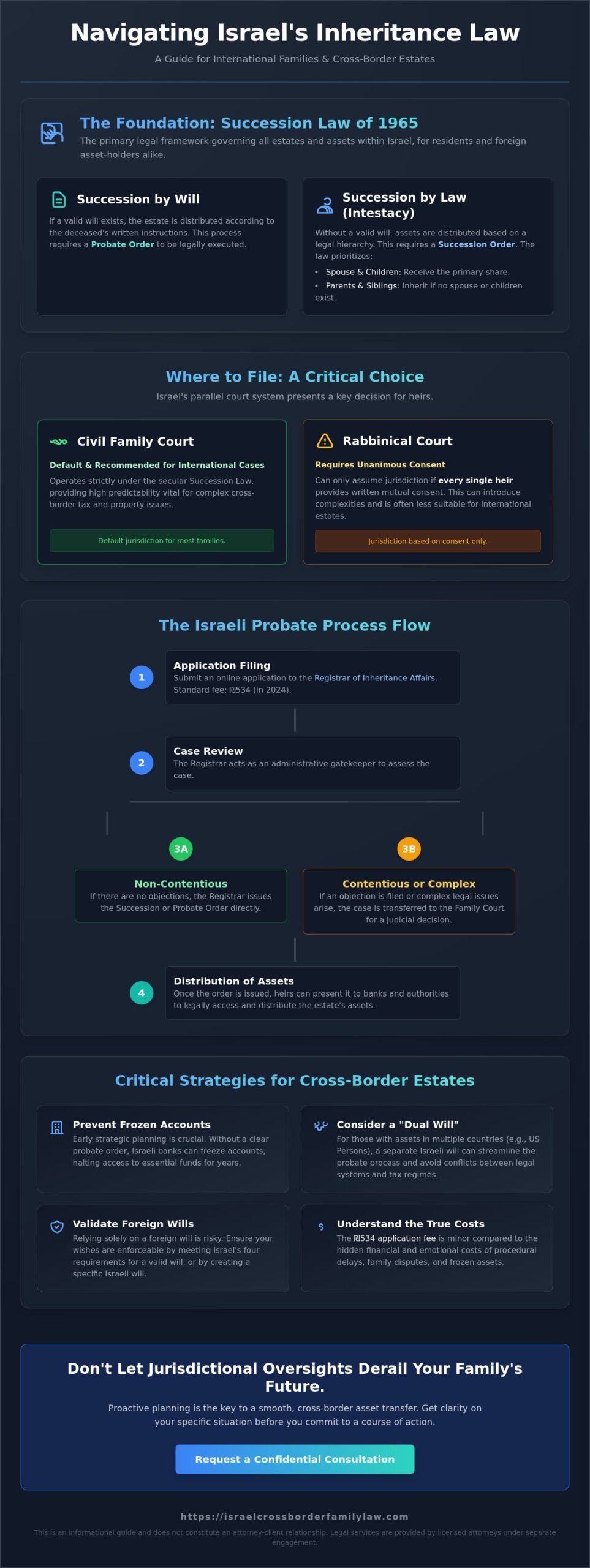
The Israeli Probate Process: From Application to Distribution
Navigating the technicalities of inheritance law in israel requires a clear strategy from the start. When a property owner passes away, Israeli banks typically freeze accounts immediately. This often creates a liquidity crisis for families who haven’t prepared for the sudden lack of access to funds. To understand these steps visually, the Israel Family Law YouTube channel provides detailed guidance on the procedural landscape. A standard probate application usually takes between three to five months to process. However, if a family member files an objection, the timeline can extend to 18 months or longer as the case moves to the Israeli Family Court for litigation.
Step-by-Step: Obtaining an Inheritance or Probate Order
- 1. Filing the application: Most applications are submitted digitally to the Registrar of Inheritance Affairs. You’ll need to submit the original death certificate and the original will, if one exists.
- 2. Public notification: The Registrar publishes a notice in daily newspapers. This gives creditors or unknown heirs a window to file objections.
- 3. Review by the Administrator General: The Apoteropos Klali reviews every file. They ensure the State’s interests are protected, particularly if minors or individuals with disabilities are named as heirs.
- 4. Issuance of the formal Order: Once approved, the Registrar issues a Tzav Yerusha (Succession Order) or a Tzav Kiyum Tzava (Probate Order). This digital document is the legal key to the deceased’s assets.
Finalizing the Estate: Banks and Real Estate
Obtaining the court order is only the midpoint of the process. For real estate, you must register the order with the Land Registry, commonly known as the Tabu. This step officially updates the title deed to the heirs’ names, which is a prerequisite for selling the property. Moving cash assets presents a different set of challenges. Israeli banks enforce strict Anti-Money Laundering (AML) protocols, especially for international transfers. If you’re moving ₪500,000 or more from an Israeli account to the US, the bank will demand extensive documentation regarding the source of funds and tax compliance. These “cross-border” friction points often surprise families who expect a simple wire transfer. It’s vital to coordinate with a professional who understands both the Israeli banking culture and the reporting requirements of your home country.
Get clarity before you commit. Request a confidential consultation.
Securing Your Family Legacy Across Borders
Managing an estate that spans two legal systems requires a strategic approach to avoid unintended consequences. Understanding how Israeli succession law differs from common law systems is vital, particularly regarding intestate rules and the specific requirements for a valid will. Navigating inheritance law in israel involves more than just translating documents; it requires a deep understanding of how Israeli authorities treat foreign assets and multi-jurisdictional tax implications. Making early, informed decisions helps mitigate risks that often lead to lengthy probate delays or family disputes.
Our team brings decades of experience to these complex cross-border matters. As bilingual professionals qualified in multiple jurisdictions, we focus on risk-based decision making to help you protect your family’s future. We understand the bicultural nuances that impact international families living in or moving to Israel. You don’t have to navigate these sophisticated legal hurdles alone. We provide the clarity needed to handle Israeli assets with confidence and precision.
Get clarity before you commit. Request a confidential consultation.
Protecting your legacy is a journey, and having the right information is the first step toward peace of mind.
This article is published on an independent advisory platform and does not constitute legal representation or legal advice. Legal services are only provided by licensed attorneys under a separate engagement.
Frequently Asked Questions
Is there an inheritance tax in Israel for US citizens?
Israel doesn’t impose an inheritance or estate tax on assets located within its borders. The Knesset abolished this tax entirely in 1981. However, US citizens must remain aware that the IRS taxes worldwide assets. If the value of your global estate exceeds the federal exemption limit, which is 13.61 million dollars for 2024, you may still face US tax obligations on your Israeli property. It’s vital to coordinate with a professional who understands both systems to manage these cross-border liabilities.
Can I use my US will to inherit property in Israel?
You can use a US will to inherit property, but it isn’t automatically recognized by Israeli authorities. To execute a foreign will, you must apply for a Probate Order through the Registrar of Inheritance Affairs. The process involves translating the document into Hebrew and obtaining an apostille. Because inheritance law in israel follows specific formal requirements, a foreign will must also comply with the laws of the place where it was signed to be valid locally.
How long does the probate process take in Israel for foreigners?
The probate process for international families typically takes between 6 and 12 months to complete. This timeline accounts for the mandatory 14 day public notice period and the time required for the Administrator General to review the file. If the case involves complex cross-border assets or missing documentation, the duration can extend beyond a year. Navigating these delays requires a strategic approach to documentation from the outset to ensure a smoother transition.
What happens if a person dies in Israel without a will?
If a person dies without a valid will, their estate is distributed according to the Succession Law of 1965. Under these rules, the surviving spouse typically receives the deceased’s car and 50% of the remaining estate. The other 50% is divided equally among the children. This rigid structure often creates complications for international families who might’ve preferred a different distribution of their global assets. Understanding how inheritance law in israel handles intestacy is crucial for those without a formal estate plan.
Do I need to go to a Rabbinical court for inheritance matters?
You aren’t required to use a Rabbinical court for inheritance matters. While these courts have concurrent jurisdiction, they can only handle the case if all legal heirs provide written, informed consent. Most international families choose the civil route through the Registrar of Inheritance Affairs. This avoids the application of religious law, which may differ significantly from the secular Succession Law regarding gender equality and the specific distribution of assets to heirs.
Can an Israeli bank freeze an account after a death?
Israeli banks will freeze an account immediately once they’re notified of the account holder’s death. This freeze stays in place until the heirs present a formal Inheritance Order or Probate Order. Even joint accounts are often restricted, meaning the surviving spouse might lose access to essential funds for daily expenses. Planning for this liquidity gap is a critical step in managing an estate. You can learn more about managing these financial hurdles at https://www.youtube.com/@IsraelFamilyLaw.
What is the difference between an Inheritance Order and a Probate Order?
An Inheritance Order is the legal document issued when someone dies without a will, defining the heirs and their shares by law. In contrast, a Probate Order is issued when a valid will exists, giving the document legal force to distribute assets as the deceased intended. Both orders serve as the key to transferring real estate titles at the Land Registry and releasing funds from financial institutions. Without one of these documents, assets remain locked in the deceased’s name.
How much does it cost to handle an inheritance in Israel?
The cost to handle an inheritance includes mandatory government filing fees and legal expenses. As of 2024, the application fee for an Inheritance Order is ₪542 for online submissions or ₪648 for paper filings. You must also pay approximately ₪150 for the mandatory newspaper advertisement that notifies potential creditors. Legal fees for cross-border cases are separate and depend on the complexity of the estate and the number of jurisdictions involved. Get clarity before you commit. Request a confidential consultation.

Article by
Gabriel Lior
A Personal Journey That Became a Mission
The advisory was founded by an American father Gabriel Lior, LLB, MBA , global entrepreneur, and cross-border advisor who spent more than a decade navigating the Israeli family court system firsthand and now lives in Singapore with his son.
As a divorced parent in a cross-border family, Gabriel faced nearly every legal challenge a foreign parent can encounter in Israel — including child custody disputes, child support proceedings, property matters in Israel and abroad, false accusations, and complex immigration and relocation proceedings.
Over the years, he learned the hard way how difficult it is for non-Israeli parents to understand the system, identify the right legal strategy, and choose the right legal representation — especially when language, culture, and jurisdictional differences are involved. He also witnessed how foreign parents and new immigrants are often disadvantaged or taken advantage of by service providers and institutions simply because they lack local knowledge or fluency.
From Client to Advisor
To truly understand — and survive — the system, Gabriel pursued formal legal education in Israel, completing two Israeli law degrees, alongside a BA and MBA earned in the United States. This was never about becoming a practicing attorney, but about gaining a deep, structural understanding of how the system works — and where it breaks down for foreign parents.
This rare combination of:
Firsthand client experience
Israeli legal and US business education
International business and negotiation training
Decades of commercial execution
created a unique perspective – one that understands both sides of the table.
After years of litigation, persistence, and at times self-representation, he ultimately succeeded in securing custody of his son and relocating abroad through a rare legal victory in the Israeli Supreme Court — becoming one of the first fathers in Israel to do so under these circumstances.
Disclaimer
Important Disclaimer:
The information provided on this website and in its content is for general informational and educational purposes only and does not constitute legal advice, legal opinion, or legal representation.
Gabriel Lior is not licensed to practice law in Israel (nor is he interested in doing so) and does not provide legal services, despite having completed 2 Law Degrees. The services offered are advisory in nature and are intended to provide general guidance, strategic insight, and information regarding cross-border family law considerations.
No attorney-client relationship is formed by accessing this website, reading its content, or communicating with us.
Any decisions made based on this information are at your own discretion and risk. For legal advice specific to your situation, you should consult a licensed attorney in the relevant jurisdiction.
Where appropriate, we may refer clients to independent, licensed attorneys or professionals. Such referrals do not constitute legal representation and no liability is assumed for services provided by third parties.