This article is published on an independent advisory platform and does not constitute an attorney-client relationship. The following content is for informational and advisory purposes only and does not represent legal advice; professional legal services are only provided by licensed attorneys under a separate engagement.
What if the US probate order you spent months securing is effectively invisible to the Israeli Land Registry? Many American heirs find it frustrating to learn that Israeli authorities don’t automatically recognize foreign legal documents. It’s natural to feel anxious about bureaucratic delays or the risk of double taxation when you’re unfamiliar with how the system in IL operates. Gaining clarity on inheritance rights in israel for us citizens is essential for anyone looking to secure family assets without unnecessary administrative friction.
This guide will help you manage the complexities of Israeli estate law with a clear understanding of your rights, the probate process, and the tax implications involved. We’ll explain the steps to obtain a succession order, why Israel’s 25% capital gains tax matters more than estate tax, and the specific IRS reporting requirements you must follow to stay compliant. By the end, you’ll have a strategic roadmap to bridge the gap between US expectations and Israeli legal realities.
Key Takeaways
- Understand the foundational 1965 Inheritance Law that governs how all assets located in Israel are distributed, regardless of the owner’s primary residence.
- Learn the mandatory procedural steps for obtaining a succession order, from digital filing with the Registrar to the public notification process required by Israeli courts.
- Clarify the cross-border tax landscape, specifically how inheritance rights in israel for us citizens interact with US IRS reporting thresholds and Israeli capital gains tax.
- Discover why utilizing separate, jurisdiction-specific wills is a critical strategy to prevent administrative friction and ensure your US estate plan doesn’t conflict with Israeli requirements.
This article is published on an independent advisory platform and does not constitute an attorney-client relationship or legal advice. The following content is for informational and advisory purposes only; professional legal services are only provided by licensed attorneys under a separate engagement.
The Foundation of Inheritance Law in Israel (1965)
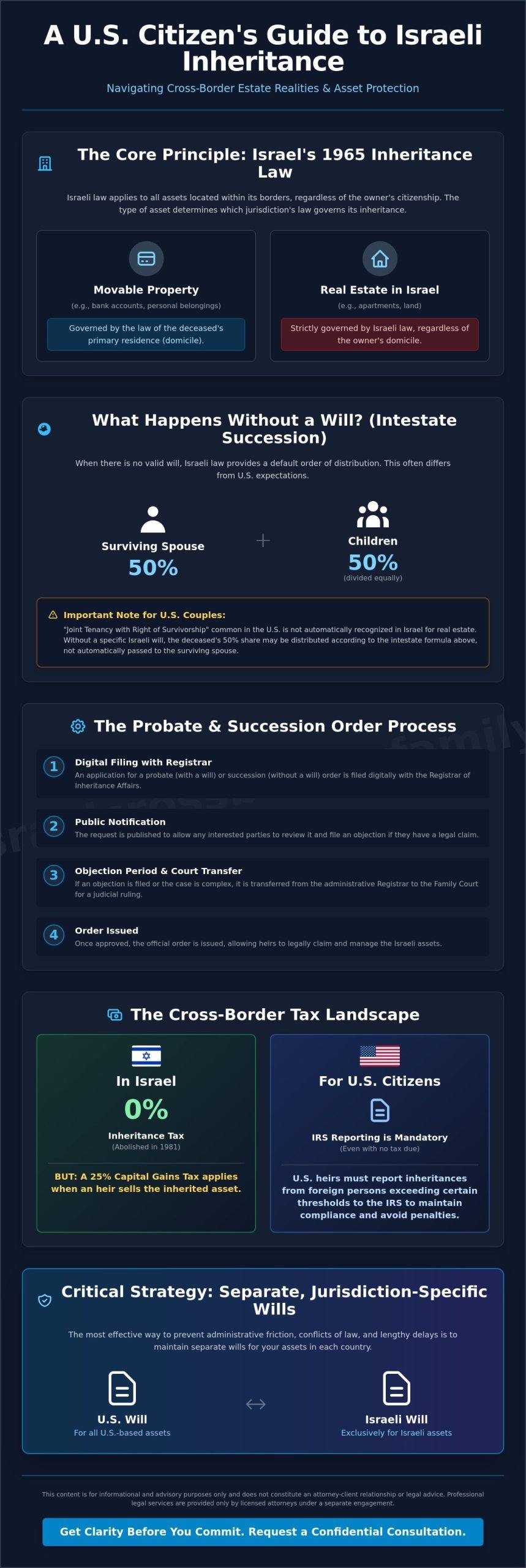
The Inheritance Law of 1965 serves as the primary legal framework for all estates involving assets in IL. For anyone exploring inheritance rights in israel for us citizens, it’s essential to understand that this law applies regardless of the deceased person’s citizenship. Israeli law makes a clear distinction based on the nature of the assets. Movable property, such as bank accounts or personal belongings, is generally governed by the law of the deceased person’s domicile, which is their primary place of residence. In contrast, all real estate located within the borders of Israel is strictly subject to Israeli law, regardless of where the owner lived or died.
This legal structure provides a high degree of certainty for families, especially since Israel abolished its Inheritance tax in 1981. While there is no local tax on the transfer of wealth, the procedural requirements to secure these assets remain rigorous. Understanding these rules early helps you avoid the common pitfalls of cross-border estates. For more visual guides and strategy discussions, you can find helpful resources on the Israel Family Law YouTube channel.
The Role of the Registrar of Inheritance Affairs
Most inheritance matters in IL begin with the Registrar of Inheritance Affairs. This administrative body is responsible for processing undisputed applications for probate or succession orders. If an application is straightforward, the Registrar handles the certification. However, if there is a dispute or if the case involves complex foreign legal questions, it’s typically transferred to the Family Court for a judicial ruling. This distinction is vital for expats and foreign nationals to understand, as the venue for your case can significantly impact the timeline and the level of documentation required.
Civil vs. Religious Courts: A Unique Israeli Dynamic
Israel’s legal landscape includes both civil and religious courts, which sometimes have overlapping authority. While the civil system is the default for inheritance, religious courts like the Rabbinical Court can also hear these cases. There is a strict requirement for this to happen: every legal heir must provide written, informed consent to use the religious court. Without unanimous agreement, the case must proceed through the civil system. Many international families prefer the civil courts because the procedures are more predictable and align more closely with Western legal standards. Choosing the correct path requires a clear understanding of these systemic differences before you begin the process.
Succession Without a Will: Intestate Rights in Israel
When a US citizen passes away leaving property in IL without a valid will, the state doesn’t simply seize the assets. This is a common fear, but it’s largely a myth. Instead, the Israeli Inheritance Law of 1965 provides a default “Order of Distribution” to ensure family members are provided for. However, these default rules often clash with American expectations of inheritance rights in israel for us citizens. For instance, many Americans assume that a surviving spouse automatically inherits everything, especially if property was held jointly. In IL, the law specifically protects the surviving spouse’s right to the family car and the contents of the shared residence, but the remaining estate is subject to a strict formula.
One major point of confusion for cross-border families involves “joint tenancy with right of survivorship.” While this is a standard way for US couples to hold property to avoid probate, Israeli land law doesn’t naturally recognize this concept. Without a will to clarify intentions, a half-share of an apartment might be distributed according to intestate rules rather than passing entirely to the surviving co-owner. For a deeper look at these multi-jurisdictional challenges, you might find this guide on Strategic Estate Planning for Dual-Country Assets helpful.
The Spousal Share and Children’s Rights
Under the standard Israeli formula, the surviving spouse receives 50% of the estate, while the children share the remaining 50% equally. If there are no children, the spouse’s share increases to two-thirds, with the remainder going to the deceased’s parents or siblings. This can create significant friction in blended families. If a US citizen has children from a previous marriage and a current spouse in Israel, the lack of a will means these parties become involuntary co-owners of Israeli real estate. Managing a property with multiple heirs across different continents is a recipe for administrative gridlock.
Why Intestacy is Risky for Cross-Border Families
Relying on legal defaults removes your ability to choose who manages your affairs in IL. In a cross-border context, you want a representative who understands both systems, yet intestacy gives the court the power to appoint an administrator. There’s also the risk of conflict between the laws of your US state and Israeli national law. Understanding how the advisory works can help you move away from these rigid defaults toward a plan that reflects your actual wishes. Taking a moment to discuss your specific family structure can provide the clarity needed to protect your future heirs.
How to Obtain a Succession or Probate Order
The path to exercising inheritance rights in israel for us citizens begins with a formal application to the Registrar of Inheritance Affairs. Most applications are now filed through a digital portal, which has streamlined the initial intake process. Once the application is submitted, the Registrar requires a mandatory publication in Israeli newspapers. This step is a legal safeguard designed to alert potential creditors or unknown heirs, giving them a window to file objections. For foreign residents, the timeline for an uncontested case typically ranges from four to eight months, though contested matters transferred to the Family Court can take much longer.
Understanding the procedural nuances of How to Obtain a Succession or Probate Order is vital because the Registrar will not issue a final decree until every technical requirement is satisfied. After the order is granted, it serves as the “key” to the estate. You must then register this order with the Land Registry (Tabu) to transfer real estate titles or present it to financial institutions to release frozen bank accounts and investment portfolios. This administrative phase is just as critical as the legal filing itself.
Essential Documentation for US Citizens
Israeli authorities require high-level verification for all US-issued documents. You’ll need an Apostille for death certificates and birth records to prove their authenticity to the Israeli government. Additionally, all English-language documents must have professional Hebrew translations. A common hurdle arises when an original will is already held by a US probate court. In these instances, you must obtain a specific type of certified copy that the Israeli Registrar will accept in place of the physical original will. Gathering these documents early prevents the application from being rejected or delayed.
The Legal Opinion on Foreign Law
An Israeli court requires a formal written statement from a legal expert to explain how the laws of a specific US state govern the distribution of the deceased’s movable assets. This document is the primary cause of delay for American heirs. Since Israeli judges aren’t experts in the probate codes of all 50 states, they rely on these formal opinions to ensure the distribution follows the laws of the deceased’s last place of residence. Working with a professional who understands both systems can help you bypass the typical administrative friction of this requirement. If you are feeling overwhelmed by the paperwork, learning more about the advisory can help you organize your strategy before you begin the filing process.
Taxation and US Reporting: What US Heirs Must Know
One of the most reassuring aspects of managing an estate in IL is the absence of a local inheritance tax. Israel abolished this tax in 1981, meaning the state does not take a percentage of the assets you receive. However, for Americans, the legal reality is rarely that simple. Your status as a US citizen means you are subject to global taxation and strict reporting requirements. While the transfer of inheritance rights in israel for us citizens might be tax-free in Jerusalem, it often triggers significant paperwork in Washington. Failing to understand these dual obligations is a common source of anxiety for international families.
The IRS requires transparency regarding foreign wealth. If the total value of your Israeli inheritance exceeds $100,000 in a single tax year, you must file Form 3520. This is an informational return rather than a tax bill, but the penalties for non-compliance are severe, often starting at 25% of the inheritance value. Additionally, if the inheritance includes Israeli bank accounts, you may need to file an FBAR (FinCEN Form 114) if your total foreign holdings exceed $10,000 at any point during the year. Discovering these accounts late in the probate process can lead to complicated back-filing requirements.
Israeli Real Estate and Capital Gains Tax
While the act of inheriting a home is tax-free, selling that property later triggers “Mas Shevach,” or Israeli appreciation tax. Israel operates on a “step-in-the-shoes” principle. This means the tax is calculated based on the original purchase price paid by the deceased, not the value at the time you inherited it. This differs significantly from the US “step-up in basis” rule, which resets the cost basis to the fair market value on the date of death. If your relative bought a Tel Aviv apartment in the 1970s for a nominal amount, your potential tax liability upon sale could be substantial. Strategic timing and understanding your residency status are vital, as Israeli residents often qualify for exemptions that non-residents do not.
US Estate Tax Considerations for Large Estates
For high-net-worth individuals, the US federal estate tax applies to your worldwide assets, including those held in IL. As of 2026, the federal exemption amount is $15 million per person. If the total estate exceeds this threshold, the IRS will tax the Israeli assets at the same rate as US property. The US-Israel Tax Treaty provides a framework to avoid double taxation on income, but it does not specifically cover estate or gift taxes. Because of these complexities, many families choose to review pricing and strategy for professional advisory services before assets are distributed. To ensure your transition is handled with precision, you should request a confidential consultation to discuss your specific reporting needs.
This article is published on an independent advisory platform and does not constitute an attorney-client relationship or legal advice. The following content is for informational and advisory purposes only; professional legal services are only provided by licensed attorneys under a separate engagement.
Strategic Estate Planning for Dual-Country Assets
Managing an estate across two legal systems requires a coordinated strategy that bridges the gap between US common law and Israeli civil law. While a single global will might seem convenient, it often creates significant hurdles for heirs during the probate process. Relying on a US-based will to govern Israeli property frequently leads to the “Legal Opinion on Foreign Law” delays discussed earlier. For those navigating inheritance rights in israel for us citizens, the most efficient path often involves creating separate, jurisdiction-specific documents that work in tandem.
A common point of friction involves the use of US-style revocable living trusts. While these are excellent tools for avoiding probate in the United States, they are often misunderstood by Israeli financial institutions and the Land Registry. In many cases, Israeli authorities don’t recognize a trustee’s power to transfer real estate title without a formal Israeli court order. This administrative friction can freeze assets for months. To better understand these nuances, you can find extensive guidance and video insights on the Israel Family Law YouTube channel.
Drafting a “Mirror Will” Strategy
The mirror will strategy involves drafting two distinct wills: one for your American assets and another specifically for your assets in IL. This approach ensures that the Israeli document complies with local linguistic and procedural requirements from day one. It’s vital that these documents are carefully coordinated. A standard “revocation clause” in a new US will can accidentally invalidate an existing Israeli will if it isn’t drafted with cross-border precision. The firm’s core philosophy is to establish a clear strategy before any commitment is made, ensuring your US estate plan doesn’t inadvertently disrupt your Israeli legacy.
Next Steps: Securing Your Legacy
Protecting your family across two legal systems requires a strategic bridge rather than a generic legal document. Early planning is the most effective way to save your heirs from months of avoidable litigation or administrative gridlock in the Israeli courts. If you’re ready to move beyond general information and develop a specific plan for your family, you can begin a confidential case review to assess your current situation. Gaining clarity on your cross-border obligations today ensures that your assets remain a blessing for your heirs tomorrow.
Get clarity before you commit. Request a confidential consultation.
Securing Your Cross-Border Legacy
Successfully managing an international estate requires more than just legal paperwork; it demands a comprehensive strategy that respects two distinct legal cultures. You’ve learned that the 1965 Inheritance Law governs assets in IL, and that relying on default intestate rules can lead to unintended consequences for your family. By addressing the “Legal Opinion on Foreign Law” early and maintaining strict compliance with US reporting thresholds, you can avoid the administrative friction that often stalls the probate process.
Our advisory platform is specialized in US-Israel cross-border strategy, providing international families with the plain English guidance they need to navigate complex systems. With decades of experience working with the Israeli Registrar of Inheritance, we focus on helping you understand inheritance rights in israel for us citizens without the typical jargon or confusion. Protecting your family’s future starts with making informed choices today.
Get clarity before you commit. Request a confidential consultation to discuss your specific estate needs. You don’t have to navigate these multi-jurisdictional challenges alone.
This article is published on an independent advisory platform and does not constitute an attorney-client relationship or legal advice. The following content is for informational and advisory purposes only; professional legal services are only provided by licensed attorneys under a separate engagement.
Frequently Asked Questions
Is there inheritance tax in Israel for US citizens?
No, Israel does not currently levy an inheritance or estate tax. This tax was abolished in 1981, and there are no confirmed plans to reintroduce it as of June 2026. However, US citizens must still consider US federal estate taxes and reporting requirements for any assets held in IL. While the transfer is tax-free in Israel, selling the asset later may trigger a 25% capital gains tax.
Can a US will be used to inherit property in Israel?
Yes, but a US will is not automatically recognized by Israeli authorities. You must first obtain a probate order from the Israeli Registrar of Inheritance Affairs. This process requires a “Legal Opinion on Foreign Law” to explain how your specific US state law governs the distribution. Without this formal expert opinion, the Israeli court cannot validate your US will to transfer local real estate or bank accounts.
How long does the probate process take in Israel?
The process typically takes between 4 to 8 months for foreign residents. For straightforward, uncontested estates involving local residents, the timeline is often shorter, ranging from 3 to 6 months. If a case is contested or involves complex multi-jurisdictional assets, it may be transferred to the Family Court, where the timeline can easily extend to 12 months or more.
What is a Succession Order (Tsav Yerusha) in Israel?
A Succession Order is a legal decree issued by the Registrar when a person dies without a valid will. It officially identifies the legal heirs and defines their specific percentage of the estate according to the Inheritance Law of 1965. Understanding inheritance rights in israel for us citizens often involves this document, as it’s required by banks and the Land Registry to move assets out of the deceased’s name.
Do I need to travel to Israel to claim my inheritance?
No, you don’t need to be physically present in IL to manage or claim an inheritance. Most applications are filed digitally, and you can appoint a local professional through a power of attorney to handle the entire process. This representative can manage everything from filing for the probate order to selling real estate or transferring funds to your US bank account remotely.
What happens if a US citizen dies in Israel without a will?
The estate is distributed according to the default rules of the Inheritance Law of 1965. Generally, the surviving spouse receives the family car and 50% of the estate, while the children share the remaining 50%. If there are no children, the spouse’s share increases, and the remainder may go to the deceased’s parents or siblings. These defaults can be complex for blended families or those with dual-country assets.
How do I report an Israeli inheritance to the IRS?
You must file Form 3520 if you receive a foreign inheritance with a total value exceeding $100,000 in a single tax year. This is an informational return, so filing it doesn’t mean you’ll be taxed on the inheritance itself. Additionally, if the inherited assets include bank accounts exceeding $10,000, you must file an FBAR (FinCEN Form 114). Accurate reporting is essential to avoid significant IRS penalties.
Can I use a US trust to hold Israeli real estate?
While technically possible, using a US revocable living trust to hold Israeli property is often administratively difficult. The Israeli Land Registry (Tabu) frequently doesn’t recognize foreign trustees without a specific Israeli court order. This can create a “bottleneck” when you try to sell or transfer the property. Many families find that a jurisdiction-specific Israeli will is a more reliable way to manage inheritance rights in israel for us citizens.
Get clarity before you commit. Request a confidential consultation.

Article by
Gabriel Lior
A Personal Journey That Became a Mission
The advisory was founded by an American father Gabriel Lior, LLB, MBA , global entrepreneur, and cross-border advisor who spent more than a decade navigating the Israeli family court system firsthand and now lives in Singapore with his son.
As a divorced parent in a cross-border family, Gabriel faced nearly every legal challenge a foreign parent can encounter in Israel — including child custody disputes, child support proceedings, property matters in Israel and abroad, false accusations, and complex immigration and relocation proceedings.
Over the years, he learned the hard way how difficult it is for non-Israeli parents to understand the system, identify the right legal strategy, and choose the right legal representation — especially when language, culture, and jurisdictional differences are involved. He also witnessed how foreign parents and new immigrants are often disadvantaged or taken advantage of by service providers and institutions simply because they lack local knowledge or fluency.
From Client to Advisor
To truly understand — and survive — the system, Gabriel pursued formal legal education in Israel, completing two Israeli law degrees, alongside a BA and MBA earned in the United States. This was never about becoming a practicing attorney, but about gaining a deep, structural understanding of how the system works — and where it breaks down for foreign parents.
This rare combination of:
Firsthand client experience
Israeli legal and US business education
International business and negotiation training
Decades of commercial execution
created a unique perspective – one that understands both sides of the table.
After years of litigation, persistence, and at times self-representation, he ultimately succeeded in securing custody of his son and relocating abroad through a rare legal victory in the Israeli Supreme Court — becoming one of the first fathers in Israel to do so under these circumstances.
Disclaimer
Important Disclaimer:
The information provided on this website and in its content is for general informational and educational purposes only and does not constitute legal advice, legal opinion, or legal representation.
Gabriel Lior is not licensed to practice law in Israel (nor is he interested in doing so) and does not provide legal services, despite having completed 2 Law Degrees. The services offered are advisory in nature and are intended to provide general guidance, strategic insight, and information regarding cross-border family law considerations.
No attorney-client relationship is formed by accessing this website, reading its content, or communicating with us.
Any decisions made based on this information are at your own discretion and risk. For legal advice specific to your situation, you should consult a licensed attorney in the relevant jurisdiction.
Where appropriate, we may refer clients to independent, licensed attorneys or professionals. Such referrals do not constitute legal representation and no liability is assumed for services provided by third parties.