When your life and assets span both the United States and Israel, pursuing a legal separation for international couples introduces a daunting layer of multi-jurisdictional complexity. Critical questions immediately arise: Which country’s laws will govern your case? How can you protect your parental rights and prevent a spouse from relocating with your children? The intricate process of dividing assets and bank accounts held in both nations, compounded by fears over your visa or residency status, can feel overwhelming, leaving you uncertain of the path forward.
This comprehensive guide is engineered to provide the strategic clarity you require. We will navigate the sophisticated legal landscape of cross-border separation, meticulously examining the pivotal choice between separation and divorce under both U.S. and Israeli law. Our objective is to empower you to make informed decisions, establish a legally binding agreement that is enforceable in both countries, and ultimately protect your parental rights and financial interests. Here, you will find a clear, strategic framework for your family’s future.
Key Takeaways
- Determining the proper jurisdiction is the most critical first step, as it dictates which country’s laws will govern your separation agreement and future obligations.
- Understand how legal separation for international couples provides a strategic alternative to divorce, allowing you to formalize duties while preserving marital status for immigration or healthcare purposes.
- Protecting your children across borders requires a meticulously crafted, multi-jurisdictional parenting plan that is legally enforceable in both the US and Israel to prevent future conflicts.
- Navigating the complexities of cross-border family law necessitates specialized legal counsel with qualifications in both US and Israeli jurisdictions to mitigate significant legal and financial risks.
What Is Legal Separation? A Critical Alternative to Divorce for Global Families
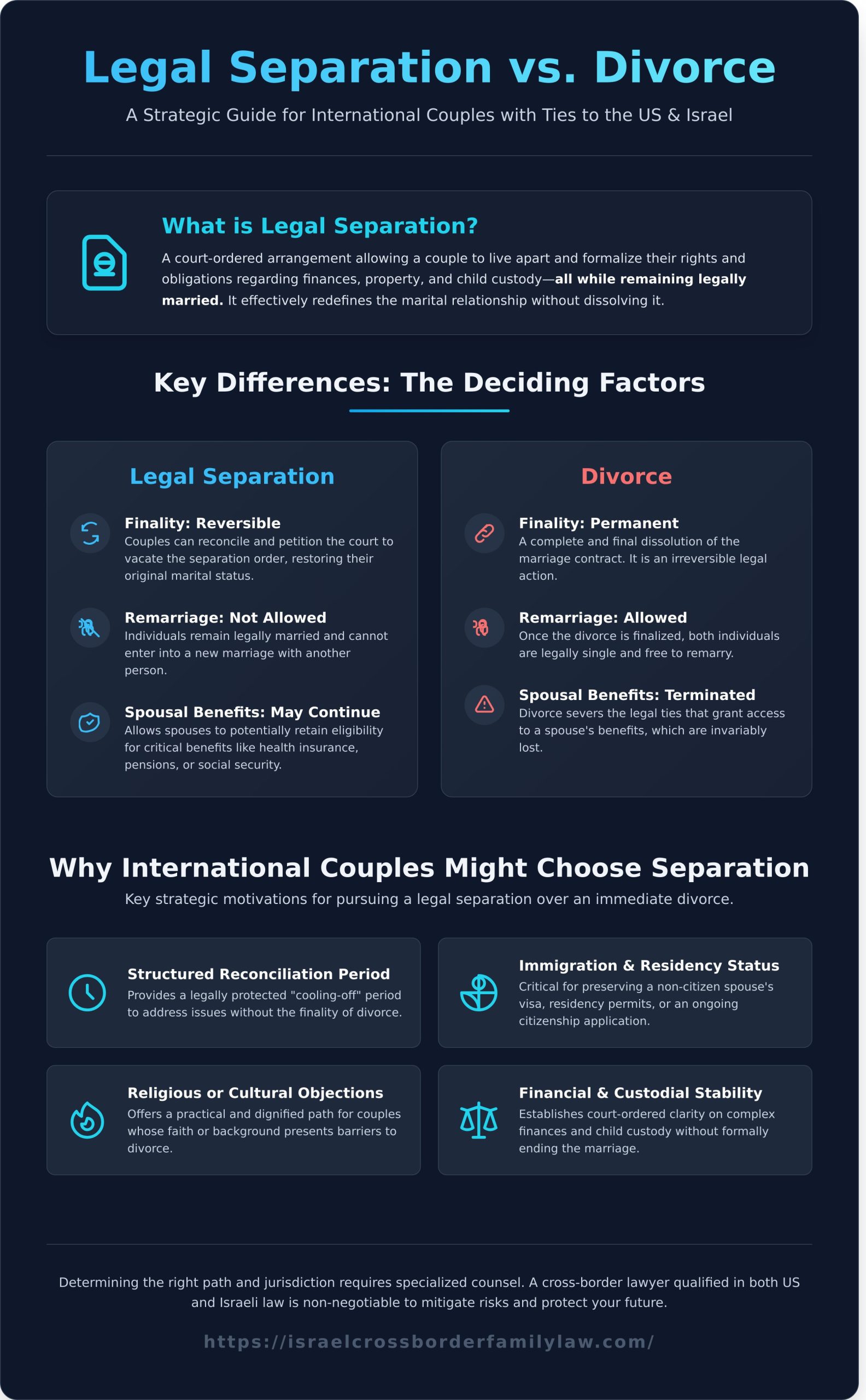
For global families navigating the complexities of marital dissolution, understanding all available legal avenues is paramount. Legal separation is a court-ordered arrangement allowing a married couple to live apart while formalizing their respective rights and obligations. Unlike divorce, which permanently terminates the marital contract, this process provides a structured framework for managing finances, property, and child custody while the couple remains legally married. To better grasp the foundational principles of What is Legal Separation? on a global scale, it is crucial to recognize it as a formal process that redefines the terms of the marital relationship without dissolving it entirely.
While Israeli law does not have a single, distinct statute for “legal separation” as found in some jurisdictions, the family courts and religious tribunals (such as the Rabbinical Court for Jewish couples) provide robust mechanisms that achieve the same functional outcome. For a deeper insight into the Israeli context, the following video provides a valuable overview.
Key Differences Between Legal Separation and Divorce
The decision between separation and divorce carries significant, long-term consequences, particularly in a cross-border context. The primary distinctions involve finality, the right to remarry, and the potential continuation of certain benefits. Discerning these differences is the first step in formulating a sound legal strategy.
- Finality: A legal separation is reversible; couples can reconcile and petition the court to vacate the separation order. Divorce, conversely, is a permanent and final dissolution of the marriage.
- Remarriage: An individual who is legally separated is still technically married and, therefore, cannot legally remarry. Divorce is a prerequisite for entering into a new marriage.
- Spousal Benefits: In some multi-jurisdictional cases, separation may allow a spouse to retain eligibility for certain health insurance, pension, or social security benefits tied to the marriage, which are invariably terminated upon divorce.
Successfully navigating the sophisticated options for divorce and separation for international families requires precise, experienced legal counsel to protect your interests across jurisdictions.
Why International Couples Might Choose Separation
The strategic choice of a legal separation for international couples is often driven by a unique set of financial, personal, and legal considerations that extend beyond borders. It offers a powerful alternative when divorce is not the immediate or desired outcome.
- Structured Reconciliation Period: It provides a legally protected “cooling-off” period, allowing couples the space to address their issues without the irreversible step of divorce.
- Religious or Cultural Objections: For couples whose faith or cultural background presents significant barriers to divorce, separation offers a practical and dignified path to living apart.
- Immigration and Residency Status: Maintaining a legal marital status can be critical for preserving a non-citizen spouse’s visa, residency permits, or ongoing application for citizenship in Israel or abroad.
- Financial and Custodial Stability: It allows for court-ordered clarity on complex financial matters and child custody arrangements, providing stability for the family without formally ending the marriage.
Jurisdiction: The Most Important Decision in a Cross-Border Separation
In any cross-border marital dissolution, the first and most consequential determination is that of jurisdiction-the legal authority of a court to hear and decide a case. For spouses with ties to both the United States and Israel, multiple courts may have the authority to preside over the matter. This creates a complex multi-jurisdictional landscape where the choice of forum can dramatically alter the outcome. A premature or ill-advised filing, often termed a ‘race to the courthouse,’ can lock the proceedings into a less favorable legal system, leading to significant financial and personal disadvantages. Therefore, a strategic assessment of jurisdictional options is of paramount importance in any legal separation for international couples.
How Is Jurisdiction Determined for International Couples?
The determination of which court holds jurisdiction is not arbitrary; it is governed by a set of established legal principles. Advising clients on the optimal forum requires a sophisticated analysis of several key factors, including:
- Habitual Residence: The country where one or both spouses have established their primary and permanent home is often a primary consideration.
- Location of Assets and Children: The physical location of significant marital property, business interests, and the children’s primary residence can grant a court jurisdiction.
- Nationality: The citizenship of one or both spouses can be a determining factor, particularly in countries where law is tied to nationality.
- Pre-determined Agreements: A valid prenuptial or postnuptial agreement may contain a ‘choice of forum’ clause, which can pre-select the jurisdiction for resolving disputes.
US vs. Israeli Courts: Key Differences in Approach
The strategic importance of jurisdiction is starkly illustrated when comparing the U.S. and Israeli legal systems. The United States generally operates under a ‘no-fault’ civil framework, where marital property is often divided equitably. This approach, as detailed by authoritative sources like the Legal Information Institute at Cornell Law School, contrasts sharply with Israel’s system. For Jewish couples in Israel, matters of personal status, including separation and divorce, are typically adjudicated by the Rabbinical Courts, which apply religious law (Halakha). This can lead to vastly different outcomes in property division and spousal support (alimony). Navigating a legal separation for international couples without clear jurisdictional guidance risks creating conflicting orders from courts in both countries, leading to protracted and costly litigation.
Crafting a Multi-Jurisdictional Separation Agreement
The Separation Agreement is the foundational legal document that formalizes the terms of your separation. For couples with connections to both the United States and Israel, this is not merely a domestic contract; it is a sophisticated, multi-jurisdictional instrument designed to be robust and enforceable across international borders. A meticulously drafted agreement is paramount in a legal separation for international couples, as it provides clarity and mitigates the risk of future cross-border litigation. It must anticipate and resolve the complex financial and personal issues unique to a global family.
Division of International Assets and Debts
A primary function of the agreement is the equitable division of a global marital estate. This requires a comprehensive approach that addresses the distinct legal and financial systems of both the US and Israel. Our legal team provides expert guidance on navigating:
- Cross-Border Property: Valuing and dividing real estate, such as a family home in Ra’anana and an apartment in New York.
- Global Financial Accounts: Apportioning bank accounts and investments held in both Israeli Shekels (₪) and US Dollars ($).
- Retirement and Pensions: Addressing the complex rules governing US-based 401(k) or IRA accounts alongside Israeli pension funds and Keren Hishtalmut.
- Multi-Currency Liabilities: Assigning responsibility for debts, including mortgages denominated in ILS and credit card balances in USD.
Full and transparent financial disclosure from both parties is a non-negotiable prerequisite for creating a valid and defensible agreement in either jurisdiction.
Structuring Cross-Border Spousal Support (Alimony)
Establishing spousal support, or alimony, between residents of different countries introduces significant complexity. The agreement must be structured to be both practical and legally sound. Key considerations include determining the amount (e.g., ₪10,000 per month) and duration of payments, and specifying the mechanics of currency conversion and international bank transfers. Critically, the agreement must address the divergent tax implications in the US and Israel, as tax treatment can significantly impact the net value of the support. Our focus is on drafting an order that is not only fair but explicitly structured for recognition and enforcement by courts in both nations.
Child Custody and Relocation: Protecting Your Children Across Borders
For international couples navigating separation, matters concerning children are invariably the most complex and emotionally charged. The multi-jurisdictional nature of the family introduces significant risks, including the potential for parental kidnapping. Establishing a clear, comprehensive, and court-ratified parenting plan is not merely advisable; it is a critical legal safeguard for your children’s stability and your parental rights. A formal agreement is the foundational step in protecting your family across international lines.
Creating a Robust International Parenting Plan
A generic custody agreement is insufficient for cross-border families. Your parenting plan must be meticulously detailed to preempt conflict and provide clarity in multiple legal systems. This document should explicitly define all aspects of the children’s lives, serving as an enforceable guide for both parents. Key components include:
- Custody Definitions: Clearly delineate between physical custody (where the child resides) and legal custody (decision-making authority on education, health, and welfare).
- Detailed Schedules: Outline precise schedules for school terms, national and religious holidays, and summer vacations, specifying handover locations and times.
- International Travel Protocols: Establish strict rules for travel, including which parent retains the children’s passports, requirements for written, notarized consent for any international travel, and communication plans while abroad.
Crafting such a sophisticated agreement requires specialized knowledge. Learn more about navigating international custody and relocation to ensure your plan is legally sound.
The Hague Convention and Preventing Parental Abduction
The Hague Convention on the Civil Aspects of International Child Abduction is an international treaty designed to secure the prompt return of children wrongfully removed to or retained in another member country. When pursuing a legal separation for international couples, a court order that establishes the child’s “habitual residence” is instrumental. This formal designation, recognized by Israeli courts and other signatory nations, provides the legal basis to argue that a child’s removal from Israel (or their designated country of residence) was wrongful.
Without this legal instrument, a parent may struggle to prove their custody rights in a foreign court. If you fear your spouse may abduct your child, it is imperative to act swiftly. Immediate steps include seeking an emergency court order preventing the child’s removal from Israel, alerting the appropriate authorities, and engaging legal counsel with proven experience in cross-border family law and Hague Convention cases.
Unique Challenges: Immigration Status, Visas, and Healthcare
For expatriates and non-citizen spouses in Israel, a marital breakdown introduces multi-jurisdictional complexities that extend far beyond asset division. The decision between separation and divorce is often dictated by critical issues such as immigration status, residency rights, and access to essential services. These matters are not peripheral; they are central to your ability to remain and function in the country. The intricate nature of legal separation for international couples demands a strategic approach, guided by professionals with deep experience in both Israeli family law and immigration regulations.
Impact of Separation on Visas and Residency Status
A foreign national’s legal status in Israel is frequently tied directly to their marriage to an Israeli citizen. A legal separation can significantly jeopardize this foundation. While a separation may not automatically invalidate a current A/5 temporary residency visa, it will almost certainly complicate or halt the gradual process toward permanent residency or citizenship managed by the Ministry of Interior (Misrad HaPnim). It is crucial to develop a proactive strategy to secure an independent immigration status, whether through a work permit or other legal avenues, before finalizing any separation agreement. Navigating these high-stakes challenges requires specialized guidance for expats and foreign nationals.
Maintaining Health Insurance and Other Benefits
One of the primary strategic reasons couples choose legal separation over divorce is to maintain access to critical benefits. In Israel, a non-citizen spouse is often covered under their partner’s national health insurance plan (Kupat Cholim). A divorce immediately terminates this eligibility, potentially leaving the non-citizen spouse facing exorbitant costs for private health insurance, which can amount to thousands of shekels monthly. A legal separation may allow this coverage to continue, but this is contingent upon the specific rules of the health fund and the formal terms of your separation agreement.
This same principle applies to other shared financial structures, including:
- Joint Bank Accounts: The separation agreement must explicitly define access rights and responsibilities to prevent financial disputes or unilateral fund depletion.
- Credit Lines and Liabilities: A formal agreement is essential to delineate who is responsible for servicing joint debts incurred during the marriage.
- Children’s Healthcare: When children reside in different countries, the agreement must clearly stipulate which parent’s insurance is primary and how cross-border medical expenses will be managed.
Given the profound financial and personal consequences, obtaining expert legal counsel is imperative to navigate these complex arrangements and protect your stability in Israel. Contact our firm to ensure your rights are comprehensively addressed.
Why a Specialized Cross-Border Lawyer Is Non-Negotiable
As we have explored, a legal separation for international couples, particularly between the U.S. and Israel, is an inherently complex, multi-jurisdictional challenge. The interplay between distinct legal systems, financial regulations, and cultural norms creates a high-stakes environment where missteps can have severe, long-lasting consequences. Attempting to navigate this landscape without integrated, dual-qualified legal counsel is not merely difficult; it is a significant strategic risk to your financial and parental rights.
The Dangers of a Single-Jurisdiction Approach
Retaining a lawyer qualified in only one country introduces critical vulnerabilities. Such representation is fundamentally incomplete and can lead to devastating errors that cost hundreds of thousands of shekels and years of protracted litigation.
- Inability to Advise: A U.S.-based attorney cannot provide binding legal advice on Israeli family court procedures, and an Israeli lawyer is not qualified to interpret U.S. state-specific property laws or federal tax implications.
- Unenforceable Agreements: A separation agreement meticulously drafted under New York law may be partially or entirely unenforceable in an Israeli court if it conflicts with local statutes or public policy.
- Procedural and Cultural Blind Spots: A lack of understanding of critical cross-border issues, from the religious implications of a Get to the procedural differences in financial discovery, can derail your case.
- Costly Future Litigation: Errors and omissions in the initial separation process almost invariably lead to future legal battles to correct or enforce the original terms across borders.
The Strategic Advantage of a US-Israel Law Firm
Engaging a firm with a dedicated team of attorneys licensed and experienced in both U.S. and Israeli law provides a decisive advantage. This unified approach transforms a fragmented, high-risk process into a cohesive, strategically managed engagement.
- A Holistic Strategy: We develop a singular legal strategy that considers the laws of both nations simultaneously, ensuring every action taken in one country supports your objectives in the other.
- Coordinated Legal Action: Our team can seamlessly file motions, manage discovery, and represent you in both U.S. and Israeli courts, ensuring perfect timing and tactical alignment.
- Deep Multi-Jurisdictional Expertise: We possess a sophisticated understanding of international tax treaties, cross-border asset division, child custody under the Hague Convention, and the unique dynamics of Israeli family courts.
- Seamless Case Management: You have one dedicated team managing your entire international case. This eliminates the risk of miscommunication between separate firms and provides you with a single, accountable point of contact.
To protect your assets, your parental rights, and your future, securing expert counsel is the most critical decision you will make. We invite you to schedule a consultation to discuss the specifics of your case with our experienced cross-border legal team.
Secure Your Future: Strategic Guidance for Your Cross-Border Separation
As this guide has illustrated, navigating a legal separation for international couples involves a sophisticated matrix of legal challenges that span continents. The critical determination of jurisdiction, the meticulous crafting of a multi-jurisdictional agreement, and the careful protection of your children’s welfare and your immigration status are not matters to be left to chance. These complex issues demand a level of expertise that transcends standard family law practice.
Protecting your future requires a strategic partner with proven experience in this highly specialized field. Our firm provides precisely that, offering deep expertise in both US and Israeli family law, honed over decades of handling complex cross-border cases. We are committed to a strategic approach designed to protect your assets and your children across continents, providing the clarity and security you need during this challenging time.
To understand how these principles apply to your unique circumstances and to secure the sophisticated representation you deserve, we invite you to Schedule a Confidential Case Review to discuss your unique situation. Taking this decisive step is the beginning of securing a stable and protected future for you and your family.
Frequently Asked Questions
Is a legal separation agreement from the US recognized in Israel, and vice versa?
The recognition of a foreign legal separation agreement is governed by principles of international comity. While a U.S. court order is generally respected, an Israeli Family Court will review the agreement to ensure it aligns with Israeli public policy before it is considered enforceable. Similarly, a U.S. state court will assess an Israeli separation decree for due process and fairness. For seamless cross-border enforcement, it is crucial that the agreement is drafted with multi-jurisdictional legal standards in mind.
Can we get legally separated if we were married in a third country but now live in the US or Israel?
Yes, the location of your marriage does not typically determine the jurisdiction for your separation. Jurisdiction is established based on the residency of one or both spouses. If you or your spouse meet the residency requirements in a particular U.S. state or in Israel, you can file for legal separation in that location. Establishing the correct jurisdiction is a critical first step and requires a careful analysis of your specific residential circumstances and the applicable local laws.
How long does the legal separation process typically take for an international couple?
The timeline for a legal separation for international couples is highly variable and contingent upon several complex factors. The duration depends on the degree of cooperation between spouses, the complexity of cross-border assets and business interests, and the need to resolve child custody arrangements across different countries. An amicable separation with a pre-negotiated agreement may conclude in months, whereas a contentious case involving multi-jurisdictional litigation can extend for a year or more, requiring extensive legal navigation.
Can I still pursue a divorce later if we start with a legal separation?
Absolutely. A legal separation is not a final dissolution of marriage and does not preclude either party from filing for divorce at a later date. In many cases, the comprehensive separation agreement, which addresses matters such as asset division, debt allocation, and spousal support, can serve as a strong foundation for a subsequent divorce decree. This can often streamline the final divorce process, making it more efficient and less contentious by having key terms already formally resolved.
What happens to our property if one of us moves back to our home country during the separation?
A properly structured legal separation agreement is specifically designed to govern the division and management of marital property, regardless of where each spouse resides. The agreement must explicitly detail the rights and responsibilities concerning assets located in both the U.S. and Israel, or elsewhere. Enforceability provisions are critical to ensure that one party’s relocation does not compromise the other’s financial rights, providing a clear legal framework for managing and protecting your international property interests.
How do we handle taxes in both countries while legally separated?
Navigating tax obligations in both the U.S. and Israel while legally separated is a sophisticated financial matter. In the U.S., you may be required to change your filing status, for instance to “married filing separately.” Israeli tax authorities have their own distinct regulations for separated individuals. Due to the complexity of international tax treaties and differing national laws, it is imperative to secure guidance from a qualified tax advisor with deep expertise in both U.S. and Israeli cross-border tax compliance.

Article by
Gabriel Lior
A Personal Journey That Became a Mission
The advisory was founded by an American father Gabriel Lior, LLB, MBA , global entrepreneur, and cross-border advisor who spent more than a decade navigating the Israeli family court system firsthand and now lives in Singapore with his son.
As a divorced parent in a cross-border family, Gabriel faced nearly every legal challenge a foreign parent can encounter in Israel — including child custody disputes, child support proceedings, property matters in Israel and abroad, false accusations, and complex immigration and relocation proceedings.
Over the years, he learned the hard way how difficult it is for non-Israeli parents to understand the system, identify the right legal strategy, and choose the right legal representation — especially when language, culture, and jurisdictional differences are involved. He also witnessed how foreign parents and new immigrants are often disadvantaged or taken advantage of by service providers and institutions simply because they lack local knowledge or fluency.
From Client to Advisor
To truly understand — and survive — the system, Gabriel pursued formal legal education in Israel, completing two Israeli law degrees, alongside a BA and MBA earned in the United States. This was never about becoming a practicing attorney, but about gaining a deep, structural understanding of how the system works — and where it breaks down for foreign parents.
This rare combination of:
Firsthand client experience
Israeli legal and US business education
International business and negotiation training
Decades of commercial execution
created a unique perspective – one that understands both sides of the table.
After years of litigation, persistence, and at times self-representation, he ultimately succeeded in securing custody of his son and relocating abroad through a rare legal victory in the Israeli Supreme Court — becoming one of the first fathers in Israel to do so under these circumstances.
Disclaimer
Important Disclaimer:
The information provided on this website and in its content is for general informational and educational purposes only and does not constitute legal advice, legal opinion, or legal representation.
Gabriel Lior is not licensed to practice law in Israel (nor is he interested in doing so) and does not provide legal services, despite having completed 2 Law Degrees. The services offered are advisory in nature and are intended to provide general guidance, strategic insight, and information regarding cross-border family law considerations.
No attorney-client relationship is formed by accessing this website, reading its content, or communicating with us.
Any decisions made based on this information are at your own discretion and risk. For legal advice specific to your situation, you should consult a licensed attorney in the relevant jurisdiction.
Where appropriate, we may refer clients to independent, licensed attorneys or professionals. Such referrals do not constitute legal representation and no liability is assumed for services provided by third parties.