This article is published on an independent advisory platform and is for informational purposes only. It does not constitute legal representation or legal advice. Legal services are only provided by licensed attorneys under a separate engagement.
An international arrest warrant for parental abduction is often the single greatest obstacle to bringing a child home safely. While it feels like a powerful tool for justice, these criminal measures frequently paralyze negotiations and prevent the very resolution parents seek. If you’re facing the possibility of a warrant in a cross-border dispute between Israel and the U.S., you’re likely feeling an overwhelming sense of urgency and fear. You might worry about being detained at a border or wonder how a criminal charge impacts your custody rights in the Israeli courts.
It’s natural to believe that involving law enforcement will force a quick solution, but the reality is often far more complex. This guide will help you understand the legal mechanics of criminal warrants and how they differ from civil Hague Convention proceedings. We’ll explore the strategic implications of Interpol Red Notices and provide a clear path toward resolving these conflicts through informed, risk-based decision-making. Get clarity before you commit. Request a confidential consultation.
Key Takeaways
- Distinguish between the civil Hague Convention and criminal charges to identify the most effective path for child return and reunification.
- Understand the mechanics of an international arrest warrant for parental abduction and how Interpol Red Notices impact global travel and border security.
- Learn why criminal warrants can paradoxically prevent a resolution by making a parent’s voluntary return to the home country legally impossible.
- Explore strategic options like “Safe Passage” agreements to resolve cross-border conflicts through informed, risk-based decision-making.
- Gain clarity on how a unified strategy addressing both Israeli and U.S. legal systems provides a safer path toward resolving complex family disputes.
This article is published on an independent advisory platform and is for informational purposes only. It does not constitute legal representation or legal advice. Legal services are only provided by licensed attorneys under a separate engagement.
Criminal vs. Civil: Understanding International Parental Abduction Frameworks
International parental abduction occurs when a parent removes a child from their country of “habitual residence” or retains them in another country without the legal consent of the other parent. In the specific context of families moving between Israel and the U.S., this often manifests as a parent taking a child for a vacation and refusing to return. Legal systems address these high-conflict situations through two distinct frameworks: the civil track and the criminal track. These systems operate under different rules, serve different purposes, and are managed by different government authorities.
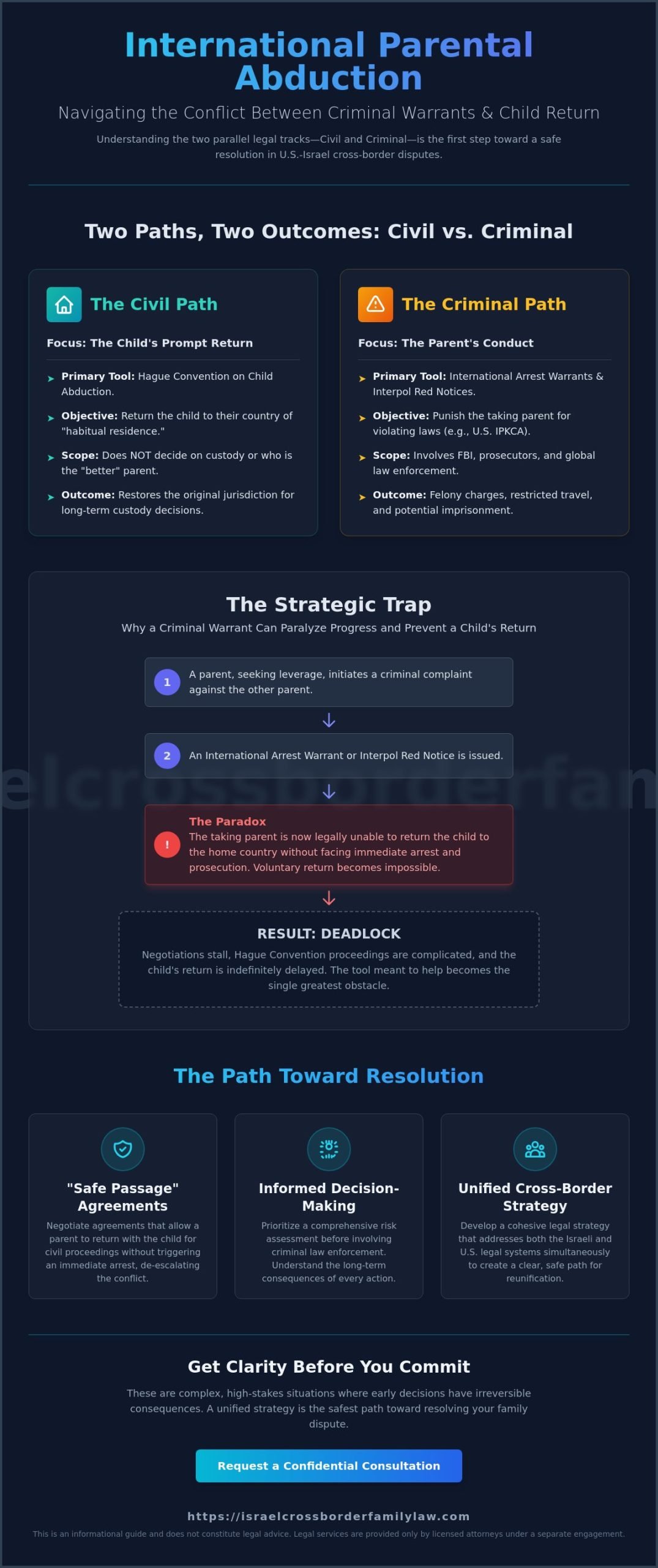
While the civil track focuses on the child’s location and physical return, the criminal track focuses on the parent’s conduct. It’s within this criminal framework that the risk of an international arrest warrant for parental abduction becomes a reality. These two paths don’t always coordinate. A parent might find themselves navigating both simultaneously, which creates a complex web of legal risks that can impact travel, employment, and future custody rights. Understanding how these tracks diverge is the first step in managing a cross-border crisis.
To better understand how these high-stakes warrants operate on the global stage, watch this helpful video:
The Civil Track: Seeking the Return of the Child
The primary mechanism for the civil return of a child is the Hague Convention on the Civil Aspects of International Child Abduction. This 1980 treaty, which both Israel and the U.S. strictly observe, aims for the prompt return of children to their home country. It’s vital to understand that a Hague proceeding doesn’t decide who is the “better” parent or who should have permanent custody. Instead, the court simply determines which country has the jurisdiction to make those long-term decisions. The goal is to restore the status quo that existed before the unauthorized removal.
The Criminal Track: Punishing the Taking Parent
The criminal track involves local law enforcement and federal agencies like the FBI. In the U.S., the International Parental Kidnapping Crime Act (IPKCA) of 1993 makes it a federal felony to remove a child from the U.S. with the intent to obstruct another parent’s rights. Israel’s criminal codes also contain provisions for child abduction, which can lead to local warrants. When a prosecutor decides to file charges, they may seek an international arrest warrant for parental abduction. A parent might choose to initiate a criminal complaint to create leverage or because they believe the civil process isn’t moving fast enough, though this decision carries significant long-term strategic risks.
These tracks can move independently. You might win a civil case for the child’s return but still face criminal charges that prevent you from traveling to see them. Because the systems are multi-jurisdictional and established on different legal philosophies, early decisions carry immense weight. Get clarity before you commit. Request a confidential consultation.
This article is published on an independent advisory platform and is for informational purposes only. It does not constitute legal representation or legal advice. Legal services are only provided by licensed attorneys under a separate engagement.
The Mechanics of an International Arrest Warrant and Interpol Red Notices
A domestic warrant transitions to the global stage when a national law enforcement agency, such as the Israel Police or the U.S. Department of Justice, requests assistance through Interpol. An international arrest warrant for parental abduction often begins as a local felony charge under statutes like the International Parental Kidnapping Crime Act (IPKCA) in the U.S. Once the prosecutor determines the suspect is abroad, they coordinate with their National Central Bureau (NCB) to broadcast the warrant through Interpol’s secure communication channels. This process effectively turns a local custody dispute into a multi-jurisdictional criminal matter.
Many parents live for months or years unaware that an “in absentia” warrant exists. This happens when a prosecutor files charges without notifying the defendant, often to prevent the parent from moving to a third country that lacks an extradition treaty. The discovery usually occurs at the worst possible moment, such as a routine passport scan at Ben Gurion Airport or during a background check for a professional license. Because these warrants are entered into the FBI’s National Crime Information Center (NCIC) or the Israeli Border Police database, they remain active until a judge formally vacates them.
What is an Interpol Red Notice?
Interpol serves as a communication hub for 196 member countries, but it doesn’t “issue” warrants itself. Instead, it publishes a Red Notice based on a valid national warrant. A Red Notice is a global alert to locate and provisionally arrest a person pending extradition. In contrast, a Blue Notice is used simply to collect information on a person’s location or identity. A Red Notice can devastate a parent’s professional life, appearing in global banking “know your customer” (KYC) checks and preventing international travel to almost any major destination.
Extradition Treaties Between Israel and the US
The Extradition Treaty between the United States and Israel, originally signed in 1962, provides the legal framework for transferring individuals between the two nations. For a parent to be extradited, the offense must meet the “dual criminality” standard, meaning the act is a crime in both Israel and the U.S. While both countries prioritize child welfare, the actual process of extradition is slow and highly political. Local courts must approve the request, and they often weigh the potential trauma to the child if the primary caregiver is forcibly removed. Before making any travel plans, it’s wise to request a strategic review of your current legal standing.
Understanding these mechanics helps you move from a state of panic to one of strategy. The goal is to resolve the underlying conflict before the criminal system’s momentum makes a civil resolution impossible. Get clarity before you commit. Request a confidential consultation.
This article is published on an independent advisory platform and is for informational purposes only. It does not constitute legal representation or legal advice. Legal services are only provided by licensed attorneys under a separate engagement.
How a Criminal Warrant Can Complicate Hague Convention Proceedings
When the civil and criminal tracks of a custody dispute collide, the legal landscape becomes exceptionally treacherous. A Hague Convention petition focuses on the child’s return to their habitual residence, yet the existence of an international arrest warrant for parental abduction often creates a physical barrier to that very goal. This creates a legal paradox. The home country demands the child’s return, but the same country’s criminal justice system threatens to arrest the parent the moment they step off the plane. This conflict can stall a case for months, leaving the child in a state of prolonged uncertainty.
The standard for the “best interests of the child” can also be distorted by parallel criminal proceedings. While the civil court is tasked with jurisdictional questions, the presence of a felony warrant may be used by the left-behind parent to argue that the taking parent is a “fugitive” or inherently unstable. This complicates any concurrent litigation regarding international custody and relocation, as the criminal charge overshadows the parental relationship.
The Barrier to Voluntary Resolution
Many taking parents initially consider a voluntary return once they understand the legal strengths of a Hague petition. However, the calculation changes when they face potential prison time. Negotiating a settlement becomes nearly impossible when one party is under the threat of immediate detention. Quashing a warrant once it’s in the Interpol system isn’t a simple administrative task. It requires a coordinated effort between authorities in both Israel and the U.S. to ensure that a return agreement actually protects the parent from arrest.
Evidence and Testimony in Cross-Border Cases
Criminal allegations frequently serve as strategic leverage in civil courts. A parent seeking the child’s return might highlight an active warrant to damage the other parent’s credibility. Another significant risk is self-incrimination. A parent testifying in a civil return hearing in Israel might inadvertently provide statements that a U.S. federal prosecutor could use in a criminal trial. Managing these risks requires a bicultural legal strategy that understands how an admission in one jurisdiction impacts the other. Get clarity before you commit. Request a confidential consultation.
This article is published on an independent advisory platform and is for informational purposes only. It does not constitute legal representation or legal advice. Legal services are only provided by licensed attorneys under a separate engagement.
Strategic Considerations for Resolving Cross-Border Legal Conflicts
Resolving a conflict involving an international arrest warrant for parental abduction requires moving beyond immediate legal defense into long-term strategic planning. The first priority for any parent in this situation is to gain absolute clarity on their legal status before attempting to cross any international border. Because border security systems are integrated globally, an active warrant in one country can trigger a detention in a third-party country, even if that country isn’t your final destination. Strategic resolution involves addressing the criminal charges not as an isolated threat, but as a component of the broader family law dispute.
One effective tool in these complex scenarios is the “Safe Passage” agreement. This is a legally binding arrangement where the state, often at the request of the left-behind parent, agrees to suspend or withdraw an arrest warrant to facilitate the child’s return. Without such an agreement, a taking parent has little incentive to comply with a Hague return order, as doing so would lead directly to their own incarceration. Successful negotiations often hinge on linking the withdrawal of criminal complaints to the final civil settlement, ensuring that both tracks resolve simultaneously.
Assessing the Risk of Arrest
Verification is the foundation of any safe legal strategy. Attempting to check for a warrant through standard public channels can sometimes alert authorities to your current location. Sophisticated checks often involve working through bicultural advisors who can query the status of a case in Israel or the U.S. without triggering an immediate enforcement action. It’s vital to understand that an international arrest warrant for parental abduction doesn’t simply expire; it must be formally vacated by a judge or withdrawn by the prosecuting agency. If you believe a warrant may be active, you should consult with a cross-border specialist immediately to map out your options.
The Role of Mediation in Abduction Cases
Mediation is often overlooked in criminalized cases, yet it remains one of the few ways to bridge the gap between parties. A mediator with specific experience in Israel-U.S. disputes can help parents focus on the child’s future rather than past grievances. For mediation to succeed when criminal charges are on the table, the process must be highly structured. It requires a deep understanding of how the “Get clarity before you commit” principle applies to every agreement made. By focusing on risk-based decision-making, parents can find a path that prioritizes the child’s return while minimizing the catastrophic impact of a criminal conviction.
Get clarity before you commit. Request a confidential consultation.
This article is published on an independent advisory platform and is for informational purposes only. It does not constitute legal representation or legal advice. Legal services are only provided by licensed attorneys under a separate engagement.
Navigating the Path Toward Resolution with Cross-Border Strategy
Generic family law advice often fails in cases involving an international arrest warrant for parental abduction because it treats the dispute as a local matter. In reality, these situations require a unified strategy that addresses the sophisticated interplay between Israeli and U.S. legal systems simultaneously. A parent might win a custody hearing in Israel, yet remain unable to travel or work globally due to an unresolved federal warrant in the U.S. This disconnect happens when legal teams don’t coordinate across borders, leaving the parent in a state of permanent legal limbo.
The advisory approach focuses on long-term family stability and risk mitigation rather than just short-term court victories. Early decisions regarding communication, travel, and even social media presence can dictate the final outcome. In cross-border crises, the momentum of the criminal justice system can quickly outpace civil negotiations. For this reason, every step must be calculated to ensure that a civil resolution in one jurisdiction actually leads to the withdrawal of criminal charges in another. By treating these matters with the same strategic rigor as a high-stakes corporate merger, parents can find a safer path through the conflict.
Why Specialized Advisory is Essential
Managing the interplay between M&A-level strategy and family law requires a “team on the ground” that understands both the Israeli marketplace and U.S. federal procedures. This bicultural expertise is critical when an international arrest warrant for parental abduction is active or imminent. For those currently navigating a divorce for international families, the need for a bridge between systems is even more acute. Specialized advisors ensure that your Israeli accounting and legal teams work seamlessly with U.S. counterparts to prevent conflicting legal commitments.
Next Steps for Parents in Conflict
- Prioritize the safety and psychological well-being of the child, as high-conflict litigation can create lasting trauma that complicates future custody.
- Avoid making any formal commitments, signed admissions, or recorded statements without a comprehensive strategy that accounts for both IL and U.S. risks.
- Request a confidential consultation to assess the specific jurisdictional risks and identify the most direct path toward a global resolution.
The goal is to move from a position of reactive fear to one of informed, risk-based decision-making. Cross-border conflicts are inherently complex, but they are not unsolvable with the right strategic framework. Get clarity before you commit. Request a confidential consultation.
This article is published on an independent advisory platform and is for informational purposes only. It does not constitute legal representation or legal advice. Legal services are only provided by licensed attorneys under a separate engagement.
Securing a Strategic Path Forward
Resolving a cross-border dispute requires more than just local legal knowledge. It demands a sophisticated understanding of how the civil Hague Convention interacts with the criminal justice system. An international arrest warrant for parental abduction can transform a private family matter into a multi-jurisdictional crisis that impacts travel and professional standing for years. Success depends on moving from a reactive state of fear to a proactive, strategy-based approach that addresses both Israeli and U.S. legal realities.
Effective resolution hinges on early, risk-based decision-making and a unified strategy that bridges the gap between systems. Our advisory platform provides specialized cross-border expertise to help families navigate these complexities through a bicultural lens. We integrate comprehensive educational resources, including our YouTube channel, to ensure you have the information needed to make informed choices. Get clarity before you commit. Request a confidential consultation to assess your specific jurisdictional risks. There’s always a path toward resolution when you approach the situation with clarity and professional guidance.
This article is published on an independent advisory platform and is for informational purposes only. It does not constitute legal representation or legal advice. Legal services are only provided by licensed attorneys under a separate engagement.
Frequently Asked Questions
Is parental abduction considered a felony in the United States?
Parental abduction is a federal felony under the International Parental Kidnapping Crime Act (IPKCA) of 1993. This law makes it a crime to remove a child from the U.S. or retain a child outside the country with the intent to obstruct another parent’s lawful exercise of parental rights. Conviction can result in fines and a prison sentence of up to three years.
Can I be arrested in Israel for a warrant issued in the US?
You can be detained in Israel based on a U.S. warrant if it has been communicated through Interpol or if a formal extradition request exists. While the Israel Police may not act immediately on every foreign warrant, the risk of detention is exceptionally high at Ben Gurion Airport or when interacting with official government agencies. Border systems are integrated to flag these warrants during routine passport scans.
What is the difference between a Hague petition and a criminal warrant?
A Hague petition is a civil mechanism focused entirely on the child’s return to their home country to resolve jurisdictional issues. In contrast, an international arrest warrant for parental abduction is an enforcement tool used by the state to punish the parent for a crime. The civil track does not result in jail time, but the criminal track can lead to arrest and extradition regardless of the civil case’s outcome.
How long does an international arrest warrant for parental abduction stay active?
An international arrest warrant for parental abduction remains active until the parent is arrested or the issuing court formally vacates the charge. These warrants do not have an expiration date. Even after the child reaches the age of 18, the original criminal charge against the parent remains on record until a judge or prosecutor dismisses the case through a formal legal proceeding.
Can an international arrest warrant be cleared if the child is returned?
Returning the child does not automatically dismiss a criminal warrant. While the child’s return may be used as a mitigating factor during sentencing, the prosecutor must take specific steps to withdraw the charges. You must negotiate the dismissal of the warrant as part of a global settlement before the return happens to ensure you aren’t arrested upon arrival in the home country.
Will Interpol arrest me at the airport for a custody dispute?
Interpol does not perform arrests; instead, local border police act on Interpol Red Notices. If a Red Notice is active in your name, you will likely be detained at the airport for identification and potentially held for extradition. This occurs even if you believe the situation is a private family matter, as the system treats the unauthorized removal as a serious felony.
What should I do if I suspect my spouse has filed a criminal complaint?
Obtain a confidential assessment of your legal standing before you attempt to travel or communicate your location. You should verify the existence of a warrant through advisors who can query databases without alerting authorities. Avoid making any written admissions or commitments until you have a unified strategy that addresses both the Israel and U.S. legal systems.
Can a “Safe Passage” order protect me from arrest during a Hague hearing?
A “Safe Passage” order can prevent your arrest while you return to participate in a Hague hearing, but it must be negotiated carefully with prosecutors. Without a formal, court-approved agreement, you risk being detained the moment you arrive for the civil hearing. Coordinating the criminal and civil tracks is the only way to ensure the return process doesn’t lead to your incarceration.

Article by
Gabriel Lior
A Personal Journey That Became a Mission
The advisory was founded by an American father Gabriel Lior, LLB, MBA , global entrepreneur, and cross-border advisor who spent more than a decade navigating the Israeli family court system firsthand and now lives in Singapore with his son.
As a divorced parent in a cross-border family, Gabriel faced nearly every legal challenge a foreign parent can encounter in Israel — including child custody disputes, child support proceedings, property matters in Israel and abroad, false accusations, and complex immigration and relocation proceedings.
Over the years, he learned the hard way how difficult it is for non-Israeli parents to understand the system, identify the right legal strategy, and choose the right legal representation — especially when language, culture, and jurisdictional differences are involved. He also witnessed how foreign parents and new immigrants are often disadvantaged or taken advantage of by service providers and institutions simply because they lack local knowledge or fluency.
From Client to Advisor
To truly understand — and survive — the system, Gabriel pursued formal legal education in Israel, completing two Israeli law degrees, alongside a BA and MBA earned in the United States. This was never about becoming a practicing attorney, but about gaining a deep, structural understanding of how the system works — and where it breaks down for foreign parents.
This rare combination of:
Firsthand client experience
Israeli legal and US business education
International business and negotiation training
Decades of commercial execution
created a unique perspective – one that understands both sides of the table.
After years of litigation, persistence, and at times self-representation, he ultimately succeeded in securing custody of his son and relocating abroad through a rare legal victory in the Israeli Supreme Court — becoming one of the first fathers in Israel to do so under these circumstances.
Disclaimer
Important Disclaimer:
The information provided on this website and in its content is for general informational and educational purposes only and does not constitute legal advice, legal opinion, or legal representation.
Gabriel Lior is not licensed to practice law in Israel (nor is he interested in doing so) and does not provide legal services, despite having completed 2 Law Degrees. The services offered are advisory in nature and are intended to provide general guidance, strategic insight, and information regarding cross-border family law considerations.
No attorney-client relationship is formed by accessing this website, reading its content, or communicating with us.
Any decisions made based on this information are at your own discretion and risk. For legal advice specific to your situation, you should consult a licensed attorney in the relevant jurisdiction.
Where appropriate, we may refer clients to independent, licensed attorneys or professionals. Such referrals do not constitute legal representation and no liability is assumed for services provided by third parties.