Imagine discovering that a custody arrangement settled in a California court isn’t recognized in Tel Aviv, or that your US based assets are suddenly subject to the jurisdiction of an Israeli Rabbinical court. For families living between the United States and Israel, the legal landscape isn’t just different; it’s often contradictory. If you feel anxious about how your divorce or inheritance will be handled across borders, your concerns are well founded. This article is published on an independent advisory platform to help you understand the complexities of international family law and how to protect your interests when your life spans both nations.
You’ll gain clarity on the “race to court” and how early decisions carry immense weight in the Israeli legal system. We’ll explain the 2026 expansion of religious court jurisdiction, the shift away from the “Tender Years Doctrine” in custody cases, and the essential role of Mirror Orders in ensuring your rights are enforceable in both jurisdictions. By the end of this guide, you’ll have a strategic overview of how to navigate these systems with confidence, ensuring your family’s future remains secure. While we provide strategic guidance, please remember that formal legal representation is only provided by licensed attorneys under a separate engagement.
Key Takeaways
- Understand why the first person to file often dictates the legal framework for the entire case and how the “Center of Life” test determines jurisdiction in Israel.
- Identify the risks to your US-based retirement accounts and real estate by understanding the fundamental differences between Israeli and American property division laws.
- Navigate the complexities of international family law regarding child custody, including how the Hague Convention defines “habitual residence” for families moving between the US and Israel.
- Gain clarity on the expanding role of Israeli Rabbinical courts and how their authority may impact civil matters beyond traditional marriage and divorce.
- Learn how to apply a strategic, advisory-first approach to minimize conflict and manage the inherent risks of navigating two different legal cultures.
Understanding International Family Law in the US-Israel Context
International family law is the specific area of legal practice that manages disputes involving marriage, divorce, child custody, and financial assets when the parties or the property are located in different countries. In the corridor between the United States and Israel, these cases are rarely straightforward. Because these two nations operate under fundamentally different legal philosophies, a decision made in a California courtroom might not be recognized by an Israeli Family Court without specific procedural steps. This article is published on an independent advisory platform, not a law firm; our focus is on providing a strategic roadmap to help you manage risks before formal litigation begins. You can learn more about how this works by visiting our page on about the advisory.
The complexities of International Matrimonial Law require a nuanced understanding of how treaties and local statutes interact across borders. For expats and foreign nationals, the goal is to create a legal bridge that protects interests in both jurisdictions. Success in these matters often depends on your ability to anticipate how one system will react to the actions of the other.
The Intersection of Two Legal Systems
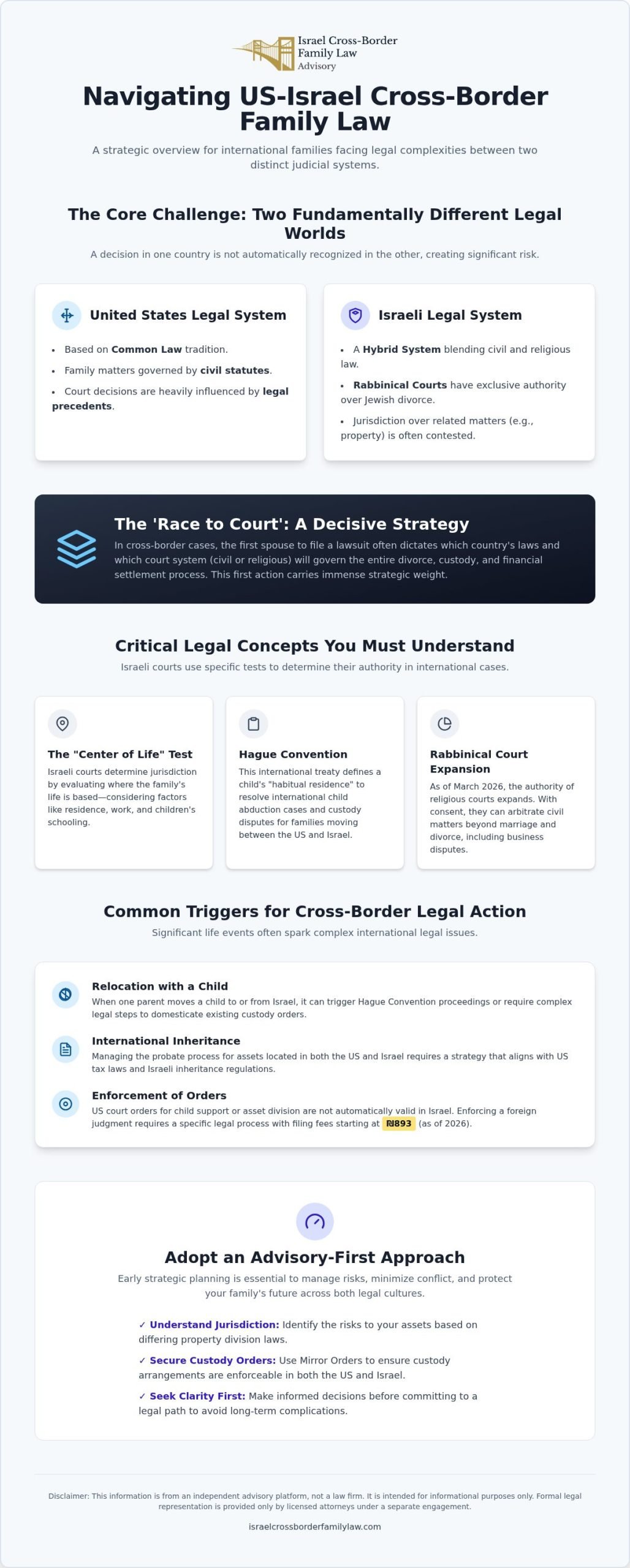
The United States relies on a common law tradition where precedents and civil statutes govern family matters. Israel utilizes a hybrid system that blends civil law with religious jurisdiction. For Jewish couples in Israel, the Rabbinical courts hold exclusive authority over the act of divorce itself. As of March 2026, the influence of these religious courts has expanded; they can now act as arbitrators in various civil disputes, including commercial matters, if both parties provide consent. This dual court system creates a unique environment where the first party to file often dictates which court hears related issues like property division. Dual citizenship adds another layer of complexity. Holding both US and Israeli passports grants you legal standing in both countries, but it also means you are subject to the responsibilities and potential liabilities of both legal frameworks simultaneously.
Common Triggers for Cross-Border Legal Action
Most international cases are sparked by significant life transitions that cross national borders. Common triggers include:
- Relocation: When one parent moves a child to or from Israel, it can immediately activate the Hague Convention or require the domestication of existing custody orders.
- Inheritance: Managing the probate process for assets located in a different country requires a strategy that respects both US tax laws and Israeli inheritance rules.
- Enforcement: US court orders for child support or asset division aren’t automatically valid in Israeli territory. As of 2026, the court filing fees for enforcing a foreign judgment in Israel start at ₪893.
Each of these triggers requires early decision-making to avoid long-term legal complications. Understanding the differences between the two systems is the first step toward protecting your family’s future. Get clarity before you commit. Request a confidential consultation.
Jurisdiction and the ‘Race to Court’ Strategy
The “Race to Court” is a defining strategic reality in international family law between the United States and Israel. This phenomenon occurs when one spouse initiates legal proceedings in one country while the other files in another. Because the legal outcomes can vary significantly depending on which court takes the case, being the first to file is often a decisive factor. In Israel, this race isn’t just between two nations; it’s also a competition between the Rabbinical and civil Family Courts.
Israeli judges utilize a “Center of Life” test to determine whether they have the authority to hear a case. They evaluate where the family actually resides, works, and where the children attend school. If you’ve lived in Tel Aviv for several years but maintain a primary residence or business in New York, the court must decide which location serves as your legal base. If both a US state court and an Israeli court claim jurisdiction, you risk facing conflicting orders. This can result in a scenario where you’re legally divorced in one jurisdiction but remain married in the other, creating immense personal and financial instability.
The Rabbinical vs. Civil Court Dynamic in Israel
Jewish couples, including American citizens living in Israel, are subject to the jurisdiction of Rabbinical courts for the act of divorce itself. However, related matters such as property division and alimony can be “bound” to the divorce suit. If you file in the Rabbinical court first and include these issues in your claim, that court may gain exclusive authority over them. Strategic planning is vital for expats and foreign nationals who must decide which system better protects their specific interests. Since the legislative changes in March 2026, religious courts in Israel can also act as arbitrators in civil disputes if both parties provide consent, adding a new layer of complexity to your choice of forum.
Determining the ‘Proper Forum’
Courts also consider a doctrine known as forum non conveniens, which helps a judge decide if another court is more appropriate for the trial. The court will weigh factors such as the children’s habitual residence and the physical location of primary assets. If your family business is in Florida but your children have lived in Jerusalem for the past year, the legal battle could be split across continents. Challenging jurisdiction requires proving that the current forum is inappropriate or that a different court is better suited to handle the matter fairly. You can request a strategic review to understand which forum offers the most secure path forward for your specific situation.
Cross-Border Financial Assets and Support Enforcement
Managing financial assets across borders requires an understanding of two distinct legal philosophies. In the United States, many states follow the principle of “Equitable Distribution,” which focuses on a fair, though not always equal, split of marital property. In contrast, Israel utilizes the “Balance of Resources” system. This approach generally assumes an equal division of all assets accumulated during the marriage, regardless of whose name is on the title. When your portfolio includes US-based 401(k)s, IRAs, or American real estate, these differences create significant valuation challenges. Israeli courts may struggle to categorize specific US retirement vehicles, making early strategic planning a necessity in international family law cases.
The US-Israel Tax Treaty also plays a vital role in these settlements. It helps prevent double taxation on transferred assets and provides a framework for how retirement distributions are treated. Ignoring these tax implications can lead to unexpected liabilities that significantly reduce the actual value of a settlement. Our role is to provide the strategic clarity you need to handle these transnational financial complexities before they lead to unnecessary loss.
Protecting Foreign Assets and Businesses
Shielding a family business or a significant inheritance requires proactive measures. If a business was established before the marriage or through non-marital funds, it’s often possible to keep it outside the “balance” in Israel. However, if marital efforts contributed to the company’s growth, the other spouse may have a claim to that increased value. One of the most effective ways to manage this risk is through a well-drafted international prenuptial agreement us israel. These documents provide essential clarity on which assets remain separate, helping you avoid the high costs and emotional toll of contested litigation later on.
Enforcing Support Orders Across Borders
A common pain point for expats is the enforcement of support. A US child support order isn’t automatically valid in Israel; it must undergo a formal domestication process in an Israeli Family Court. As of 2026, the court filing fee to begin this process is ₪893. When the court reviews these foreign orders, it considers the Israeli baseline for a child’s essential needs, which currently ranges from ₪1,600 to ₪2,250 per month per child. For those managing arrears, a January 2025 reform set the interest rate on child support debts at 3.5% while eliminating compound interest. Navigating child support cross border enforcement requires a steady hand and a clear understanding of these local standards to ensure your US-based rights are successfully upheld within the Israeli territory. Get clarity before you commit. Request a confidential consultation.
International Child Custody and the Hague Convention
The Hague Convention is the primary mechanism for resolving international child abduction between signatory nations, including the United States and Israel. It’s a treaty designed to return a child who has been “wrongfully removed” from their habitual residence. In the context of international family law, habitual residence refers to the country where the child was most settled before the dispute began. This determination is based on the child’s daily life, including their school, social ties, and medical care. If a parent attempts “self-help” by taking a child across borders without a court order or formal written consent, they trigger a legal crisis that is often resolved through fast-tracked Hague proceedings.
Israeli courts take these cases seriously. The focus is not on who is the “better” parent, but on whether the child should be returned to their home country so that the proper court can decide on custody. Relocation cases, where one parent seeks to move a child back to the US permanently, require a high level of strategic preparation to prove that the move serves the child’s best interests while maintaining the other parent’s rights.
The Hague Convention Process in Israel
The process involves the Central Authority in both the US and Israel. Once a petition is filed, the Israeli Family Court must determine if the removal was indeed wrongful. There are limited defenses against a return order. A court may refuse to return a child if there’s a “grave risk” that the return would expose them to physical or psychological harm. Additionally, the court may consider the “age and maturity” of the child if they are old enough to express a settled desire to stay. By 2026, Israeli courts have moved away from the “Tender Years Doctrine,” which historically favored mothers for children under six. Judges now prioritize the child’s need for a consistent relationship with both parents. You can learn more about these protections on our page regarding hague convention child abduction.
Preventing International Child Abduction
Strategic prevention is always more effective than reactive litigation. Common “red flags” include a spouse liquidating assets, quitting a job without a new one lined up, or renewing passports in secret. To prevent an unauthorized departure from Israel, you can seek a Tzav Ikur Yetzia, or an Exit Stay order. This order alerts border control and prevents the child from leaving the country until the court reaches a decision. In 2026, Israeli courts increasingly require “Mirror Orders” in relocation cases. These are decrees from the destination country that reflect the Israeli court’s decision to ensure continuity of enforcement across borders. Statistics show that Israeli judges follow the recommendations of the Pekidat Sa’ad (Welfare Officer) in over 90% of custody cases. If you are concerned about a potential relocation, contact us for a confidential case review to discuss a protective strategy.
Strategic Planning: Managing Risks and Seeking Clarity
Success in cases involving international family law is rarely determined in the courtroom alone. It’s won or lost in the initial weeks of planning. The first 30 days of a cross-border dispute are critical. During this window, the decisions you make regarding where to file and how to communicate will set the trajectory for the next several years. A misstep early on can lead to expensive jurisdictional battles that drain both your finances and your emotional well-being. By prioritizing strategy over immediate conflict, you can identify the most secure path forward before the “race to court” reaches a point of no return.
An independent advisory platform serves as a steady guide before you commit to a specific litigation path. This approach allows you to manage multi-jurisdictional complexity without the pressure of immediate legal action. It’s vital to distinguish between strategic guidance and legal representation. While we provide the roadmap, risk assessment, and decision-making frameworks, formal legal services are only provided by licensed attorneys under a separate engagement. You can read more about the advisory and how we help bridge the gap between the US and Israeli legal cultures.
Next Steps: Getting Clarity
Moving forward requires a clear assessment of your current legal and financial standing. You’ll need to gather essential documentation, including proof of residency to satisfy the “Center of Life” test, detailed financial statements for both US and Israeli assets, and any existing court orders or prenuptial agreements. Setting realistic expectations for international legal timelines is also necessary. International service of process and Hague Convention proceedings have their own rhythms that require patience and precise execution.
Your goal is to reach a resolution that is enforceable in both the United States and Israel, ensuring that your rights aren’t lost in translation between two systems. This requires a proactive stance and a commitment to seeking clarity before making life-altering commitments. Get clarity before you commit. Request a confidential consultation.
Securing Your Interests Across the US-Israel Bridge
Managing a life that spans both the United States and Israel requires a sophisticated legal strategy that respects the unique requirements of both nations. We’ve examined how the “race to court” can dictate the trajectory of your case and why understanding the specific differences in property division is vital for protecting your financial future. Whether you’re addressing complex child custody matters or the enforcement of support orders, success in international family law depends on the clarity of your initial decisions.
Our advisory platform serves as a steady guide, helping you navigate these multi-jurisdictional complexities with confidence. By focusing on risk assessment and strategic coordination before engaging in formal litigation, you can minimize conflict and ensure your rights aren’t lost in translation. As an independent advisory platform, we focus on strategy and decision-making guidance; formal legal representation is only provided by licensed attorneys under a separate engagement. Get clarity before you commit. Request a confidential case review. With the right roadmap, you can protect your family’s interests and move forward with peace of mind.
Frequently Asked Questions
The following information is published on an independent advisory platform, not a law firm. This content is intended for educational purposes and does not constitute legal advice. Strategic guidance is provided here to help you manage risks, but formal legal representation is only provided by licensed attorneys under a separate engagement.
Which country has jurisdiction if we are US citizens living in Israel?
Jurisdiction is primarily determined by the “Center of Life” test. If your family resides in Israel, the local Family or Rabbinical courts likely have authority over your case. However, US courts may also claim jurisdiction if you maintain a primary residence or significant business interests there. This dual claim creates complexity in international family law cases, as both systems might simultaneously issue orders that conflict with one another.
Can an Israeli Rabbinical court decide on my assets located in the US?
Yes, a Rabbinical court can issue rulings on US based assets if those matters are “bound” to the divorce suit. While the court has authority over the parties involved, enforcing an Israeli order against property in the United States requires additional steps in American courts. US financial institutions don’t automatically follow Israeli decrees. You’ll need to domesticate the order in the relevant US state to ensure it’s legally binding.
How do I enforce a US child support order in Israel?
You must register the US order in an Israeli Family Court through a formal domestication process. As of 2026, the initial filing fee for this procedure is ₪893. The Israeli court will review the order to ensure it aligns with local public policy and the child’s essential needs baseline. This baseline currently ranges from ₪1,600 to ₪2,250 per month. Once domesticated, the order is enforceable by the Israeli Enforcement and Collection Authority.
What is the Hague Convention, and does it apply to US-Israel cases?
The Hague Convention is an international treaty designed to return children who have been wrongfully removed from their country of habitual residence. Both the US and Israel are signatories, so the treaty applies to cross border disputes between them. It’s a critical tool in international family law for preventing unauthorized relocation. The focus remains on returning the child to their home country so the proper local courts can decide on long term custody.
Can I move back to the US with my children after an Israeli divorce?
You generally cannot relocate children across borders without the other parent’s written consent or a specific court order. If you seek to move back to the US, you must prove to the Israeli court that the move serves the child’s best interests. In 2026, judges frequently require “Mirror Orders” from the US destination. These legal decrees ensure the original Israeli custody terms remain enforceable once you’ve arrived in the United States.
Are US prenuptial agreements enforceable in Israeli courts?
US prenuptial agreements aren’t automatically enforceable but can be recognized if they meet specific Israeli legal standards. An Israeli court will examine whether the agreement was entered into voluntarily and whether its terms conflict with local public policy. To increase the likelihood of recognition, it’s often recommended to have the agreement validated by an Israeli court or a notary, especially if it involves assets or property located within the Israeli territory.
How long does a cross-border divorce case typically take?
These cases often take significantly longer than domestic divorces due to the need for international service of process and jurisdictional arguments. While a simple case might conclude in 12 to 18 months, contested matters involving assets in multiple countries or Hague Convention proceedings can last several years. The complexity of coordinating between two different legal systems and the potential for appeals in both jurisdictions contribute to these extended and challenging timelines.
What are the risks of filing for divorce in Israel vs. the US?
Filing in Israel subjects your assets to the “Balance of Resources” system, which generally assumes an equal split. In many US states, “Equitable Distribution” allows for more flexibility based on individual circumstances. Conversely, filing in the US may lead to an order that an Israeli court refuses to domesticate if it conflicts with local religious or civil laws. The “race to court” is a high stakes decision that dictates your financial outcome.
Get clarity before you commit. Request a confidential consultation.

Article by
Gabriel Lior
A Personal Journey That Became a Mission
The advisory was founded by an American father Gabriel Lior, LLB, MBA , global entrepreneur, and cross-border advisor who spent more than a decade navigating the Israeli family court system firsthand and now lives in Singapore with his son.
As a divorced parent in a cross-border family, Gabriel faced nearly every legal challenge a foreign parent can encounter in Israel — including child custody disputes, child support proceedings, property matters in Israel and abroad, false accusations, and complex immigration and relocation proceedings.
Over the years, he learned the hard way how difficult it is for non-Israeli parents to understand the system, identify the right legal strategy, and choose the right legal representation — especially when language, culture, and jurisdictional differences are involved. He also witnessed how foreign parents and new immigrants are often disadvantaged or taken advantage of by service providers and institutions simply because they lack local knowledge or fluency.
From Client to Advisor
To truly understand — and survive — the system, Gabriel pursued formal legal education in Israel, completing two Israeli law degrees, alongside a BA and MBA earned in the United States. This was never about becoming a practicing attorney, but about gaining a deep, structural understanding of how the system works — and where it breaks down for foreign parents.
This rare combination of:
Firsthand client experience
Israeli legal and US business education
International business and negotiation training
Decades of commercial execution
created a unique perspective – one that understands both sides of the table.
After years of litigation, persistence, and at times self-representation, he ultimately succeeded in securing custody of his son and relocating abroad through a rare legal victory in the Israeli Supreme Court — becoming one of the first fathers in Israel to do so under these circumstances.
Disclaimer
Important Disclaimer:
The information provided on this website and in its content is for general informational and educational purposes only and does not constitute legal advice, legal opinion, or legal representation.
Gabriel Lior is not licensed to practice law in Israel (nor is he interested in doing so) and does not provide legal services, despite having completed 2 Law Degrees. The services offered are advisory in nature and are intended to provide general guidance, strategic insight, and information regarding cross-border family law considerations.
No attorney-client relationship is formed by accessing this website, reading its content, or communicating with us.
Any decisions made based on this information are at your own discretion and risk. For legal advice specific to your situation, you should consult a licensed attorney in the relevant jurisdiction.
Where appropriate, we may refer clients to independent, licensed attorneys or professionals. Such referrals do not constitute legal representation and no liability is assumed for services provided by third parties.