This article is published on an independent advisory platform and does not constitute a law firm or an attorney-client relationship.
What if the most expensive part of your custody arrangement isn’t the legal process itself, but the recurring $1,400 round-trip flights required to maintain a cross-border relationship? For many international families, the question of who pays for child’s travel between us and israel becomes a point of significant friction. You likely feel the weight of these high costs and the confusion that arises when US state laws clash with Israeli ‘Mezonot’ rules. It’s a complex landscape where a single flight can disrupt a carefully balanced monthly budget.
We understand the anxiety that comes with navigating ‘Stay of Exit’ orders and the fear that a lack of financial clarity might prevent your child from traveling altogether. This guide provides the strategic insight you need to understand how international travel expenses are allocated and how to protect your rights. We’ll walk you through the factors courts consider, from the 25 NIS ETA-IL fee to substantial bank guarantees, ensuring you have a clear roadmap for your parenting plan. Get clarity before you commit. Request a confidential consultation.
Key Takeaways
- Learn to distinguish between basic child support and extraordinary travel expenses to avoid unexpected financial burdens.
- Understand the different approaches taken by US and Israeli courts when deciding who pays for child’s travel between us and israel.
- Explore how to mitigate the risk of ‘Stay of Exit’ orders through proactive legal strategy and financial security measures.
- Gain insights into drafting effective travel clauses that specify booking timeframes and airline standards to prevent future disputes.
- Identify how parental income levels and the frequency of visitation trips directly impact the final allocation of travel costs.
The Financial Reality of Cross-Border Visitation Expenses
In cross-border family dynamics, the logistical challenge of moving a child between the US and Israel represents a substantial financial commitment. While basic child support, known as Mezonot in Israel, typically covers the child’s daily necessities like housing, food, and education, it rarely accounts for the extraordinary costs associated with international aviation. This distinction is critical because many parents assume their existing support orders cover these trips, leading to significant friction when a summer vacation or holiday visit approaches.
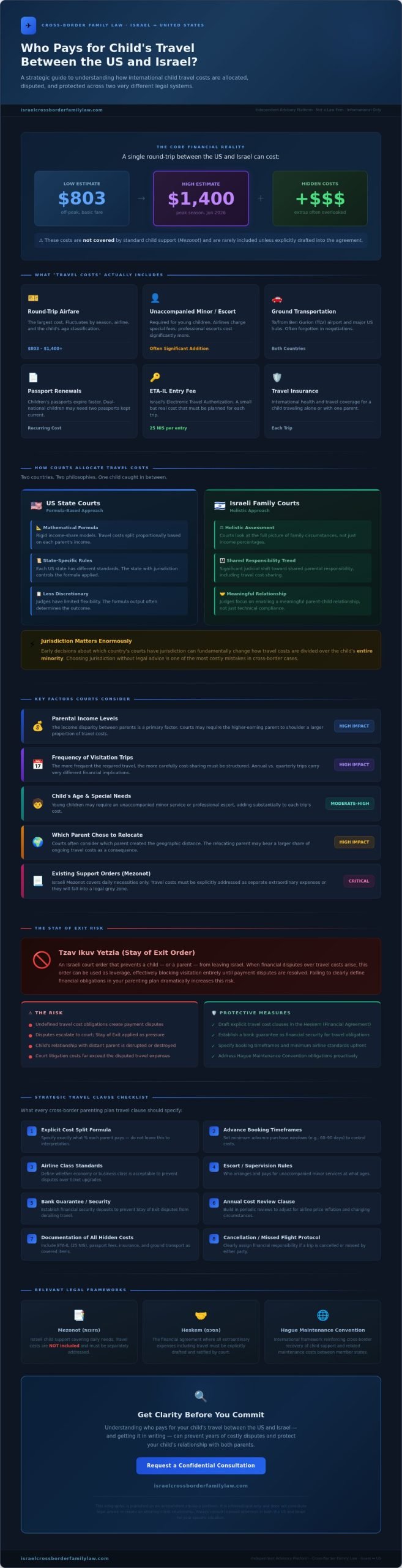
The US-Israel travel corridor is notoriously expensive. With round-trip flights in June 2026 estimated to range from $803 to $1,400, the question of who pays for child’s travel between us and israel is often the primary source of post-divorce litigation for expats. These costs aren’t static; they fluctuate based on peak travel periods and the child’s age, especially if an airline’s “unaccompanied minor” fee or a professional escort is required. Addressing these expenses during the initial drafting of the Heskem (Financial Agreement) is essential for long-term stability. Failing to define these obligations early often results in a “Stay of Exit” order being used as leverage during payment disputes. International obligations are often reinforced by the Hague Maintenance Convention, which provides a framework for the cross-border recovery of child support and related maintenance costs.
To better understand the complexities of moving children across borders after a divorce, watch this helpful video:
What Constitutes ‘Travel Costs’?
Travel expenses encompass more than just the ticket price. A comprehensive financial plan must account for round-trip airfare for the child and, if necessary, a travel escort for younger children. It’s also vital to consider ground transportation to and from Ben Gurion (TLV) and major US hubs, along with incidental costs like passport renewals, the 25 NIS ETA-IL fee, and international travel insurance. These “hidden” costs can add hundreds of dollars to a single trip, making strategic international family planning a necessity.
The Role of the Israeli Advisory Platform
This article is published on an independent advisory platform, not a law firm. Our role is to provide educational resources and strategic clarity for the international community. The information provided here is for informational purposes and does not create an attorney-client relationship. Because legal systems and cultures differ significantly, you should always consult licensed attorneys in both the US and Israel for specific legal advice regarding your cross-border custody situation.
This article is published on an independent advisory platform and does not constitute a law firm or an attorney-client relationship.
How Courts Allocate Travel Expenses: US vs. Israel
Courts in both nations recognize the financial strain of international visitation, yet their legal frameworks for determining who pays for child’s travel between us and israel differ in significant ways. While US state courts often rely on rigid mathematical formulas, Israeli family courts tend to adopt a more holistic view of the family’s situation. Understanding these philosophical differences is essential before entering any negotiation or litigation. Early decisions regarding jurisdiction can fundamentally change how these costs are divided over the child’s entire minority.
The Israeli judiciary has seen a significant shift toward the principle of shared parental responsibility. In this context, judges look beyond basic child support to ensure the child can maintain a meaningful relationship with both parents. According to the Israeli Family Law guidelines, the court evaluates the best interests of the child alongside parental income parity. If one parent relocates for a career advancement, the court may place a larger portion of the travel burden on them to facilitate the other parent’s access. This is a departure from older practices that placed the entire financial burden on the father regardless of the move’s intent.
In contrast, US state courts typically approach travel as a “deviation” from established child support guidelines. If the child lives primarily in Israel, the US-based parent might receive a credit against their monthly support obligation to account for the high cost of flights. The reason for the move, whether for work or family, remains a primary factor in how the court determines who pays for child’s travel between us and israel. This ensures that the parent remaining in the US isn’t unfairly penalized by the other’s choice to move abroad.
Israeli Judicial Trends in Travel Allocation
Israeli judges often assess which parent “created” the geographical distance. If a parent chooses to relocate to Israel, they may be required to cover the majority of the travel costs as a way of “balancing the burden.” This approach ensures that the non-resident parent can still exercise their visitation rights without facing financial ruin. Modern rulings often reduce Mezonot payments to offset these high aviation expenses.
US Jurisdictional Perspectives
The “Initial Order” holds great weight in US courts. Whichever state issued the original divorce decree often maintains jurisdiction over future support modifications. US courts generally prefer a proportional split based on income. If one parent earns significantly more, they will likely pay a larger share of the airfare. Navigating these overlapping rules requires a clear strategy. You can request a confidential case review to assess your specific situation. Get clarity before you commit. Request a confidential consultation.
This article is published on an independent advisory platform and does not constitute a law firm or an attorney-client relationship.
Factors Influencing the Division of Costs
Determining who pays for child’s travel between us and israel requires an analysis of several practical and financial variables. Courts do not simply look at total income; they examine the “disposable” income available to each parent after accounting for local tax structures and the high cost of living in hubs like Tel Aviv or New York. This financial inquiry is central to achieving an equitable distribution of the travel burden. While the parent who initiates a move often faces increased scrutiny, the final allocation is rarely a simple penalty for relocating. Instead, it’s a strategic calculation based on the specific logistics of the US-Israel corridor.
Loyalty programs and airline miles have become a standard component of modern cross-border agreements. Because round-trip flights can range from $803 to $1,400, miles represent a fungible asset that can significantly reduce out-of-pocket expenses. A well-drafted agreement should specify which parent is responsible for providing miles and how they’re valued in the context of the total travel budget. This level of detail is particularly helpful for expats and foreign nationals who may have high travel volume for work and accumulate significant rewards.
Income Disparity and Cost Sharing
Calculating income across different currencies like USD and ILS is inherently complex. Courts must adjust for the purchasing power in each region. For example, a parent living in a high-cost area of Israel may have less “ability to pay” than their nominal salary suggests. If one parent provides all housing and local transportation during the visit, this contribution may sometimes be used to offset their share of the international airfare. It’s about balancing the total financial weight of the visitation period.
The ‘Escort’ Requirement
Logistical costs increase when a child is too young to fly as an “unaccompanied minor.” Airline policies vary, but children under a certain age often require a parent or guardian to fly with them. This doubles or triples the ticket cost for each trip. Your agreement should clearly define who pays for the escort’s ticket and who is responsible for the time spent “shuttling” the child. These “Unaccompanied Minor” fees and escort tickets can quickly exceed the basic support budget, making it vital to understand the financial implications before finalizing a parenting plan. Get clarity before you commit. Request a confidential consultation.
This article is published on an independent advisory platform and does not constitute a law firm or an attorney-client relationship.
Mitigating Risks: Stay of Exit Orders and Financial Security
In the Israeli legal system, the “Stay of Exit” (Nochal) order is a powerful tool designed to prevent the unauthorized removal of a child from the country. For international families, this order is often a source of significant stress. It can be issued even without a specific threat of abduction if there’s a pending legal dispute. When parents cannot agree on who pays for child’s travel between us and israel, one party might use an exit order to block travel until the financial obligations are resolved. This intersection of travel costs and custodial rights makes early legal clarity vital.
To have an exit order lifted for a specific trip, the traveling parent is typically required to provide financial guarantees. These measures ensure the child’s return to Israel. While the Hague Convention provides an international framework for returning children who have been wrongfully retained, Israeli courts often prefer immediate financial security within their own jurisdiction. These guarantees can range from bank guarantees to formal “guarantors” who remain in the country while the child is abroad. Understanding these requirements is a fundamental part of managing international custody and relocation.
Preventing ‘Airport Surprises’
Expats often discover an exit order only upon arriving at Ben Gurion Airport. This scenario is avoidable through proactive verification of the child’s legal status. If the order is linked to travel-related debt or unpaid child support, that debt must be settled or restructured before the court will lift the restriction. Clear language in your parenting agreement regarding the exact return date and the consequences of a late return is essential to minimize these risks. It’s much easier to resolve these issues months before a flight than hours before departure.
Security Bonds and Guarantees
Courts may require a cash deposit or a bank guarantee, sometimes totaling hundreds of thousands of shekels, before permitting a child to leave the country. The parent wishing to travel usually bears the cost of setting up these securities, including bank fees. Without a formal travel protocol, you risk the trip being canceled at the last minute. To ensure your travel plans are legally sound and to avoid disputes over who pays for child’s travel between us and israel, contact us for professional guidance on navigating these cross-border requirements.
This article is published on an independent advisory platform and does not constitute a law firm or an attorney-client relationship.
Strategic Drafting of Travel Clauses
A well-structured legal document acts as a safeguard against the friction that often arises from international logistics. When determining who pays for child’s travel between us and israel, the language must be granular enough to cover not just the ticket price, but the entire travel experience. Vague terms like “reasonable costs” are an invitation for future litigation. Instead, parents should focus on concrete parameters that reflect the reality of the $803 to $1,400 round-trip costs and the specific requirements of the US-Israel corridor. Precision at the drafting stage prevents the need for costly enforcement actions later.
The ‘Booking Window’ is a vital component of any agreement. Tickets should ideally be purchased at least 60 to 90 days in advance to manage costs and ensure availability during peak seasons. Your clause should also specify the class of service and whether direct flights are mandatory. While direct flights are often more expensive, they significantly reduce the risks associated with layovers, especially for younger children. These details should be seamlessly integrated with your overall international custody and relocation strategy to ensure consistency across all legal filings. Don’t forget to allocate ‘Extraordinary Costs’ such as passport renewals, the 25 NIS ETA-IL fee, and potential emergency rebooking fees.
The Anatomy of a Clear Travel Clause
- Step 1: Determine the percentage split based on current income levels. This ensures that the financial burden remains proportionate to each parent’s ability to pay.
- Step 2: Set strict deadlines for flight selection and payment. For example, the traveling parent must propose dates 90 days out, and the other parent must confirm within 7 days.
- Step 3: Define the process for escorting the child. Specify who is responsible for the escort’s airfare and the exact location at Ben Gurion or the US hub where the handover will occur.
Addressing Changes in Circumstances
Financial stability can shift, and airfare prices can spike unexpectedly. A resilient agreement includes provisions for these fluctuations. If a parent’s income changes significantly, the cost-sharing ratio might need a structured review. We follow the ‘Get Clarity Before You Commit’ principle; it’s always better to negotiate these possibilities upfront rather than reacting to a crisis. If a dispute does arise, your agreement should require a specific period of mediation before either parent seeks court intervention. This proactive approach saves time and reduces the emotional toll on the family. Get clarity before you commit. Request a confidential consultation.
This article is published on an independent advisory platform and does not constitute a law firm or an attorney-client relationship.
Securing Your Family’s Cross-Border Future
Navigating the financial complexities of international visitation requires more than just a basic understanding of child support. You’ve learned that the distinction between standard maintenance and extraordinary expenses is the cornerstone of a stable agreement. By addressing the specific logistics of the US-Israel corridor, such as booking windows and security bonds, you can prevent the “airport surprises” that often derail family travel. These early decisions have a lasting impact on your family’s financial and emotional well-being.
Establishing a clear protocol for who pays for child’s travel between us and israel is not just about managing costs; it’s about protecting the child’s relationship with both parents across thousands of miles. Our specialized expertise in US-Israel family law and experience with complex cross-border enforcement allows us to provide tailored strategies for international families. These strategies are designed to bridge the gap between divergent legal systems and cultures while ensuring compliance with international treaties.
Get clarity before you commit. Request a confidential consultation. Taking proactive steps today ensures your family remains connected and your rights are protected in every jurisdiction.
This article is published on an independent advisory platform and does not constitute a law firm or an attorney-client relationship.
Frequently Asked Questions
Does child support in Israel (Mezonot) automatically cover international flights?
Israeli child support, or Mezonot, does not automatically include the cost of international airfare. These costs are categorized as extraordinary expenses that require a separate allocation in a legal agreement. While Mezonot covers daily essentials like food and housing, the high cost of the US-Israel corridor means flights are treated as a distinct financial obligation that parents must address specifically.
What happens if I can’t afford my share of the child’s travel costs?
If a parent’s financial situation changes, they may petition the court for a modification of the travel cost allocation. However, courts prioritize the child’s right to maintain a relationship with both parents and will examine the petitioner’s earning capacity. It’s often more effective to negotiate a maximum annual cap on travel expenses during the initial drafting of the agreement to prevent future insolvency.
Can my ex-spouse stop our child from traveling to the US if there is a support dispute?
An ex-spouse can potentially block travel by requesting a Stay of Exit order if there’s an unresolved financial dispute or unpaid maintenance. Israeli courts take travel-related debts seriously and may prevent the child’s departure until the debt is settled or secured. To avoid these airport surprises, it’s vital to ensure all payments are up to date and legal status is verified well before departure.
How do Israeli courts decide who pays for the parent’s flight to escort the child?
Israeli courts typically allocate escort costs based on the relative income of both parents and the reason for the relocation. If a child is too young to fly as an unaccompanied minor, the cost of the adult’s round-trip ticket is added to the total visitation budget. Judges often look at which parent is better positioned to absorb these costs without compromising the child’s basic needs.
Are airline miles considered a valid way to pay for visitation travel?
Airline miles are frequently recognized as a valid method for fulfilling travel obligations in cross-border agreements. Using miles can be a strategic way to manage the question of who pays for child’s travel between us and israel without depleting cash reserves. Clear language in the agreement should define the valuation of these miles and specify which parent is responsible for the actual booking process.
What is a ‘Stay of Exit’ order and how does it relate to travel expenses?
A Stay of Exit order is a legal restriction that prevents a person from leaving Israel. In the context of travel expenses, these orders are often used as security to ensure that a parent pays their share of the visitation costs or returns the child. Lifting such an order usually requires providing a bank guarantee or other financial security to the court to ensure compliance.
Can a US court order an Israeli parent to pay for flights?
A US court can order an Israeli-resident parent to pay for flights if that court retains jurisdiction over the support matter. While the US order is legally binding in its own jurisdiction, enforcing it in Israel often involves a secondary legal process under international treaties. This multi-jurisdictional complexity is why many families seek clarity through a unified, cross-border strategy rather than relying on a single court.
How often can travel expense terms be renegotiated in a cross-border case?
Travel terms can generally only be renegotiated if there’s a material change in circumstances, such as a significant shift in income or a child’s age. Minor fluctuations in airfare or currency exchange rates usually aren’t enough to trigger a court-ordered modification. Strategic drafting that accounts for who pays for child’s travel between us and israel during future price spikes can prevent the need for frequent and costly renegotiation.

Article by
Gabriel Lior
A Personal Journey That Became a Mission
The advisory was founded by an American father Gabriel Lior, LLB, MBA , global entrepreneur, and cross-border advisor who spent more than a decade navigating the Israeli family court system firsthand and now lives in Singapore with his son.
As a divorced parent in a cross-border family, Gabriel faced nearly every legal challenge a foreign parent can encounter in Israel — including child custody disputes, child support proceedings, property matters in Israel and abroad, false accusations, and complex immigration and relocation proceedings.
Over the years, he learned the hard way how difficult it is for non-Israeli parents to understand the system, identify the right legal strategy, and choose the right legal representation — especially when language, culture, and jurisdictional differences are involved. He also witnessed how foreign parents and new immigrants are often disadvantaged or taken advantage of by service providers and institutions simply because they lack local knowledge or fluency.
From Client to Advisor
To truly understand — and survive — the system, Gabriel pursued formal legal education in Israel, completing two Israeli law degrees, alongside a BA and MBA earned in the United States. This was never about becoming a practicing attorney, but about gaining a deep, structural understanding of how the system works — and where it breaks down for foreign parents.
This rare combination of:
Firsthand client experience
Israeli legal and US business education
International business and negotiation training
Decades of commercial execution
created a unique perspective – one that understands both sides of the table.
After years of litigation, persistence, and at times self-representation, he ultimately succeeded in securing custody of his son and relocating abroad through a rare legal victory in the Israeli Supreme Court — becoming one of the first fathers in Israel to do so under these circumstances.
Disclaimer
Important Disclaimer:
The information provided on this website and in its content is for general informational and educational purposes only and does not constitute legal advice, legal opinion, or legal representation.
Gabriel Lior is not licensed to practice law in Israel (nor is he interested in doing so) and does not provide legal services, despite having completed 2 Law Degrees. The services offered are advisory in nature and are intended to provide general guidance, strategic insight, and information regarding cross-border family law considerations.
No attorney-client relationship is formed by accessing this website, reading its content, or communicating with us.
Any decisions made based on this information are at your own discretion and risk. For legal advice specific to your situation, you should consult a licensed attorney in the relevant jurisdiction.
Where appropriate, we may refer clients to independent, licensed attorneys or professionals. Such referrals do not constitute legal representation and no liability is assumed for services provided by third parties.