This article is published on an independent advisory platform, not a law firm, and does not imply an attorney-client relationship. Legal services are only provided by licensed attorneys under a separate engagement.
What if the lawyer you hired to protect your family’s future in Israel is actually putting your US-based assets at risk? It’s a common fear for many of the 35,000 North Americans who move to IL each year, only to find that the Hebrew-speaking legal system operates on entirely different principles than what they’re used to back home. Managing a cross-border estate or a divorce between Tel Aviv and New York isn’t just about knowing the statutes. It’s about translating two distinct legal cultures that often clash. When considering whether a Decker law firm or a similar cross-border practice is the right fit, you must ensure they can bridge this gap effectively.
You’re likely feeling the weight of these high stakes, and you’re right to want a clear strategy before making a commitment. This article helps you understand the landscape of Israeli legal representation for internationals and how to choose an advisor who manages the unique risks of US-Israel cross-border cases. We’ll examine how to find a bicultural team that protects your assets in both countries and reduces the risk of early, costly mistakes. For more visual guidance on these complex topics, you can also explore the insights shared on the Israel Family Law YouTube channel. Get clarity before you commit. Request a confidential consultation.
Key Takeaways
- Navigate the prominent landscape of Israeli legal representation and determine if a specialized “Decker” firm is the right choice for your cross-border requirements.
- Uncover how the US-Israel Tax Treaty and the “dual track” court system in IL can significantly impact the outcome of international divorce and estate matters.
- Learn to distinguish between a standard litigation-first approach and a strategic, bicultural methodology designed to protect global assets.
- Identify hidden financial risks, including the costs of asset transfers in ₪ (ILS), and the potential for default judgments in international proceedings.
- Discover how to transition from legal uncertainty to a data-backed plan by prioritizing strategy and risk assessment before making formal commitments.
This article is published on an independent advisory platform and is not a law firm. The information provided does not constitute legal advice and does not imply or create an attorney-client relationship. Legal services are only provided by licensed attorneys under a separate, formal engagement.
Understanding the Legal Landscape: Why Search for a ‘Decker’ Firm in Israel?
When internationals begin their search for legal representation in Israel, the name Decker frequently appears at the top of the list. This prominence isn’t accidental; specific firms have built a significant reputation within the Israeli legal market for catering to the Anglo community. However, selecting a legal advisor involves more than recognizing a well-known brand. You’re looking for a bridge between the US and IL legal systems, two frameworks that often operate on entirely different cultural and procedural assumptions.
A cross-border advisor serves as more than a translator. They act as a strategic guide through a multi-jurisdictional landscape where a decision made in a Tel Aviv courtroom can have immediate tax or custodial consequences in California or New York. While name recognition offers a sense of security, sensitive family or estate matters require a nuanced approach that prioritizes strategy over mere visibility. You need to ensure the firm’s specific expertise aligns with the complexities of your international life.
To better understand the context of this legal search and the firm’s presence in the market, watch this helpful video:
The Anglo Experience in the Israeli Legal System
Expats often enter the Israeli legal arena with significant misconceptions. They might assume that because Israel is a “start-up nation” with Western ties, the courts function exactly like those in the US. In reality, the Israeli system is fast-paced and heavily reliant on dense Hebrew documentation. Without a “team on the ground” in Tel Aviv to provide plain English explanations, clients often feel sidelined in their own cases. It’s vital to have an advisor who can demystify complex terms and explain why a ₪10,000 filing fee or a specific evidentiary rule exists within the local context.
When to Seek Specialized Cross-Border Counsel
General practice firms often lack the sophisticated tools needed for cases involving assets, children, or businesses spread across two continents. If your situation involves a custody dispute, for instance, your advisor must be intimately familiar with the Hague Convention on International Child Abduction to protect your family’s interests. Early decisions in these multi-jurisdictional disputes are rarely reversible. Choosing an advisor who understands how to navigate both systems simultaneously is the only way to ensure long-term stability for your estate or your children.
Get clarity before you commit. Request a confidential consultation.
The Unique Challenges of US-Israel Cross-Border Family Law
Managing family legal matters across two jurisdictions requires more than just knowing the law; it demands a strategic understanding of how two distinct systems interact. A firm like Decker often emphasizes the complexities of the “dual track” system in Israel. This system splits authority between civil family courts and religious Rabbinical courts. Where you file first often dictates which court has jurisdiction over specific issues like alimony or property division. This “race to the court” is a critical strategic moment. Filing in Israel a single day before a US filing can change the financial outcome of a case by hundreds of thousands of shekels (₪).
The US-Israel Tax Treaty also plays a silent but powerful role in these transitions. It affects how assets are taxed during a divorce or after an inheritance. Without a cross-border strategy, you might pay unnecessary taxes on both sides of the ocean. Cultural differences also matter. Israeli legal culture is often more direct and litigation-heavy than the corporate environment many US expats expect. Understanding these nuances helps avoid costly misunderstandings during negotiations.
Divorce and Separation for International Families
Handling divorce and separation when one spouse lives in the US and the other in Israel creates logistical and legal hurdles. Enforcing financial obligations requires specific procedures to ensure orders are recognized by both governments. You can find detailed technical steps in this guide on US-Israel child support enforcement. For families with children, the Hague Convention governs international relocation and potential abduction cases. If a parent moves a child without consent, the legal response must be immediate. Early strategy is the only way to protect parental rights in these high-stakes situations.
Wills, Estates, and Asset Protection
A standard US will is rarely enough if you own property in Israel. Israeli probate laws have specific requirements that a foreign document might not meet, leading to delays in the execution of an estate. Managing an inheritance across borders involves navigating different tax brackets and reporting requirements. For high-net-worth expats, dual-country estate planning is a necessity. It ensures that your assets, whether they are worth ₪1,500,000 or ₪15,000,000, are protected from double taxation and lengthy court battles. Get clarity before you commit. Request a confidential consultation to discuss your specific cross-border needs.
Evaluating Legal Representation: Strategy vs. Standard Practice
Choosing a legal representative for a cross-border matter requires looking beyond a prestigious brand name. Many firms operate under a litigation-first mindset. They prioritize filing motions and aggressive court appearances as the default response. While this creates a flurry of activity, it often leads to escalating costs and emotional exhaustion. A strategy-first approach is different. It evaluates the long-term impact of every move on both sides of the ocean. When evaluating a Decker law firm or advisor, you must ensure they prioritize risk management over immediate conflict.
Bicultural and bilingual attorneys are non-negotiable for these cases. It isn’t just about translating Hebrew to English. It’s about understanding the cultural “why” behind legal behaviors. An attorney who doesn’t grasp the nuances of the Israeli “Start-up Nation” mentality or the procedural expectations of a US court will struggle to bridge the gap. They might miss the subtle implications of a witness’s testimony or fail to frame an argument in a way that resonates with a specific judge’s cultural background.
Financial transparency is another critical pillar. You should never feel uncertain about your legal spend. Understanding pricing and how it works allows you to make decisions based on value rather than fear. In the Israeli market, costs are often quoted in Israeli Shekels (₪), and you must account for VAT (currently 17%) on local services. A professional advisor provides clear fee structures to prevent the “sticker shock” that often accompanies complex international litigation.
Questions to Ask a Potential Advisor
- How do you handle the communication gap between US and IL legal teams? Misalignment between attorneys in different time zones can lead to ₪20,000 mistakes in document filing.
- What is your specific experience with the US-Israel Tax Treaty? The treaty, originally signed in 1975, has massive implications for how assets are divided or taxed during a cross-border divorce.
- Can you explain the risks of my case in plain English? If an advisor hides behind legal jargon, they aren’t empowering you to make an informed choice.
The Advisory Model vs. Traditional Law Firms
Traditional firms often focus on the “win” in a specific courtroom. Our advisory model is different. By understanding how our advisory works, you gain clarity before you commit to a heavy retainer. We provide an independent perspective, which is vital in high-conflict family matters. When emotions are high, an objective view helps you avoid reactive decisions that could haunt you for years.
We focus on education and risk management. Our goal isn’t to promote aggressive litigation but to help you navigate the inherent complexity of the US-IL corridor. This approach ensures you understand the significant differences between the two legal systems before you take action. Get clarity before you commit. Request a confidential consultation.
This article is published on an independent advisory platform, not a law firm. The information provided is for educational purposes only and does not constitute an attorney-client relationship. Legal services are only provided by licensed attorneys under a separate engagement.
Managing Risks in International Divorce and Estate Matters
Navigating the intersection of US and Israeli law involves more than just translating documents from Hebrew to English. It requires a strategic approach to mitigate high-stakes risks that often catch international families off guard. One of the most severe risks is a default judgment. If a party in the US is served with Israeli court papers and fails to respond within the statutory 60-day period required for international service, the Israeli court may rule entirely in favor of the petitioner. Undoing such a ruling is technically difficult and often costs upwards of ₪25,000 in legal fees alone.
Financial exposure also extends to the hidden costs of cross-border asset transfers. Moving funds or liquidating property isn’t just about the exchange rate. Hidden costs, such as the ₪200 to ₪500 fees per international wire or the complex tax liabilities under the US-Israel Tax Treaty, can erode an estate’s value. While a Decker law firm may provide the necessary bicultural perspective, you must ensure your advisor understands the specific procedural traps of both systems to avoid these leaks.
The emotional toll of multi-year litigation shouldn’t be underestimated. Cases spanning two continents frequently last 24 to 48 months. This duration impacts mental health and family dynamics significantly. Seeking clarity before signing any Israeli legal documents is the only way to prevent long-term regret. Never sign a “Power of Attorney” or a settlement agreement without a full English explanation of every clause, as these documents carry different weights in Israel than they do in the US.
Early Decision Points with High Impact
Choosing the right jurisdiction is a strategic decision that changes everything. The “Race to the Court” is a real phenomenon where filing first in an Israeli Rabbinical Court versus a US Family Court can fundamentally change the outcome of alimony or property division. Using standard templates for cross-border prenuptial agreements is another common pitfall. These “off-the-shelf” forms usually fail because they don’t account for Israeli “Balance of Resources” laws. This is why expats and foreign nationals need a customized roadmap that addresses the specific regulations of both countries.
Protecting Children and Assets
Preventing international child abduction requires proactive legal measures rather than reactive ones. Strategic steps include depositing passports with a neutral third party or obtaining a “no-exit” order, known in Israel as a Tsav Ikuv Yetzia Min HaAretz. Securing assets also requires a local presence. Protecting a ₪3,000,000 apartment in Tel Aviv while you reside in New York requires specific liens or cautionary notes registered with the Land Registry (Tabu). Choosing a Decker legal professional involves verifying they have a dedicated “team on the ground” to handle these filings personally. For more details, you can watch our guide on international custody on our YouTube channel at https://www.youtube.com/@IsraelFamilyLaw.
Get clarity before you commit. Request a confidential consultation.
This article is published on an independent advisory platform and does not constitute a law firm or an attorney-client relationship. Legal services are only provided by licensed attorneys under a separate engagement.
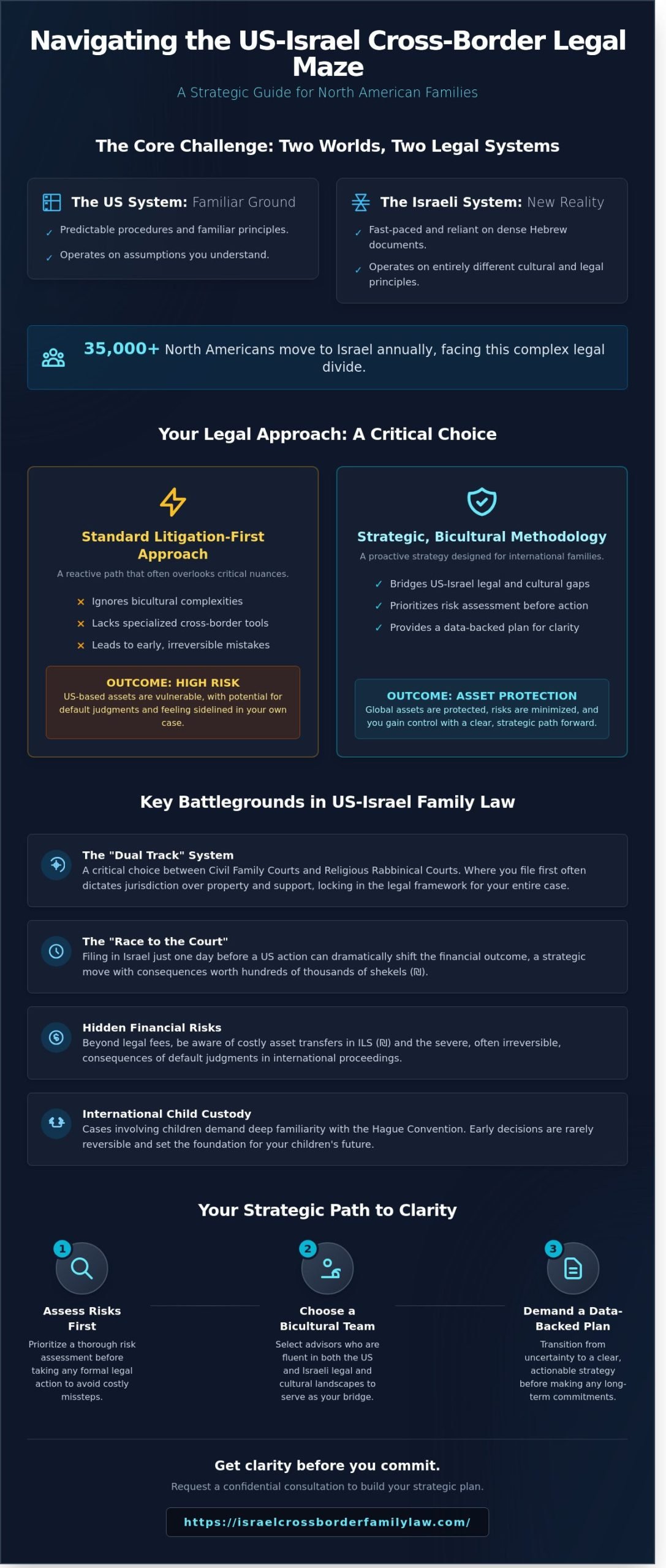
Getting Clarity: The Strategic Path Forward for International Families
International legal conflicts often begin with a sense of overwhelming confusion. Families frequently find themselves caught between two sets of rules, unsure how a decision made in a US court might trigger a ₪40,000 unexpected liability in Israel. Moving away from this uncertainty requires a data-backed legal strategy rather than a reactive, emotional response. A Decker law firm or a specialized cross-border advisor focuses on providing this clarity through rigorous jurisdictional analysis and evidence-based planning.
By engaging in a confidential case review, you can assess the specific risks of your situation before you file a single document. This neutral, calm approach is designed to foster long-term settlements that protect your assets and your children’s stability. Instead of rushing into litigation, strategic advisors help you weigh the costs and benefits of different venues, ensuring your first move isn’t your biggest mistake.
Building Your Cross-Border Legal Team
Effective representation doesn’t happen in a vacuum. We collaborate with your existing US or IL professionals to ensure every tactical move is synchronized. This involves managing communication across seven to ten hour time zones and ensuring that legal precision in one country doesn’t create a compliance failure in the other. Our focus remains on achieving your family objectives by coordinating with accountants, wealth managers, and local litigators. This team-based approach prevents the “silo” effect, where one lawyer’s success in a local court inadvertently causes a massive financial loss in a different jurisdiction.
Final Guidance for the Anglo Community
Don’t let the fear of the unknown drive your legal decisions. Many expats feel pressured to sign agreements they don’t fully understand because they worry about the complexities of the Israeli Rabbinical courts or the local civil system. You have the power of informed choice. Understanding the nuances of a Decker style practice allows you to bridge the gap between your home culture and the Israeli legal environment. Using a strategy rooted in facts rather than fear leads to more sustainable outcomes for international families.
The path forward is built on informed decisions and professional coordination. Get clarity before you commit. Request a confidential consultation to start your journey with a clear, strategic map of the road ahead.
Securing Your Family’s Future Across Borders
Navigating the intersection of two distinct legal systems requires more than standard representation. You need a strategy that accounts for the 10,000 kilometers separating Jerusalem and New York. Engaging a Decker firm means prioritizing a bicultural approach that bridges the gap between Israeli family courts and U.S. legal expectations. Data from the Israeli Central Bureau of Statistics indicates that thousands of international families navigate these complexities annually, yet many overlook how early jurisdictional decisions impact their long-term rights. By focusing on risk mitigation rather than reactive litigation, you protect your global assets and your children’s stability. Choosing a team with 20 years of specialized experience in the US-Israel corridor ensures you aren’t just another case file. It’s about finding an advisor who understands that a ₪500,000 estate matter in Tel Aviv involves different regulatory hurdles than one in the States. Taking the right steps today prevents costly errors tomorrow.
Get clarity before you commit. Request a confidential consultation.
You don’t have to navigate these complex international waters alone; the right guidance makes all the difference.
This article is published on an independent advisory platform and does not constitute a law firm. The information provided is for educational and advisory purposes only and does not establish an attorney-client relationship. Legal services are only provided by licensed attorneys under a separate, formal engagement.
Frequently Asked Questions
Is a US prenuptial agreement valid in Israel?
A US prenuptial agreement is generally valid in Israel, but it requires formal validation by an Israeli Family Court to be fully enforceable. Under the Spouses (Property Relations) Law of 1973, foreign agreements must meet specific procedural standards to override default Israeli property division rules. A Decker legal expert can guide you through the process of having your US document approved locally to ensure your assets remain protected under Israeli jurisdiction.
What is the difference between the Rabbinical Court and Civil Court for divorce?
The Rabbinical Court holds exclusive authority over the actual act of divorce for Jewish couples, while the Family Court handles civil matters like property distribution and child custody. This creates a “race for jurisdiction” where the venue that receives the first filing often dictates which legal principles apply to the case. Since the 2016 Litigation Settlement Law, all couples must attend mandatory mediation sessions before they can proceed with litigation in either court system.
Can I enforce a US child support order in Israel?
You can enforce a US child support order by applying to an Israeli court to have the judgment declared enforceable under the Foreign Judgments Enforcement Law of 1958. Once the court recognizes the order, it’s sent to the Enforcement and Collection Authority to ensure payment. Israel and the US maintain reciprocal agreements that streamline this process, though you’ll need to prove the original US court had proper jurisdiction over the parties.
How long does the probate process take for assets in Israel?
The probate process for Israeli assets typically takes between 6 and 12 months when handled through the Inheritance Registrar. If the estate involves complex cross-border elements or if family members contest the will, the timeline can easily extend beyond 18 months. You’ll need an Israeli Succession Order to transfer title for real estate or to release funds held in local bank accounts, regardless of whether a US probate process is already underway.
Do I need a separate will for my Israeli property if I have a US will?
You aren’t legally required to have a separate will, but creating an Israel-specific will can reduce administrative delays and legal costs by approximately 30 percent. While Israeli law recognizes foreign wills under the 1965 Inheritance Law, the document must undergo a complex process of translation and notarization. A Decker advisor helps structure a local will that works in harmony with your US estate plan to avoid conflicts between different legal systems.
What should I look for in an international divorce lawyer?
Look for a practitioner who possesses dual licensing and specific experience in multi-jurisdictional litigation between the US and Israel. They should demonstrate a deep understanding of the 1980 Hague Convention and have a physical team on the ground in Israel to manage urgent filings. You need someone who understands the bicultural nuances of both legal systems to navigate the complexities of international asset division and custody arrangements effectively.
How does the US-Israel tax treaty affect my inheritance?
The US-Israel tax treaty focuses on preventing double taxation on income, but it doesn’t directly cover inheritance taxes because Israel abolished its inheritance tax in 1981. However, US citizens are still subject to US federal estate tax on their global assets, including property located in Israel. It’s vital to review the 1975 treaty provisions to understand how capital gains taxes might apply when you sell inherited Israeli property later.
What is the Hague Convention in the context of Israel and the US?
The 1980 Hague Convention is an international treaty that governs cases of international child abduction, ensuring the prompt return of children to their country of habitual residence. If a child is moved between the US and Israel without the consent of both parents, this treaty provides the legal framework for a return order. Statistics from the Ministry of Justice show that these cases are prioritized in Israeli courts, often reaching a resolution within 6 to 24 weeks.
For more information on navigating these complex legal landscapes, you can view educational resources on the Israel Family Law YouTube channel.
Get clarity before you commit. Request a confidential consultation.

Article by
Gabriel Lior
A Personal Journey That Became a Mission
The advisory was founded by an American father Gabriel Lior, LLB, MBA , global entrepreneur, and cross-border advisor who spent more than a decade navigating the Israeli family court system firsthand and now lives in Singapore with his son.
As a divorced parent in a cross-border family, Gabriel faced nearly every legal challenge a foreign parent can encounter in Israel — including child custody disputes, child support proceedings, property matters in Israel and abroad, false accusations, and complex immigration and relocation proceedings.
Over the years, he learned the hard way how difficult it is for non-Israeli parents to understand the system, identify the right legal strategy, and choose the right legal representation — especially when language, culture, and jurisdictional differences are involved. He also witnessed how foreign parents and new immigrants are often disadvantaged or taken advantage of by service providers and institutions simply because they lack local knowledge or fluency.
From Client to Advisor
To truly understand — and survive — the system, Gabriel pursued formal legal education in Israel, completing two Israeli law degrees, alongside a BA and MBA earned in the United States. This was never about becoming a practicing attorney, but about gaining a deep, structural understanding of how the system works — and where it breaks down for foreign parents.
This rare combination of:
Firsthand client experience
Israeli legal and US business education
International business and negotiation training
Decades of commercial execution
created a unique perspective – one that understands both sides of the table.
After years of litigation, persistence, and at times self-representation, he ultimately succeeded in securing custody of his son and relocating abroad through a rare legal victory in the Israeli Supreme Court — becoming one of the first fathers in Israel to do so under these circumstances.
Disclaimer
Important Disclaimer:
The information provided on this website and in its content is for general informational and educational purposes only and does not constitute legal advice, legal opinion, or legal representation.
Gabriel Lior is not licensed to practice law in Israel (nor is he interested in doing so) and does not provide legal services, despite having completed 2 Law Degrees. The services offered are advisory in nature and are intended to provide general guidance, strategic insight, and information regarding cross-border family law considerations.
No attorney-client relationship is formed by accessing this website, reading its content, or communicating with us.
Any decisions made based on this information are at your own discretion and risk. For legal advice specific to your situation, you should consult a licensed attorney in the relevant jurisdiction.
Where appropriate, we may refer clients to independent, licensed attorneys or professionals. Such referrals do not constitute legal representation and no liability is assumed for services provided by third parties.