What if the court handling your divorce has no legal power to touch your most valuable asset? Most international families assume that a single court order will resolve everything, but managing Foreign Real Estate in Divorce Cases introduces a unique layer of complexity. You likely feel the weight of this uncertainty, especially when your assets are scattered across borders and legal systems. It’s a stressful position, particularly when you’re trying to navigate the significant differences between the Israeli legal system and those abroad without falling into the trap of double taxation or jurisdictional competition.
This guide provides a clear roadmap for asset division in cross-border divorces. You’ll learn how courts handle property they cannot physically seize and how to leverage strategies like property ‘offsetting’ to avoid conflicting orders. We will also examine the risks of high-cost litigation and the weight of early decisions, ensuring you have the clarity needed before making any permanent commitments. For further insights, we recommend viewing the strategic overviews at the IsraelFamilyLaw YouTube channel. This information is published on an independent advisory platform and does not constitute formal legal representation or advice; legal services are only provided by licensed attorneys under a separate engagement.
Key Takeaways
- Understand why property is governed by the laws of its physical location and how courts use personal authority to manage assets they cannot physically seize.
- Learn the essential process of tracing funds to protect separate property when handling Foreign Real Estate in Divorce Cases.
- Discover the strategy of offsetting to balance your global portfolio and avoid the logistical complications of selling homes in two different countries.
- Identify how the US-Israel Tax Treaty and Israeli betterment taxes impact the actual net value of your marital assets before you commit to a settlement.
- Recognize why seeking early clarity on jurisdiction is the most critical step in protecting your long-term financial interests and avoiding conflicting court orders.
Understanding Jurisdiction in Foreign Real Estate Divorce
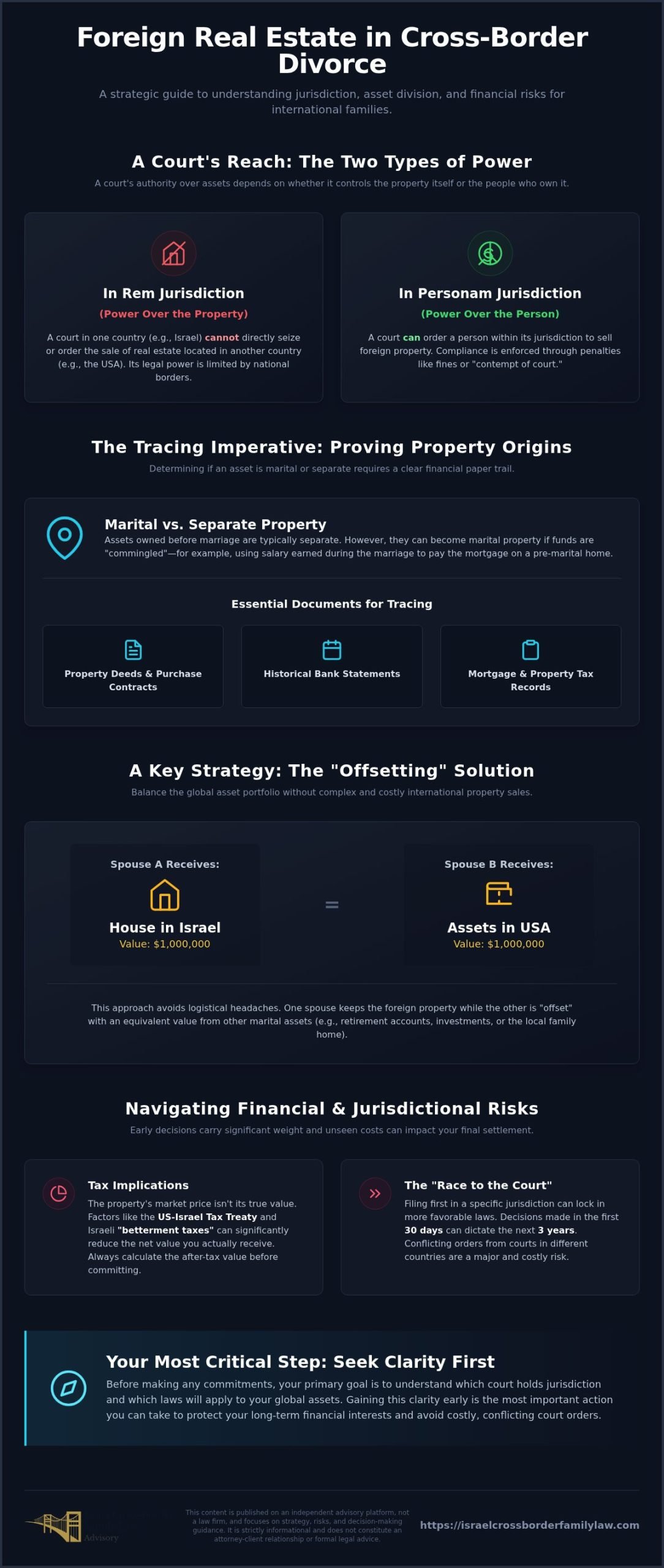
Real estate is legally classified as “immovable” property. Under the principle of Lex Situs, the laws of the country where the land is physically located generally govern its title and transfer. However, when managing Foreign Real Estate in Divorce Cases, the situation becomes more nuanced because a court in one country can still exert influence over property in another. While a judge in Israel cannot technically seize a house in Florida, they can issue orders to a spouse living within their jurisdiction, compelling them to sell the property or transfer its value to the other party.
The distinction between jurisdiction types is vital for international families to understand. In rem jurisdiction refers to a court’s power over the physical property itself, which is strictly limited by national borders. In contrast, in personam jurisdiction is the authority a court has over the specific individuals involved in the case. This personal authority allows a court to bypass the physical location of an asset by controlling the actions of the owners themselves.
The Limits of Israeli Civil and Rabbinical Courts
The Israeli Financial Relations Law (1973) serves as the foundation for asset division, utilizing a “balancing of resources” (Izun Mashabim) to ensure an equitable split of the marital estate. For expats, this means the court evaluates the total global value of all assets, regardless of whether they are held in Tel Aviv or New York. The Rabbinical Court also maintains jurisdiction over these matters and frequently applies similar balancing principles to achieve a fair outcome. A major risk for international families is the “race to the court,” where filing first in one jurisdiction might secure more favorable rules for property valuation or division under international matrimonial law. Decisions made in the first 30 days often dictate the trajectory of the next three years, especially when conflicting orders arise between an Israeli and a US court.
US State Court Authority Over International Land
A state judge in New Jersey or Texas lacks the legal authority to sign a deed for a property located in Israel. To address this, US courts utilize their personal jurisdiction over the parties to enforce agreements or judgments. If a spouse refuses to comply with an order to sell or transfer foreign land, the court can use “contempt of court” charges, including fines or imprisonment, as a tool for enforcement. In personam jurisdiction functions as the primary mechanism in cross-border asset division by allowing a court to order a spouse to pay a specific sum or execute a deed under the threat of legal penalty.
This content is published on an independent advisory platform, not a law firm, and focuses on strategy, risks, and decision-making guidance. It is strictly informational and does not constitute an attorney-client relationship or formal legal advice. For more information on our approach, visit About the Advisory.
Classification and Valuation of Overseas Assets
Distinguishing between marital and separate property is the primary challenge when managing Foreign Real Estate in Divorce Cases. In a cross-border context, the legal system often looks beyond whose name is on the deed to determine the true nature of the asset. Identifying the origin of the purchase funds and the ongoing source of mortgage payments is essential for a fair division.
The Tracing Problem: Marital vs. Separate Property
Israeli law generally views assets brought into a marriage as separate property. However, this status can change if funds are “commingled” during the relationship. If a spouse uses their salary earned during the marriage to pay the mortgage on a pre-marital apartment in Jerusalem or a house in the US, the other spouse may gain a legal interest in that asset. Proving that an asset remains separate requires a rigorous process called tracing. To succeed, you must provide a clear paper trail, including:
- Foreign property deeds and original purchase contracts.
- Historical bank statements showing the flow of pre-marital funds.
- Records of mortgage payments and property tax history.
Without these documents, the court may default to treating the asset as part of the marital pool. It’s often beneficial to seek a professional review of your financial history before these issues escalate in court.
Valuing Real Estate Across Borders
Determining the value of a property in a different country involves more than just a simple appraisal. You must account for currency fluctuations between the US Dollar and the Israeli Shekel, as well as local market conditions in specific neighborhoods like Ra’anana or Herzliya. The “date of separation” serves as the fixed point for valuation, but a delay in the proceedings can lead to significant discrepancies if the market shifts. Additionally, international forensic accountants are often employed to identify hidden offshore holdings or complex corporate structures that might mask the true value of the marital estate. A comprehensive valuation must also subtract any outstanding foreign mortgage debt and potential liens to arrive at a “net value” that can be balanced against other assets.
This content is published on an independent advisory platform, not a law firm, and focuses on strategy, risks, and decision-making guidance. It is strictly informational and does not constitute an attorney-client relationship or formal legal advice. For more information on our approach, visit About the Advisory.
Strategies for Division: Offsetting and Value Balancing
When physical division of a property is impossible or impractical, offsetting becomes the most effective strategy for managing Foreign Real Estate in Divorce Cases. This mechanism allows a couple to balance the total value of their global estate without the need for multiple international sales. Instead of selling every asset and splitting the proceeds, one spouse may retain the primary residence in Israel while the other keeps a vacation home or investment property in the US. This approach minimizes transaction costs and avoids the logistical nightmare of navigating two different closing processes simultaneously.
The Offset Framework: A Practical Example
Imagine a couple owns a home in Netanya valued at $1 million and a condo in Florida also valued at $1 million. A simple 50/50 split might suggest each person takes one property, but this is rarely equitable in a cross-border context. The tax liabilities, maintenance costs, and potential for future appreciation differ significantly between jurisdictions. To achieve true balance, we often look at the entire marital “pot,” using other assets like pensions, stock portfolios, or cash savings to equalize the ledger. If the Florida condo carries a higher capital gains tax burden upon sale, the spouse keeping it might receive a larger share of a liquid brokerage account to compensate for that future liability.
Implementing the ‘Buy-Out’ Strategy
If one spouse wishes to keep a specific property but lacks the liquid funds to pay the other their share, a buy-out is often structured through refinancing. This process involves taking out a new mortgage to pay off the departing spouse and removing their name from the title. In Israel, legal instruments like a “Caution Note” (He’arat Azhara) can be recorded against the property to secure a spouse’s interest until the full payout is made. Net equity is the only relevant figure in a cross-border offset because it represents the actual liquid value a spouse receives after accounting for hypothetical taxes and transaction costs.
For families with children, a “deferred sale” might be the most stable option. This allows one parent to remain in the home for a set period, such as until the youngest child finishes school, before the property is eventually sold or the buy-out is finalized. This strategy requires a detailed agreement regarding who pays the mortgage, taxes, and repairs during the interim period. Seeking a confidential case review can help you determine which of these structured payouts fits your specific financial goals.
This content is published on an independent advisory platform, not a law firm, and focuses on strategy, risks, and decision-making guidance. It is strictly informational and does not constitute an attorney-client relationship or formal legal advice. For more information on our approach, visit How it Works.
Tax Implications and Enforcement Risks
Dividing Foreign Real Estate in Divorce Cases requires a deep understanding of how two different tax authorities view the same transaction. A property transfer that appears equitable on paper can quickly become a financial burden if you don’t account for the tax liabilities triggered by a sale or title change. The US-Israel Tax Treaty serves as a vital tool to prevent double taxation, but it does not eliminate all obligations. Both jurisdictions have specific rules that can significantly impact the final “net” amount each spouse receives.
Tax Compliance for International Property Sales
If you are selling US real estate while living in Israel, you must consider the Foreign Investment in Real Property Tax Act (FIRPTA). This law generally requires a 15% withholding on the gross sales price if the seller is a foreign national. However, US taxpayers can often utilize the Section 121 exclusion, which allows individuals to exclude up to $250,000 of gain, or $500,000 for married couples filing jointly, from the sale of a principal residence. In Israel, the “Mas Shevach” (Betterment Tax) targets the increase in property value since the date of purchase. Coordinating these two systems is complex. Failing to align the timing of a sale with your divorce decree can lead to tax surprises that diminish your marital pot.
Enforcement and Compliance Hurdles
Obtaining a court order in one country does not guarantee its enforcement in another. An Israeli court might choose to ignore a US property order if it conflicts with local public policy or if the proper procedures for recognizing a foreign judgment are not followed. Under the Foreign Judgments Enforcement Law, an Israeli court must formally validate a US decree before it can be used to transfer title in a local land registry. This process is often time-consuming and expensive.
To mitigate these risks, many international families use “Mirror Orders.” This involves obtaining matching judgments in both the US and Israel, ensuring that both legal systems recognize the same division of assets. Using escrow accounts to hold funds until all foreign title transfers are verified provides an additional layer of security. Because of these hurdles, a voluntary settlement is almost always superior to a litigated order. It allows for more creative and enforceable solutions that both courts are likely to respect.
This content is published on an independent advisory platform, not a law firm, and focuses on strategy, risks, and decision-making guidance. It is strictly informational and does not constitute an attorney-client relationship or formal legal advice. For more information on our approach, visit For Expats and Foreign Nationals.
Strategic Decision Making in Cross-Border Divorce
Decisions made in the first month of a cross-border separation often dictate the outcome of the next three years. This is especially true when managing Foreign Real Estate in Divorce Cases. Choosing where to file is not just a procedural step; it is a strategic move that determines which laws apply to your property. If you act without a clear plan, you risk falling into a “race to the court” that can lead to conflicting orders and excessive legal fees. Seeking a strategic overview early allows you to maintain control over the process rather than reacting to the other party’s moves.
The Weight of Early Decisions
Choosing the right jurisdiction involves more than just picking a convenient location. You must decide whether your interests are better served in Tel Aviv or a US State Court. A “do-it-yourself” approach to international property agreements often fails because it misses the nuances of title transfer and tax compliance. A calm, strategic approach prevents the emotional and financial depletion that often accompanies high-conflict litigation. By seeking clarity early, you can integrate complex property division into a broader US-Israel prenuptial or postnuptial agreement, providing long-term security. Learn more about our strategy for expats and foreign nationals to see how early planning protects global assets.
Seeking Clarity Before Commitment
The independent advisory model is designed for international families who need a bridge between two legal systems. Multi-qualified practitioners understand the cultural and legal differences between Israel and the US, allowing them to craft solutions that both systems can recognize. Before making any permanent commitments, it’s helpful to watch the guidance on the Israel Family Law YouTube channel. This resource provides a foundation for understanding the complexities involved and helps you ask the right questions when interviewing potential legal teams.
Focus on the “bridge” between systems rather than the conflict itself. Cross-border issues are inherently complex, but they are manageable with the right strategy. By prioritizing clarity and expert guidance, you can navigate the division of foreign assets with confidence and move toward a stable financial future.
This content is published on an independent advisory platform, not a law firm, and focuses on strategy, risks, and decision-making guidance rather than an attorney-client relationship. It is strictly informational and does not constitute formal legal advice. Legal services are only provided by licensed attorneys under a separate engagement. For more information, visit About the Advisory.
Securing Your Global Financial Future
Managing property across borders requires more than just local legal knowledge; it demands a strategic overview that bridges two distinct legal systems. You’ve seen how the distinction between personal jurisdiction and physical property location allows courts to influence assets abroad, and how offsetting strategies can simplify an otherwise complex division. By accounting for tax treaties and betterment taxes early, you avoid the financial surprises that often derail settlements. Each decision carries significant weight, and seeking clarity before you commit to a specific jurisdiction is the most effective way to protect your long-term interests.
Our advisory platform provides authoritative cross-border expertise for families navigating these multi-jurisdictional complexities. Practitioners licensed in multiple jurisdictions ensure that your interests are protected under both Israeli and US law, focusing on the weight of early decisions to prevent long-term litigation. This calm, strategic approach helps you move from confusion to a clear roadmap for your future. We are dedicated to helping you navigate the inherent challenges of Foreign Real Estate in Divorce Cases with confidence and precision.
Get clarity before you commit. Request a confidential consultation.
Frequently Asked Questions
Can an Israeli court force the sale of a house located in the United States?
An Israeli court lacks the authority to physically seize or sign a deed for land located in the United States. However, it can exercise personal jurisdiction over a spouse living in Israel, ordering them to sell the property or transfer its value. If the spouse refuses, the court may use sanctions such as fines or imprisonment for contempt to compel compliance. This indirect method is the primary way courts manage assets they cannot touch directly.
How do courts value a property when the exchange rate between USD and ILS is fluctuating?
Courts generally determine the value of a property based on the exchange rate active on the “date of separation” or the specific date of the appraisal. Because the USD and ILS exchange rate can be volatile, professional appraisers typically provide valuations in both currencies. This ensures the balancing of resources remains equitable even if the market shifts during the proceedings. Timing is critical to ensure the final ledger reflects the true net value of the estate.
Do I have to pay capital gains tax in both the US and Israel when I sell my marital home?
You may be subject to tax in both jurisdictions, but the US-Israel Tax Treaty is designed to prevent double taxation through the use of foreign tax credits. In the US, you might face FIRPTA withholding, while in Israel, the Mas Shevach tax applies to the increase in property value. Coordinating the sale through dual-qualified professionals ensures you utilize all available exclusions, such as the primary residence exclusion, to protect your share of the proceeds.
What happens if my spouse hides property they own in another country?
Courts employ international forensic accountants to identify hidden holdings and trace the flow of funds across borders. If a spouse is found to be hiding Foreign Real Estate in Divorce Cases, the court may impose severe financial sanctions or award the other party a significantly larger share of the known marital assets. Full disclosure is a legal requirement; attempting to conceal assets often results in greater financial loss than a transparent division.
Can a US prenuptial agreement protect my real estate in Israel?
A US prenuptial agreement can protect your assets in Israel, provided it is drafted with cross-border enforcement in mind. To be effective, the document should explicitly mention global real estate and comply with the formal requirements of the Israeli Financial Relations Law. It is often necessary to have the agreement reviewed by practitioners in both countries to ensure it will be recognized by an Israeli court if a dispute arises later.
How long does it take to enforce a foreign property order in the Israeli court system?
The process of recognizing and enforcing a foreign property order in Israel can take anywhere from six months to over a year. This involves filing a petition under the Foreign Judgments Enforcement Law to prove the original order is final and does not contradict Israeli public policy. Because this path is often slow and costly, many international families prefer to reach a voluntary settlement that can be implemented more quickly through local administrative channels.
What is a ‘Mirror Order’ and why do I need one for my cross-border assets?
A Mirror Order is a secondary judgment obtained in a different country that exactly matches the terms of your original divorce decree. You need one because land registries in Israel or the US generally won’t accept a foreign court order for a title transfer. Obtaining Mirror Orders for Foreign Real Estate in Divorce Cases ensures that the local authorities in both jurisdictions have the legal power to update ownership records without further litigation.
This content is published on an independent advisory platform, not a law firm, and focuses on strategy, risks, and decision-making guidance. It is strictly informational and does not constitute formal legal advice. Legal services are only provided by licensed attorneys under a separate engagement.

Article by
Gabriel Lior
A Personal Journey That Became a Mission
The advisory was founded by an American father Gabriel Lior, LLB, MBA , global entrepreneur, and cross-border advisor who spent more than a decade navigating the Israeli family court system firsthand and now lives in Singapore with his son.
As a divorced parent in a cross-border family, Gabriel faced nearly every legal challenge a foreign parent can encounter in Israel — including child custody disputes, child support proceedings, property matters in Israel and abroad, false accusations, and complex immigration and relocation proceedings.
Over the years, he learned the hard way how difficult it is for non-Israeli parents to understand the system, identify the right legal strategy, and choose the right legal representation — especially when language, culture, and jurisdictional differences are involved. He also witnessed how foreign parents and new immigrants are often disadvantaged or taken advantage of by service providers and institutions simply because they lack local knowledge or fluency.
From Client to Advisor
To truly understand — and survive — the system, Gabriel pursued formal legal education in Israel, completing two Israeli law degrees, alongside a BA and MBA earned in the United States. This was never about becoming a practicing attorney, but about gaining a deep, structural understanding of how the system works — and where it breaks down for foreign parents.
This rare combination of:
Firsthand client experience
Israeli legal and US business education
International business and negotiation training
Decades of commercial execution
created a unique perspective – one that understands both sides of the table.
After years of litigation, persistence, and at times self-representation, he ultimately succeeded in securing custody of his son and relocating abroad through a rare legal victory in the Israeli Supreme Court — becoming one of the first fathers in Israel to do so under these circumstances.
Disclaimer
Important Disclaimer:
The information provided on this website and in its content is for general informational and educational purposes only and does not constitute legal advice, legal opinion, or legal representation.
Gabriel Lior is not licensed to practice law in Israel (nor is he interested in doing so) and does not provide legal services, despite having completed 2 Law Degrees. The services offered are advisory in nature and are intended to provide general guidance, strategic insight, and information regarding cross-border family law considerations.
No attorney-client relationship is formed by accessing this website, reading its content, or communicating with us.
Any decisions made based on this information are at your own discretion and risk. For legal advice specific to your situation, you should consult a licensed attorney in the relevant jurisdiction.
Where appropriate, we may refer clients to independent, licensed attorneys or professionals. Such referrals do not constitute legal representation and no liability is assumed for services provided by third parties.