What if your spouse claims their digital wallet is an unreachable “black box,” even though it represents a significant portion of your family’s global wealth? This article is published on an independent advisory platform, not a law firm, and focuses on strategy, risks, and decision-making guidance rather than a formal attorney-client relationship. It’s natural to feel anxious when managing Cryptocurrency in International Divorce, especially when you’re caught between the differing legal systems of the United States and Israel. This guide will help you navigate the complexities of identifying, valuing, and dividing digital assets with expert strategic insight. We’ll provide a clear framework for asset disclosure, jurisdictional filing strategies, and practical methods to protect your settlement from the extreme market volatility inherent in the digital landscape.
Key Takeaways
- Learn why digital assets are treated as shared property under both Israeli and US law, regardless of where the private keys are stored.
- Discover the strategic steps for identifying hidden wallets and navigating the complexities of Cryptocurrency in International Divorce across borderless digital networks.
- Understand how the “race to the court” affects your case and whether filing first in Israel or the US provides better discovery powers for your specific assets.
- Gain insights into managing extreme price volatility and the tax implications of the 25% capital gains rate on crypto assets in Israel.
- Develop a proactive plan to protect your digital wealth by coordinating between multi-jurisdictional legal teams before making any permanent commitments.
Cryptocurrency as a Marital Asset in Cross-Border US-Israel Divorces
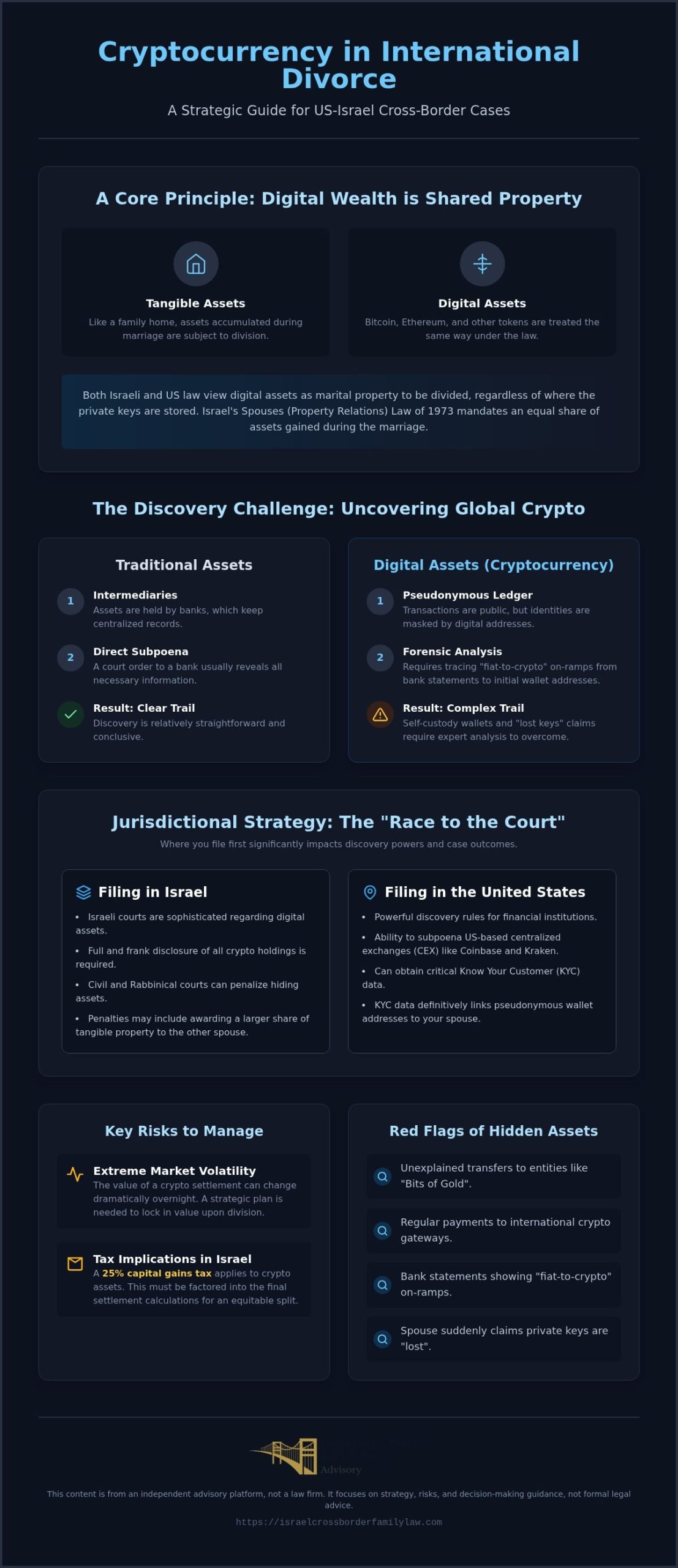
Israeli and US legal systems share a common ground: they treat digital wealth as property subject to division. Under Israel’s Spouses (Property Relations) Law of 1973, assets accumulated during the marriage are generally shared equally. This includes Bitcoin, Ethereum, and various stablecoins. The Anglo expat community in Israel is often at the center of these disputes because their financial lives are frequently bridge-funded between two countries. Many work in tech or receive compensation in digital formats, making Cryptocurrency in International Divorce a high-stakes issue that traditional legal frameworks aren’t always prepared to handle. Unlike tangible property like a family home or traditional financial accounts, these are locationless assets that exist only on a distributed ledger.
Digital Assets vs. Traditional Financial Holdings
Traditional finance relies on intermediaries like banks that keep centralized records. If a spouse suspects hidden wealth, a subpoena to a local bank usually provides answers. Crypto operates differently. While the ledger is public, it’s pseudonymous. This means transactions are visible, but the owner’s identity is masked by a digital address. Understanding what is cryptocurrency is the first step in realizing that traditional discovery methods often fall short. If a spouse uses a self-custody wallet rather than a Centralized Exchange (CEX), a bank subpoena will reveal nothing. The wealth remains invisible unless you know where to look and how to track the digital trail across borders.
The Legal Status of Crypto in the Israeli Family Court
Israeli judges are increasingly sophisticated regarding digital property. They view tokens as assets, not just “magic internet money.” This means all digital holdings fall under the requirement for full and frank disclosure. For expats and foreign nationals, the stakes are high. If a spouse is caught hiding crypto, both the Civil Family Court and the Rabbinical Court have the power to penalize them. Consequences can include awarding the other spouse a larger share of the tangible marital estate, such as the family home, or issuing personal sanctions. The court’s goal is an equitable split, and they won’t hesitate to use their authority to balance the scales if one party attempts to shield digital wealth from the process.
The Discovery Process: Identifying and Tracking Global Crypto
Uncovering Cryptocurrency in International Divorce requires a departure from standard financial auditing. While a spouse may believe their digital wealth is shielded by anonymity, the reality is that most crypto journeys begin at a traditional bank. The ledger doesn’t lie. A strategic forensic review starts with identifying ‘fiat-to-crypto’ on-ramps in bank statements. You should look for specific red flags, such as transfers of ₪15,000 or ₪30,000 to entities like Bits of Gold, or frequent payments to international gateways. These transfers provide the initial wallet addresses needed for on-chain analysis. By bridging US discovery powers with Israeli forensic requirements, we can transform a suspected hidden account into a verifiable marital asset. This collaborative approach between blockchain experts and legal professionals ensures that no stone is left unturned. If you suspect assets are being diverted, it’s prudent to request a confidential strategic review before the digital trail becomes too difficult to reconstruct.
Tracking Transfers to Centralized Exchanges
Centralized exchanges (CEX) like Coinbase or Kraken serve as the primary gateways for most users. Even if the account holder is a permanent resident in Israel, US-based exchanges are subject to rigorous US discovery rules. Subpoenaing these entities can yield critical Know Your Customer (KYC) data, definitively linking a pseudonymous digital address to your spouse. Referencing IRS tax principles for virtual currency further supports the argument that these holdings are classified as property. Understanding how the advisory works helps you coordinate between US subpoenas and Israeli court orders effectively.
Forensic Analysis of Cold Wallets and Private Keys
The process becomes more complex when assets are moved to self-custody “cold wallets,” such as Trezor devices. A common tactic in high-conflict cases is the claim that private keys have been “lost” or that a password has been forgotten. Israeli courts are increasingly skeptical of these claims when forensic accountants can demonstrate recent activity. Blockchain explorers allow investigators to verify the total balance and transaction history of a specific wallet address publicly, providing evidence of asset existence even if the private key remains hidden. If a spouse willfully withholds access, courts may award the other party a larger share of tangible assets to offset the hidden crypto.
Jurisdictional Strategy: Filing in Israel vs. the United States
Choosing where to initiate proceedings is often the most consequential decision in a cross-border case. In the context of Cryptocurrency in International Divorce, the “race to the court” determines which legal system’s discovery powers will govern the search for digital wealth. US jurisdictions like New York or California offer aggressive subpoena powers that can compel exchanges to produce records in weeks. In contrast, Israeli courts rely heavily on “Smidat” (valuation) experts. These court-appointed professionals have the authority to investigate global holdings and report directly to the judge. The choice of forum isn’t just about convenience; it’s about which system provides the most effective leverage to force disclosure of a borderless asset.
The doctrine of Forum Non Conveniens often plays a central role when one spouse attempts to move the case to a jurisdiction they perceive as more favorable. If a spouse argues that the US is a more appropriate forum because the crypto exchanges are located there, the other party must demonstrate why Israel remains the center of the family’s life. Decisions made in these early stages carry immense weight. A successful jurisdictional argument can mean the difference between a transparent discovery process and one where assets remain hidden behind international legal barriers.
Enforcing Disclosure Orders Across Borders
A common hurdle is whether a US exchange will honor an Israeli court order. Generally, they won’t without a corresponding US order. While the Hague Convention provides a framework for evidence gathering, it’s often a slow and bureaucratic process. A more potent strategy involves 28 U.S.C. Section 1782. This federal statute allows a litigant in an Israeli proceeding to apply directly to a US court for discovery from a person or entity residing in the United States. It bypasses much of the international red tape, allowing you to secure records from exchanges or forensic firms located in the US to support your case in Israel.
The Role of the Israeli Rabbinical Court in Crypto Disputes
For many international families, our approach for expats must account for the Rabbinical Court’s jurisdiction. Religious courts view digital tokens as property, but they approach the division through the lens of a “Gett” (divorce decree) negotiation. If a spouse is found to be withholding private keys, the Rabbinical Court can apply significant pressure, including sanctions, to ensure the digital wealth is accounted for before the marriage is religiously dissolved. This dual-system complexity requires a coordinated strategy that bridges civil discovery with religious legal requirements.
Valuation and Division: Addressing Volatility and Tax
The extreme volatility of digital tokens often complicates the standard “date of separation” valuation used in Israeli courts. If Bitcoin surges or drops significantly between the separation date and the trial, a cash buyout based on an outdated price can result in a settlement that is far from equitable. To mitigate this risk, parties often negotiate “in-kind” distributions. By transferring half of the actual tokens to a new wallet, both spouses share the future market risk and reward equally. When managing Cryptocurrency in International Divorce, you must also account for the embedded tax liability. The spouse who receives the crypto also receives its original cost basis. Since Israel applies a flat 25% capital gains tax on these assets, failing to factor in this future payment during negotiations can leave you with significantly less net wealth than anticipated.
Managing Market Volatility During Litigation
Courts can provide stability by issuing temporary injunctions that freeze known wallets or by ordering the conversion of volatile assets into stablecoins. This process preserves the ILS value of the marital estate while the legal process unfolds. The Smidat process in Israel is a formal judicial procedure where a court-appointed financial expert investigates and values complex assets to provide the judge with a neutral appraisal of the tech-heavy marital estate. These experts are essential for translating blockchain data into a format the court can use for final distribution orders. Using shadow accounts to track value changes without moving funds is another sophisticated way to maintain transparency during long disputes.
Cross-Border Tax Compliance
US citizens residing in Israel face a dual reporting burden that can lead to significant penalties if ignored. The IRS requires the filing of Form 8938 for specified foreign financial assets, which includes cryptocurrency held on Israeli or other non-US exchanges. While the US-Israel Tax Treaty provides a framework to avoid double taxation, it doesn’t automatically align the different tax rates or holding period benefits between the two countries. For instance, the US offers lower rates for assets held over a year, while Israel maintains a flat 25% rate regardless of the duration. You should Review our advisory pricing and process to see how we help clients navigate these overlapping requirements. Obtaining a professional consultation on asset valuation is a critical step in ensuring that your settlement accounts for these hidden cross-border costs.
Strategic Planning: Protecting Your Interests Early
In high-stakes cases involving Cryptocurrency in International Divorce, the window for effective strategy is narrow. Early decisions regarding where to file and how to disclose assets often dictate the final outcome. Attempting to hide digital wealth is a high-risk gamble that rarely pays off. Israeli courts view non-disclosure as a fundamental breach of transparency. If a spouse is found to have concealed private keys or transferred tokens to anonymous wallets during the proceedings, judges may award the other party a significantly larger portion of the family’s tangible property in Israel, such as a home in Tel Aviv or Herzliya, to balance the scales. Transparency is your best protection against severe court sanctions.
Creating a Digital Asset Inventory is a critical first step before any legal papers are served. This inventory should include public wallet addresses, records of transfers from traditional bank accounts, and logins for centralized exchanges like Coinbase or Kraken. You should also document the physical locations of cold storage devices and gather tax returns from both the US and Israel that may reference crypto gains. Having this data organized allows your legal team to act quickly before assets can be moved or “lost” in the digital ether.
Building a Transnational Legal Team
Managing a case across two legal systems requires a bridge. It’s not enough to have a lawyer in New York and another in Jerusalem; they must work in sync to be effective. Practitioners licensed in both jurisdictions provide a unique advantage by understanding the nuances of both the Israeli Family Court and US state court dynamics. This coordination is vital when syncing forensic accountants across time zones to ensure that subpoenas and on-chain analysis happen simultaneously. For those with complex business interests, Navigating US-Israel M&A and Business Assets provides further context on how corporate and family wealth often overlap in these scenarios.
The Advisory Advantage: Clarity Before Commitment
The primary goal of a cross-border advisor is to provide clarity before you commit to a specific legal path. US courts often focus on rigid discovery rules, while Israeli courts may defer to court-appointed experts. Understanding these cultural differences in how legal systems handle “tech” wealth is essential for accurate risk assessment. A strategic plan developed early allows you to anticipate tax traps and jurisdictional hurdles before they become permanent liabilities. In international family law, the weight of your initial decisions cannot be overstated. A proactive approach ensures that your global assets are protected and that the final division is both fair and transparent.
Securing Your Digital Future Across Borders
Managing Cryptocurrency in International Divorce requires a shift from traditional auditing to a specialized transnational strategy. We’ve explored how digital assets are classified as marital property under both US and Israeli law, making full disclosure a legal necessity rather than an option. By leveraging US discovery powers alongside Israeli forensic expertise, you can ensure that locationless wealth is accurately identified and valued. It’s essential to account for the 25% Israeli capital gains tax and market volatility before finalizing any settlement, as these factors significantly impact your net recovery.
Our advisory provides specialized cross-border strategy for US-Israel families, offering authoritative expertise in complex digital asset discovery. We maintain a calm, advisory approach for international expats who need to bridge the gap between two distinct legal systems. Get clarity before you commit. Request a confidential consultation to discuss your specific circumstances. You don’t have to navigate these digital complexities alone. With the right strategic framework, you can protect your global assets and achieve a transparent, equitable resolution.
Frequently Asked Questions
Is cryptocurrency considered a marital asset in Israel?
Yes, cryptocurrency is classified as a marital asset under the Spouses (Property Relations) Law of 1973. This means that Cryptocurrency in International Divorce is treated similarly to real estate or traditional bank accounts. The Israel Tax Authority classifies these tokens as property rather than currency, ensuring they are subject to equitable division between spouses if they were accumulated during the period of the marriage.
Can my spouse hide crypto in a cold wallet so I can’t find it?
While a cold wallet provides physical security, it doesn’t make assets invisible to a professional forensic investigation. Most digital wealth leaves a paper trail in traditional bank statements through fiat-to-crypto transfers. Forensic experts use these historical records to identify specific wallet addresses, allowing them to monitor the blockchain and prove the existence of assets even if the physical device remains hidden.
How do Israeli courts value Bitcoin if the price changes every day?
Israeli courts typically rely on court-appointed “Smidat” experts to determine a fair value for volatile digital assets. The court may choose the date of separation or the date of the final trial as the valuation point. In many cases, an “in-kind” distribution is preferred, where the tokens themselves are split. This ensures both parties share the market risk and potential rewards equally.
What happens if my spouse refuses to disclose their private keys?
Refusal to disclose private keys is treated as a breach of the duty of full and frank disclosure. If the court is convinced that a spouse is withholding access, it can issue sanctions or award the other spouse a larger share of tangible assets, like real estate. Judges are increasingly skeptical of claims that keys were “lost” when blockchain activity suggests the wallet is active.
Will a US court order help me get information from an Israeli exchange?
A US court order is effective for obtaining data from US-based exchanges, but Israeli exchanges generally require an Israeli court order. To bridge this gap, litigants often use Section 1782 discovery in the US to support their Israeli proceedings. This allows for a coordinated gathering of evidence across both jurisdictions to ensure a complete financial picture is presented to the court in Israel.
Are there tax penalties for transferring crypto as part of a divorce settlement?
Transferring assets between spouses during a divorce is typically not a taxable event, but the future tax liability remains. The recipient spouse inherits the original cost basis of the tokens. In Israel, this means they will eventually owe a 25% capital gains tax on the total appreciation. Failing to account for this future tax burden can lead to a settlement that isn’t truly equitable.
How long does it take to forensically track crypto in an international case?
Forensic tracking usually takes several weeks to several months, depending on the complexity of the digital trail. Simple transfers to major exchanges are identified quickly, while assets moved through “mixers” require more intensive on-chain analysis. Managing Cryptocurrency in International Divorce efficiently requires early coordination between legal and forensic teams to ensure that all digital evidence is preserved and authenticated before it’s moved.
Can I freeze my spouse’s crypto account during a divorce in Israel?
Yes, you can request a temporary injunction from the Israeli Family Court to freeze known crypto accounts or wallets. If the assets are held on a centralized exchange, the court order can be served directly to the platform. For self-custody wallets, the court can issue personal orders prohibiting the spouse from moving funds, with significant legal penalties for any non-compliance with the order.

Article by
Gabriel Lior
A Personal Journey That Became a Mission
The advisory was founded by an American father Gabriel Lior, LLB, MBA , global entrepreneur, and cross-border advisor who spent more than a decade navigating the Israeli family court system firsthand and now lives in Singapore with his son.
As a divorced parent in a cross-border family, Gabriel faced nearly every legal challenge a foreign parent can encounter in Israel — including child custody disputes, child support proceedings, property matters in Israel and abroad, false accusations, and complex immigration and relocation proceedings.
Over the years, he learned the hard way how difficult it is for non-Israeli parents to understand the system, identify the right legal strategy, and choose the right legal representation — especially when language, culture, and jurisdictional differences are involved. He also witnessed how foreign parents and new immigrants are often disadvantaged or taken advantage of by service providers and institutions simply because they lack local knowledge or fluency.
From Client to Advisor
To truly understand — and survive — the system, Gabriel pursued formal legal education in Israel, completing two Israeli law degrees, alongside a BA and MBA earned in the United States. This was never about becoming a practicing attorney, but about gaining a deep, structural understanding of how the system works — and where it breaks down for foreign parents.
This rare combination of:
Firsthand client experience
Israeli legal and US business education
International business and negotiation training
Decades of commercial execution
created a unique perspective – one that understands both sides of the table.
After years of litigation, persistence, and at times self-representation, he ultimately succeeded in securing custody of his son and relocating abroad through a rare legal victory in the Israeli Supreme Court — becoming one of the first fathers in Israel to do so under these circumstances.
Disclaimer
Important Disclaimer:
The information provided on this website and in its content is for general informational and educational purposes only and does not constitute legal advice, legal opinion, or legal representation.
Gabriel Lior is not licensed to practice law in Israel (nor is he interested in doing so) and does not provide legal services, despite having completed 2 Law Degrees. The services offered are advisory in nature and are intended to provide general guidance, strategic insight, and information regarding cross-border family law considerations.
No attorney-client relationship is formed by accessing this website, reading its content, or communicating with us.
Any decisions made based on this information are at your own discretion and risk. For legal advice specific to your situation, you should consult a licensed attorney in the relevant jurisdiction.
Where appropriate, we may refer clients to independent, licensed attorneys or professionals. Such referrals do not constitute legal representation and no liability is assumed for services provided by third parties.