Could the very first document you file in an Israeli court determine the fate of your global assets for years to come? For many expats and international families, the Israeli legal system feels like a maze of unfamiliar Hebrew terms and conflicting jurisdictions between civil and religious courts. Choosing Israel family mediation isn’t just a soft alternative to litigation; it’s a strategic shield designed to keep control in your hands rather than leaving it to a judge.
We understand that the fear of the Rabbinic Court system or the high costs of cross-border litigation can feel overwhelming. It’s natural to worry about how your US-based interests will be treated within a local framework you don’t fully understand. This guide explains how mediation serves as a critical tool for international families to find a peaceful resolution that respects both jurisdictions.
We’ll examine the 2026 regulations for the mandatory dispute settlement law, the 45-day cooling-off period, and how to avoid the exhaustion of the Israeli court system. This article is published on an independent advisory platform and provides informational strategy rather than formal legal representation. For more visual guidance, you can view expert insights on the Israel Family Law YouTube channel.
Key Takeaways
- Understand the mandatory “Request for Settlement of Dispute” framework and its role as the required preliminary step in the Israeli legal system.
- Learn how Israel family mediation provides a strategic advantage for managing multi-jurisdictional complexity and protecting international assets.
- Discover how to bypass the financial and emotional exhaustion of public litigation through a private, structured negotiation process.
- Identify the critical importance of seeking clarity and professional strategy before making high-stakes decisions that impact your cross-border interests.
- Gain a step-by-step overview of the mediation journey, from the initial disclosure of global needs to the final court-approved agreement.
In the context of the Israeli legal system, family mediation is a structured negotiation process where a neutral third party helps spouses reach a mutually acceptable agreement. Unlike a judge who imposes a decision, a mediator facilitates communication to resolve disputes regarding assets, custody, and support. For those navigating Israel family mediation, it’s essential to recognize that this is a professional framework designed to protect your interests through collaboration rather than conflict. This section provides informational strategy; it’s published on an independent advisory platform and does not constitute legal representation.
To better understand this concept, watch this helpful video:
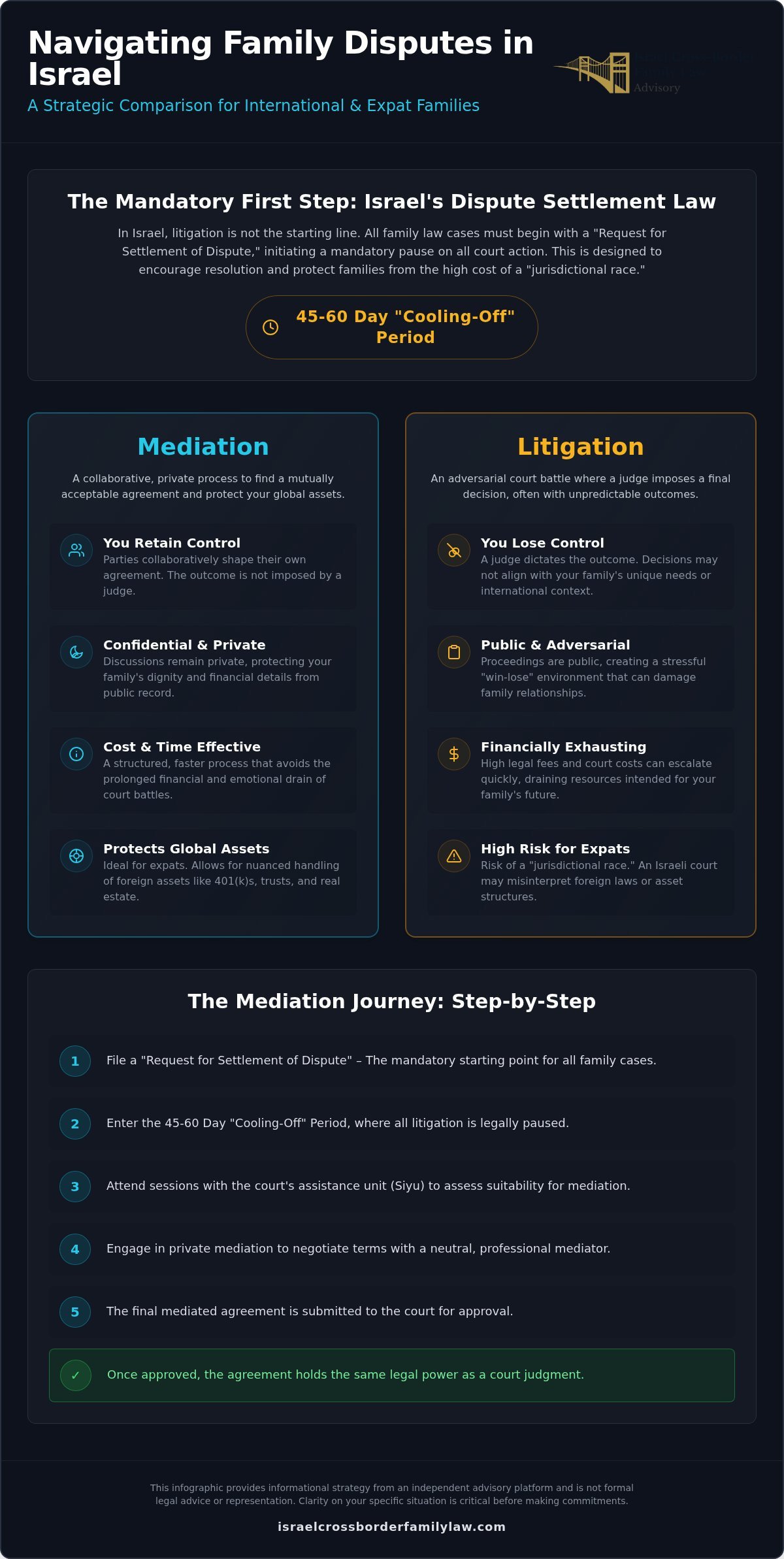
Since 2016, the Law for the Settlement of Disputes in Family Matters has transformed how families approach separation. It’s no longer an optional alternative; it’s a mandatory first step. Before you can file a lawsuit in either the Family Court or the Rabbinical Court (Beit Din), you must first file a “Request for Settlement of Dispute.” This application, which carries a nominal fee of 119 NIS as of 2026, initiates a legal pause on all litigation to encourage an amicable resolution.
The Compulsory Nature of Mediation in Israel
This mandatory process creates a “cooling-off” period that typically lasts between 45 and 60 days. During this window, you’re required to attend sessions with the court’s assistance unit, known as Siyu. These professionals assess the situation and determine if the case can be resolved through mediation. You can’t skip this step to rush into court. The system is designed to prevent the exhaustion of judicial resources and, more importantly, to protect families from the high costs of a jurisdictional race. You can learn more about how it works on our advisory platform.
Mediation vs. Couple’s Therapy: A Critical Distinction
It’s easy to confuse these two services, but their goals are fundamentally different. Therapy focuses on emotional healing and potential reconciliation. Mediation focuses on the practical and legal dissolution of the partnership. While therapy might explore why things happened, mediation focuses on how to move forward. A signed mediation agreement, once approved by the court, carries the same legal weight as a court judgment. Confusing these two can lead to poor legal outcomes if you share sensitive strategic information during mediation that you intended for a therapeutic setting.
It’s also vital to distinguish between the mediator and a legal advisor. The mediator must remain neutral and cannot provide specific legal strategy to either side. An independent advisor helps you understand the long-term impact of your decisions before you sign any binding documents. Seeking clarity early ensures that the final agreement respects your international interests and cross-border assets.
The Cross-Border Dimension: Why International Families Need Mediation
For families holding US-Israel dual citizenship, the legal landscape is exceptionally complex. A common risk is the “jurisdictional race,” where spouses rush to file in the court system they believe favors their position. Israel family mediation provides a strategic pause to this competition. By choosing a mediated path, you align your resolution with international legal frameworks rather than fighting a two-front war in different countries. This proactive approach prevents the exhaustion of resources and protects your long-term interests.
Language barriers often complicate these proceedings. For Anglos, participating in a Hebrew-based court session can lead to misunderstandings that carry lifelong consequences. Mediation conducted in English ensures every nuance of your financial or parental rights is understood. This is particularly critical when protecting assets like US real estate, 401(k) plans, or high-tech stock options that an Israeli judge might not be familiar with. By prioritizing Israel family mediation, you ensure that your global footprint is respected in the final settlement.
Navigating International Child Custody and Relocation
Relocation is one of the most contentious issues for expats. Without a clear, mediated agreement, moving a child across borders can inadvertently trigger the Hague Convention. Mediation allows parents to draft detailed international custody relocation plans. These agreements define visitation schedules and travel logistics before they escalate into an “abduction” claim. It’s about building a framework that works for your specific family dynamic.
Enforcing Support Orders Across Borders
A settlement is only effective if it’s enforceable. For international families, child support cross-border enforcement requires specific language that satisfies both Israeli and US authorities. We’ve seen cases where currency fluctuations or international transfer fees significantly reduce the actual support received. Mediation provides the space to account for these variables, ensuring the financial stability of the children regardless of where they reside.
Seeking clarity on these complex issues before making a legal commitment is essential. You might find it helpful to request a confidential case review to understand your specific risks.
Mediation vs. Litigation: Analyzing the Risks and Benefits
The choice between Israel family mediation and litigation often comes down to a concept we call “judicial exhaustion.” For foreigners, the Israeli court system can be a marathon. A standard divorce case for Olim often stretches between 6 to 18 months, and that doesn’t account for the added complexity of cross-border assets. Litigation is an adversarial process by design; it forces parties into “winner” and “loser” roles, which often leads to emotional and financial depletion. Mediation, by contrast, offers a structured exit that preserves resources rather than consuming them.
Privacy is another critical factor. While mediation sessions are strictly confidential, court filings are part of a public record. For families with sensitive business interests or high-profile roles, the exposure of a public trial can be damaging. Beyond the financial cost-benefit analysis, the emotional toll on children is significantly lower when parents choose a mediated path. Children don’t just witness the conflict; they feel the weight of an adversarial system that often treats custody as a series of legal checkboxes rather than a nuanced family dynamic.
Control Over the Outcome: The Power of Choice
In litigation, a judge who may not share your cultural background or language makes the final decisions for your family. This is particularly risky if your case moves into the Rabbinic Court (Beit Din). These religious courts operate under different principles than civil courts, and their rulings may not always align with the expectations of Anglo families. Mediation lets you maintain control. It allows for creative solutions that a judge simply cannot order, such as specific travel arrangements for holidays in your home country. This flexibility helps maintain a functional co-parenting relationship long after the documents are signed.
The Downsides and Risks of Mediation
While we advocate for collaborative solutions, it’s vital to recognize when mediation isn’t the right fit. If there’s a history of domestic abuse or a legitimate concern that one party is hiding global assets, the neutral setting of mediation may not provide enough protection. There is also the risk of “mediation fatigue.” After several sessions, you might feel pressured to settle for less than you deserve just to end the process. This is why you still need an independent advisor to review any proposed agreement. Seeking clarity on your rights ensures you don’t confuse the mediator’s neutrality with a lack of legal protection for your specific interests.
The Mediation Process Step-by-Step for Expats
When embarking on Israel family mediation, having a clear roadmap reduces the anxiety of the unknown. The process follows a structured sequence designed to move from initial conflict to a court-approved resolution. It’s a professional environment where strategy meets cooperation. This article is for informational purposes and is published on an independent advisory platform; it does not constitute an attorney-client relationship.
- Initial Consultation: The mediator establishes ground rules, explains the principle of confidentiality, and ensures both parties are committed to the process.
- Information Gathering: This is a critical phase for expats. It requires full disclosure of global assets, including foreign bank accounts, pensions, and real estate.
- Negotiation Phase: Parties address the core issues of custody, child support, and property division. The focus is on finding a balance that respects the interests of both spouses and the children.
- Drafting the Agreement: Once verbal “deals” are reached, they must be translated into a precise legal contract. For international families, this document must be robust enough to be recognized in multiple jurisdictions.
- Court Approval: The final agreement is submitted to either the Family Court or the Rabbinical Court. Once the judge reviews and approves it, the agreement becomes a binding court judgment.
Preparing for Your First Mediation Session
Success in Israel family mediation starts before you enter the room. You should create a comprehensive “needs and wants” list that covers both your Israeli holdings and your foreign assets. It’s also helpful to understand the difference between the “Anglo” mindset, which often values directness and efficiency, and local Israeli negotiation styles, which can be more fluid and assertive. You’ll find it beneficial to review how it works to align your expectations with the local framework.
The Role of the ‘Get’ (Rabbinic Divorce) in Mediation
For Jewish couples, the civil divorce is only half of the process. The “Get,” or religious divorce, must be granted through the Rabbinical Court. A significant advantage of mediation is the ability to include specific clauses that ensure the religious divorce is handled smoothly. By addressing this within the mediated agreement, you can prevent the risk of “get refusal” or long delays. For non-Jewish expats, the process differs, but the goal remains the same: a clean legal break that respects your cultural and religious needs. If you’re ready to discuss your specific situation, you can request a confidential consultation to gain clarity on your next steps.
Strategy and Decision-Making: Seeking Clarity Before You Commit
Decisions made during the initial stages of a family dispute carry immense weight, especially when those decisions involve assets or children in multiple countries. This article is published on an independent advisory platform and focuses on strategy rather than legal representation. In cross-border family law, a single misstep during the mandatory “Request for Settlement of Dispute” phase can inadvertently lock you into a jurisdiction that may not favor your long-term interests. Seeking clarity through an independent advisory review ensures you understand the strategic implications of every clause before you commit your signature. Israel family mediation should be viewed as a high-stakes negotiation where you’re building the foundation for your future life across two different legal systems.
Choosing the Right Mediator for an Anglo Family
Not all professionals are equipped to handle the unique friction points of an international family. For Anglos, cultural competency is just as important as legal knowledge. You need a mediator who understands the nuances of US or UK norms, such as the specific structure of college funds or the tax implications of foreign real estate. A bilingual mediator is non-negotiable. Relying on a translator or struggling through Hebrew-only sessions often leads to “agreement fatigue.” This is a state where a party settles for less than they deserve simply because they’re exhausted by the communication gap. Your mediator must be able to bridge the gap between the Israeli system and your home culture’s expectations.
Finalizing Your Path Forward
When you evaluate the pricing of professional mediation, it’s helpful to weigh it against the alternative of multi-year litigation. The “Anglo advantage” in this process is the ability to bypass much of the Hebrew-only bureaucracy that defines the Israeli court system. Effective Israel family mediation allows you to be an active participant in your resolution rather than a passive observer of a judge’s ruling. It’s about maintaining dignity and ensuring that the final agreement is enforceable both in Israel and abroad. You shouldn’t feel rushed into a deal that doesn’t account for your global footprint.
Before you take the first step, ensure you have a clear understanding of the risks and opportunities ahead. Get clarity before you commit. Request a confidential consultation to discuss your specific strategy.
Securing Your Family’s Future Through Strategic Resolution
Navigating the intersection of two legal systems requires more than just a mediator; it requires a specialized multi-jurisdictional strategy. By choosing Israel family mediation, you’ve taken the first step toward protecting your global assets and maintaining control over your family’s narrative. We’ve explored how the mandatory dispute settlement framework serves as a vital cooling-off period, allowing international families to bypass the exhaustion of the court system. This professional path ensures that complex issues like US property division and the religious Get are handled with the cultural nuance they deserve.
Our independent advisory platform focuses on providing a calm, strategic approach for families who need to bridge the gap between Israeli law and their home country’s norms. We emphasize seeking clarity before making binding legal commitments to ensure your final agreement is robust and enforceable worldwide. You don’t have to face these complexities alone or in a language you hasn’t mastered. Specialized US-Israel cross-border expertise ensures that your strategy respects the unique requirements of both jurisdictions.
Get clarity before you commit. Request a confidential consultation. We’re here to help you move forward with confidence and peace of mind.
Frequently Asked Questions
This FAQ section is published on an independent advisory platform and provides informational strategy for international families. It doesn’t constitute legal representation or formal legal advice. For specific guidance, you should consult with a licensed professional.
Is mediation mandatory for divorce in Israel?
Yes, it’s a legal requirement. Since 2016, any party wishing to file for divorce or custody must first submit a “Request for Settlement of Dispute.” This application initiates a mandatory 45 to 60 day stay on litigation. While you’re required to attend initial sessions with the court’s assistance unit, you aren’t forced to reach a settlement. The goal is simply to explore collaborative options before entering an adversarial court process.
Can we conduct family mediation in English if we live in Israel?
Absolutely, and for many expats, it’s a strategic necessity. Participating in Israel family mediation in your native language prevents the translation exhaustion that often occurs in Hebrew-only proceedings. A bilingual mediator ensures that both parties understand every nuanced detail regarding global assets and parental rights. This clarity is vital for preventing future disputes that stem from simple linguistic misunderstandings during the negotiation phase. It’s about ensuring your voice is accurately heard.
How long does the family mediation process typically take in Israel?
The initial mandatory phase lasts between 45 and 60 days. If you choose to continue with private mediation, most cases reach a full settlement within three to six months. This timeline is significantly shorter than the average 18 months often required for litigated divorces involving foreign nationals. The speed of the process depends largely on how quickly both parties disclose their financial information and their willingness to compromise on key cross-border issues.
Is a mediated agreement in Israel legally binding in the United States?
An Israeli court-approved agreement is a binding judgment in Israel, but its enforcement in the US requires specific cross-border drafting. US courts generally respect foreign judgments if they meet certain standards of due process and don’t violate local public policy. To ensure your agreement holds weight abroad, professional cross-border drafting is essential to satisfy the requirements of both jurisdictions. This creates a more secure legal foundation for families with interests in both countries.
What happens if we cannot reach an agreement in mediation?
If you don’t reach a settlement, the litigation freeze is lifted. At this point, the parties may proceed to file lawsuits in either the civil Family Court or the religious Rabbinical Court. The party who filed the initial “Request for Settlement of Dispute” typically has a 15-day window to choose the court first. This “race for jurisdiction” is a significant risk, which is why many families prefer to stay in the mediated process as long as possible.
Can mediation help with international child relocation disputes?
Mediation is one of the most effective tools for resolving relocation issues. It allows parents to create detailed schedules that account for international travel, school holidays, and time zone differences. By proactively addressing these logistics in a mediated agreement, you can avoid the risk of a wrongful removal claim under the Hague Convention. This collaborative approach focuses on the child’s best interests while respecting the parents’ need for global mobility and contact.
Do I still need my own lawyer if we have a mediator?
Yes, you should always have your own independent advisor. A mediator must remain neutral and cannot provide legal strategy or represent your personal interests. An independent advisor reviews the proposed agreement to ensure you aren’t sacrificing your rights or overlooking the long-term impact on your foreign assets. Seeking this clarity before you sign ensures the agreement is fair and doesn’t leave you vulnerable to future legal challenges in either jurisdiction.
How much does family mediation cost in Tel Aviv or Jerusalem?
Fees for Israel family mediation depend on the complexity of your global assets and the number of sessions required. While the court’s initial application fee is 119 NIS as of 2026, private mediators typically charge an hourly rate or a flat fee per session. Although costs vary between Tel Aviv and Jerusalem, mediation is consistently more affordable than multi-year litigation. You should check with individual practitioners to understand their specific fee structures and the value they provide.

Article by
Gabriel Lior
A Personal Journey That Became a Mission
The advisory was founded by an American father Gabriel Lior, LLB, MBA , global entrepreneur, and cross-border advisor who spent more than a decade navigating the Israeli family court system firsthand and now lives in Singapore with his son.
As a divorced parent in a cross-border family, Gabriel faced nearly every legal challenge a foreign parent can encounter in Israel — including child custody disputes, child support proceedings, property matters in Israel and abroad, false accusations, and complex immigration and relocation proceedings.
Over the years, he learned the hard way how difficult it is for non-Israeli parents to understand the system, identify the right legal strategy, and choose the right legal representation — especially when language, culture, and jurisdictional differences are involved. He also witnessed how foreign parents and new immigrants are often disadvantaged or taken advantage of by service providers and institutions simply because they lack local knowledge or fluency.
From Client to Advisor
To truly understand — and survive — the system, Gabriel pursued formal legal education in Israel, completing two Israeli law degrees, alongside a BA and MBA earned in the United States. This was never about becoming a practicing attorney, but about gaining a deep, structural understanding of how the system works — and where it breaks down for foreign parents.
This rare combination of:
Firsthand client experience
Israeli legal and US business education
International business and negotiation training
Decades of commercial execution
created a unique perspective – one that understands both sides of the table.
After years of litigation, persistence, and at times self-representation, he ultimately succeeded in securing custody of his son and relocating abroad through a rare legal victory in the Israeli Supreme Court — becoming one of the first fathers in Israel to do so under these circumstances.
Disclaimer
Important Disclaimer:
The information provided on this website and in its content is for general informational and educational purposes only and does not constitute legal advice, legal opinion, or legal representation.
Gabriel Lior is not licensed to practice law in Israel (nor is he interested in doing so) and does not provide legal services, despite having completed 2 Law Degrees. The services offered are advisory in nature and are intended to provide general guidance, strategic insight, and information regarding cross-border family law considerations.
No attorney-client relationship is formed by accessing this website, reading its content, or communicating with us.
Any decisions made based on this information are at your own discretion and risk. For legal advice specific to your situation, you should consult a licensed attorney in the relevant jurisdiction.
Where appropriate, we may refer clients to independent, licensed attorneys or professionals. Such referrals do not constitute legal representation and no liability is assumed for services provided by third parties.