This article is published on an independent advisory platform (not a law firm). It focuses on strategy, risks, and decision-making guidance rather than legal representation. Legal services are provided only by licensed attorneys under separate engagement.
In Israel, establishing fatherhood is a formal judicial process requiring a court order, not just a signature on a birth certificate. For many, the discovery that paternity rights for US expats in Israel depend on mandatory DNA testing under the Tissue Typing Law creates immediate stress. You’re likely concerned about how these local mandates intersect with US citizenship requirements or if your family will be pulled into Religious Courts. These fears are valid, as the path to securing your child’s future involves navigating two different legal systems simultaneously.
We recognize the weight of these decisions and the confusion surrounding “Tissue Typing.” This guide offers the clarity you need to manage the Israeli judicial system and US consular requirements with strategic foresight. You’ll learn how to handle mandatory testing, the differences between Civil and Religious courts, and the steps to ensure your child’s eligibility for a US passport. By taking informed steps early, you can establish a firm foundation for custody and visitation rights. Get clarity before you commit. Request a confidential consultation.
Key Takeaways
- Learn why a birth certificate signature is insufficient and how paternity rights for US expats in Israel require a formal judicial declaration from the Family Court.
- Understand the mandatory requirements of the Tissue Typing Law and why only court-ordered DNA testing is admissible for legal recognition in Israel.
- Discover how to align your Israeli court proceedings with US State Department standards to secure your child’s US citizenship and Consular Report of Birth Abroad.
- Explore the strategic importance of establishing Parental Responsibility (Apotropus) to protect your long-term custody and visitation rights.
- Identify how early strategic decisions can prevent complex cross-border conflicts and provide a stable legal foundation for your family’s future.
This article is published on an independent advisory platform (not a law firm). It focuses on strategy, risks, and decision-making guidance rather than legal representation. Legal services are provided only by licensed attorneys under separate engagement.
Understanding Paternity Law in Israel for American Expats
Establishing fatherhood in the United States often feels like a routine administrative task. You sign a form at the hospital, your name appears on the birth certificate, and your legal rights are secured. However, paternity rights for US expats in Israel operate under a fundamentally different philosophy. In the Israeli legal system, a Judicial Declaration of Paternity is a formal court order issued by a Family Court that legally establishes a biological man as the father of a child for all civil and religious purposes. Without this specific court order, an unmarried American father may find himself with no legal standing, regardless of what the birth certificate says.
Many expats rely on hospital registration as proof of parentage. While the hospital collects data for the Ministry of Interior, this registration doesn’t carry the same weight as a judicial finding. Different paternity law frameworks across the globe handle this transition from biology to legal rights in various ways, but Israel remains one of the most strictly regulated. If you are an American living in Tel Aviv or Jerusalem, understanding this distinction is the first step toward securing your child’s future and your own parental standing.
The Judicial vs. Administrative Divide
The US system’s administrative ease often creates a false sense of security for expats. You might assume that being present at the birth and being recognized by the mother is enough. It isn’t. In Israel, if the parents aren’t legally married, the law requires a court process to confirm paternity. This isn’t just a formality; the Israeli State Attorney often becomes a party to these cases. Their role is to ensure the child’s rights are protected and to navigate the complexities of religious law. This involvement adds a layer of scrutiny that most Americans find surprising. Early strategy is vital because waiting too long can complicate the legal status for foreign nationals and their children.
The Role of the Ministry of Interior (Misrad HaPnim)
The Ministry of Interior (Misrad HaPnim) manages the population registry, but they aren’t authorized to grant paternity to unmarried couples. They simply record what the court decides. A significant hurdle is the 300-day rule. If a child is born to a woman who is married, the husband is legally presumed to be the father. If she is divorced, this presumption continues for 300 days after the divorce is finalized. This rule exists to prevent legal and religious complications regarding the child’s status. For an expat father, this means that if your partner was recently divorced, you cannot simply claim the child at the hospital. You must go through the Family Court to displace the legal presumption and establish your biological link.
This article is published on an independent advisory platform (not a law firm). Do NOT use language that implies attorney-client relationship, legal representation, or giving legal advice. Focus on strategy, risks, and decision-making guidance. Soft CTA to advisory call / WhatsApp.
The Process of Establishing Legal Paternity in Israel
Establishing paternity rights for US expats in Israel requires moving through a specific judicial sequence that begins in the Family Court. The process is not a simple administrative filing but a legal action where the State Attorney’s office and the Ministry of Social Affairs act as observers to ensure the child’s legal and religious status is protected. In Israel, legal paternity is exclusively established through DNA testing performed at court-authorized medical centers under a specific judicial mandate. Private DNA results from commercial kits, such as 23andMe or Ancestry, are legally inadmissible and cannot be used to bypass this requirement.
The court’s primary objective is to verify biological ties while adhering to the Tissue Typing Law. This law centralizes all paternity testing to prevent fraud and maintain the integrity of the population registry. Because the State Attorney is a party to every paternity claim, the process involves a higher level of scrutiny than most Americans anticipate. Securing a judicial decree is essential for accessing Social Security benefits and paternity recognition for the child under US law. You can explore strategic options to streamline this process and avoid common procedural pitfalls.
Court-Ordered DNA Testing (Tissue Typing)
Once a claim is filed, the court issues a directive for testing at authorized facilities like Sheba Medical Center or Hadassah Hospital. This is where Israeli law diverges sharply from US expectations. If there is a concern that a DNA test might result in “Mamzerut”—a religious status of illegitimacy that carries severe social and legal consequences within the Jewish community—the court may block the test entirely. The judiciary balances the child’s best interests against the father’s right to know his biological connection. This intersection of civil and religious law is a critical factor for expats and foreign nationals to consider before initiating a claim.
Timeline and Procedural Milestones
A typical paternity action takes several months to conclude. After the initial filing, expect a wait for the State Attorney’s response, followed by the court order for testing and the subsequent lab analysis. If one parent is currently outside of Israel, the process requires specialized coordination to ensure DNA samples are collected and transported according to strict evidentiary standards. Local presence or representation in courts like Ra’anana or Haifa is often necessary to manage these logistical hurdles. Early strategy helps navigate these milestones without unnecessary delays. Get clarity before you commit. Request a confidential consultation.
This article is published on an independent advisory platform (not a law firm). Do NOT use language that implies attorney-client relationship, legal representation, or giving legal advice. Focus on strategy, risks, and decision-making guidance. Soft CTA to advisory call / WhatsApp.
Interplay Between Israeli Paternity and US Citizenship
Establishing paternity rights for US expats in Israel is the mandatory prerequisite for transmitting American citizenship to a child born abroad. While the Israeli judicial decree satisfies local requirements, the US State Department applies its own evidentiary standards under the Immigration and Nationality Act. Specifically, for children born out of wedlock to a US citizen father, the “clear and convincing evidence” standard must be met to prove a biological relationship. An Israeli court order resulting from a court-supervised DNA test serves as the primary evidence needed to satisfy US consular officials during the citizenship application process.
Beyond proving a biological link, the US citizen father must provide a written agreement to provide financial support for the child until they reach the age of 18. This commitment is a statutory requirement for transmitting citizenship in these specific cases. Understanding how these obligations are documented is vital, especially regarding the long-term implications of cross-border child support enforcement. Early coordination ensures that the evidence gathered for the Israeli Family Court also meets the stringent requirements of the US federal government.
The CRBA Process for Expats in Israel
When applying for a Consular Report of Birth Abroad (CRBA) at the US Embassy in Jerusalem or the branch office in Tel Aviv, the judicial decree from the Israeli Family Court carries significantly more weight than hospital records. Consular officers often request the full court protocol to ensure the DNA testing followed international chain-of-custody standards. In addition to biological proof, the father must document his physical presence in the United States for the required duration prior to the child’s birth. This multi-layered documentation process requires careful management to avoid delays in the child’s recognition as a US citizen.
Social Security and Passport Issuance
Obtaining the CRBA allows you to secure a US Social Security Number and a US passport for the child. While dual citizenship offers significant benefits, it also introduces complex jurisdictional obligations that parents must manage. For example, Israeli law allows for a “Stay of Exit” (Tzav Ikur Yetzia) order, which can prevent a child from leaving the country during a legal dispute. This risk highlights why early strategic planning is essential for international families to maintain mobility and protect their rights in both jurisdictions. Strategic foresight helps you navigate these competing legal systems without compromising your family’s security.
This article is published on an independent advisory platform (not a law firm). Soft CTA to advisory call / WhatsApp.
Custody, Support, and Visitation Rights for Expat Fathers
Establishing biological parentage is only the first hurdle in securing paternity rights for US expats in Israel. Once the court issues a judicial decree, the focus shifts to securing your legal standing as a guardian, known in Israel as Apotropus. This status grants you the right to make critical decisions regarding your child’s education, medical care, and international travel. Without specifically addressing parental responsibility alongside paternity, a father might find himself with a biological link but no authority to influence the child’s upbringing. Protecting these rights requires understanding international custody and relocation protocols before disputes arise.
The Shift Toward Joint Parental Responsibility
Israeli family law has evolved significantly. In 2026, the courts increasingly favor joint parental responsibility, moving away from outdated gender-based presumptions. While the “Tender Years Presumption” historically suggested that children under six should remain with their mother, modern judicial practice balances this against the child’s right to a meaningful relationship with both parents. For American expats, it’s essential to develop a comprehensive Parenting Plan. This document should detail visitation schedules that account for US holidays, school breaks, and the potential for international travel, ensuring the child maintains a connection to their American heritage.
Child Support Obligations for US Citizens
Child support in Israel is divided into “essential needs” and “extra expenses.” Essential needs cover basic housing, food, and clothing, while extras include extracurricular activities and private schooling. It’s a common misconception that US-based income is shielded from Israeli court jurisdiction. Israeli courts can and do assess a father’s global financial standing when calculating support obligations. If payments fall into arrears, enforcement occurs through the Hotsaa LaPoal (Execution Office). This agency has the power to freeze bank accounts and, most critically for expats, issue “Stay of Exit” orders that prevent you from leaving Israel until the debt is settled.
Early decisions regarding support and custody determine the long-term stability of your international family. By coordinating your legal moves in both Israel and the US, you can avoid common pitfalls that lead to litigation. Get clarity before you commit. Request a confidential consultation.
This article is published on an independent advisory platform (not a law firm). Soft CTA to advisory call / WhatsApp.
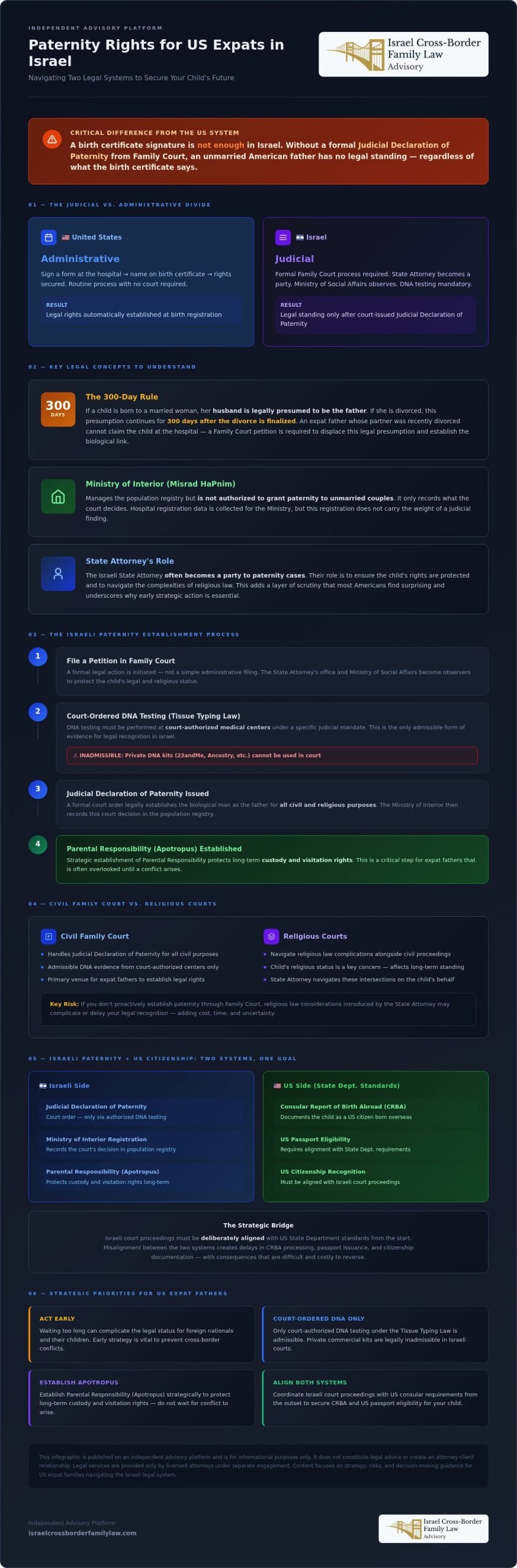
Navigating the Cross-Border Complexity with Strategy
Securing paternity rights for US expats in Israel isn’t just about filing a claim; it’s about synchronizing two distinct legal systems to ensure your child’s status is recognized globally. A “litigation-first” approach often fails because it ignores the long-term strategic implications of Israeli judicial decisions on US citizenship. For example, rushing into an Israeli Family Court without preparing the documentation required by the US State Department can lead to administrative deadlocks. You need a plan that addresses both the immediate need for a judicial decree and the eventual application for a Consular Report of Birth Abroad.
Coordinating your legal moves in both jurisdictions is the only way to avoid the risks of conflicting orders. Decisions made in Tel Aviv or Jerusalem will impact your ability to secure a US passport or manage future relocation. The Israel Cross-Border Family Law Advisory serves as a bridge, helping you understand how local mandates like the Tissue Typing Law intersect with American expectations of parental rights. Clarity before commitment is essential because once a judicial process begins, the State Attorney and social services become permanent fixtures in your family’s legal life.
The Advisory Approach to Paternity
Our advisory model focuses on identifying risks before they escalate into legal crises. We examine mixed Israeli-international family dynamics to spot potential hurdles, such as religious law complications or travel restrictions. We provide referrals to specialized attorneys in innovation hubs like Herzliya or Netanya who understand the nuances of expat life. To better understand the landscape, you can watch our guidance on Israeli Family Law Strategy. This preparation ensures that when you do enter the courtroom, you have a roadmap for both your Israeli and US obligations.
Next Steps for US Expat Fathers
The first step is gathering all necessary US and Israeli documentation, including proof of physical presence in the States and local birth records. You should then schedule a strategic assessment to evaluate jurisdictional risks and child support expectations. This early decision-making is the best way to prevent future Hague Convention risks or exit orders. You can request a confidential case review to begin building your pathway toward legal paternity and parental responsibility. Taking an informed approach today protects your relationship with your child for years to come.
This article is published on an independent advisory platform (not a law firm). Soft CTA to advisory call / WhatsApp.
Securing Your Family’s Cross-Border Future
Navigating the intersection of Israeli family law and US citizenship requirements demands strategic foresight. Establishing paternity rights for US expats in Israel is a formal judicial process that cannot be bypassed with simple hospital registration or voluntary acknowledgments. By addressing mandatory DNA testing and parental responsibility early, you protect your legal standing in the Family Court while simultaneously satisfying the evidentiary standards for a US Consular Report of Birth Abroad.
Our advisory platform offers specialized cross-border strategic expertise to help international families manage complex jurisdictional conflicts with confidence. We prioritize providing clarity before you commit to the judicial system, ensuring your decisions are informed and sustainable across both legal landscapes. This confidential guidance serves as a bridge between your family’s current needs and a secure, recognized legal foundation in both nations.
You have the power to build a stable and recognized future for your child by making informed strategic choices today.
This article is published on an independent advisory platform (not a law firm). Soft CTA to advisory call / WhatsApp.
Frequently Asked Questions
Is a birth certificate enough to prove paternity in Israel for US citizenship?
No, an Israeli birth certificate is generally insufficient for the US State Department when parents are unmarried. You must provide clear and convincing evidence of a biological link to transmit citizenship to your child. This usually requires a judicial decree from an Israeli Family Court following a court-ordered DNA test. Securing paternity rights for US expats in Israel involves meeting both local judicial standards and US consular requirements to ensure the child’s recognition.
Can I do a private DNA test in Israel to establish paternity?
You cannot use private DNA kits to establish legal parentage in Israel. The Tissue Typing Law mandates that all genetic testing for paternity must be court-authorized and conducted at certified labs like those at Sheba or Hadassah Medical Centers. Results from commercial services like 23andMe are legally inadmissible in Israeli courts and won’t be recognized by the Ministry of Interior. All testing must follow a strict judicial chain of custody to be valid.
What happens if the mother refuses to cooperate with a paternity test?
If a mother refuses to cooperate, the Family Court can still intervene. The court prioritizes the child’s best interest and has the power to draw legal conclusions from a refusal to test. While the court rarely forces a physical procedure, a persistent refusal might result in a judicial presumption of paternity. Strategic guidance is necessary to navigate the sensitivities of the State Attorney’s office and potential religious law implications regarding the child’s legal status.
How long does the judicial paternity process take in Israel?
The process typically spans several months from the initial filing in a Family Court located in cities like Tel Aviv or Jerusalem. You must account for the State Attorney’s review period, the scheduling of the DNA test at an authorized hospital, and the time required for the lab to process results. Procedural milestones can vary based on court backlogs in cities like Haifa or Netanya. Early decision-making is the best way to avoid unnecessary delays.
Will establishing paternity in Israel automatically make me liable for child support?
Establishing legal paternity creates an immediate and binding obligation to provide child support. Under Israeli law, fathers are responsible for the essential needs of the child regardless of their marital status. This obligation is enforceable through the Execution Office (Hotsaa LaPoal), which can impose sanctions like bank account freezes or travel restrictions. It’s vital to understand these financial commitments before initiating a claim, as they apply to your global income and assets regardless of location.
Can a US expat father get joint custody in Israel?
Yes, US expat fathers can successfully secure joint parental responsibility, known as Apotropus. Israeli courts in cities like Ra’anana and Herzliya have moved toward a more balanced view of fatherhood, often granting joint custody even for young children. To protect these rights, you should develop a detailed Parenting Plan that addresses the unique needs of an international family. This ensures your paternity rights for US expats in Israel include meaningful involvement in the child’s daily life.
Does the Israeli Rabbinical Court have jurisdiction over paternity for US expats?
Paternity actions for unmarried couples generally fall under the jurisdiction of the Civil Family Courts. The Rabbinical Court typically handles matters for Jewish couples who are or were legally married in Israel. However, the civil court must still consider religious implications, such as the risk of Mamzerut, which can affect whether a DNA test is authorized. Most expats will find their cases managed in civil courts located in cities like Netanya, Rehovot, or Beit Shemesh.
What is a ‘Stay of Exit’ order and how does it affect paternity cases?
A ‘Stay of Exit’ (Tzav Ikur Yetzia) is a judicial measure that prevents a person or child from leaving Israel. In paternity cases, these are frequently issued against the child to prevent relocation during a dispute, or against the father to ensure child support payments are met. This can create significant logistical challenges for expats who need to travel for work. Understanding how to manage these orders is a critical part of any cross-border legal strategy.

Article by
Gabriel Lior
A Personal Journey That Became a Mission
The advisory was founded by an American father Gabriel Lior, LLB, MBA , global entrepreneur, and cross-border advisor who spent more than a decade navigating the Israeli family court system firsthand and now lives in Singapore with his son.
As a divorced parent in a cross-border family, Gabriel faced nearly every legal challenge a foreign parent can encounter in Israel — including child custody disputes, child support proceedings, property matters in Israel and abroad, false accusations, and complex immigration and relocation proceedings.
Over the years, he learned the hard way how difficult it is for non-Israeli parents to understand the system, identify the right legal strategy, and choose the right legal representation — especially when language, culture, and jurisdictional differences are involved. He also witnessed how foreign parents and new immigrants are often disadvantaged or taken advantage of by service providers and institutions simply because they lack local knowledge or fluency.
From Client to Advisor
To truly understand — and survive — the system, Gabriel pursued formal legal education in Israel, completing two Israeli law degrees, alongside a BA and MBA earned in the United States. This was never about becoming a practicing attorney, but about gaining a deep, structural understanding of how the system works — and where it breaks down for foreign parents.
This rare combination of:
Firsthand client experience
Israeli legal and US business education
International business and negotiation training
Decades of commercial execution
created a unique perspective – one that understands both sides of the table.
After years of litigation, persistence, and at times self-representation, he ultimately succeeded in securing custody of his son and relocating abroad through a rare legal victory in the Israeli Supreme Court — becoming one of the first fathers in Israel to do so under these circumstances.
Disclaimer
Important Disclaimer:
The information provided on this website and in its content is for general informational and educational purposes only and does not constitute legal advice, legal opinion, or legal representation.
Gabriel Lior is not licensed to practice law in Israel (nor is he interested in doing so) and does not provide legal services, despite having completed 2 Law Degrees. The services offered are advisory in nature and are intended to provide general guidance, strategic insight, and information regarding cross-border family law considerations.
No attorney-client relationship is formed by accessing this website, reading its content, or communicating with us.
Any decisions made based on this information are at your own discretion and risk. For legal advice specific to your situation, you should consult a licensed attorney in the relevant jurisdiction.
Where appropriate, we may refer clients to independent, licensed attorneys or professionals. Such referrals do not constitute legal representation and no liability is assumed for services provided by third parties.