What if the most significant risk to your family’s wealth isn’t a market downturn, but a single legal document that doesn’t translate across borders? Many expats and international families believe that a standard US estate plan or a signed agreement automatically holds weight in Israel. However, the reality is that conflicting laws can lead to unexpected tax burdens or assets being frozen in probate. Engaging an israel international lawyer provides the necessary clarity to manage these multi-jurisdictional complexities before they become crises.
It’s natural to feel frustrated when you receive contradictory advice from experts in different countries. You want to know your assets are secure and that your representative understands the cultural nuances of the Israeli court system. This guide, published on an independent advisory platform, explores how a unified legal strategy protects your interests. You’ll discover how to bridge the gap between US and Israeli law for your family and estate. We’ll also examine the specific risks of cross-border litigation and how to navigate the new 2026 reporting requirements for residents in Israel. For deeper insights, you can view helpful resources on the Israel Family Law YouTube channel.
Key Takeaways
- Understand why local expertise alone often falls short when managing assets or family matters that span across both US and Israeli jurisdictions.
- Learn how an israel international lawyer serves as a strategic bridge, ensuring that legal documents like wills or prenuptial agreements are enforceable in both countries.
- Identify the significant risks of jurisdictional conflict, including the potential for double taxation or contradictory court orders that can freeze international assets.
- Discover a step-by-step framework for selecting a legal advisor who holds the specific multi-jurisdictional qualifications needed for cross-border facilitation.
- Gain clarity on why early legal decisions carry immense weight and how a unified strategy protects your family’s long-term interests in both regions.
Beyond Borders: Why You Need an International Lawyer in Israel
Private international law is the specific framework that governs legal disputes between individuals or businesses when more than one country’s legal system is involved. While public international law deals with treaties between nations, private law is what directly impacts your family’s assets, your divorce, or your estate. Engaging an israel international lawyer is essential because local practitioners often overlook how a decision in an Israeli court might negatively impact your standing in the United States. Without a coordinated plan, you may find that a successful outcome in one jurisdiction creates an unenforceable order or a significant tax liability in the other.
Local lawyers in Israel frequently struggle with US-based legal concepts such as the specific requirements of a US trust or the nuances of American corporate governance. They might draft documents that are perfectly valid under local law but fail to account for your global obligations. An international advisor acts as a strategic bridge, connecting these divergent systems to protect your wealth and provide the clarity you need before making any major legal commitments.
To better understand the strategic importance of cross-border legal coordination, watch this helpful video:
The Cultural Gap in Legal Practice
The Israeli legal style is often characterized by its directness and assertive nature, which can be jarring for expats accustomed to the formal tone of US legal practice. Effective representation requires more than just Hebrew fluency; it requires an “Anglo-friendly” approach that prioritizes clear communication and detailed strategic explanations. For instance, understanding how Marriage laws in Israel interact with civil life is vital, as the interplay between religious and secular courts differs vastly from the American system. This cultural translation is a critical differentiator for families who need to feel secure in a foreign legal environment.
Managing Multi-Jurisdictional Complexity
The risk of “Parallel Proceedings” is a constant concern when assets or family members are located in two different countries. This occurs when legal actions are filed in both jurisdictions simultaneously, leading to a race for a judgment that can freeze your assets or leave you with contradictory orders. An israel international lawyer evaluates these risks by considering the most appropriate court to hear a case, ensuring that your US and Israeli legal matters move in the same direction. Early decisions in these matters are often irreversible, making a single point of strategy necessary to prevent jurisdictional errors.
Disclaimer: This content is published on an independent advisory platform, not a law firm. It is intended for informational and advisory purposes only. Legal services are only provided by licensed attorneys under a separate engagement.
Key Areas of Cross-Border Practice: Family, Estates, and Corporate Law
Success in multi-jurisdictional legal matters requires more than a general understanding of the law. It demands a specific focus on the friction points between two sovereign systems. An israel international lawyer provides the strategic oversight needed to manage these complexities, ensuring that actions taken in one country don’t create unintended consequences in the other. Whether you’re dealing with personal family matters or high-stakes corporate transactions, a unified approach is the only way to protect your global interests.
International Family Law and Divorce
US citizens living in Israel face a distinct set of challenges during a divorce. The Israeli legal system allows for a “race to the court,” where the first party to file in either the rabbinical or secular family court can significantly influence the procedural landscape. This makes early decision-making critical. Protecting your parental rights often involves navigating Israel’s Hague Convention enforcement protocols, which manage the return of children in cases of international abduction. Additionally, you must ensure that any financial settlement is enforceable in the US. You can learn more about cross-border child support and the mechanisms used to enforce these orders across international lines.
Estates and Wills for Global Families
Estate planning for international families is rarely as simple as drafting a single document. A standard Israeli will often fails to address US-based retirement accounts or the specific tax implications for American heirs. In Israel, heirs don’t receive a “step-up in basis” on inherited property. This means that when a property is sold, a 25% capital gains tax is due on the profit calculated from the deceased person’s original purchase price. Strategic use of trusts can help protect these assets from a lengthy probate process. Given the 2026 reporting law changes that require Israeli residents to disclose worldwide assets, having a coordinated plan is more important than ever. You can request a confidential case review to see how these rules apply to your family.
US-Israel Corporate and Transactional Facilitation
For Israeli startups, entering the US market is a milestone that brings complex regulatory requirements. An israel international lawyer guides these entities through SEC compliance and corporate governance to ensure they’re ready for US investment. On the flip side, US entities investing in the Israeli tech sector require rigorous due diligence to manage local labor laws and tax obligations. Managing a cross-border team requires a deep understanding of how Israeli employment contracts interact with US corporate standards. This strategic facilitation acts as a bridge, helping businesses capitalize on opportunities while minimizing jurisdictional risks.
Enforcement of foreign judgments is the final piece of the puzzle. Israeli courts don’t automatically recognize US court orders. They must undergo a formal enforcement process that verifies reciprocity and finality. Understanding these requirements early on helps you build a case that will actually hold weight in an Israeli court.
This content is published on an independent advisory platform and does not constitute formal legal representation. Legal services are provided only by licensed attorneys under a separate engagement.
The High Cost of Conflict: Managing US-Israel Jurisdictional Risks
Managing legal risk across borders requires identifying which country’s laws will actually apply to your situation. The principle of “Forum Non Conveniens” allows a court to dismiss a case if another jurisdiction is significantly more suitable to hear the matter. An israel international lawyer helps you determine if your case should be heard in a US state court or an Israeli family court. This decision isn’t just about convenience. It’s about which system offers the best protection for your specific assets and family rights.
Filing in both countries without a unified plan often leads to contradictory rulings. For example, a US court might award you a specific property, while an Israeli court rules that the same asset must be balanced under local laws. In Israel, the default “balancing of resources” means assets acquired during the marriage are typically split equally. These conflicts can lead to years of expensive litigation and frozen assets that neither party can access. You can get a strategic assessment of your jurisdictional risks to avoid these common pitfalls.
The US-Israel Tax Treaty and Regulatory Compliance
Proactive structuring is the only way to avoid the burden of double taxation. While Israel has no inheritance tax in 2026, the lack of a “step-up in basis” means heirs pay a 25% capital gains tax on the profit from the original purchase price. Effective January 1, 2026, a major legal shift occurred: all Israeli tax residents, including new immigrants (Olim), must now file annual returns disclosing their worldwide income and assets. This abolished the long-standing reporting exemption. Compliance with FATCA and other US regulations is also mandatory for US citizens living in Israel. You can find more details on how these changes affect expats and foreign nationals through our advisory resources.
Risk Management in Cross-Border Litigation
Entering litigation without a clear strategy is a high-stakes gamble. You need to assess whether a “win” in an Israeli court will be recognized by US federal agencies or state courts. Israeli courts don’t automatically enforce foreign judgments; they require a formal validation process. Early jurisdictional challenges are often the most effective way to protect your interests before a case gains momentum. A neutral, advisory perspective helps you see the risks honestly. This clarity allows you to make informed decisions about whether to settle or proceed with a multi-country legal battle.
This content is published on an independent advisory platform and does not constitute formal legal representation. Legal services are provided only by licensed attorneys under a separate engagement.
How to Select a Cross-Border Legal Advisor: A Step-by-Step Framework
Choosing the right representative is often the most critical decision you’ll make in a cross-border case. It’s not just about finding a practitioner with a law degree; it’s about finding a strategic partner who understands the friction between two distinct legal systems. Engaging an israel international lawyer who specializes in facilitation ensures that your US-based interests aren’t sacrificed for a short-term “win” in an Israeli court. This selection process requires a methodical approach to verify that your advisor can actually navigate the multi-jurisdictional complexity of your life.
Qualifications and Licensing
A local attorney in Tel Aviv may excel at domestic litigation, but they might lack the credentials or knowledge to handle a US-based trust or retirement account. You should prioritize an advisor who is cross-qualified and, ideally, licensed in both jurisdictions. This dual perspective ensures they aren’t just translating Hebrew words, but translating entire legal concepts. Having a physical presence in the target market is equally important. It allows for active, local engagement with courts and government agencies that remote counsel simply cannot provide. You can see how our advisory process works to understand the value of this integrated approach.
Experience in “general” international law isn’t enough. You need specific evidence of US-Israel facilitation. Ask how they’ve handled the 2026 reporting law changes or the enforcement of US judgments in Israeli courts. Their communication style should be a primary factor in your choice. If they hide behind dense legal jargon or refuse to provide a clear strategy in plain English, they may not be the right fit. A good advisor makes the complex feel manageable and provides the clarity you need before you commit to a course of action.
The Value of an Independent Advisory Perspective
Many families rush to hire a litigator as soon as a conflict arises. However, seeking strategic clarity before entering the courtroom can save significant costs and emotional stress. An advisor focused on strategy rather than just transactions will help you evaluate the long-term impact of your choices. They should work collaboratively with your existing professional teams, such as your US-based CPA or family attorney, to ensure a unified front. This calm and authoritative approach provides the reassurance you need when managing assets in multiple countries.
Testing an advisor’s understanding of your specific complexity is the final step. Request a confidential review of your case to see if they can identify the unique jurisdictional risks we discussed in previous sections. This initial interaction will reveal if they truly act as a bridge between legal systems. Request a strategic consultation today to begin protecting your international interests.
Disclaimer: This content is published on an independent advisory platform, not a law firm. It is intended for informational and advisory purposes only. Legal services are only provided by licensed attorneys under a separate engagement.
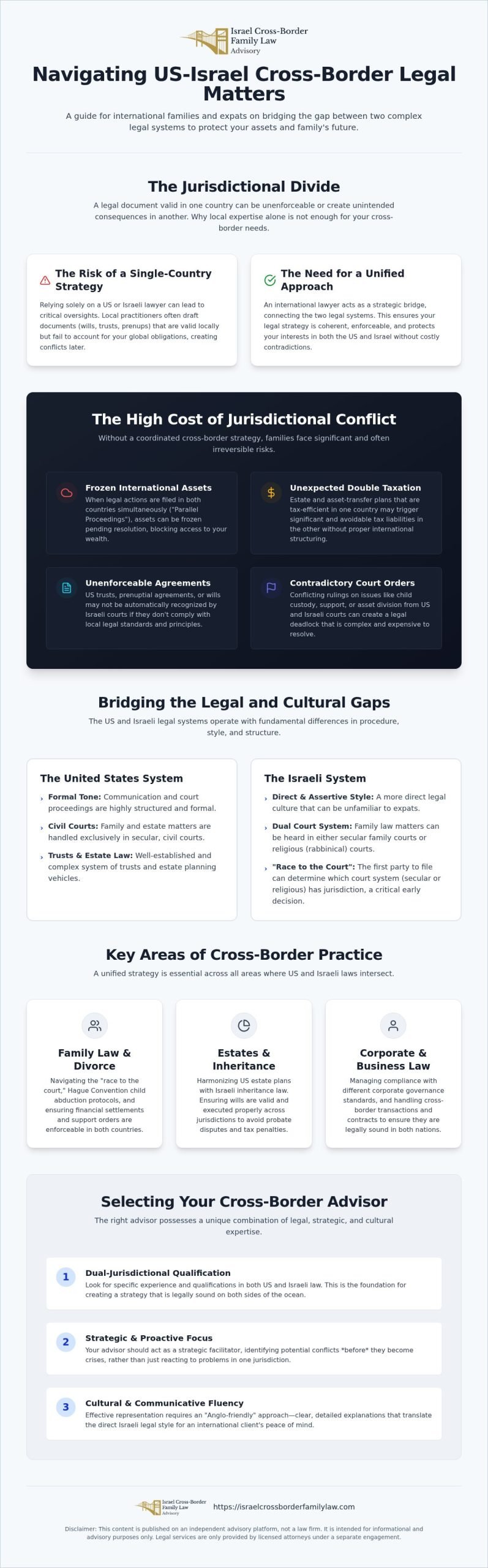
Strategic Clarity: The Cross-Border Advisory Approach
The concept of a “bridge” is central to managing affairs between Israel and the US. It’s about more than just knowing two sets of rules; it’s about connecting an emerging innovation hub with established global markets. An israel international lawyer serves as this bridge, ensuring that your personal and commercial goals aren’t lost in the gap between divergent systems. Whether you’re moving a family or scaling a startup, the objective is to create a seamless transition where assets remain protected and legal standing is clear in both jurisdictions.
Early decisions carry immense weight in international law. A choice made today regarding a will, a prenuptial agreement, or a corporate structure can determine your tax liability and legal rights for decades. We view our role as a partner in your long-term success, providing the strategic foresight needed to avoid common pitfalls. You can start this process by requesting a case review for expats and foreign nationals to identify potential vulnerabilities in your current plan.
Building a Unified US-Israel Strategy
Fragmented legal advice is one of the greatest risks for international families. When you receive one set of instructions in California and another in Jerusalem, the resulting confusion can lead to costly errors. A unified strategy replaces this friction with a comprehensive plan. This is especially vital in the technology and startup sectors, where cross-border labor laws and equity markets intersect. By aligning your legal approach across borders, you ensure that your representative understands the cultural and legal divergence that defines US-Israel relations. Seeking professional guidance is the best way to navigate these differences safely.
Next Steps for International Families and Businesses
The first step toward security is an honest assessment of your situation. A confidential consultation allows you to explore jurisdictional risks without the pressure of immediate litigation. This advisory approach is designed to give you the clarity you need before you make any permanent commitments. It’s about moving from a state of uncertainty to one of informed confidence. We focus on strategy and decision-making guidance to help you navigate the inherent complexity of cross-border issues.
Disclaimer: This content is published on an independent advisory platform, not a law firm. It’s intended for informational and advisory purposes only. Legal services are only provided by licensed attorneys under a separate engagement.
Get clarity before you commit. Request a confidential consultation.
Secure Your Global Future with Strategic Clarity
Managing a life that spans two countries doesn’t have to be a source of constant legal anxiety. By prioritizing a unified strategy, you can protect your family’s assets and ensure your legal standing remains firm in both the US and Israel. Early decisions regarding wills or jurisdictional selection carry immense weight for your long-term security. Navigating the 2026 worldwide asset reporting requirements and the nuances of the US-Israel tax treaty requires specialized expertise in both legal systems.
An israel international lawyer acts as a critical bridge, facilitating communication and strategy between divergent business cultures. This advisory approach provides the clarity you need to move forward with confidence, whether you’re scaling a business or protecting your estate. Our focus is on providing strategic guidance that respects the complexity of your international life.
Disclaimer: This content is published on an independent advisory platform, not a law firm. It’s intended for informational and advisory purposes only. Legal services are only provided by licensed attorneys under a separate engagement.
Get clarity before you commit. Request a confidential consultation.
Taking the first step toward a coordinated plan is the most effective way to achieve peace of mind. We look forward to helping you build a secure legal foundation for your cross-border interests.
Frequently Asked Questions
What is the role of an international lawyer in a US-Israel divorce?
An israel international lawyer acts as a strategic coordinator during a US-Israel divorce. They manage the “race to the court” by determining whether filing in a US state court or an Israeli family court offers better protection. This role involves ensuring that a settlement reached in one jurisdiction doesn’t create unforeseen tax liabilities or unenforceable custody orders in the other. Their focus is on creating a unified strategy that prevents expensive, parallel legal proceedings.
Can a US lawyer represent me in an Israeli court?
Only attorneys licensed by the Israel Bar Association can appear in Israeli courts. While your US counsel can provide background information, they cannot argue your case before an Israeli judge. A cross-qualified israel international lawyer bridges this gap by advising on US legal concepts while working directly with local Israeli litigators. This partnership ensures your representative understands both the cultural nuances of the Israeli system and your specific US legal requirements.
How does the US-Israel tax treaty affect my international assets?
The US-Israel tax treaty is designed to prevent double taxation on the same income. It provides a framework for credits and exemptions, but it doesn’t eliminate all reporting requirements. Effective January 1, 2026, all Israeli tax residents must disclose their worldwide assets and income. You must still navigate specific Israeli taxes, such as the 25% capital gains tax on inherited property, which the treaty might not fully mitigate without proactive legal structuring.
Are US prenuptial agreements enforceable in Israel?
US prenuptial agreements aren’t automatically binding in Israel. Israeli law typically requires that financial agreements between spouses be validated by a court or a marriage registrar to be enforceable. If you have a US agreement, you should seek an advisory review to determine if it needs to be “domesticated” in Israel. Without this step, your separate assets might be subject to Israel’s default “balancing of resources” rules during a divorce.
What happens if I have conflicting court orders from the US and Israel?
Conflicting orders lead to a “limping” legal status where your rights vary by country. This often results in frozen bank accounts and an inability to sell property. To prevent this, you need to establish the most appropriate forum, known as Forum Non Conveniens, at the very start of your case. Resolving these conflicts after they occur is significantly more expensive and complex than preventing them through a coordinated, multi-jurisdictional legal strategy from the outset.
Do I need a separate will for my assets in Israel?
Holding a separate Israeli will is highly recommended for anyone with local assets. While Israeli courts may recognize a foreign will, the probate process is often slower and more complex. A local will drafted in Hebrew and English ensures that your Israeli property is handled according to local regulations. It also helps your heirs manage the 25% capital gains tax liability that applies when inherited Israeli real estate is eventually sold.
How do I enforce a US child support order in Israel?
Enforcing a US child support order requires a formal process in the Israeli family court system. Israel generally respects foreign judgments provided they’re final and don’t contradict local public policy. You’ll need to provide certified copies of the US order and demonstrate that the defendant had a fair opportunity to present their case. Once the Israeli court recognizes the judgment, it becomes enforceable through local collection agencies, ensuring consistent support for your children.
What is the “Hague Convention” and why does it matter for my family?
The Hague Convention is an international treaty that governs the return of children who’ve been wrongfully removed from their home country. It doesn’t decide custody; instead, it determines which country has the jurisdiction to make that decision. If a child is taken to Israel without consent, the treaty provides a fast-track legal mechanism to return them to their original residence. Understanding these protocols is vital for any family living across international borders.

Article by
Gabriel Lior
A Personal Journey That Became a Mission
The advisory was founded by an American father Gabriel Lior, LLB, MBA , global entrepreneur, and cross-border advisor who spent more than a decade navigating the Israeli family court system firsthand and now lives in Singapore with his son.
As a divorced parent in a cross-border family, Gabriel faced nearly every legal challenge a foreign parent can encounter in Israel — including child custody disputes, child support proceedings, property matters in Israel and abroad, false accusations, and complex immigration and relocation proceedings.
Over the years, he learned the hard way how difficult it is for non-Israeli parents to understand the system, identify the right legal strategy, and choose the right legal representation — especially when language, culture, and jurisdictional differences are involved. He also witnessed how foreign parents and new immigrants are often disadvantaged or taken advantage of by service providers and institutions simply because they lack local knowledge or fluency.
From Client to Advisor
To truly understand — and survive — the system, Gabriel pursued formal legal education in Israel, completing two Israeli law degrees, alongside a BA and MBA earned in the United States. This was never about becoming a practicing attorney, but about gaining a deep, structural understanding of how the system works — and where it breaks down for foreign parents.
This rare combination of:
Firsthand client experience
Israeli legal and US business education
International business and negotiation training
Decades of commercial execution
created a unique perspective – one that understands both sides of the table.
After years of litigation, persistence, and at times self-representation, he ultimately succeeded in securing custody of his son and relocating abroad through a rare legal victory in the Israeli Supreme Court — becoming one of the first fathers in Israel to do so under these circumstances.
Disclaimer
Important Disclaimer:
The information provided on this website and in its content is for general informational and educational purposes only and does not constitute legal advice, legal opinion, or legal representation.
Gabriel Lior is not licensed to practice law in Israel (nor is he interested in doing so) and does not provide legal services, despite having completed 2 Law Degrees. The services offered are advisory in nature and are intended to provide general guidance, strategic insight, and information regarding cross-border family law considerations.
No attorney-client relationship is formed by accessing this website, reading its content, or communicating with us.
Any decisions made based on this information are at your own discretion and risk. For legal advice specific to your situation, you should consult a licensed attorney in the relevant jurisdiction.
Where appropriate, we may refer clients to independent, licensed attorneys or professionals. Such referrals do not constitute legal representation and no liability is assumed for services provided by third parties.