This article is published on an independent advisory platform and does not constitute a legal opinion or an attorney-client relationship. Legal services are only provided by licensed attorneys under a separate engagement.
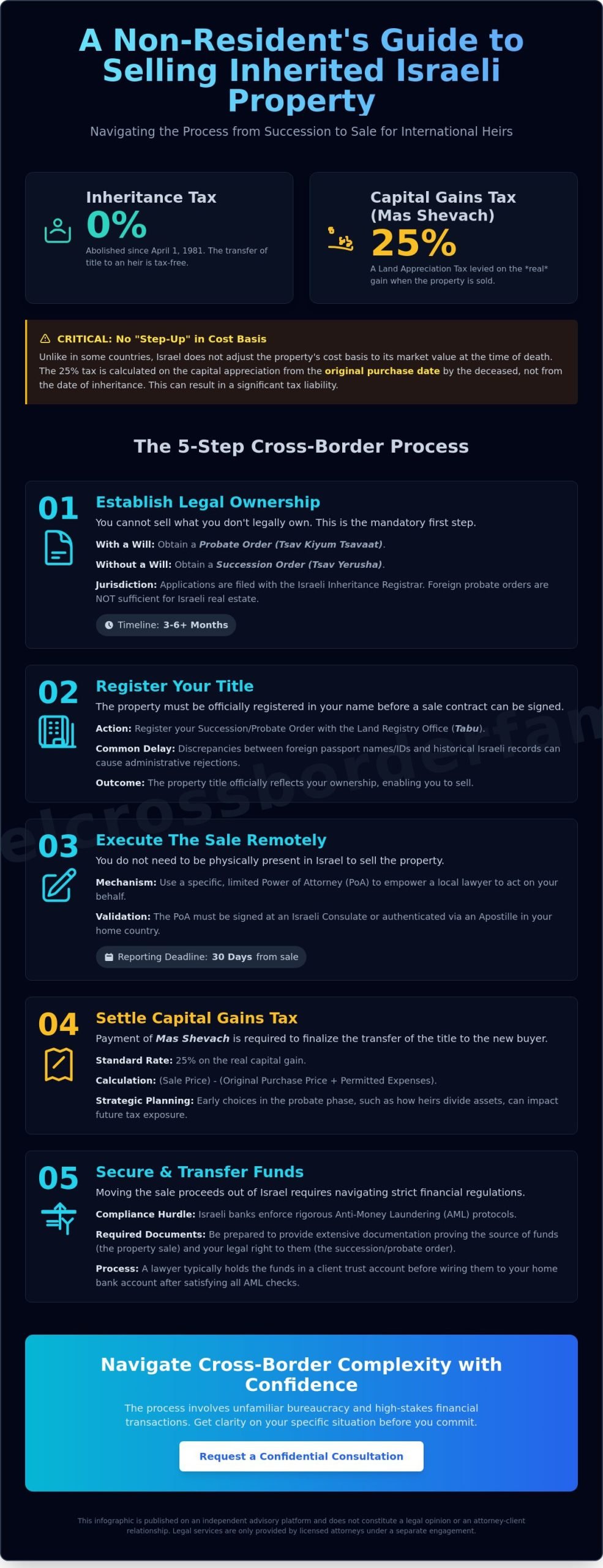
Did you know that while Israel has maintained a 0% inheritance tax rate since April 1, 1981, selling that same asset can still result in a 25% capital gains tax? Many international heirs are surprised to find that Israel doesn’t offer a “step-up” in cost basis to market value at the time of death. If you’re selling inherited property in Israel as a non-resident, you’re likely concerned about navigating unfamiliar bureaucracy and the logistics of managing a high-value transaction from abroad. It’s common to feel uneasy when you’re thousands of miles away from the legal system governing your inheritance.
This guide provides the clarity you need to handle these cross-border complexities without unnecessary risk. You’ll gain a clear roadmap of the process, from the 3 to 6 month timeline for a Succession Order to the mandatory 30-day window for reporting the sale. We’ll explain how to manage the Mas Shevach tax and ensure the secure transfer of your funds to your home account. For more guidance, you can view our videos on the Israel Family Law YouTube channel. Get clarity before you commit. Request a confidential consultation.
Key Takeaways
- Establish legal ownership through a Succession or Probate Order as the mandatory first step before any property transaction can occur.
- Differentiate between Israel’s 0% inheritance tax and the standard 25% Mas Shevach (Capital Gains Tax) that applies to the eventual sale.
- Learn the logistics of selling inherited property in Israel as a non-resident using a specific Power of Attorney signed at a consulate or via Apostille.
- Prepare for the rigorous anti-money laundering (AML) protocols required by Israeli banks to ensure the secure transfer of sale proceeds to your home country.
- Identify how early strategic choices during the probate phase can help you avoid “forced heirship” complications and minimize tax exposure.
This article is published on an independent advisory platform and does not constitute a legal opinion or an attorney-client relationship. Legal services are only provided by licensed attorneys under a separate engagement.
Establishing Legal Title: The Succession and Probate Order
You can’t sell what you don’t legally own. In Israel, the process of selling inherited property in israel as a non-resident starts with obtaining a court-validated order. If the deceased left no will, you must apply for a Tsav Yerusha (Succession Order). This document identifies the legal heirs according to the 1965 Inheritance Law. If a will exists, you’ll need a Tsav Kiyum Tsavaat (Probate Order). Both applications are typically submitted to the Inheritance Registrar, known as the Rasham HaYerushot, who oversees the distribution of assets and ensures the deceased’s wishes or legal defaults are respected.
It’s a common misconception that a probate order from your home country is sufficient. Israeli authorities don’t automatically recognize foreign court orders for the transfer of local real estate. You must go through the local Israeli process to validate the transfer of land. This framework is rooted in Israeli property law, which requires specific local registration for any real estate transaction. The timeline for obtaining these orders generally ranges from 3 to 6 months, though complex cases involving multiple jurisdictions can extend to a year or more.
To better understand the financial implications of these transfers, watch this helpful video:
Registering Your Rights in the Tabu
Once you have the succession or probate order, you must register your rights in the Land Registry, or Tabu. Navigating the Tabu is a critical phase of selling inherited property in israel as a non-resident because it bridges the gap between inheritance and the open market. You can’t sign a binding sale contract until the property title reflects your name. Registration for foreign nationals can encounter delays that take several weeks beyond the initial inheritance order period. These delays frequently stem from technical discrepancies in identification documents or name spellings between foreign passports and historical Israeli records. You’ll need to ensure your passport details match the registry precisely to avoid administrative rejection.
When a Foreign Will is Involved
If the deceased lived outside of Israel, the process becomes more complex. The Registrar often requires a formal legal opinion on the laws of the foreign jurisdiction. This ensures the will complies with both local standards and Israeli public policy. All foreign documents, including death certificates and the will itself, must be professionally translated into Hebrew and notarized. You can learn more about how we facilitate these multi-jurisdictional steps by reviewing how the advisory works. Early strategic planning is essential; decisions made during the probate phase can significantly impact your future tax liability when you eventually sell the asset. Get clarity before you commit. Request a confidential consultation.
This article is published on an independent advisory platform and does not constitute a legal opinion or an attorney-client relationship. Legal services are only provided by licensed attorneys under a separate engagement.
Taxation Realities: Inheritance Tax vs. Capital Gains
Israel doesn’t impose an estate or inheritance tax. This policy has been in effect since April 1, 1981, and there are no current plans to reintroduce it. While the transfer of the property title to an heir is tax-free, the act of selling inherited property in israel as a non-resident triggers a different obligation: Mas Shevach. This Land Appreciation Tax is a 25% levy on the real capital gain achieved from the sale.
A critical difference between Israeli and foreign systems is the lack of a “step-up” basis. In many jurisdictions, the “cost” of the property is reset to the market value on the date of death. In Israel, you “step into the shoes” of the deceased. Your tax is calculated using the original purchase price paid by your benefactor. If the property was acquired decades ago, the taxable gain could be significant. High earners should also account for a 3% surtax if their total annual taxable income in Israel exceeds ILS 721,560. You are required to file a notice of the transaction with the Israel Tax Authority (Rishut HaMisim) within 30 days of signing the sale agreement.
Capital Gains Tax (Mas Shevach) Exemptions
Exemptions that once favored non-residents have tightened significantly. Since 2014, the “Single Residential Property” exemption is largely unavailable to those living abroad. To qualify, you must provide a “Certificate of Non-Residency” from your home country’s tax authority to prove you don’t own a home there. For properties held long-term, a linear tax calculation applies. The portion of the gain attributed to the period before November 7, 2001, is taxed at marginal rates up to 50%, while the period from January 1, 2012, to the sale date is taxed at the 25% rate.
The US-Israel Tax Treaty and Double Taxation
For US citizens, the risk of paying tax twice on the same gain is a major concern. The US-Israel tax treaty provides a mechanism to mitigate this through the Foreign Tax Credit. You can generally claim the Mas Shevach paid in Israel as a credit against your US tax liability. This process isn’t automatic; it requires precise coordination between your Israeli and US tax professionals. Mistakes in reporting can lead to IRS penalties or lost credits. Understanding these inheritance laws for foreign nationals is vital for protecting your family’s wealth. Get clarity before you commit. Request a confidential consultation to discuss your specific strategy.
This article is published on an independent advisory platform and does not constitute a legal opinion or an attorney-client relationship. Legal services are only provided by licensed attorneys under a separate engagement.
Executing the Sale Remotely: Power of Attorney and Logistics
You don’t need to fly to Tel Aviv or Jerusalem to complete a real estate transaction. Most heirs manage selling inherited property in israel as a non-resident entirely from their home country by appointing a bicultural team on the ground. The process begins with selecting an Israeli attorney who understands both the local market and the specific needs of international families. You’ll grant this professional a Power of Attorney (POA) to sign the sale agreement, handle tax filings, and register the transfer at the Land Registry on your behalf.
The Role of the Apostille and Notarization
For sellers based in the United States or Europe, an Apostille is mandatory. This is an international certification established by the 1961 Hague Convention that authenticates documents for use in Israel. You must sign the POA either at an Israeli Consulate or before a local notary public. If you use a local notary, you must then obtain an Apostille from your Secretary of State’s office. We strongly advise using a “Specific” Power of Attorney. Unlike a “General” POA, a Specific POA limits the lawyer’s authority strictly to this property sale. This provides a layer of security for the heir. A frequent cause for Land Registry rejection is a name mismatch between the POA and the historical records in the Tabu. Ensure every document uses the exact spelling found on your passport.
Marketing the Property from Abroad
The Israeli market offers both exclusive and open listing options. An exclusive listing often incentivizes an agent to invest in professional photography and 3D virtual tours. These tools are vital for remote sellers who can’t personally host open houses. If the property involves “Key Money” tenants, the situation is more complex. These protected tenancies, governed by the Tenant Protection Law, can significantly impact the property’s market price and the timeline for a sale. You’ll also need to manage any existing rental agreements carefully. The “vacant possession” clause in your sale contract must align perfectly with the termination dates of current leases to avoid breach of contract. Get clarity before you commit. Request a confidential consultation to discuss your remote sale strategy.
This article is published on an independent advisory platform and does not constitute a legal opinion or an attorney-client relationship. Legal services are only provided by licensed attorneys under a separate engagement.
Financial Compliance and Transferring Sale Proceeds
Liquidating assets is only half the battle. The final stage of selling inherited property in israel as a non-resident involves moving the capital across borders while satisfying rigorous banking regulations. Israeli financial institutions have significantly tightened their compliance protocols to meet global Anti-Money Laundering (AML) standards. This makes opening or even maintaining a bank account as a non-resident a significant hurdle. Without a proactive strategy, your sale proceeds may remain inaccessible in an Israeli account for an extended period.
Obtaining the Tax Clearance Certificate
The Ishur Mas Shevach (Tax Clearance Certificate) is the most critical document for releasing your money. During the closing process, a portion of the sale price is typically held in a secure escrow account managed by the attorneys. This amount often ranges from 15% to 40% of the total price, depending on the estimated capital gains tax liability. The Israeli Tax Authority generally takes between 45 and 90 days to process these clearances and confirm that all obligations are met. Only after this certificate is presented can the escrow agent release the final payment to you.
Currency Exchange and Transfer Strategies
Standard retail banks often charge high spreads and fees on international transfers. For large sums, specialized currency exchange firms can offer more competitive rates, potentially saving you thousands of dollars compared to a traditional bank-to-bank wire. When selling inherited property in israel as a non-resident, you must also prepare for your home country’s reporting requirements. For example, US residents must ensure their reporting aligns with FBAR and FATCA regulations to avoid steep penalties. Understanding these logistical costs is part of your overall pricing and expectations. Strategy is the best defense against administrative delays. Contact us today to ensure your proceeds reach your home account securely.
This article is published on an independent advisory platform and does not constitute a legal opinion or an attorney-client relationship. Legal services are only provided by licensed attorneys under a separate engagement.
Strategic Planning: Avoiding Common Pitfalls
The decisions you make during the initial probate phase have a long shadow. When selling inherited property in israel as a non-resident, heirs often view the Succession Order as a mere administrative hurdle. However, how you structure this order can determine your eventual tax base. For instance, an “Agreement Between Heirs” executed before the order is issued can sometimes shift the tax burden or utilize specific exemptions that would be lost once the property is registered. Rushing this first step without a holistic view of the 25% capital gains tax discussed earlier is a common strategic error.
Another significant risk is the clash between foreign wills and Israeli inheritance principles. While Israel generally respects the freedom of testation, certain statutory rights for surviving spouses may conflict with provisions in a foreign will that wasn’t tailored for the Israeli legal system. This complexity is why a risk-based approach is superior to a purely transactional one. You must also exercise extreme caution regarding the Zichron Devarim. In the Israeli marketplace, this preliminary memorandum is often considered a legally binding contract. Signing one without professional oversight can commit you to a sale before you’ve fully understood your tax obligations or confirmed your legal title.
Why Legal Systems Clash
Israel’s legal system is a unique hybrid that differs significantly from the Common Law systems found in the US or UK. These differences are often masked by language barriers. A Hebrew term may appear to mean “escrow” or “guarantee” but carry different legal weight under Israeli statutes. Without a bilingual, bicultural advocate to act as a bridge, these nuances can lead to misinterpreted clauses and financial loss. Having a team on the ground that understands both business cultures ensures that your interests are protected in a language you actually speak.
Next Steps: Getting Clarity
You don’t need to be physically present in Israel to begin this journey. The entire process, from the initial application at the Inheritance Registrar to the final currency transfer, can be managed through a secure remote framework. The most effective first step is a strategy session to map out your specific tax profile and title status before the property is even listed. This proactive planning prevents the 3 to 6 month probate timeline from becoming a source of stress. To begin your assessment, you can request a confidential case review. Get clarity before you commit. Request a confidential consultation.
This article is published on an independent advisory platform and does not constitute a legal opinion or an attorney-client relationship. Legal services are only provided by licensed attorneys under a separate engagement.
Securing Your Family’s Israeli Legacy from Abroad
Successfully selling inherited property in israel as a non-resident requires more than just finding a buyer. It’s a multi-stage journey that demands precise coordination between the Land Registry, the Tax Authority, and international banking systems. You’ve learned that while there’s no inheritance tax, the 25% capital gains tax and the mandatory 30-day reporting window create a tight timeline that requires a proactive strategy. Managing the 3 to 6 month probate process alongside rigorous anti-money laundering checks is essential for a secure transfer of funds.
Our bilingual and bicultural legal experts act as your bridge between these two distinct legal cultures. With a dedicated team on the ground in both Tel Aviv and New York, we bring decades of collective experience in cross-border estate law to every transaction. We provide the steady guidance you need to navigate these sophisticated multi-jurisdictional challenges with the reassurance of a professional home in both countries. You don’t have to face the complexities of the Israeli bureaucracy alone.
Get clarity before you commit. Request a confidential consultation. We’re here to help you move forward with strategy and peace of mind.
This article is published on an independent advisory platform and does not constitute a legal opinion or an attorney-client relationship. Legal services are only provided by licensed attorneys under a separate engagement.
Frequently Asked Questions
Do I have to pay inheritance tax in Israel if I live in the US?
No, you don’t have to pay inheritance or estate tax in Israel. The state abolished these taxes on April 1, 1981, and they remain at 0% today. However, US residents must still report the inheritance to the IRS if the value exceeds $100,000 using Form 3520. While the inheritance itself is tax-free, the eventual sale of the property will trigger capital gains tax obligations in Israel.
Can I sell my inherited Israeli apartment without traveling to Israel?
Yes, it’s entirely possible to manage the process of selling inherited property in israel as a non-resident without visiting the country. You can appoint an Israeli lawyer through a specific Power of Attorney to act as your representative. This allows your advocate to handle the probate application, sign the sale contract, and manage the transfer of funds while you remain in your home country.
How long does the probate process take in Israel for a non-resident?
The legal process to obtain a Succession or Probate Order typically takes between 3 to 6 months. If the case involves complex foreign documentation or multiple heirs across different jurisdictions, the timeline can extend to 12 months. You must complete this mandatory step before you can legally register the property in your name at the Land Registry or sign a binding sale agreement with a buyer.
What is Mas Shevach and how is it calculated for an inherited home?
Mas Shevach is a Land Appreciation Tax, which is a 25% levy on the real capital gain achieved from the sale. Israel doesn’t provide an automatic “step-up” in cost basis to market value at the time of death. Instead, the gain is calculated based on the original purchase price paid by the deceased. For properties owned since before January 1, 2012, a linear calculation is applied to determine the tax.
Can I use a US-based Power of Attorney to sell property in Israel?
You cannot use a standard US-formatted Power of Attorney for Israeli real estate. You must use a specific Israeli document drafted by a local attorney. This POA must be signed either at an Israeli Consulate or before a local notary and then authenticated with an Apostille. This ensures the document complies with the 1961 Hague Convention and is accepted by the Israeli Land Registry and financial institutions.
What happens if there is no will for the property in Israel?
If the deceased left no will, the estate is distributed according to the default rules of the 1965 Inheritance Law. You’ll need to apply for a Succession Order (Tsav Yerusha) through the Inheritance Registrar. This legal document identifies the rightful heirs, usually dividing the asset between the surviving spouse and children. This order is a prerequisite for selling inherited property in israel as a non-resident.
How do I move the money from the sale back to my US bank account?
Moving funds requires obtaining a Tax Clearance Certificate (Ishur Mas Shevach) to release money from escrow. You must also satisfy the bank’s Anti-Money Laundering (AML) checks by providing a clear paper trail of the inheritance. Once cleared, you can use specialized currency exchange firms to transfer the shekels into dollars. This often provides a more favorable exchange rate than traditional retail banks. Get clarity before you commit. Request a confidential consultation.
Is a foreign will valid for selling real estate in Israel?
A foreign will is not automatically valid and must be validated through an Israeli Probate Order (Tsav Kiyum Tsavaat). The Inheritance Registrar typically requires a formal legal opinion explaining the inheritance laws of the deceased’s home country. Additionally, all foreign documents, including the death certificate and the will, must be professionally translated into Hebrew and notarized before the Israeli authorities will process the property transfer.

Article by
Gabriel Lior
A Personal Journey That Became a Mission
The advisory was founded by an American father Gabriel Lior, LLB, MBA , global entrepreneur, and cross-border advisor who spent more than a decade navigating the Israeli family court system firsthand and now lives in Singapore with his son.
As a divorced parent in a cross-border family, Gabriel faced nearly every legal challenge a foreign parent can encounter in Israel — including child custody disputes, child support proceedings, property matters in Israel and abroad, false accusations, and complex immigration and relocation proceedings.
Over the years, he learned the hard way how difficult it is for non-Israeli parents to understand the system, identify the right legal strategy, and choose the right legal representation — especially when language, culture, and jurisdictional differences are involved. He also witnessed how foreign parents and new immigrants are often disadvantaged or taken advantage of by service providers and institutions simply because they lack local knowledge or fluency.
From Client to Advisor
To truly understand — and survive — the system, Gabriel pursued formal legal education in Israel, completing two Israeli law degrees, alongside a BA and MBA earned in the United States. This was never about becoming a practicing attorney, but about gaining a deep, structural understanding of how the system works — and where it breaks down for foreign parents.
This rare combination of:
Firsthand client experience
Israeli legal and US business education
International business and negotiation training
Decades of commercial execution
created a unique perspective – one that understands both sides of the table.
After years of litigation, persistence, and at times self-representation, he ultimately succeeded in securing custody of his son and relocating abroad through a rare legal victory in the Israeli Supreme Court — becoming one of the first fathers in Israel to do so under these circumstances.
Disclaimer
Important Disclaimer:
The information provided on this website and in its content is for general informational and educational purposes only and does not constitute legal advice, legal opinion, or legal representation.
Gabriel Lior is not licensed to practice law in Israel (nor is he interested in doing so) and does not provide legal services, despite having completed 2 Law Degrees. The services offered are advisory in nature and are intended to provide general guidance, strategic insight, and information regarding cross-border family law considerations.
No attorney-client relationship is formed by accessing this website, reading its content, or communicating with us.
Any decisions made based on this information are at your own discretion and risk. For legal advice specific to your situation, you should consult a licensed attorney in the relevant jurisdiction.
Where appropriate, we may refer clients to independent, licensed attorneys or professionals. Such referrals do not constitute legal representation and no liability is assumed for services provided by third parties.