Disclaimer: This content is published on an independent advisory platform, not a law firm. It focuses on strategy, risks, and decision-making guidance rather than a formal attorney-client relationship.
What if the legal protection you secured in the United States effectively vanishes the moment you establish residency in Israel? For many international couples, the assumption that a standard US contract will automatically hold up in an Israeli Family Court or Rabbinical Court is a risky gamble. If you’re seeking a valid israel us prenuptial agreement, you’ve likely realized that a one-size-fits-all document cannot bridge the gap between these two complex legal systems. You’ve worked hard to build your assets and deserve to enter your marriage with total confidence rather than anxiety over conflicting laws.
This guide explains how to navigate the complex legal intersection of US and Israeli law to protect your assets and future with a valid cross-border agreement. We’ll examine the essential procedural steps for 2026, from the ₪446 notary verification for new couples to the strategic choices that determine which court system would handle your future matters. By focusing on strategic clarity before you commit, you can build a secure foundation for your life together.
Key Takeaways
- Learn why standard agreements often fail the “cross-border trap” and how to avoid having your US contract ignored by Israeli authorities due to public policy exceptions.
- Understand the critical role of the Israeli Rabbinical Courts and how their unique perspective on marriage impacts your jurisdictional planning and asset protection.
- Identify the specific clauses needed for a robust israel us prenuptial agreement, focusing on forum selection and choice of law to prevent a future jurisdictional tug-of-war.
- Discover the collaborative process of engaging dual-country counsel to review your assets across both your primary domicile and secondary international locations.
- Get clear on the essential validation steps in Israel, including the ₪446 notary fee for pre-marital agreements, to ensure your document is legally recognized and binding.
Why Standard Prenuptial Agreements Often Fail in US-Israel Contexts
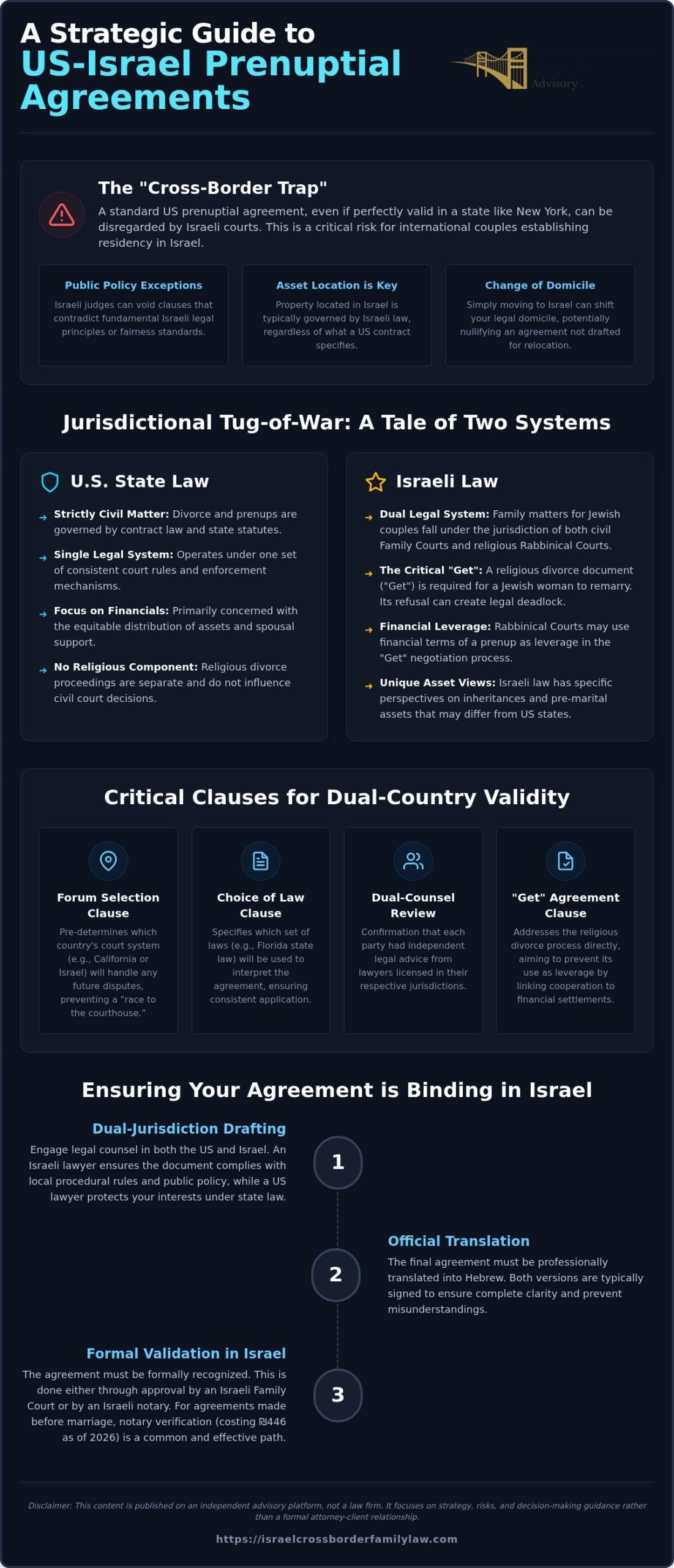
Many couples assume that a document signed in a US state will automatically protect them globally. This assumption leads to what we call the “Cross-Border Trap.” An israel us prenuptial agreement needs to be more than a simple contract; it must serve as a jurisdictional map. While you might understand what is a prenuptial agreement in a general sense, the reality changes when two different legal systems collide. A document perfectly valid in New York can be completely ignored in Tel Aviv if it doesn’t meet specific Israeli procedural requirements or local standards of fairness.
To better understand how these agreements function within the local system, watch this helpful video:
Israeli courts often apply “public policy” exceptions to foreign contracts. These exceptions allow a judge to void specific clauses if they believe the agreement contradicts fundamental Israeli legal principles. Additionally, asset location plays a decisive role. If you own property in Israel, local law usually dictates how it’s divided, regardless of what a US contract says. Simply moving to Israel can change your legal domicile. This shift can nullify prior agreements that weren’t drafted to anticipate international relocation.
The Difference Between Domestic and International Agreements
Domestic agreements operate under a single set of court rules. They assume one definition of marital property and a single enforcement mechanism. In contrast, international agreements must reconcile two different legal cultures. Israeli law has specific views on inheritances and pre-marital assets that differ significantly from many US states. Using “boilerplate” templates from the internet is dangerous for expats and foreign nationals because these forms rarely account for multi-jurisdictional complexity.
The Risk of ‘Forum Shopping’ in Cross-Border Marriages
When a marriage breaks down, a spouse might rush to file for divorce in Israel to bypass a US prenup. This “race to the court” happens because different courts offer different financial advantages. If one spouse believes the Israeli Rabbinical Court will grant a more favorable asset distribution than a US court, they may try to establish jurisdiction there first. A robust israel us prenuptial agreement prevents this by including a clear forum selection clause. This pre-determines which legal system will handle the case, providing strategic clarity before a conflict ever begins.
The Jurisdictional Tug-of-War: Israeli Rabbinical Courts vs. US State Laws
In Israel, the legal landscape for Jewish couples is distinct because personal status matters fall under the exclusive jurisdiction of Rabbinical Courts. This creates a significant contrast with US state laws in places like California or Florida, where divorce is strictly a civil matter governed by contract principles. When drafting an israel us prenuptial agreement, you aren’t just dealing with civil law. You’re navigating a religious legal framework that has its own set of rules and priorities. This dual-layered system requires a document that can speak to both a secular judge in the US and a rabbinical panel in Israel.
The most critical complication is the “Get,” the religious divorce document required for a Jewish woman to remarry. Many US prenuptial agreements fail to address the refusal to grant a Get, which can lead to years of legal deadlock in Israel. While a US court might view a prenup as a final settlement of assets, an Israeli Rabbinical Court may use the financial terms of the agreement as leverage during the religious divorce process. Protecting yourself requires specific language that addresses these religious requirements directly.
Understanding the Dual Court System in Israel
Israel maintains a parallel authority between civil Family Courts and religious Rabbinical Courts. While both can handle property division, the Rabbinical Court has unique power over the religious status of the couple. For an agreement to be effective in Israel, it must be formally validated. This is a non-negotiable step. Without this validation, usually performed by a judge or a notary for a statutory fee of ₪446 for pre-marital agreements, the document may not be recognized if a spouse files for divorce within the Israeli system. For those seeking legal guidance for expats and foreign nationals, understanding this validation process is essential to ensure your document isn’t dismissed during a crisis.
Enforcing US Clauses in an Israeli Religious Context
One of the most complex aspects of navigating cross-border prenuptial agreements is how religious courts view civil waivers. For example, a US-drafted waiver of alimony might be scrutinized differently in a Rabbinical Court if it’s deemed to leave a spouse without basic support. These courts also consider the “Ketubah,” the traditional Jewish marriage contract. The Ketubah often contains financial obligations that a US prenup might try to waive, but the Rabbinical Court may still uphold the Ketubah’s terms. If your document doesn’t explicitly mention the Rabbinical Court’s jurisdiction, you’re leaving your future to chance. To avoid these pitfalls, it’s helpful to request a confidential consultation to clarify how your specific assets will be treated.
Critical Clauses: What Your Agreement Must Include for Dual-Country Validity
Creating a robust israel us prenuptial agreement requires precision in drafting clauses that satisfy both US civil standards and Israeli legal requirements. It isn’t enough to list your assets; you must define the rules that will govern them across changing jurisdictions. A Choice of Law clause is the first line of defense, explicitly stating which country’s laws should be used to interpret the contract. Without this, a judge in Tel Aviv might apply Israeli law to a US-based retirement account, potentially leading to an outcome you didn’t intend.
Equally vital is the Forum Selection clause. This determines in advance which court system has the authority to hear a case. Given the complexity of Cross-Border Prenuptial Agreements in Jewish Law, Jewish couples must also include an ‘Anti-Get Refusal’ clause. This provision creates financial consequences if one spouse refuses to grant or receive a religious divorce, ensuring the agreement remains enforceable within the Israeli Rabbinical system. Proper asset segregation is also necessary to distinguish between US-based 401(k) plans and Israeli ‘Keren Hishtalmut’ funds, as these vehicles have different tax implications and liquidity rules in their respective countries.
Addressing Real Estate and Business Interests
Property ownership in different countries demands specific handling. An agreement must account for the valuation and division of a luxury apartment in Tel Aviv differently than a suburban home in Los Angeles. For those involved in the Israeli tech sector, handling business valuations for startups within a US legal framework is a common challenge. You should specify how intellectual property and future equity are treated to avoid expensive litigation. For more on how these assets impact broader family obligations, see our guide on cross-border child support and asset enforcement.
Provisions for Future Relocation
If you currently live in the US but plan to move to Israel, your agreement should include ‘activation’ clauses. these provisions trigger specific rules the moment you establish residency in a new country. You’ll need to define what happens to ‘community property’ acquired while living abroad, as Israeli law and various US state laws have conflicting definitions of shared assets. To remain valid, the document must be viewed as fair and reasonable under both US and Israeli standards at the time of enforcement. This foresight prevents your agreement from being struck down as unconscionable if your financial circumstances change significantly after your move.
The Drafting Process: Coordinating Counsel Across Two Jurisdictions
Creating a legally sound israel us prenuptial agreement is a collaborative effort that requires more than a single signature. It involves a structured, multi-step process to ensure the document remains resilient in both the United States and Israel. You cannot rely on a single attorney to manage this process. One lawyer rarely possesses the dual expertise required to navigate the specific state laws of, for example, New York or California, while simultaneously addressing the requirements of the Israeli Spouses’ Property Relations Law. A successful drafting process typically follows these four essential steps:
- Step 1: Identify your primary domicile and all secondary asset locations to determine which laws will take precedence.
- Step 2: Engage independent legal counsel in both the US and Israel to review the draft from their respective jurisdictional perspectives.
- Step 3: Harmonize the language of the agreement so that the English and Hebrew versions are legally equivalent and do not contain contradictory terms.
- Step 4: Formally validate the document in an Israeli court or before a notary if you are currently living in or planning a move to Israel.
By coordinating your legal strategy this way, you prevent the common mistake of having a document that is “perfect” in one country but completely unenforceable in the other. To understand how we facilitate this coordination, you can review our advisory pricing and process.
The Importance of Translation and Notarization
A simple word-for-word translation is insufficient for international contracts. You need “legal equivalence,” which ensures that a concept like “equitable distribution” in US law is properly translated into a recognized legal framework within the Israeli system. Lost-in-translation errors are a frequent source of litigation when marriages dissolve across borders. Additionally, US-signed documents often require an Apostille, an international certification, to be recognized by Israeli authorities. This administrative step is vital for the agreement’s validity when presented to the Israeli Family Court or Rabbinical Court.
Validating the Agreement in Israel
In Israel, the law treats an unvalidated prenuptial agreement differently than a standard contract. Without formal approval from an Israeli Family Court judge or a qualified notary, the document may be viewed as a mere “statement of intent” rather than a binding financial agreement. This validation process confirms that both parties entered the agreement through their own free will and fully understood the financial consequences. For couples already married, court approval is mandatory. If you are ready to begin this process, you should speak with a cross-border strategist to ensure your timeline aligns with these formal requirements.
Moving Forward with Clarity: Strategic Decisions Before the Wedding
The decisions you make before your wedding will echo through your financial life for decades. While the legal technicalities are vital, an israel us prenuptial agreement also serves as a powerful communication tool. It forces a transparent dialogue about expectations, assets, and future goals that many couples otherwise avoid. Approaching this process with a sense of partnership rather than defense can actually strengthen a relationship’s foundation by removing ambiguity from the start.
Timing is perhaps the most critical strategic factor. Agreements signed under the shadow of a looming wedding date are frequently challenged in court. Judges in both US civil courts and Israeli religious or family courts look for evidence that each party had sufficient time to review the terms without duress. If a document is presented just days before the ceremony, it risks being struck down as unconscionable. We recommend beginning this process at least three to six months before your wedding date to ensure every clause is thoroughly vetted by independent counsel in both jurisdictions.
Recognize that cross-border law isn’t static. A robust agreement drafted in 2026 might require a strategic review by 2030 as your domicile changes or as new precedents are set in international family law. Viewing your prenup as a living document, rather than a “sign and forget” contract, is the best way to maintain long-term protection as your life moves between the US and Israel.
Resources for Further Learning
If you’re still gathering information, there are several ways to deepen your understanding of these complex issues. You can find visual explainers and deep dives into specific legal scenarios on the Israel Family Law YouTube channel. For those who need a more personalized approach, a confidential case review can help identify hidden risks specific to your asset portfolio. You can also learn more about how our cross-border advisory works to see how we bridge the gap between US and Israeli legal cultures.
A Reassuring Final Step
Navigating the intersection of two legal systems is inherently complex, but it doesn’t have to be overwhelming. Our role is to provide the strategic clarity you need to move forward with confidence. By addressing potential conflicts today, you’re effectively preventing high-cost litigation and emotional distress tomorrow. Clarity today prevents conflict tomorrow. Get clarity before you commit. Request a confidential consultation to discuss your specific needs in a secure environment.
Building a Secure Foundation Across Borders
Navigating the legal landscape between the United States and Israel requires a proactive strategy that extends beyond a standard contract. As an independent advisory platform, we focus on resolving the inherent conflicts between these two divergent systems. A successful israel us prenuptial agreement must account for the mandatory jurisdiction of Israeli Rabbinical Courts while simultaneously protecting assets under US state laws. By coordinating independent counsel in both nations, you’ll ensure that your document is not only legally sound but also practically enforceable regardless of where your life leads.
The weight of these early decisions will influence your financial security for years to come. Our calm, Anglo-friendly approach is designed to help you identify hidden risks and establish clear jurisdictional roadmaps before you reach the chuppah. Taking the time to formally validate your agreement through the proper Israeli channels is a vital step in preventing future litigation and emotional distress. Get clarity before you commit. Request a confidential consultation to discuss your specific cross-border needs. You deserve to move forward into your new life with total confidence and peace of mind.
Frequently Asked Questions
Is a US prenuptial agreement valid in Israel?
A US prenuptial agreement is not automatically valid or enforceable in Israel. To be legally binding, it must undergo a formal validation process by an Israeli notary or the Family Court to ensure it complies with the Spouses’ Property Relations Law. Without this specific step, an Israeli judge may view the document as a mere statement of intent rather than a binding financial contract.
Do I need two separate prenups if I have assets in both the US and Israel?
You don’t necessarily need two separate documents, but your single israel us prenuptial agreement must be drafted to satisfy both legal systems. It should include specific provisions for US-based assets like 401(k) plans and Israeli assets such as a Keren Hishtalmut. Coordinating with counsel in both jurisdictions ensures the language is harmonized and enforceable in both the US and Israel.
Can an Israeli Rabbinical court overturn my US prenup?
Yes, a Rabbinical Court can potentially overturn or ignore clauses that contradict Israeli public policy or religious law. Because these courts have exclusive jurisdiction over Jewish divorce in Israel, they may scrutinize an agreement that leaves a spouse without support. Including specific religious clauses and ensuring the document is validated in Israel are essential steps to prevent the court from setting aside your US-drafted terms.
What happens to my Israeli inheritance if I have a US prenup?
Israeli law generally excludes inheritances from the division of marital property, but these assets become vulnerable if they are commingled with shared funds. A robust agreement explicitly defines inheritances as separate property. This prevents a spouse from claiming a share of family wealth that was intended to remain separate, providing clarity that the default legal framework might not fully guarantee during a dispute.
How much does it cost to validate a US prenup in an Israeli court?
The official court filing fee to approve an uncontested financial agreement in the Israeli Family Court is ₪536 as of 2026. This process is required for couples who are already married. For those not yet married, the statutory fee for a notary to verify the agreement is ₪446. These fees cover the administrative validation required to make the document legally effective within the Israeli system.
What is an ‘Anti-Get Refusal’ clause and why do I need it?
This clause creates financial consequences if a spouse refuses to grant or receive a “Get,” the religious divorce document. It is necessary because US civil courts cannot intervene in religious matters. By including this provision in your israel us prenuptial agreement, you establish a civilly enforceable incentive that prevents the religious divorce from being used as leverage during property or custody negotiations in Israel.
Can I sign a postnuptial agreement if we are already married and moving to Israel?
You can sign a postnuptial agreement, known in Israel as a “Heskem Mamon,” even after your wedding. However, unlike a pre-marital agreement, a postnuptial contract must be approved by the Israeli Family Court or Rabbinical Court to be valid. This ensures both parties understand their rights before the act of moving to Israel changes their legal domicile and property relations status.
Does a prenup protect my business interests in an Israeli startup?
A prenup provides critical protection for business interests, provided it includes specific language regarding startup valuations and future equity. Israeli courts often apply an “equitable balancing” of assets accumulated during marriage. A well-drafted agreement defines business holdings, including intellectual property and exit proceeds, as separate property, ensuring these interests are not subject to division under the standard property laws of either country.

Article by
Gabriel Lior
A Personal Journey That Became a Mission
The advisory was founded by an American father Gabriel Lior, LLB, MBA , global entrepreneur, and cross-border advisor who spent more than a decade navigating the Israeli family court system firsthand and now lives in Singapore with his son.
As a divorced parent in a cross-border family, Gabriel faced nearly every legal challenge a foreign parent can encounter in Israel — including child custody disputes, child support proceedings, property matters in Israel and abroad, false accusations, and complex immigration and relocation proceedings.
Over the years, he learned the hard way how difficult it is for non-Israeli parents to understand the system, identify the right legal strategy, and choose the right legal representation — especially when language, culture, and jurisdictional differences are involved. He also witnessed how foreign parents and new immigrants are often disadvantaged or taken advantage of by service providers and institutions simply because they lack local knowledge or fluency.
From Client to Advisor
To truly understand — and survive — the system, Gabriel pursued formal legal education in Israel, completing two Israeli law degrees, alongside a BA and MBA earned in the United States. This was never about becoming a practicing attorney, but about gaining a deep, structural understanding of how the system works — and where it breaks down for foreign parents.
This rare combination of:
Firsthand client experience
Israeli legal and US business education
International business and negotiation training
Decades of commercial execution
created a unique perspective – one that understands both sides of the table.
After years of litigation, persistence, and at times self-representation, he ultimately succeeded in securing custody of his son and relocating abroad through a rare legal victory in the Israeli Supreme Court — becoming one of the first fathers in Israel to do so under these circumstances.
Disclaimer
Important Disclaimer:
The information provided on this website and in its content is for general informational and educational purposes only and does not constitute legal advice, legal opinion, or legal representation.
Gabriel Lior is not licensed to practice law in Israel (nor is he interested in doing so) and does not provide legal services, despite having completed 2 Law Degrees. The services offered are advisory in nature and are intended to provide general guidance, strategic insight, and information regarding cross-border family law considerations.
No attorney-client relationship is formed by accessing this website, reading its content, or communicating with us.
Any decisions made based on this information are at your own discretion and risk. For legal advice specific to your situation, you should consult a licensed attorney in the relevant jurisdiction.
Where appropriate, we may refer clients to independent, licensed attorneys or professionals. Such referrals do not constitute legal representation and no liability is assumed for services provided by third parties.